
A full flat roof replacement in London usually costs £140 to £250 per m² once the old covering is stripped, the deck is checked or renewed, insulation is added to meet building regulations, and a new membrane is laid for a typical single-storey rear extension of 20 to 25 m², which comes to about £3,500 to £6,000. A small outrigger roof is often £1,800 to £3,500, while a large extension or double garage can reach £5,500 to £9,500. The biggest swings in price come from rotten decking, insulation upgrades, access and scaffolding, rather than the choice of membrane.
How Much Does a New Flat Roof Cost in London?
Most quotes for flat roof replacement in London fall into a fairly narrow band per square metre. The total then depends on roof size, access and what is found once the old covering comes off.
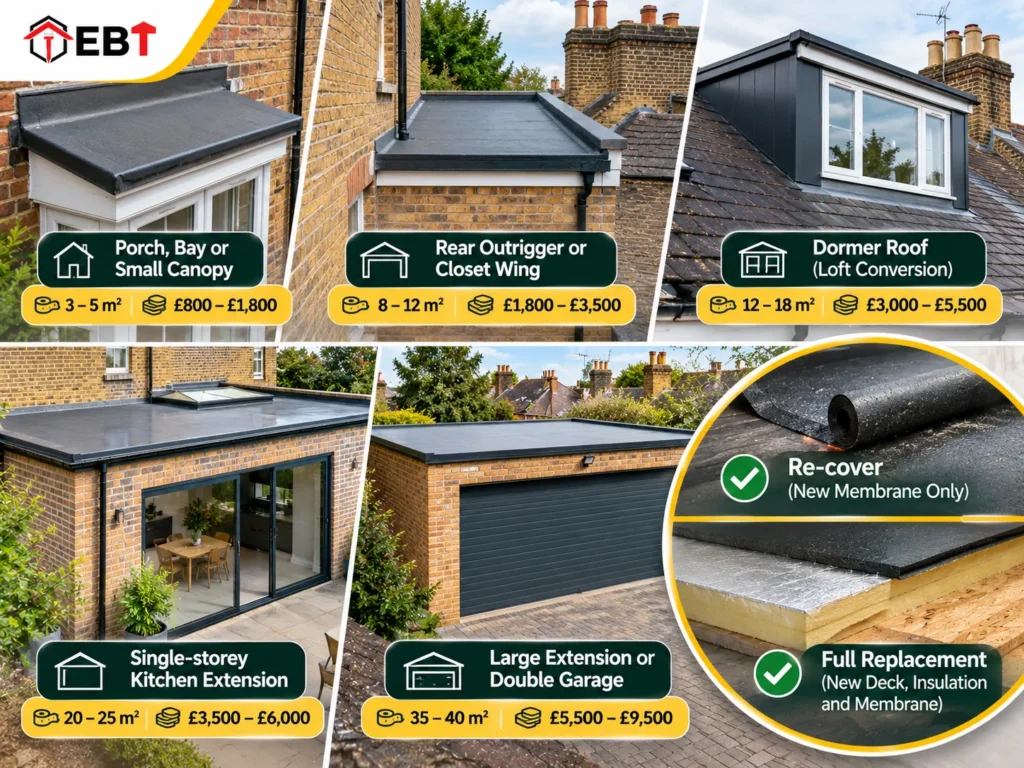
The table below shows typical totals for the flat roofs we see most often on North London houses. It assumes a full strip, a new warm roof build-up with insulation, a new membrane and new edge trims, and includes VAT.
| Flat roof | Typical size | Typical total cost | Usual time on site |
|---|---|---|---|
| Porch, bay or small canopy | 3 to 5 m² | £800 to £1,800 | 1 day |
| Rear outrigger or closet wing | 8 to 12 m² | £1,800 to £3,500 | 1 to 2 days |
| Dormer roof on a loft conversion | 12 to 18 m² | £3,000 to £5,500 | 2 to 3 days |
| Single-storey kitchen extension | 20 to 25 m² | £3,500 to £6,000 | 2 to 4 days |
| Large extension or double garage | 35 to 40 m² | £5,500 to £9,500 | 3 to 5 days |
Small roofs cost more per square metre because setup, access, waste removal and detailing take much the same time regardless of size. Dormer roofs usually need scaffolding, which explains why they cost more than an extension roof of similar area.
Re-cover vs Full Replacement
Some cheaper quotes are for a re-cover only: a new membrane laid over the existing deck, with no change to the insulation. That can be fine on a roof with a sound deck and recent insulation.
On most older London flat roofs, it is not a like-for-like comparison. If the deck is soft or the roof is more than 50% renewed, building regulations normally expect the insulation to be upgraded, which a re-cover price leaves out.
Flat Roof Replacement Cost per m²
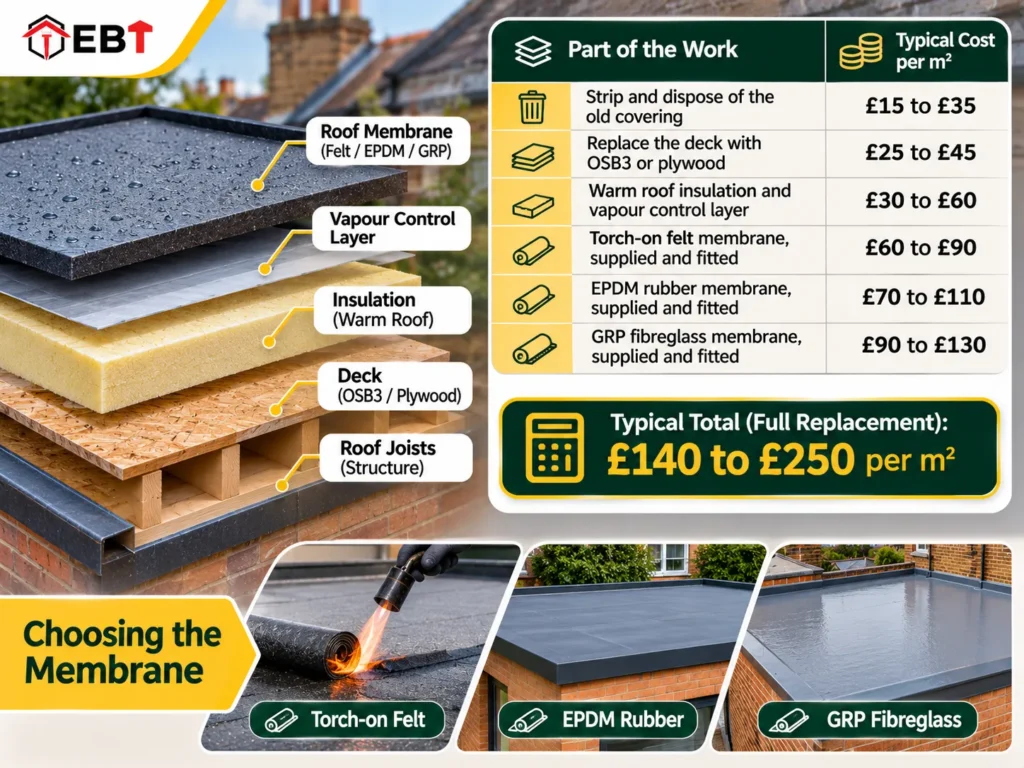
A full replacement is made up of several layers of work. Seeing them separately helps when comparing quotes, because one roofer may include decking and insulation while another prices them as extras.
| Part of the work | Typical cost per m² |
|---|---|
| Strip and dispose of the old covering | £15 to £35 |
| Replace the deck with OSB3 or plywood | £25 to £45 |
| Warm roof insulation and vapour control layer | £30 to £60 |
| Torch-on felt membrane, supplied and fitted | £60 to £90 |
| EPDM rubber membrane, supplied and fitted | £70 to £110 |
| GRP fibreglass membrane, supplied and fitted | £90 to £130 |
Add the deck and insulation to a membrane price and the total lands in the £140 to £250 per m² range above. Edge trims, outlets and upstands are usually included in a good membrane price; check that they are.
Choosing the Membrane
The membrane makes less difference to the total than most people expect. On a 20 m² roof, moving from felt to GRP typically adds around £600 to £800.
Torch-on felt roofing is the lowest cost option and copes well with complex roofs. It is laid with an open flame, which some buildings and insurers restrict.
EPDM roofing is a single sheet of synthetic rubber, so a typical extension roof has few or no joins.
GRP fibreglass roofing gives a hard, seamless finish that suits roofs with foot traffic or a lot of detailing.
For a side-by-side look at how the two most popular options age, see our guide to GRP fibreglass vs EPDM rubber roofing.
What Pushes the Price Up
Two roofs of the same size can be priced very differently. These are the factors that move a London quote most.
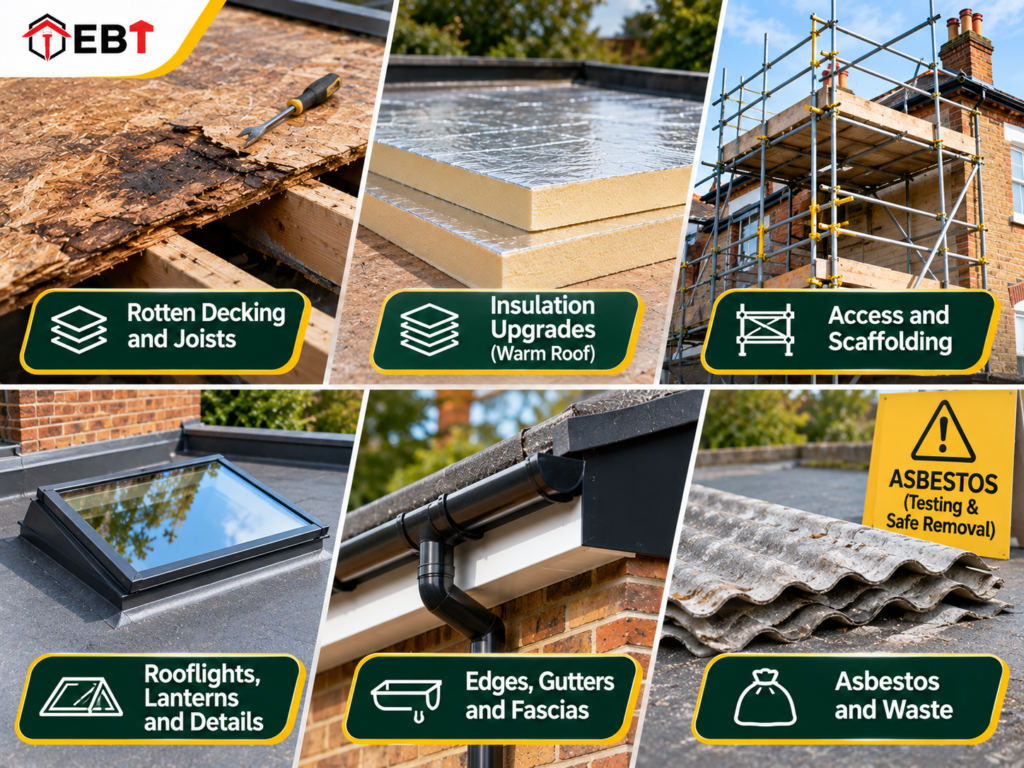
Rotten Decking and Joists
The deck is the timber sheet the membrane sits on. Older London flat roofs were often decked with chipboard, which crumbles once it gets wet. Soft spots underfoot, sagging between joists, or water stains on the ceiling below usually mean the deck has to go.
Joists are less often affected, but where a roof has leaked for years, the ends of joists and the wall plate can rot. Replacing or doubling up joists adds cost and time, and a fair quote will give a rate for it rather than a fixed sum.
Insulation Upgrades
Many older flat roofs have little or no insulation, or a few centimetres of glass fibre between the joists. Bringing a roof up to current standards usually means a warm roof: rigid PIR boards laid on top of the deck, with a vapour control layer underneath and the membrane on top.
To meet building regulations, the insulation is typically around 120 to 150 mm thick. That raises the finished roof level, which affects door thresholds, window sills and the height of the wall flashings. Our roof insulation team plans these levels before work starts so nothing is cut short on the day.
Access and Scaffolding
A ground floor extension can often be reached from a tower or ladder access. Dormers, outriggers above a first floor, and roofs reached only through the house need scaffolding, typically £900 to £1,050 a week in London.
If the scaffold has to go on the pavement, the council needs a licence. Islington, for example, charges from around £540 and asks for advance notice, so this needs to be built into the programme as well as the budget.
Rooflights, Lanterns and Details
Every opening in a flat roof needs upstands, flashings and careful detailing. Replacing a tired rooflight while the roof is stripped is far cheaper than doing it later. Our skylight installation service covers fixed rooflights, opening units and lanterns.
Other details that add cost include abutments where the flat roof meets the house wall, junctions with a pitched roof, and parapet walls that need new copings.
Edges, Gutters and Fascias
A new flat roof usually needs new edge trims and often a new gutter at the drip edge. Rotten timber at the roof edge is common on older extensions, and replacing fascias and soffits at the same time avoids disturbing the new membrane later.
Where the old gutter is undersized, cracked or poorly fixed, guttering installation at the same visit keeps water away from the new roof edge and the wall below.
Asbestos and Waste
Some older flat roofs and garage roofs contain asbestos, either in the felt layers or as corrugated cement sheets. If there is any doubt, a sample should be tested before the roof is stripped. Removal by a suitable contractor adds cost and time, and is far safer than finding it halfway through the job.
Waste removal is usually a skip or a wait-and-load lorry. On streets where a skip cannot be placed without a permit, this adds a small but real cost.
Building Regulations for Flat Roof Replacement
Replacing a flat roof is not just a repair in the eyes of building regulations. When more than 50% of the roof is renewed, or more than 25% of the whole building envelope, the work counts as renovating a thermal element under Part L.
The renovated roof should then reach a U-value of 0.18 W/m²K, unless that is not technically or functionally possible or would not pay back within 15 years. In practice, a full flat roof replacement on a house almost always needs the insulation upgrade.
Who Signs It Off
A roofer registered with a competent person scheme, such as Competent Roofer, can self-certify the work and the homeowner receives a certificate when it is complete. Otherwise, the work is notified to building control before it starts, and an inspector checks it.
Keep the certificate. Solicitors ask for it when a house is sold, and a missing sign-off for a recent roof can hold up a sale.
Planning Permission
Replacing a flat roof like for like does not normally need planning permission. Raising the height for insulation is usually treated as part of the same roof, but a big change in height, a new roof terrace or a change in appearance on a listed building or in a sensitive conservation area street should be checked with the council first.
Signs Your Flat Roof Needs Replacing
A flat roof does not always need replacing at the first leak. These signs suggest the roof is past repair:
- Leaks that return after repeated patching, or appear in different places
- Soft or spongy areas when walking on the roof, which point to a rotten deck
- Blistering, cracking or splits across large areas of felt
- Standing water that stays for days after rain, known as ponding, which shows the falls have failed
- Condensation, damp or mould on the ceiling below with no obvious leak
- A roof that is near or past its expected life
Torch-on felt roofs typically last 15 to 25 years, while well-installed EPDM and GRP roofs can last 25 years or more. If yours is older than that and showing several of the signs above, replacement is usually the better use of money.
Repair or Replace?
A single split, a failed seal at an upstand, or a blocked outlet can usually be repaired for a few hundred pounds. Our guide to roof repair cost in Islington gives typical prices for these smaller jobs.
As a rough rule, if more than a quarter of the roof needs work, or the deck is soft in several places, a repair is unlikely to last. Our flat roof repairs team will say honestly which side of that line a roof falls on.
How a Flat Roof Is Replaced
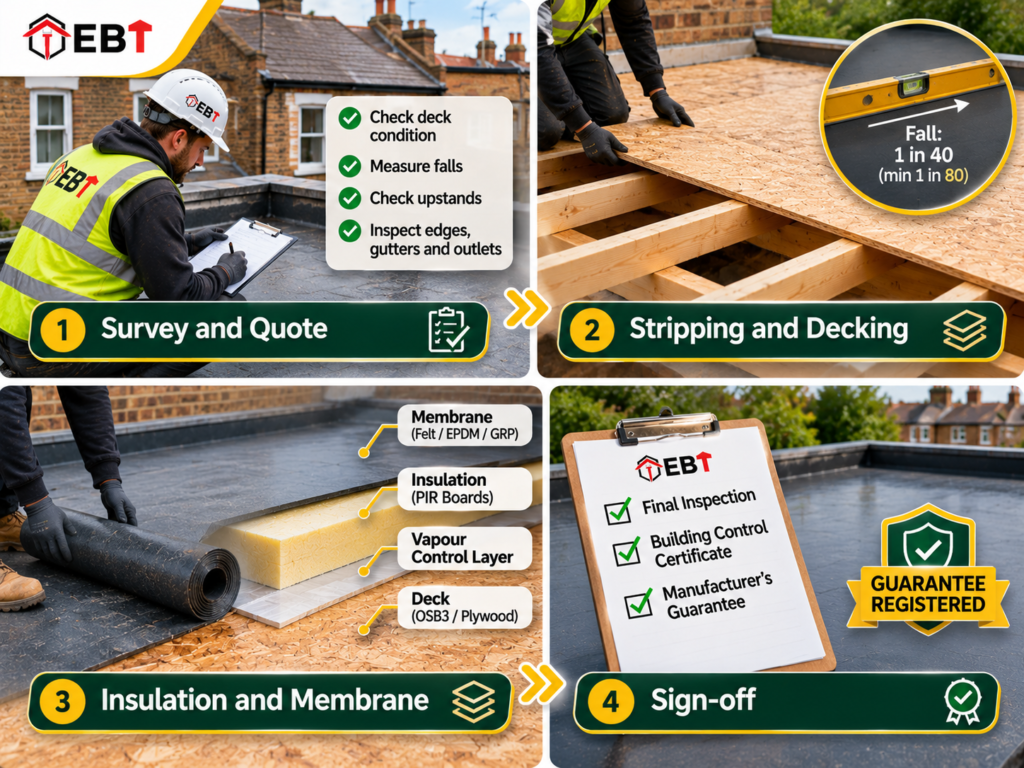
Knowing the sequence helps you judge whether a quote has missed anything.
Survey and Quote
We start by going onto the roof and, where possible, looking at the ceiling below. The survey checks the deck by walking it, measures the falls, notes the upstand heights at doors and windows, and looks at the edges, gutters and outlets. A good quote should list each layer and give rates for any timber found to be rotten.
Stripping and Decking
The old covering is stripped down to the joists or the deck, and the waste is cleared. Rotten boards are replaced with OSB3 or plywood, and firrings are adjusted or added to give the roof a proper fall towards the gutter or outlet.
A flat roof is never truly flat. It should be built to a fall of around 1 in 40 so that, after settlement, it still drains at no less than 1 in 80.
Insulation and Membrane
The vapour control layer goes down first, then the insulation boards, then the membrane. Upstands are taken up the walls by at least 150 mm, with flashings over the top, and edge trims and outlets are fitted.
Most of this is done in one or two dry days. The roof is kept watertight at the end of each day, so the house is not left exposed overnight.
Sign-off
Once the roof is complete, it is inspected, any building control certificate is issued, and the manufacturer’s guarantee is registered where the system offers one.
Getting Accurate Quotes
Flat roof quotes are easy to compare badly. A low price often means one of the layers above has been left out.
What a Good Quote Includes
When comparing prices, check that each quote states:
- Whether the deck is being replaced, and the rate for extra boards or timber
- The insulation type and thickness, and the U-value it achieves
- The membrane system and the length of any guarantee
- Edge trims, upstands, flashings, outlets and gutters
- Scaffolding, pavement licences and waste removal
- Who handles building regulations sign-off
VAT and Payment
Building work on an existing home is normally charged at the standard 20% VAT. The insulation part of the work may qualify for the zero rate on energy-saving materials, so it is worth asking for it to be shown as a separate line. Stage payments linked to progress are normal on larger roofs; a large deposit before any work starts is not.
Flat Roofs on Different Parts of the House
The same principles apply across the house, but each type of flat roof has its own quirks.
Rear Extensions
Most rear extensions in Islington, Hackney and Camden have a flat roof, often with a rooflight or lantern. These are usually the easiest to replace because access is good. The main thing to plan is the junction with the house wall and any windows above, where the new roof level must leave enough upstand. If you are deciding what roof to put on a new extension, our comparison of flat roof vs pitched roof covers the trade offs.
Outriggers and Closet Wings
The narrow back additions on Victorian terraces often have small flat roofs reached only through a bathroom window or from scaffolding. They are small but fiddly, with parapet walls, soil pipes and neighbouring roofs to work around.
Dormers
Dormer roofs on loft conversions are high, exposed and usually need scaffolding. The roof is small, but the edges, cheeks and abutments with the main roof slopes need careful work.
Garages
Garage roofs are simpler but often older. Check for asbestos and whether the garage needs to be insulated at all, as an unheated garage does not need to meet the same standard as a heated room.
Frequently Asked Questions
How much does it cost to replace a flat roof on an extension?
For a typical 20 to 25 m² single-storey extension in London, a full replacement with new insulation and membrane usually costs £3,500 to £6,000. Rotten decking, rooflights and scaffolding can push it higher.
How much does a flat roof cost per m²?
A full flat roof replacement in London typically costs £140 to £250 per m², including stripping, decking, insulation and the membrane. A re-cover over a sound deck without insulation is cheaper, often under £100 per m².
How long does it take to replace a flat roof?
Most domestic flat roofs take one to five days on site, depending on size, access and the amount of timber that needs replacing. Weather can add days, as membranes are only laid in dry conditions.
Do I need building regulations to replace a flat roof?
Usually yes. Renewing more than half of a flat roof counts as renovating a thermal element, so it must normally be insulated to a U-value of 0.18 W/m²K and signed off by building control or a registered competent person.
How long does a flat roof last?
Torch-on felt roofs typically last 15 to 25 years. Well-installed EPDM and GRP roofs can last 25 years or more. Good falls, sound decking and regular gutter clearing all extend the life of any flat roof.
Can a new flat roof be laid over the old one?
Sometimes, if the deck underneath is dry and sound and there is enough height for the new layers. On most older London roofs, stripping back is safer because it lets the deck be checked and the insulation brought up to standard.
Is the cheapest flat roof quote the best value?
Rarely. A low quote often leaves out the deck, the insulation or the building regulations sign-off. Compare quotes layer by layer before choosing on price.
Planning Your Flat Roof Replacement
The cost of replacing a flat roof in London comes down to three things: the size and access, the condition of the deck, and the insulation needed to meet building regulations. The membrane is a smaller part of the decision than it first appears.
The most useful step is an honest survey before any prices are compared. Once you know what is under the old covering, choosing the right system and the right budget becomes straightforward.

Tilly Bani is a renovation and roofing specialist with over 15 years of experience in construction and property refurbishment across North London. He specialises in roofing, structural repairs, and full home renovations, helping homeowners improve property value and safety.