
| Quick Answer An annual boiler service in Islington costs between £90 and £140 and takes 45 to 90 minutes. Booking a yearly boiler service helps avoid costly repairs later. A Gas Safe registered engineer inspects and cleans the internal components, checks the flue, tests gas pressure, examines safety controls, and issues a service record. In Islington’s hard water zone and Victorian housing stock, annual servicing is especially important because limescale and old pipework accelerate the faults that lead to breakdowns and carbon monoxide risk. |
Introduction
Most Islington homeowners think about their boiler twice a year: when they turn the heating on in October and when it breaks down in January. Many residents compare boiler installation service options before winter starts. Annual boiler servicing exists precisely to interrupt that cycle, but many people skip it either because they are uncertain what it covers or because they assume nothing is wrong.
This guide explains what an annual boiler service in Islington actually involves, what engineers look for, why the borough’s housing conditions make it more important than the national average, what it costs, and what the legal position is for landlords and owner-occupiers. By the end, you will know exactly what to expect from a service appointment and why delaying it is rarely the money-saving decision it appears to be.
What an Annual Boiler Service Includes
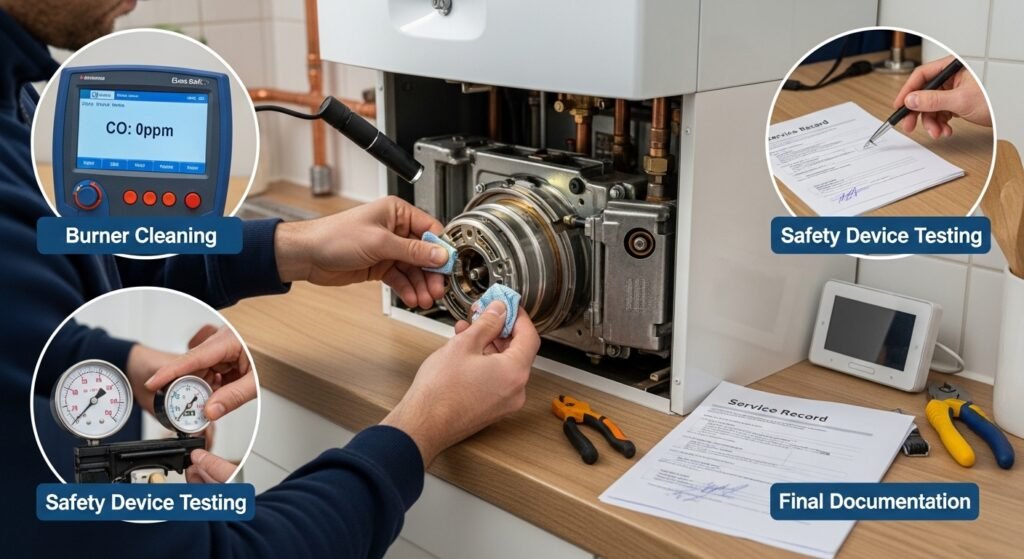
A boiler service is not a simple visual check. A full boiler servicing visit includes safety checks and cleaning. A Gas Safe registered engineer conducting a thorough service will work through a structured series of checks, cleaning tasks, and tests that cover the boiler’s safety and efficiency. The entire appointment typically takes 45 to 90 minutes for a combi boiler. System boilers with a hot water cylinder take slightly longer.
Visual Inspection
The engineer starts by examining the boiler’s external casing for any signs of damage, corrosion, or sooting, which can indicate combustion problems. Visible faults may also indicate the need for boiler repairs. They check the surrounding area for condensation that would not normally be present and look at the flue terminal outside the building for obstructions or damage.
This external inspection takes only a few minutes but can immediately identify problems that a homeowner would not notice, including faint soot marks around the boiler casing that suggest incomplete combustion.
Internal Component Inspection and Cleaning
The engineer removes the boiler casing and inspects all visible internal components. This is the core of the service. Key components checked include:
- The burner: The engineer examines the burner for signs of corrosion, debris, or carbon deposits. A dirty or degraded burner produces an irregular flame and reduces combustion efficiency. It is cleaned or flagged for replacement if its condition warrants.
- The heat exchanger: This is the component where combustion gases heat the water. Heavy buildup can shorten the life of your boiler system. Limescale deposits on the heat exchanger, which are particularly common in Islington’s hard water area, reduce heat transfer efficiency and cause the boiler to work harder. The engineer checks for scale, corrosion, or cracking.
- The ignition electrodes: These create the spark that ignites the gas. Worn or contaminated electrodes cause ignition failures and are one of the most common causes of boiler lockout. They are inspected and cleaned.
- The condensate trap: Condensing boilers produce acidic condensate that collects in a trap and drains away through the condensate pipe. A blocked trap causes a lockout. The engineer checks it is clear and draining correctly.
- Seals and gaskets: Internal seals prevent gas and water from leaking into incorrect parts of the boiler. Degraded seals can cause leaks, reduce efficiency, or allow combustion gases to bypass the heat exchanger. These are inspected visually.
- The pump (where applicable): In system boilers, the circulation pump is checked for correct operation and any signs of leakage or bearing wear.
Flue and Ventilation Check
The flue carries combustion gases from the boiler to the outside. Correct flue work is essential during any gas work services. A blocked, damaged, or incorrectly positioned flue is one of the most serious safety risks associated with gas boilers, as it can allow carbon monoxide to accumulate inside the property.
The engineer checks the flue for obstructions such as bird nests or debris, inspects the joints and seals for leakage, and verifies that the terminal outside the building meets current Building Regulations clearance distances from windows, doors, and boundaries. In Islington’s Victorian properties, where boilers have often been installed in awkward positions within tight kitchen cupboards or utility areas, flue routing can be non-standard and deserves careful inspection.
Gas Pressure and Flow Rate Testing
The engineer tests the gas pressure at the boiler’s inlet and measures the flow rate through the burner against the manufacturer’s specifications. Low readings may require professional gas line installation checks. Low gas pressure reduces heating performance. Pressure outside the manufacturer’s specified range can indicate a supply problem from the mains or an internal fault.
They also check the working pressure, the burner pressure, and compare readings against the boiler’s data plate. These measurements confirm the boiler is receiving sufficient gas and burning it within its designed parameters.
Flue Gas Analysis
Using a combustion analyser, the engineer measures the composition of the gases leaving the boiler through the flue. This tells them how efficiently the boiler is burning gas and whether the air-to-gas ratio is correct.
A boiler burning gas with too little air produces carbon monoxide as a by-product of incomplete combustion. Flue gas analysis is the definitive safety check for carbon monoxide production, going beyond what any alarm or visual inspection can confirm. Modern Gas Safe engineers treat this as a mandatory step rather than an optional extra.
Controls and Safety Devices Test
The engineer tests the boiler’s operational controls, including the thermostat response, the programmer or smart thermostat connection, and the pressure gauge reading. Modern homes often upgrade controls during heating upgrades. They check all safety devices, including:
- The pressure relief valve: this vents excess pressure if the system overpressurises. If it is stuck open or stuck closed, it represents a safety failure.
- The thermostats and high-limit switches that shut the boiler down if it overheats
- The automatic air vent in system boilers
They also check that the expansion vessel is correctly charged, which prevents pressure spikes in the heating circuit.
System Pressure Check
The engineer checks the system pressure, typically 1 to 1.5 bar when cold for a sealed system. Pressure that has dropped repeatedly since the last service suggests a slow leak somewhere in the heating circuit, which the engineer will attempt to locate. Persistent pressure loss may need expert leak detection. They also check for any signs of water weeping at radiator valves, pipe joints, or the boiler connections.
Final Test and Documentation
After completing all checks and cleaning, the engineer fires the boiler, runs it through heating and hot water modes, and confirms everything is operating as expected. They then complete a service record, noting all checks performed, any issues found, and any recommendations for remedial work. This service record is your documentation that the service took place and is important for warranty purposes.
Why Annual Servicing Matters More in Islington
Boiler servicing matters in every part of the UK. Choosing a trusted Islington heating company can improve service quality. In Islington specifically, there are three factors that make it more important than in most other areas.
Hard Water from Thames Water
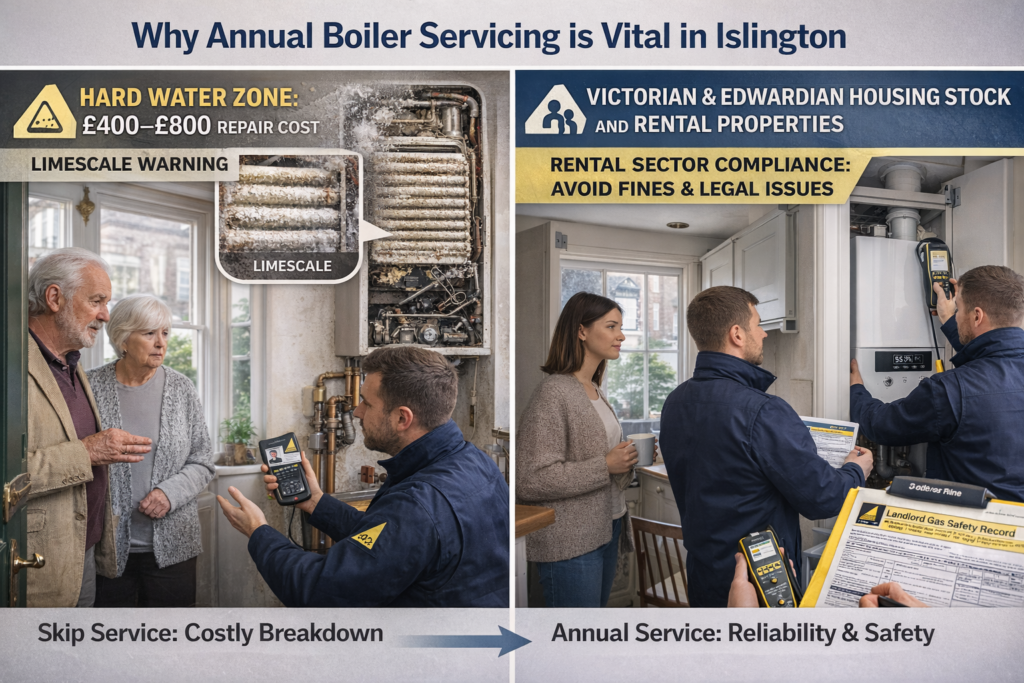
Thames Water classifies Islington’s water supply as very hard. The water contains high concentrations of calcium carbonate that deposit as limescale inside the boiler’s heat exchanger, pipes, and radiators when heated. Older homes may also need pipework replacement if scaling is severe. This is a gradual process that is invisible until the scale layer becomes thick enough to cause problems.
Limescale in a heat exchanger acts as an insulating layer, reducing the rate at which heat transfers from the burner to the water. The boiler must run longer to achieve the same water temperature, consuming more gas for the same heat output. Severe scale buildup causes the heat exchanger to overheat, producing the kettling sound that many Islington homeowners recognise as a rumbling or boiling noise from the boiler. Left untreated, it eventually causes heat exchanger failure, which is one of the most expensive repairs a boiler can need, typically £400 to £800.
Annual servicing in Islington should include scale inhibitor treatment and descaling where evidence of buildup is found. It should also include a check that the magnetic filter, if fitted, is clean. Scale and sludge accumulate faster in Islington’s hard water than in most of the UK, making a 12-month service interval correct rather than conservative.
Victorian and Edwardian Housing Stock
The majority of Islington’s residential properties are Victorian or Edwardian terraces, many of which have been modified multiple times over more than a century. Many owners combine heating work with full refurbishment upgrades. Boilers in these properties are frequently installed in tight kitchen cupboards, awkward utility areas, or ceiling-height positions that were never designed for modern appliances.
Old and narrow pipework, modified flue routes, and heating systems that have been extended or adapted over the years create conditions where small faults develop faster and can be harder to detect without a thorough inspection. An engineer who regularly services boilers in Islington’s period housing stock develops familiarity with the specific configurations and failure patterns common to these properties.
Annual servicing in an older Islington property is also the right time to identify whether the boiler’s installation has developed any compliance issues since it was last inspected. Building Regulations and Gas Safe requirements evolve, and a boiler that was correctly installed ten years ago may have a flue terminal that no longer meets current clearance standards because a window or extension has been added nearby.
Density of Rental Properties
Islington has a high proportion of privately rented properties. Landlords often book annual gas safety checks alongside servicing. According to census data, a substantial percentage of Islington’s housing is rented from private landlords, and many buildings are subdivided into multiple flats. Boilers in rented properties often run for longer periods than in owner-occupied homes, experience more varied usage patterns, and receive less immediate attention when minor problems develop because tenants and landlords sometimes have different senses of urgency about maintenance.
For landlords in Islington, annual servicing is not just good practice. It is an important part of meeting legal obligations under the Landlord and Tenant Act 1985, which requires landlords to keep heating and hot water installations in repair and proper working order. A boiler that breaks down because basic servicing was skipped creates legal exposure for the landlord and genuine hardship for the tenant.
The Legal Position for Homeowners and Landlords
The rules for annual boiler servicing differ between owner-occupiers and landlords, and it is worth being clear on both.

Owner-Occupiers
Annual boiler servicing is not a legal requirement for owner-occupiers under UK law. However, it is required by most boiler manufacturers to keep the warranty valid. Worcester Bosch, Vaillant, Viessmann, and Baxi all condition their multi-year warranties on evidence of annual servicing by a Gas Safe-registered engineer. Skipping a service invalidates the warranty from that year onwards, so a boiler under a 10-year Worcester Bosch warranty that misses its third annual service loses that warranty protection at year three.
Beyond warranty, annual servicing is strongly recommended by the Gas Safe Register and by the Health and Safety Executive as a carbon monoxide prevention measure.
Landlords
For landlords in Islington, the legal picture is more demanding. Under the Gas Safety (Installation and Use) Regulations 1998, landlords must arrange an annual gas safety inspection of all gas appliances in their rental properties. This inspection must be carried out by a Gas Safe registered engineer and must result in a Gas Safety Record (commonly called a CP12) being issued and provided to tenants within 28 days.
The annual gas safety check and the annual boiler service are related but distinct. A gas safety check covers all gas appliances in the property and confirms they are safe. A boiler service is the maintenance work that keeps the boiler operating at a standard, including safety checks. In practice, many engineers complete both in a single visit, but a gas safety check alone without servicing leaves the boiler’s mechanical condition unexamined beyond safety-critical items.
Landlords who do not arrange annual gas safety checks face unlimited fines, potential imprisonment of up to six months, invalidated landlord insurance, and loss of the ability to serve valid Section 21 eviction notices. Islington’s housing market means the consequences of non-compliance are real: Islington Council’s Housing Enforcement team has active powers to pursue landlords who fail to meet their obligations.
What Boiler Servicing Costs in Islington
Boiler servicing in Islington costs more than the UK national average due to higher labour rates in North London, parking and logistics costs, and the higher complexity of servicing older and often tighter boiler installations in Victorian properties. Local boiler installation experts may offer combined packages.
The typical cost of a boiler service in Islington in 2026:
- Standard combi boiler service: £100 to £140
- System boiler service (including cylinder checks): £120 to £160
- Combined service and gas safety check (landlord CP12): £120 to £180
These are one-off payment figures. Engineers who service multiple properties for a landlord or management company typically offer reduced rates per property for portfolio work.
Booking in spring or early summer, when engineers are less busy than in the autumn and winter peak, can reduce costs by £10 to £20. More importantly, spring booking means the boiler is serviced, and any faults are identified before the heating is needed intensively. Discovering a heat exchanger problem in April gives months of lead time. Discovering it in November creates an emergency.
Boiler cover plans from companies such as British Gas HomeCare, Hive, and Vaillant typically include the annual service as part of the monthly subscription. Monthly costs run from £8 to £20, depending on the level of cover, with boiler-only plans at the cheaper end and full central heating cover including emergency call-outs and parts at the higher end. For homeowners with older boilers that are more likely to require repairs between services, a cover plan that combines the annual service with breakdown protection can offer better overall value than paying for each separately.
Signs Your Boiler Needs a Service More Urgently
An annual service schedule is the baseline. These signs suggest the boiler needs attention before the next scheduled appointment:
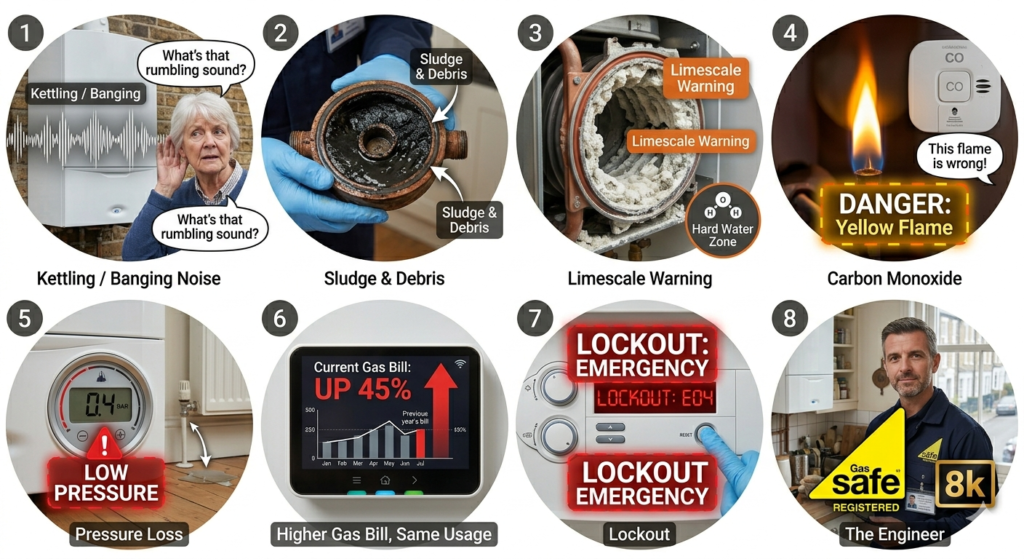
The boiler is making new noises. Kettling (a rumbling or boiling sound) indicates limescale in the heat exchanger. Banging suggests air or sludge in the system. Both warrant investigation rather than being left until the next annual service.
The pilot flame is yellow or orange. A healthy gas boiler burns with a clear blue flame. A yellow or orange flame indicates incomplete combustion and potential carbon monoxide production. This is an emergency that requires an immediate call to a Gas Safe engineer, not a service booking.
The boiler is losing pressure repeatedly. A sealed system that needs topping up every few weeks has a leak somewhere. The annual service checks for this, but repeated pressure loss between services warrants an earlier call. This can also point to hidden faults needing boiler repairs.
Energy bills are rising without a change in usage. An inefficient boiler working harder than it should due to scale buildup or component degradation will show in the gas bill. If quarterly gas costs are rising noticeably without a change in behaviour or tariff, the boiler’s efficiency is declining.
The boiler is locking out repeatedly. A boiler that shuts itself down frequently and needs resetting is not a boiler that is working correctly. Each lockout event represents a safety mechanism triggered for a reason. Finding that reason is what a service appointment is for.
How to Book a Boiler Service in Islington
When booking a boiler service in Islington, these steps ensure you get the right service at the right price.
Verify Gas Safe registration before booking. Every engineer working on a gas boiler must be Gas Safe registered. Check at gassaferegister.co.uk using the engineer’s name or registration number. An engineer who cannot confirm their registration should not be booked. Always choose qualified teams for any gas work services.
Ask whether the service covers your boiler type. Not all Gas Safe engineers are qualified for all boiler types. The back of the Gas Safe ID card lists specific qualifications. For most domestic combi boilers in Islington, this is a standard qualification, but for older or less common boilers, confirm before booking.
Get a written confirmation of what the service includes. A service that consists only of a visual check and a flu inspection is not a full service. Confirm that the engineer will remove the casing, inspect and clean internal components, conduct flue gas analysis, and issue a service record.
Check whether the service includes a gas safety certificate. If you are a landlord, you need both the annual gas safety check and the boiler service. Many Islington engineers offer a combined appointment that covers both. Confirm this at booking rather than discovering it at the end of the visit that only one of the two was completed.
Book in spring or summer when availability is better. Islington engineers are in high demand from October onwards. Booking in April, May, or June means more appointment flexibility, sometimes lower prices, and the certainty that the boiler is in good condition before winter.
FAQ
Q: Is an annual boiler service a legal requirement in Islington?
For homeowners, annual boiler servicing is not a legal requirement, but it is required by most manufacturers to keep the warranty valid. For landlords, the Gas Safety (Installation and Use) Regulations 1998 require an annual gas safety check by a Gas Safe registered engineer. While the service itself is technically separate from the legal check, skipping service makes it significantly harder to meet the legal obligation to maintain the heating system in a safe and working condition. Most Islington heating engineers offer a combined service and gas safety check in one appointment.
Q: How long does a boiler service take in Islington?
A standard combi boiler service takes 45 to 90 minutes. System boilers with a hot water cylinder take slightly longer, typically 60 to 120 minutes. In some Islington Victorian properties where the boiler is in a tight cupboard or an awkward position, access adds time. If the engineer discovers issues that need addressing during the service, the appointment can run longer. Always allow two hours in your schedule to avoid being caught short. Homes with older systems may need extra hot water cylinder checks.
Q: Does a boiler service include a carbon monoxide test?
A thorough boiler service should include flue gas analysis, which uses a combustion analyser to measure the gases leaving the boiler’s flue. This is the definitive test for carbon monoxide production and is more comprehensive than a CO alarm, which only detects CO that has already escaped into the room. Ask specifically whether flue gas analysis is included when booking. In Islington, where older boilers and modified flue routes are common, this check is particularly important.
Q: What happens if the engineer finds a fault during the service?
The engineer will explain what they have found, its severity, and what remedial work is needed. Minor issues such as a dirty condensate trap or a slightly corroded seal are often resolved during the service visit at no extra charge or for a small parts cost. Major faults, such as a failing heat exchanger or PCB, are quoted separately. You are under no obligation to agree to repair work during the service appointment, though safety-critical faults should be addressed promptly. The service record will document all findings, giving you a clear picture of the boiler’s condition and any outstanding work.
Q: How does Islington’s hard water affect how often I should service my boiler?
In Islington’s very hard water zone, limescale builds inside the boiler’s heat exchanger faster than in softer water areas. This makes annual servicing more important rather than less: the 12-month interval ensures scale is identified and treated before it causes heat exchanger damage. If your boiler does not have a scale inhibitor fitted to the mains cold water supply, ask the engineer to fit one at the next service. It costs £150 to £300 fitted and significantly slows limescale accumulation, reducing the rate at which scale-related maintenance needs arise between services.
Conclusion
An annual boiler service in Islington is a 45 to 90-minute investment that protects against carbon monoxide risk, maintains warranty cover, prevents the scale and sludge problems that accelerate in Islington’s hard water zone, and identifies small faults before they become expensive breakdowns in January. The cost of £100 to £140 for a combi boiler service is consistently lower than any emergency repair call-out for a fault that a service would have caught.
For landlords, the annual service is also the practical foundation for meeting legal gas safety obligations. A boiler that breaks down in winter because it was not serviced creates tenant hardship, legal exposure, and emergency costs that far exceed any savings made by skipping the appointment.
Book in spring for better availability and lower prices, confirm the engineer’s Gas Safe registration before they arrive, and ask specifically for confirmation that flue gas analysis and internal cleaning are included. Those two checks are what distinguish a thorough service from a superficial one. Regular boiler maintenance keeps systems efficient year-round.

Tilly Bani is a renovation and roofing specialist with over 15 years of experience in construction and property refurbishment across North London. He specialises in roofing, structural repairs, and full home renovations, helping homeowners improve property value and safety.