
| Quick Answer A standard like-for-like combi boiler swap takes 4 to 8 hours in most North London homes and is completed in a single day. For professional boiler installation services, timelines may vary depending on access and system condition. A system boiler replacement takes 1 to 2 days in most cases. A full conversion, such as switching from a conventional to a combi boiler, takes 2 to 3 days. In North London specifically, Victorian terraces, converted flats, restricted parking, and hard water considerations regularly add time beyond what national guides suggest. |
Introduction
Booking a boiler installation in North London raises a question that most guides answer in vague terms: how long will this actually take? Many properties choose a professional boiler installation for faster replacement. The honest answer depends entirely on your property type, your existing system, and the specific complications that North London homes introduce at a higher rate than anywhere else in the UK.
This guide breaks down boiler installation times by job type, explains the North London factors that extend timelines beyond the national average, walks you through what happens on installation day, and tells you how to prepare to keep delays to a minimum.
Boiler Installation Times by Job Type
The type of installation you need is the single biggest factor in how long the job takes. These are realistic timelines for North London properties in 2026.
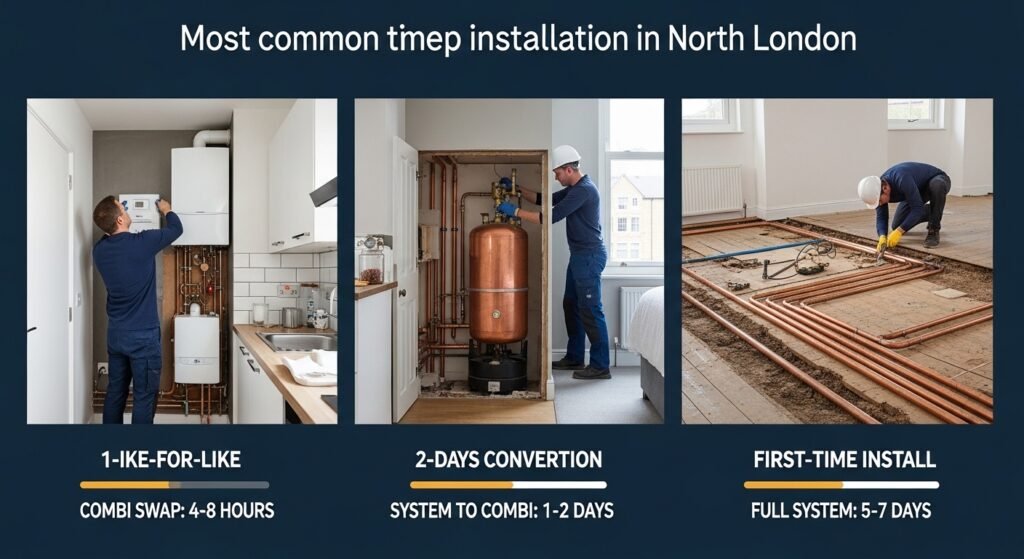
Like-for-Like Combi Swap: 4 to 8 Hours
Replacing an existing combi boiler with a new combi boiler in the same position is the fastest installation type. The engineer removes the old unit, mounts the new one on the same bracket or wall fixings, reconnects the existing pipework, installs a new flue if needed, and commissions the system.
In a straightforward Victorian terrace in Islington or a Camden flat with clear access, this job completes well within a single day. Most engineers start between 8 and 9 am and are done by 2 to 4 pm, leaving the homeowner with a fully working system by mid-afternoon.
Where this estimate stretches toward 8 hours: the old boiler is larger than the new one and bracket positions differ, the flue needs repositioning to meet current Building Regulations clearance distances, or the engineer discovers corroded pipework connections that need cutting out and replacing.
System Boiler Replacement: 1 to 2 Days
System boilers work with a separate unvented hot water cylinder. Replacing one involves the boiler unit itself plus the cylinder connections, the pressure relief valve, and the associated pipework. In a larger North London Edwardian semi in Muswell Hill or Highgate with two or more bathrooms, this is the typical setup.
Day one covers the removal of the old boiler and cylinder if needed, installation of the new boiler, and primary pipework connections. Day two covers cylinder work, controls, commissioning, and balancing the radiators. In properties where the cylinder is in an awkward airing cupboard with restricted access, both days run close to their limits.
Conventional to Combi Conversion: 2 to 3 Days
Converting from a conventional (regular) boiler to a combi is a significantly bigger job. Many homeowners plan wider heating upgrades during conversions. It involves:
- Removing the old boiler, hot water cylinder, and cold water storage tank (usually in the loft)
- Draining and decommissioning these components
- Rerouting pipework throughout the property. Older homes may also require pipework replacement during upgrades.
- Installing the new combi boiler and a new flue
- Reconnecting all radiators and hot water outlets to the new pressurised system. This is also a good time to review radiator installation needs.
- Commissioning, testing, and balancing
In a typical three-bedroom North London Victorian terrace, this conversion runs to two full days. Properties with larger loft tanks, multiple floors, or complex pipework layouts regularly take three days.
System to Combi Conversion: 1 to 2 Days
Switching from a system boiler to a combi means removing the hot water cylinder and its associated pipework. This frees up the airing cupboard but requires rerouting the hot water distribution. The timeline is shorter than a full conventional conversion because there is no loft tank to remove, but it still commonly runs to two days in North London properties where the cylinder is in a tight cupboard, and pipework runs across multiple floors.
Boiler Relocation: Add 1 to 3 Days
Moving a boiler to a new position in the property, whether from kitchen to utility room, or from one wall to another to accommodate a kitchen extension, requires new gas pipe routing, a new flue outlet through the wall, extended condensate pipework, and electrical reconnections. Safe moves often include certified gas line installation work.
This is not a job that adds a few hours. Moving a boiler in a North London Victorian terrace typically adds a full extra day to whatever the base installation time would have been. In properties where the relocation involves drilling through multiple walls, running pipe under floorboards, or working through a party wall, two additional days is realistic.
First-Time Central Heating Installation: 5 to 7 Days
Properties without existing central heating, including some older North London properties still running on storage heaters or back boilers, require a complete system installation. Many owners choose trusted North London service providers for full projects. This means installing the boiler, fitting all radiators, running new pipework throughout the property, connecting controls, and commissioning the entire system. Complete heating systems planning helps reduce future issues.
This is a major project. Expect five to seven days in an average-sized North London home, with larger properties taking longer. The disruption is significant: floors may need to come up for pipework, walls are chased for pipes, and the property will have no heating or hot water for most of the work period.
Powerflush: Add 4 to 6 Hours
Most North London boiler installations require a powerflush, a high-pressure clean of the heating system that removes magnetite sludge and debris before the new boiler is connected. Regular boiler servicing can help maintain system efficiency. This is particularly important in North London’s Victorian housing stock, where old pipework carries years of accumulated sludge.
A powerflush is not always a separate appointment. Many engineers build it into the installation day for smaller systems. For larger properties with 10 or more radiators, it extends the day’s work by 4 to 6 hours and may require an early start or a second day.
Why North London Installations Take Longer
A standard national guide will tell you a combi swap takes 4 to 6 hours. That is accurate for a modern semi-detached house in Leicester or a purpose-built flat in Manchester. It is frequently not accurate for North London. These are the specific factors that extend timelines here.
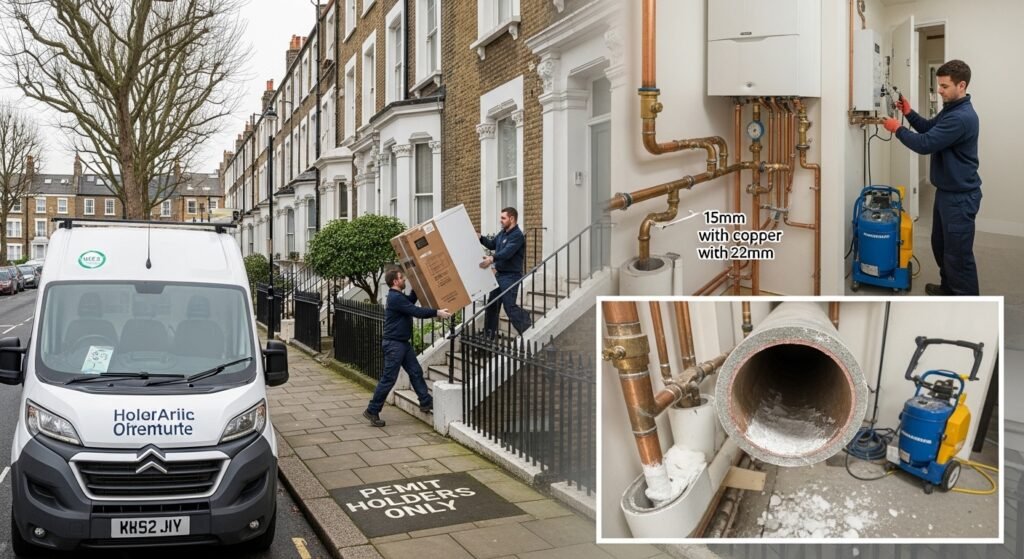
Victorian and Edwardian Housing Stock
The majority of North London’s residential streets, from Archway and Tufnell Park in Islington to Stoke Newington in Hackney and Crouch End in Haringey, consist of Victorian and Edwardian terraces that are 100 to 140 years old. These properties were built long before modern central heating existed. Some homes combine heating work with full refurbishment improvements. Over their lifetimes, they have been plumbed, replumbed, extended, converted, and modified in ways that rarely follow any consistent plan.
Gas pipes in these properties sometimes run through unexpected routes. Flue positions often do not comply with current Building Regulations clearance distances from windows, doors, and neighbouring boundaries. Pipework is frequently a mix of different ages and materials. What looks like a straightforward combi swap at the quotation stage reveals complications once the old boiler comes off the wall.
Experienced North London engineers factor this in during their survey and quote. Engineers who quote without conducting a physical site visit are far more likely to encounter surprises on installation day, which translates directly into extended time and additional costs.
Converted Flats and Access Complications
A large proportion of North London’s Victorian terraces have been divided into flats. Installing or replacing a boiler in a converted flat introduces access challenges that do not exist in a whole house.
Carrying a new boiler, flue components, and tools up narrow Victorian stairs to a first or second-floor flat takes time. Getting the old boiler down and out adds more. When the flat is on an upper floor of a building without a passenger lift, every component must be manhandled up and down by hand. Engineers working in North London’s converted properties routinely account for an extra hour or two compared to the same job in a ground-floor property with direct street access.
Flue routing in converted flats is often constrained by what can be done within the flat’s footprint without affecting shared areas or requiring freeholder consent. In some cases, the only compliant flue route requires drilling through a shared external wall or running through a void above a neighbouring flat. Both scenarios require coordination and sometimes additional permissions that delay the start date.
Hard Water and Scale Buildup
Thames Water supplies very hard water to all North London boroughs. Hard water accelerates scale buildup inside heat exchangers, pipework, and radiators. Early leak detection can prevent hidden system damage. Properties in Camden, Islington, Hackney, and Haringey that have not had a power flush in recent years often have significant sludge in the system. Scale issues can shorten the life of a boiler without regular boiler servicing.
An engineer who opens up a North London heating system and finds heavy sludge has a choice: flush the system properly before connecting the new boiler, which adds time, or connect without flushing and risk the sludge damaging the new boiler’s heat exchanger within months, which would void the warranty. Any competent Gas Safe engineer chooses to flush.
This reality means a powerflush is rarely genuinely optional in North London. Factor it into your timeline planning from the start rather than treating it as an unexpected addition on installation day.
Parking, ULEZ, and Logistics
North London’s street-level logistics create delays that are invisible in any other UK region. Engineers working in Islington, Camden, or Hackney need to park a van carrying a boiler, tools, and materials near your property for a full working day. Controlled Parking Zones across these boroughs require permits that engineers must either carry or arrange in advance.
The expanded ULEZ zone, which since August 2023 covers all 32 London boroughs, means engineers with non-compliant vans pay £12.50 per day. Many reputable North London heating companies operate ULEZ-compliant vehicles, but smaller sole traders may factor this cost into their daily rate.
Red routes along major North London roads such as the A1, Seven Sisters Road, and Archway Road prohibit stopping entirely. Engineers working on properties directly on or near red routes must park at a distance and carry equipment, which adds meaningful time to the job.
When requesting quotes, ask explicitly whether parking and any logistics costs are included in the price. In North London, these are real expenses that affect the economics of the job.
Gas Pipe Condition and Sizing
Modern high-efficiency combi boilers require a 22mm gas supply pipe. Many North London Victorian properties still run on 15mm internal gas pipes that date from the original installation. When an engineer discovers undersized pipework during installation, they must upgrade the pipe run from the meter to the boiler position before they can connect the new unit safely. Upgrades must meet rules with certified gas safety checks
Upgrading internal gas pipework in a North London terrace typically adds half a day to the job. In properties where the pipe run is long, runs under floorboards, or passes through multiple rooms, it can add a full day.
This is another reason why a physical site survey before installation matters. An engineer who has seen the pipework can identify and quote for this work upfront. An engineer who has only done an online assessment may discover it on installation day.
What Happens on Installation Day: Step by Step
Understanding the sequence of work helps you plan around the disruption and manage expectations about when heating and hot water will be restored. After fitting, many owners request smart heating controls upgrades.
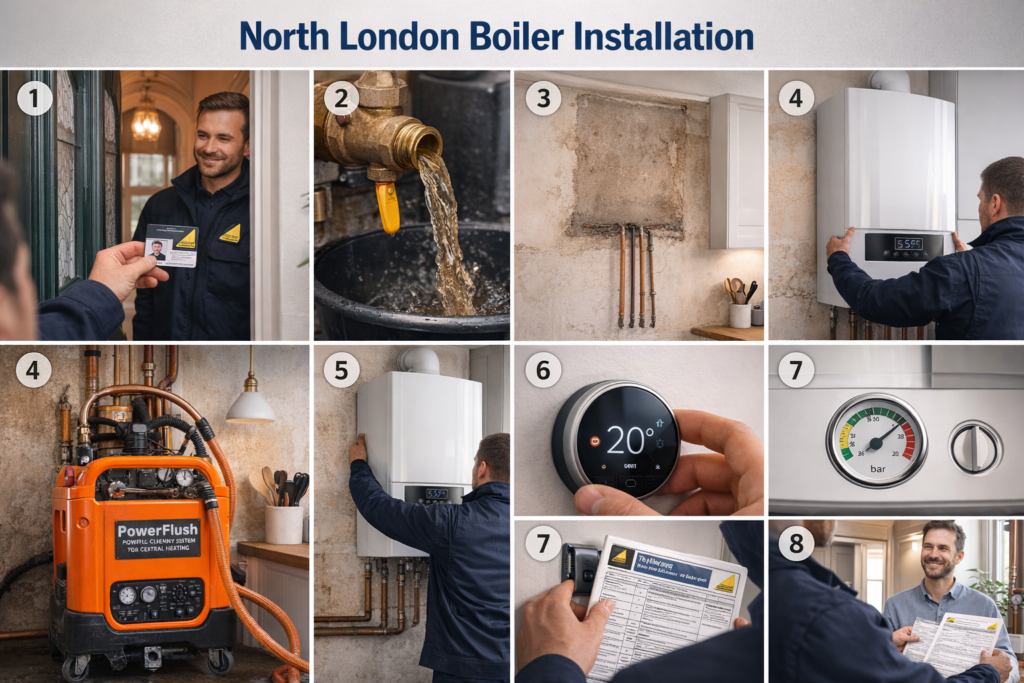
1. Engineer arrival and safety checks (30 to 45 minutes). The engineer arrives, presents their Gas Safe ID, and conducts an initial assessment of the work area. They confirm the plan, check gas pressure, and turn off the gas, water, and electricity to the boiler circuit.
2. Draining the system (30 to 60 minutes). The central heating system is drained before the old boiler can be disconnected. In larger properties with more radiators, draining takes longer.
3. Removing the old boiler (1 to 2 hours). The old boiler is disconnected from the gas, water, and flue connections and taken off the wall. This includes capping any pipework that will not be reused and removing the old flue. Disposing of the old boiler is typically included in the installation quote, but confirm this before work begins.
4. Powerflush if required (4 to 6 hours for a full flush). If the system requires a power flush, this typically happens after the old boiler is removed and before the new one is connected. The engineer connects a powerflush machine to the heating circuit and runs cleaning chemicals through the system under pressure.
5. Installing the new boiler and flue (2 to 4 hours). The new boiler is mounted, gas and water connections are made, and the new flue is installed through the wall. If the flue position is changing or requires a longer run, this stage takes longer.
6. Reconnecting controls and condensate pipework (1 hour). The programmer, room thermostat or smart thermostat, and condensate pipe are connected and routed correctly. The condensate pipe must drain to a suitable external point and be protected against freezing.
7. System refill and initial testing (30 to 60 minutes). The system is refilled with water, a corrosion inhibitor is added, and the system is pressurised. The engineer tests for leaks at all connection points before firing the boiler.
8. Commissioning, balancing, and handover (1 to 2 hours). The boiler is fired and runs through its operating modes. Radiators are balanced to ensure even heat distribution throughout the property. The engineer shows the homeowner how to operate the boiler and controls, explains the warranty registration process, and provides the Gas Safety Certificate and Benchmark commissioning document.
The total sequence for a straightforward combi swap runs 6 to 8 hours. A system boiler installation with cylinder work and multiple radiators to balance runs a full day and into a second.
How to Prepare to Minimise Delays
Preparation on your side directly reduces the chance of the installation running over time. Check meter access before your boiler installation day arrives.
Clear access before the engineer arrives. Move anything stored in front of the boiler, under the stairs if that is where the controls are, and along the likely pipework routes. Engineers working in North London frequently lose 30 to 60 minutes at the start of a job, clearing items that the homeowner had not moved.
Confirm parking in advance. If your street has a Controlled Parking Zone, arrange a suspension permit for installation day. Permit suspension applications to your borough council typically need to be submitted 5 to 10 working days in advance. Providing parking close to your property is one of the most practical things you can do to keep the job on schedule.
Have the boiler manual and any service records available. If the engineer is replacing a boiler under warranty or needs to understand how the existing system is configured, documentation speeds things up. If you do not have the manual, most are available online from the manufacturer.
Confirm your hot water and heating needs for the day. Plan for a full day without heating or hot water on installation day. Fill flasks, arrange for showers at a friend’s or family member’s, and if the installation is in winter, have a plan for keeping the property warm. Electric plug-in heaters provide adequate temporary heating for the duration.
Raise any concerns during the survey, not on installation day. If you want the boiler relocated, want a smart thermostat added, or are concerned about specific pipework, discuss this at the quotation stage. Changes requested on the day of installation add time, and in some cases cannot be accommodated without rescheduling.
How Long Before You Can Book an Installation in North London
In North London, booking lead times vary significantly by season and installer type. Busy seasons mean booking early with local boiler experts.
During spring and summer (April to September), most reputable Gas Safe engineers can schedule an installation within 1 to 2 weeks. Some national online boiler companies offer next-day installation, though this usually means a limited boiler choice and less flexibility on timing.
During autumn and winter (October to March), demand peaks significantly. Experienced local engineers in Camden, Islington, Hackney, and neighbouring boroughs are often booked 3 to 6 weeks out by November and December. Emergency replacements for properties with no heating can sometimes be prioritised, but this depends on availability.
Booking in spring or early autumn gives you the best combination of availability and scheduling flexibility. It also means installation day is less likely to coincide with the coldest period of the year, which makes the temporary loss of heating easier to manage.
FAQ
Q: Will I be without heating and hot water for the whole day during installation?
For most installations, yes: you will be without heating and hot water during the working day. For a standard combi swap starting at 8 am, heating and hot water are typically restored by 3 to 5 pm. In a system boiler installation running across two days, the engineer will usually prioritise restoring hot water at the end of day one, so you are not without it overnight. Confirm this plan with your engineer before installation starts. Emergency breakdowns may need quick boiler repair service instead.
Q: Does a boiler installation take longer in a North London flat?
Generally yes. Converted flats in North London Victorian terraces add time compared to the same job in a ground-floor house. Carrying the boiler and equipment up narrow staircases, restricted access to flue positions, and the need for freeholder approval in some cases all extend the timeline. A combi swap that takes 5 hours in a house may take 7 to 8 hours in a second-floor converted flat with limited access.
Q: How much does a powerflush add to the installation time?
A full power flush adds 4 to 6 hours to the installation. For a property with 6 to 8 radiators, it is usually manageable within a single extended installation day if work starts early. For properties with 10 or more radiators, a powerflush commonly requires a separate appointment the day before installation or runs the job into a second day. In North London, where old pipework makes a powerflush more likely to be necessary, factor this into your planning from the start.
Q: Can a boiler be installed in North London in one day?
A like-for-like combi boiler swap in a property with clear access, compliant existing pipework, and no need for a powerflush can be completed in one day in North London, typically 6 to 8 hours. Any conversion, relocation, system upgrade, or property with access complications extends the job to two or more days. Ask your engineer to be specific about their timeline estimate for your particular property and installation type during the survey visit.
Q: When is the best time of year to book a boiler installation in North London?
April to September gives you the best combination of installer availability and comfortable conditions on installation day. Spring bookings avoid the winter rush when heating engineers across North London are at maximum capacity. You also avoid the situation where a winter installation day means managing a cold property for 8 hours while work is underway. Late summer and early autumn are particularly good: engineers are available, days are mild, and you are fully prepared for winter before demand peaks.
Q: What should I check before the engineer arrives on installation day?
Clear the area around the boiler, the airing cupboard if relevant, and any pipework routes that may need access. Confirm parking has been arranged if your street is in a Controlled Parking Zone. Have the old boiler manual or service records available if you have them. Check that the gas meter is accessible and that you know its location. Make sure an adult is present throughout the full installation to allow access and answer any questions the engineer has about the property.
Conclusion
Boiler installation times in North London range from a single day for a straightforward combi swap to three or more days for full system conversions. The borough’s Victorian housing stock, converted flats, hard water conditions, restricted parking, and older pipework all push timelines beyond what applies in other UK regions.
The most reliable way to get an accurate timeline for your specific installation is a physical site survey by a Gas Safe-registered engineer who has seen your property, your existing system, and the access conditions. Use that survey as the basis for your planning, allow more time than you think you need, and book in spring or early autumn when North London engineers have the availability to give your installation the time it actually requires. Get quotes from trusted boiler installers in London before deciding.

Tilly Bani is a renovation and roofing specialist with over 15 years of experience in construction and property refurbishment across North London. He specialises in roofing, structural repairs, and full home renovations, helping homeowners improve property value and safety.