
| Quick Answer Home improvement costs in Hackney run 25 to 40% above the UK national average, driven by East London labour rates, period housing complexity, and the logistical realities of working in a dense urban borough. A full kitchen renovation costs £15,000 to £40,000. A bathroom costs £8,000 to £20,000. A single-storey rear extension runs £50,000 to £105,000, and a loft conversion costs £55,000 to £120,000. A complete whole-house renovation of a three-bedroom Victorian terrace typically costs £120,000 to £220,000 including VAT. |
Introduction
Hackney homeowners face a specific set of decisions when budgeting for improvements. The borough’s Victorian terraces in Stoke Newington, Clapton, Dalston, and De Beauvoir Town have real character but come with older plumbing, outdated electrics, and structural quirks that push costs above what a generic London guide will tell you. At the same time, Hackney’s strong property market makes well-executed improvements one of the most reliable ways to increase both the value and the liveability of your home. Many homeowners begin by speaking with trusted Hackney builders before setting budgets.
This guide covers 2026 pricing for every major home improvement category, from kitchens and bathrooms to extensions, loft conversions, and full renovation projects. Larger projects are often managed as a full home refurbishment for better efficiency. It also covers the Hackney-specific factors, conservation areas, planning rules, and logistical costs that affect your final bill.
Why Home Improvement Costs More in Hackney Than the UK Average
Before getting into room-by-room costs, it is worth understanding what drives Hackney’s pricing premium over national benchmarks.
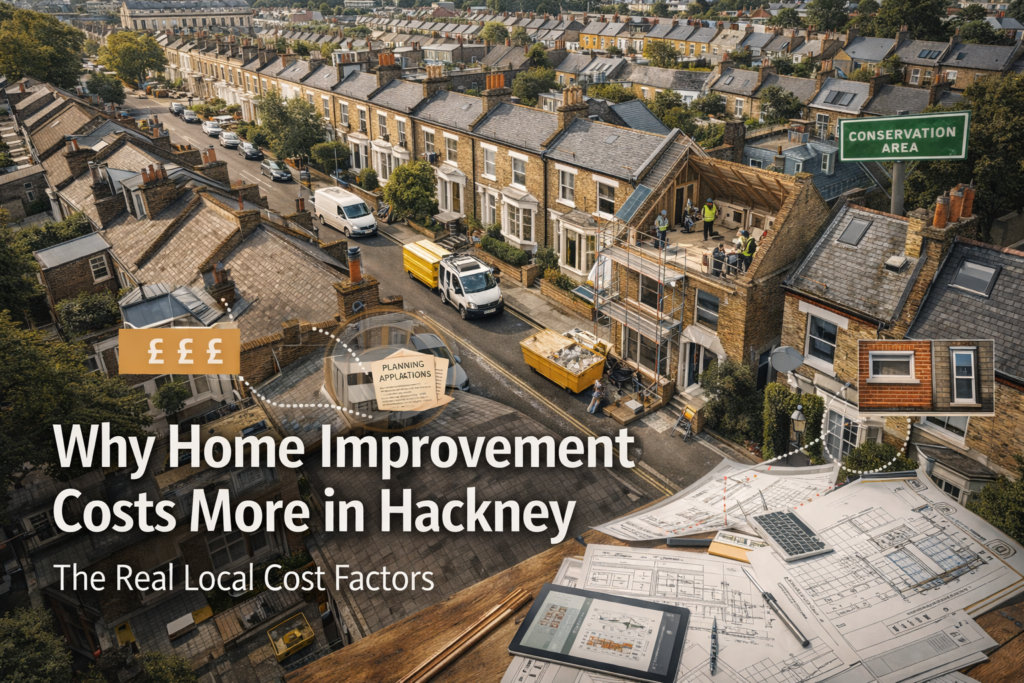
Labour rates. Tradespeople in Hackney and the wider East London market command rates well above the national average. Labour typically accounts for 30 to 50% of any renovation budget. Skilled tradespeople with experience in period properties, particularly those who can work on Victorian lime plaster, original sash windows, and Victorian drainage systems, charge more than general contractors.
Period property complexity. Approximately 60 to 70% of Hackney’s residential housing stock is Victorian or Edwardian. These properties frequently have suspended timber floors, outdated lead pipework, original clay drainage, solid brick walls with no insulation cavity, and electrical systems that predate modern wiring standards. Uncovering and fixing these issues during a renovation adds cost that does not appear in quotes built around modern properties.
Conservation area rules. Hackney has 35 conservation areas, covering streets around Clapton Square, De Beauvoir Town, Broadway Market, Stoke Newington, Victoria Park, and Hackney Road, among others. Working within these areas requires materials that match the existing character of the property, planning applications for external changes that would be permitted development elsewhere, and design approaches that satisfy Hackney Council’s heritage guidelines. This adds both professional fees and time to any project.
Logistics. Hackney’s dense residential streets create real operational costs. Skip deliveries and scaffold installation require careful coordination around congestion on main roads like the A10 and Mare Street. Parking permits for contractor vehicles add to overhead. Builders typically factor all of this into their Hackney quotes.
Updated planning rules. Hackney adopted a new Residential Extensions and Alterations Supplementary Planning Document in December 2025, which came into effect in January 2026. This updated guidance replaced the 2009 version and now shapes how extensions and alterations across the borough are assessed. Any project started in 2026 needs to be designed in line with this updated SPD.
Kitchen Renovation Costs in Hackney
A kitchen renovation is the most common improvement Hackney homeowners undertake, particularly in Victorian terraces where the original kitchen was a small, separate service room with no connection to the living space. Many families upgrade layouts using experienced kitchen fitters.
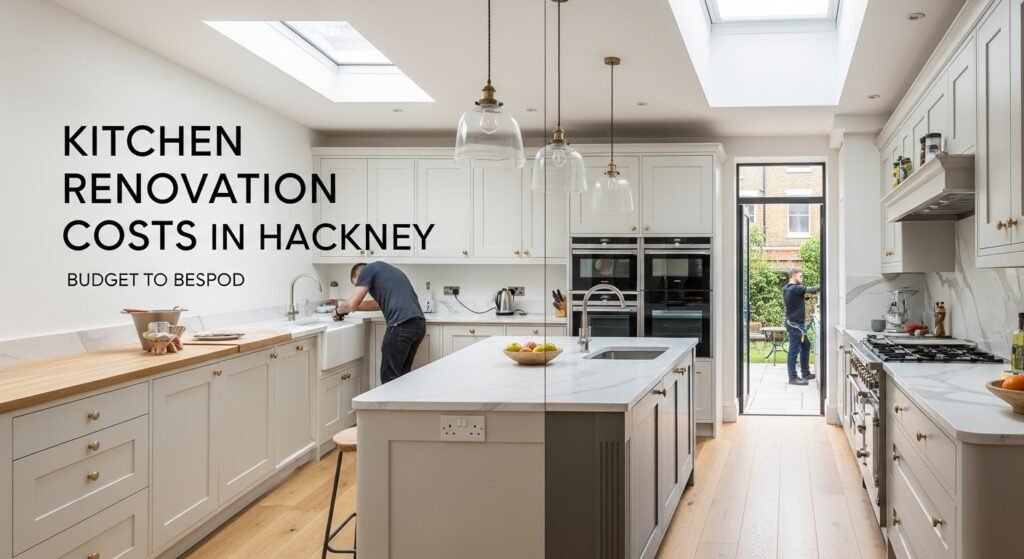
| Specification | Cost Range (inc. VAT) |
| Budget refresh (units replaced, no layout change) | £8,000 – £15,000 |
| Mid-range full renovation | £15,000 – £30,000 |
| High-end bespoke kitchen | £30,000 – £50,000+ |
These figures cover the kitchen fit-out only. If you are also extending into a rear addition or side return to create more floor area, the extension costs are separate (covered below).
What Drives Kitchen Costs in Hackney
Layout changes. Moving the sink, relocating the gas supply, or creating an island all require a plumber and a gas-safe engineer, which adds £800 to £2,500, depending on the complexity. Keeping the existing layout and running new services in the same positions is the most effective way to control costs.
Units and worktops. Off-the-shelf units from Howdens, Wren, or IKEA form the base of a budget kitchen. Mid-range rigid-built cabinets from Magnet, John Lewis of Hungerford, or independent suppliers typically cost £4,000 to £10,000 for the units alone. Quartz worktops add £1,500 to £3,500. Natural stone (marble, granite) adds £2,500 to £6,000.
Appliances. Mid-range integrated appliances from Bosch or Siemens add £2,000 to £4,000. Professional electrical upgrades may also be needed for modern appliances. Premium brands (Miele, Gaggenau, AEG) push that to £5,000 to £12,000.
Electrical upgrade. Victorian kitchens in Hackney frequently need additional circuits, a new consumer unit, or an upgrade to the existing fuseboard to support modern appliances safely. Budget £800 to £2,000 for this if it has not been done recently.
Bathroom Renovation Costs in Hackney
Bathroom renovations in Hackney Victorian terraces are complicated by the fact that bathrooms were often retrofitted into spaces not designed for them, leaving cramped layouts and substandard ventilation. Many owners hire specialist bathroom fitters to maximise limited space.
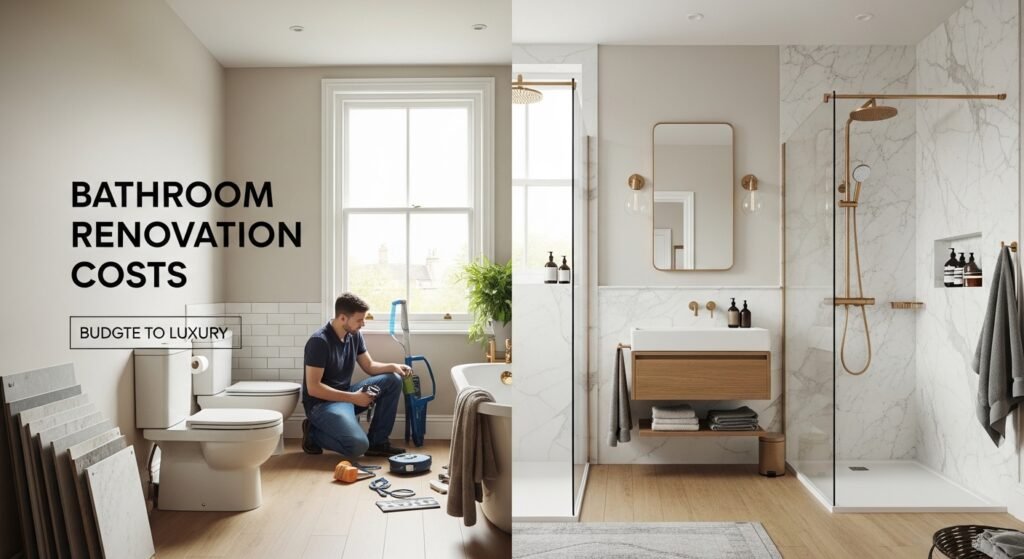
| Specification | Cost Range (inc. VAT) |
| Budget refurb (suite replaced, no layout change) | £6,000 – £10,000 |
| Mid-range full renovation | £10,000 – £16,000 |
| High-end wet room or luxury bathroom | £16,000 – £25,000+ |
| Ensuite (smaller room) | £7,000 – £14,000 |
Key Cost Drivers for Hackney Bathrooms
Old plumbing. Lead supply pipes are still found in many Hackney Victorian terraces. Replacing them adds £500 to £1,500 to a bathroom renovation, but removes a genuine health risk and is increasingly flagged by homebuyers’ surveyors.
Tanking and waterproofing. Victorian walls are solid brick. Professional waterproof tanking helps prevent future damp issues. Waterproofing them properly, known as tanking, requires specialist materials and adds £400 to £800 to the job. Skipping this step is a false economy; poorly waterproofed bathrooms in solid-wall properties fail within a few years.
Tiling costs. Ceramic tiles cost £20 to £50 per square metre. Large-format porcelain runs £50 to £100. Natural stone or bespoke tiles can reach £150 to £300 per square metre. Tiling labour in Hackney costs £180 to £300 per day.
Hard water. Hackney’s water supply from Thames Water is classified as hard. Limescale builds up rapidly on screens, taps, and shower heads. Many homeowners installing new bathrooms in 2026 are adding inline water softeners (£300 to £800) or specifying limescale-resistant coatings to extend the life of fixtures.
Loft Conversion Costs in Hackney
Loft conversions are the most popular way for Hackney homeowners to add a bedroom or bathroom without sacrificing garden space. Extra daylight is often added through expert skylight installation. Victorian terraces in Stoke Newington, Clapton, and De Beauvoir Town typically have roof structures well suited to rear dormer conversions.
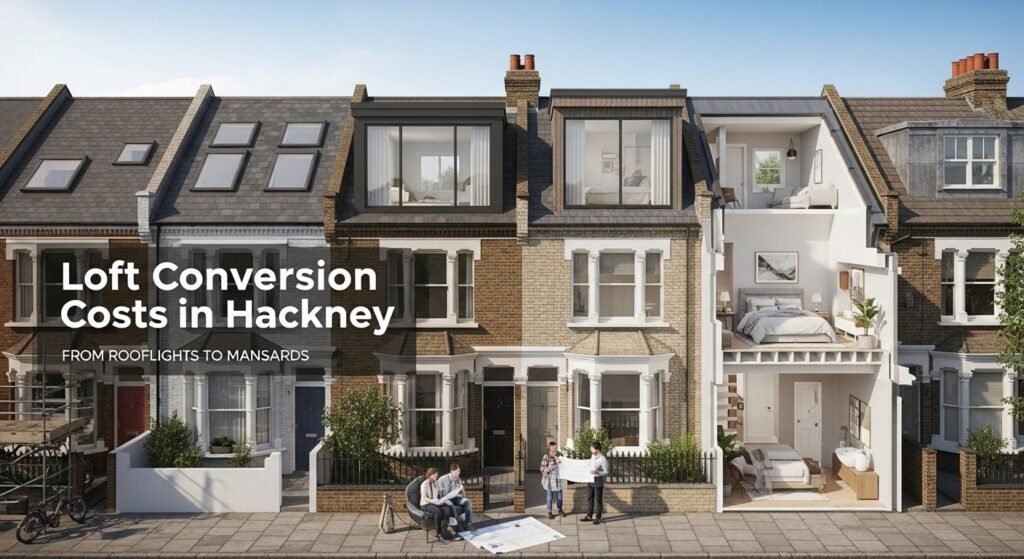
| Conversion Type | Typical Cost Range (inc. VAT) |
| Velux / rooflight (no structural roof change) | £18,000 – £35,000 |
| Rear dormer | £55,000 – £85,000 |
| Hip-to-gable (semi-detached houses) | £60,000 – £95,000 |
| Mansard (changes roofline significantly) | £75,000 – £120,000+ |
A well-executed loft conversion with a bedroom and ensuite bathroom can add up to 24% to a London property’s value, according to Nationwide’s October 2025 House Price Index research.
Planning Rules for Loft Conversions in Hackney
Most loft conversions on Hackney houses can proceed under permitted development without a planning application, subject to the standard volume limits (40 cubic metres for terraced houses, 50 cubic metres for semi-detached and detached).
However, Hackney’s 35 conservation areas change this. In conservation areas, any external extension to the roof requires planning permission. A rear dormer or hip-to-gable conversion in De Beauvoir Town, Clapton Square, Stoke Newington, or Broadway Market conservation areas needs a householder planning application, which costs £548 and takes 8 weeks to decide.
Mansard conversions, which significantly alter the roofline, almost always need planning permission regardless of conservation area status.
Flats and maisonettes do not have permitted development rights. Any loft conversion in a converted flat requires full planning permission.
Single-Storey Rear Extension Costs in Hackney
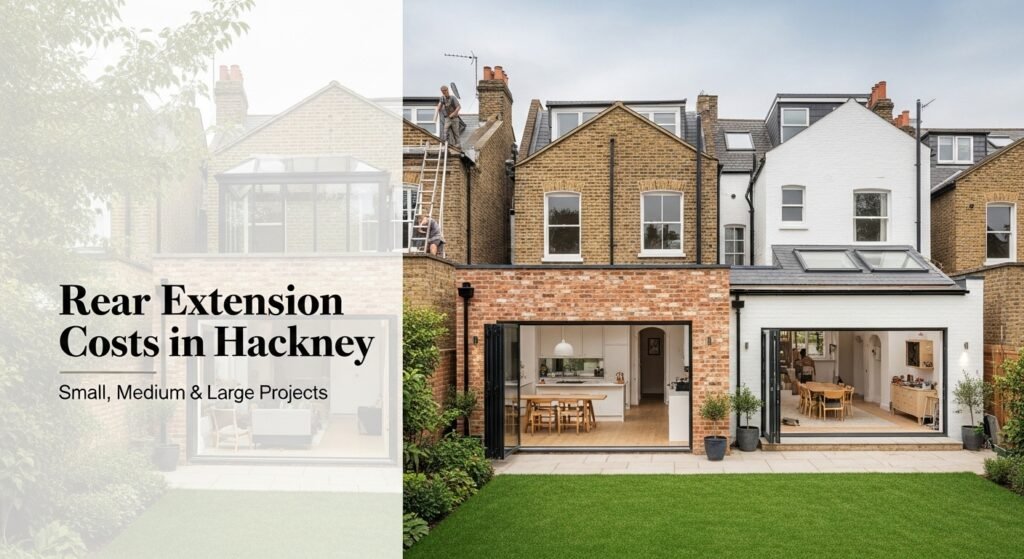
Single-storey rear extensions are the most common structural home improvement in Hackney’s Victorian terraces. Most projects involve structural and external works handled by experienced roofing services. They push the kitchen footprint into the garden to create an open-plan kitchen-dining space.
| Size | Structural Build Cost (ex. VAT) |
| Small (15 – 20m²) | £50,000 – £75,000 |
| Medium (20 – 30m²) | £75,000 – £105,000 |
| Large (30m²+) | £105,000 – £150,000+ |
London extension costs in 2026 run £3,200 to £4,600 per square metre for the structural build, up roughly 3 to 4% from 2025, following sustained labour cost inflation.
These build costs do not include the kitchen fit-out, which adds £15,000 to £40,000 depending on specification. Add professional fees (architect and structural engineer at 10 to 15% of build cost), the planning application fee of £548 for a householder application, building regulations approval, and a 10% contingency, and the all-in cost for a 20m² rear extension with a mid-range kitchen is typically £95,000 to £135,000.
Side Return Extensions
Side return extensions use the narrow alleyway beside a Victorian terrace to widen the kitchen footprint. They cost £35,000 to £65,000 as a standalone project. Combined with a rear extension, they form a wraparound that costs £90,000 to £155,000.
Side extensions are not permitted development in Hackney’s conservation areas. A planning application is required.
Full Loft-Plus-Extension Projects: Combined Costs
Many Hackney homeowners tackle a rear extension and a loft conversion simultaneously. There are real efficiency savings in doing both at once: the disruption happens once, the structural engineer’s fees are shared, and the builder’s mobilisation costs are not duplicated.
A combined rear extension (20m²) and rear dormer loft conversion in a three-bedroom Victorian terrace in Hackney typically costs:
| Item | Estimated Cost |
| Single-storey rear extension (structural build, 20m²) | £70,000 |
| Mid-range kitchen fit-out | £22,000 |
| Rear dormer loft conversion with bedroom and ensuite | £70,000 |
| Architect fees (both projects combined) | £12,000 |
| Structural engineer | £2,500 |
| Planning applications (both) | £1,096 |
| Building regulations | £1,800 |
| Party wall surveyors | £1,500 |
| Contingency (10%) | £18,000 |
| Total (inc. VAT) | ~£239,000 |
This is a realistic all-in figure for a project that would turn a standard Hackney terrace into a four-bedroom home with an open-plan ground floor. At Hackney’s current property prices, the value uplift from this work typically exceeds the cost of the improvement.
Rewiring and Replumbing Costs in Hackney
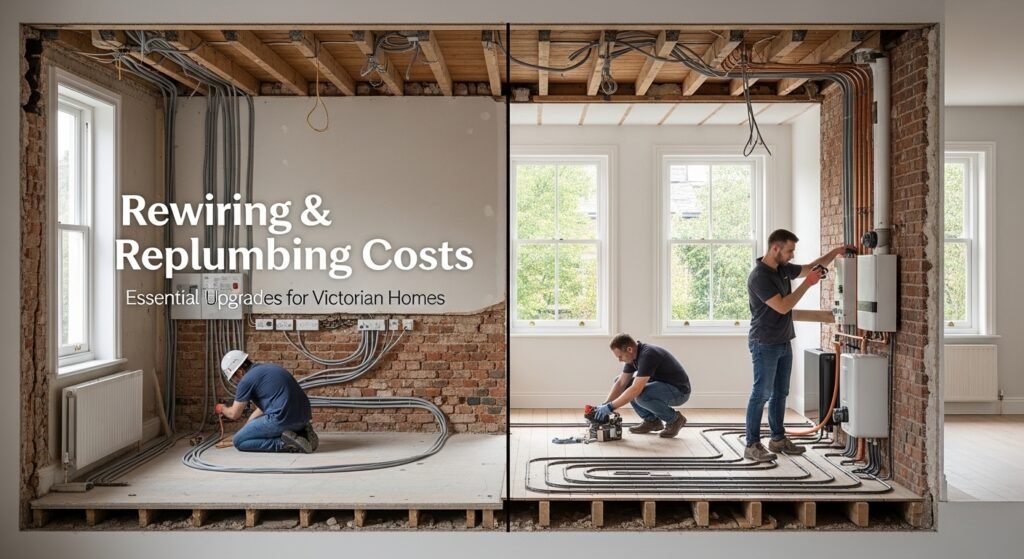
Victorian properties in Hackney almost universally need full rewiring and replumbing when undergoing a major renovation. Both are best done together, while walls and floors are already open. Older homes frequently benefit from complete house rewiring.
Rewiring Costs
| 4-bedroom house | Full Rewire Cost (inc. VAT) |
| 1-2 bedroom flat | £3,500 – £6,000 |
| 3 bedroom terrace | £6,000 – £10,000 |
| 4 bedroom house | £9,000 – £14,000 |
All electrical work in bathrooms must be carried out by a Part P-registered electrician and signed off under building regulations. Where boards are outdated, a consumer unit upgrade is often required. An Electrical Installation Condition Report (EICR) costs £100 to £300 and tells you the state of existing wiring before you commit to a full rewire.
Replumbing Costs
| Project | Cost Range (inc. VAT) |
| Lead pipe replacement only | £800 – £2,500 |
| Full replumb (three-bedroom house) | £5,000 – £9,500 |
| New central heating system with combi boiler | £4,500 – £8,000 |
| Underfloor heating (per m², wet system) | £60 – £120 |
Replacing lead supply pipes is increasingly flagged by solicitors and surveyors as a condition of sale in Hackney. If your property has not had this done, factoring it in now prevents the issue arising during a future sale.
Structural Work Costs in Hackney
Opening up a Victorian terrace to create an open-plan ground floor requires structural steelwork. These are the typical costs for common structural jobs in Hackney properties.
| Structural Job | Cost Range (inc. VAT) |
| Structural wall removal and RSJ beam (single opening) | £2,500 – £5,500 |
| Chimney breast removal (ground floor) | £2,000 – £4,500 |
| Chimney breast removal (two floors) | £4,500 – £8,000 |
| Foundation underpinning (per linear metre) | £1,500 – £3,000 |
| Damp-proof course installation | £2,000 – £5,000 |
| Damp treatment and lime replastering (ground floor) | £3,000 – £8,000 |
All chimney breast removals require a structural engineer to design the steel support and sign off on the work. If a chimney breast is shared with a neighbour, a Party Wall Agreement is required before any work starts.
Whole-House Renovation Costs in Hackney
For homeowners buying a Hackney Victorian terrace in need of complete renovation, or tackling a long-deferred full-house project, here are the realistic costs.
| Renovation Level | Cost Per m² (inc. VAT) | Three-Bed House (110m²) |
| Cosmetic (decoration, flooring, basic fixtures) | £600 – £900 | £66,000 – £99,000 |
| Mid-range (rewire, replumb, kitchen, bathroom, structural changes) | £1,200 – £1,800 | £132,000 – £198,000 |
| High-end (bespoke joinery, premium finishes, underfloor heating) | £1,800 – £2,800 | £198,000 – £308,000 |
| Full restoration (period features, structural work, extensions) | £2,500 – £3,500+ | £275,000 – £385,000+ |
A confirmed real-world example: a full renovation of a three-bedroom Victorian mid-terrace in Hackney of approximately 105 square metres, including structural alterations to open the ground floor, a new kitchen with quartz worktops, two new bathrooms, complete rewiring and replumbing, replastering, engineered oak flooring, new internal joinery, and full redecoration, came in at £148,000 including VAT. That equates to approximately £1,410 per square metre. The property’s value increased by £120,000 following the works, an 81% return on the renovation investment.
Additional Costs Hackney Homeowners Frequently Overlook
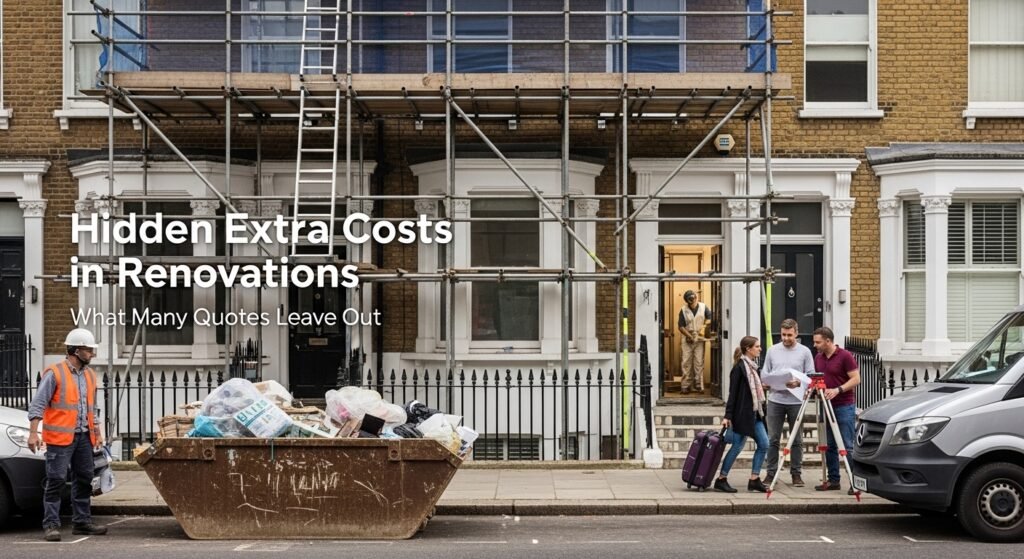
Many quotes do not include costs that are nonetheless unavoidable. These are the most common budget surprises in Hackney renovation projects.
Asbestos removal. Properties built before 1985 may contain asbestos in floor tiles, ceiling coatings, or pipe lagging. In Hackney Victorian terraces, the most common locations are artex ceilings and old floor adhesive. If found, licensed removal costs £500 to £1,500 and must happen before any other work continues.
Skip hire and waste disposal. A full renovation generates significant waste. Skip hire in Hackney costs £350 to £600 per skip. Hackney Council requires skip permits for any skip placed on a public road, which costs around £100 and takes a few days to process. Budget £1,500 to £3,000 for total waste disposal on a full renovation.
Scaffold. Any work on the roof or upper floors requires scaffolding. A standard scaffold on a Hackney terrace costs £1,200 to £2,500 per week, including erection and dismantling. A loft conversion typically requires a scaffold for four to eight weeks.
Party wall surveyors. Any extension or structural work affecting a shared party wall requires formal notice to neighbours. If a neighbour dissents, both sides appoint surveyors to agree a Party Wall Award. Budget £700 to £1,500 per surveyor.
Temporary accommodation. A full whole-house renovation is not livable during construction. Temporary rental accommodation in Hackney adds £2,000 to £4,500 per month to the project.
Conservation area design fees. Properties in Hackney’s conservation areas require additional architectural time to prepare design and access statements, heritage assessments, and more detailed drawings for planning applications. This adds £1,500 to £4,000 to professional fees.
What Home Improvements Add the Most Value in Hackney?
Not all home improvements deliver the same return. In Hackney’s property market, where average prices remain robust, the improvements with the strongest value uplift are:
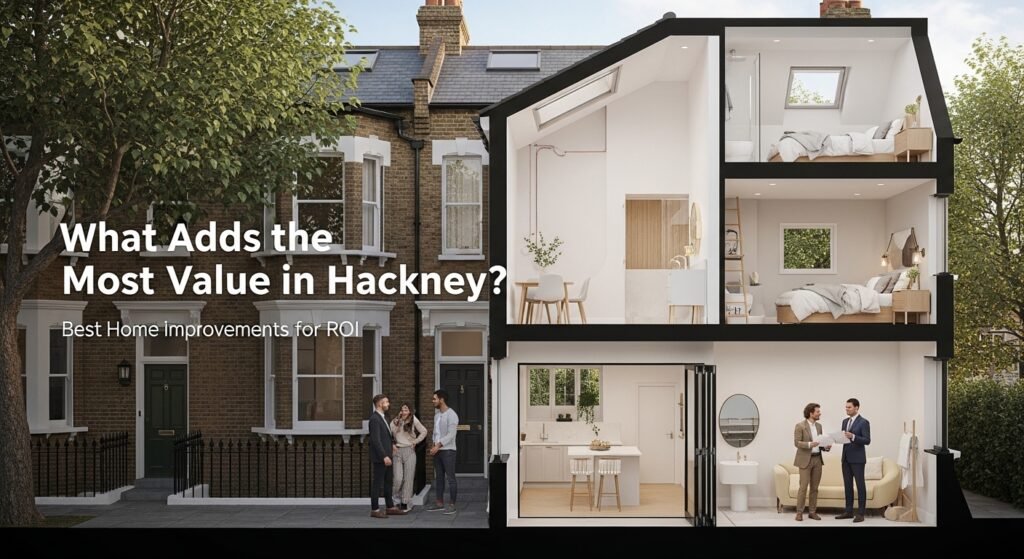
Kitchen extensions create an open-plan space. Turning a narrow galley kitchen into an open-plan kitchen-dining-living space connected to the garden is the single most requested improvement and the one buyers respond to most consistently. A well-executed rear extension with a quality kitchen can return more than its cost in Hackney’s market.
Loft conversions adding a bedroom. A loft conversion adding a proper bedroom and bathroom can increase the value of a three-bedroom Hackney terrace by 15 to 24%, according to Nationwide data. In absolute terms, on a property valued at £650,000, that is £97,500 to £156,000 of added value from a project costing £65,000 to £85,000.
Full rewire and replumb. These improvements are invisible but increasingly called out by surveyors. An unrewired or partially rewired Victorian terrace in Hackney will receive lower offers and is harder to mortgage. Completing both as part of a renovation removes this obstacle and adds confidence for buyers.
Bathroom addition. Adding a second bathroom or ensuite to a three-bedroom house with one bathroom increases buyer demand significantly in Hackney, where families and professional sharers both pay premiums for additional bathrooms.
Improvements with weaker returns in Hackney. Highly personalised finishes, such as bold colour schemes, unconventional layouts, or ultra-bespoke kitchens that exceed the property’s price bracket, rarely return their cost. A £60,000 kitchen in a street where comparable houses sell for £600,000 will not outperform a well-specified £25,000 kitchen in the same location.
How to Get Accurate Quotes for Hackney Home Improvements
Getting accurate quotes in Hackney requires more than calling three builders. Here is what separates a useful quote process from one that leads to budget overruns.
Get a structural survey and a damp and timber report before quoting for anything involving walls, floors, or the roof. Victorian properties in Hackney routinely conceal problems that are invisible until walls come down. A structural survey costs £500 to £1,500 and changes the scope of the project in ways that matter.
Provide the same brief to every contractor. Quotes are only comparable if they are priced against identical specifications. Specify the same tiles, the same kitchen brand, the same level of structural work. Without a consistent brief, you are comparing different projects, not different prices.
Ask what is specifically excluded. Waste disposal, structural engineer fees, scaffold, party wall notices, and building regulations are commonly omitted from initial quotes. Ask each contractor to confirm what is and is not included, line by line.
Use the FMB directory. The Federation of Master Builders maintains a directory of vetted and inspected contractors. Members carry insurance, guarantee their work, and are monitored. For Hackney Victorian properties with their period complexity, an FMB-registered contractor with experience in the area reduces the risk of the problems that cause costs to overrun.
Do not use unregistered tradespeople for electrical or gas work. All electrical work must be carried out by a Part P-registered electrician. All gas work requires a Gas Safe registered engineer. Using unregistered tradespeople invalidates building regulations sign-off, creates problems when you sell, and is a safety risk.
FAQ
Q: How much does a full house renovation cost in Hackney?
A full mid-range renovation of a three-bedroom Victorian terrace in Hackney typically costs £132,000 to £198,000, including VAT. This covers rewiring, replumbing, a new central heating system, kitchen renovation, two bathrooms, structural changes to open the ground floor, replastering, flooring, and decoration. It does not include extensions or a loft conversion. Light cosmetic-only renovations start around £66,000 to £99,000 for the same property. High-end specifications with bespoke joinery and underfloor heating throughout run £198,000 to £308,000.
Q: Do I need planning permission for home improvements in Hackney?
Most internal improvements do not need planning permission. New kitchens, bathrooms, rewiring, and structural changes to internal walls do not require a planning application. External changes are more complex. Hackney has 35 conservation areas, and within these, changes that would be permitted development elsewhere, including side extensions, roof dormers, and sometimes replacement windows, require a planning application. A householder planning application costs £548 and takes 8 weeks to decide. Hackney also adopted a new Residential Extensions and Alterations Supplementary Planning Document in January 2026 that guides how all extensions across the borough are assessed. Check Hackney Council’s planning pages and conservation area map before starting any external work.
Q: How long do home improvement projects take in Hackney?
A kitchen or bathroom renovation takes 2 to 4 weeks. A full loft conversion takes 8 to 14 weeks. A single-storey rear extension takes 10 to 16 weeks for the structural build, plus 2 to 4 weeks for the kitchen fit-out. A full whole-house renovation of a three-bedroom terrace takes 10 to 20 weeks of construction time. Add 3 to 6 months for the design, planning, and professional fee stage before construction starts. If planning permission is required, the council has an 8-week decision target for householder applications, but conservation area projects with heritage considerations sometimes take longer.
Q: How much more does it cost to improve a home in a Hackney conservation area?
Directly, a conservation area adds the £548 planning application fee and 8 weeks of waiting. Indirectly, it adds £1,500 to £4,000 in extra architect fees for heritage-specific drawings and statements, requires more expensive materials to match the existing building character, and limits the design options available. In some conservation areas with Article 4 directions, works as minor as replacing windows or painting external brickwork require planning permission. The total direct and indirect cost premium for working in a Hackney conservation area typically ranges from £3,000 to £7,000 on a standard extension project.
Q: What is the biggest hidden cost in a Hackney home improvement project?
The most common and most expensive surprise is structural or services-related work discovered once walls, floors, or ceilings come down. Lead pipes, asbestos tiles, rotten floor joists, and active damp are all common in Hackney’s Victorian stock and none are visible during a standard inspection. Budget a contingency of 10 to 15% on top of all quoted costs. On a £100,000 project, that is £10,000 to £15,000 held in reserve. If you do not need it, you keep it. If you do, the project keeps moving without a financing crisis.
Q: How do I find a reliable builder for home improvements in Hackney?
Use the Federation of Master Builders (FMB) directory, TrustMark, or Checkatrade to find vetted contractors with verified project histories. Prioritise builders who have completed projects specifically in Hackney or similar inner East London boroughs. Get at least three written quotes with detailed cost breakdowns and ask for references from similar period property projects. Never pay more than 25 to 30% upfront, and release remaining payments on completion of agreed milestones rather than on a fixed schedule. For any project involving structural work or a planning application, appoint a qualified architect before approaching builders.
Conclusion
Home improvement costs in Hackney in 2026 are high, but so is the return when projects are well-executed. A kitchen extension that opens a Victorian terrace to the garden, a loft conversion that adds a bedroom and bathroom, or a full renovation that brings all systems up to modern standards can each return more than their cost in a borough where property values continue to hold up.
The key to staying on budget is building it accurately from the start. That means commissioning a structural survey before finalising the scope, getting comparable quotes with the same specification, setting aside a 10 to 15% contingency for the surprises that Victorian properties reliably produce, and checking your conservation area status before committing to any external changes. Do those things, and a Hackney home improvement project delivers exactly what it should: a better home and a stronger asset. For accurate quotes and renovation advice, you can contact our team.

Tilly Bani is a renovation and roofing specialist with over 15 years of experience in construction and property refurbishment across North London. He specialises in roofing, structural repairs, and full home renovations, helping homeowners improve property value and safety.