
| Quick Answer If your boiler breaks in Hackney, start by checking for safety issues: a gas smell means call 0800 111 999 immediately and leave the property; a yellow flame or CO alarm activation means the same. For a standard breakdown with no safety concern, check the pressure gauge, look for a fault code on the display, check that the condensate pipe has not frozen, and confirm the gas meter has credit. If none of these resolves it, call a Gas Safe registered engineer. Emergency call-outs in Hackney typically take 30 minutes to 2 hours, depending on time of day and season. |
Introduction
A boiler breakdown in Hackney is not just an inconvenience. In a Victorian terrace in Clapton with a family in it, a flat conversion in Dalston on a January night, or a rental property in Stoke Newington where you are the landlord, a non-working boiler creates real hardship fast.
Hackney’s housing stock makes boiler problems both more common and more complicated than in other parts of London. The borough is full of Victorian and Edwardian terraces, many converted into flats, with old pipework, hard water from Thames Water, and heating systems that have been modified multiple times over their lives. These properties are more prone to pressure drops, sludge buildup, and limescale-related faults than newer builds.
This guide tells you exactly what to do, in the right order, when your boiler breaks in Hackney. It covers safety checks first, then the checks you can do yourself, when to call an emergency engineer, what to expect in terms of cost and response time, and what Hackney-specific factors are likely behind the fault.
Step 1: Check for Safety Issues First
Before anything else, rule out the two situations that require immediate action regardless of any other consideration.
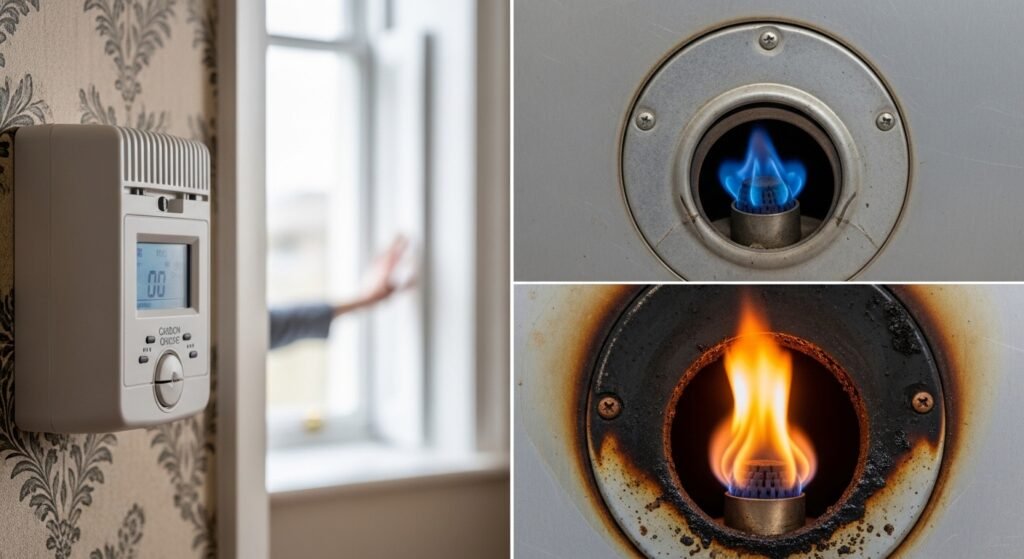
Gas Smell
Natural gas has a distinctive sulphur smell, often described as rotten eggs or bad eggs. This odour is added deliberately to an otherwise odourless gas to make it detectable.
If you smell gas:
- Do not switch any lights or electrical switches on or off
- Do not use any naked flames, cigarettes, or lighters
- Do not use your mobile phone inside the property
- Open windows and doors to ventilate
- Turn off the gas supply at the emergency control valve near the meter (only if safe to reach it)
- Leave the property immediately
- Call the National Gas Emergency Service on 0800 111 999 from outside the property. This line is free and available 24 hours a day, 365 days a year
- Do not return until a Gas Safe engineer has declared the property safe
The Gas Emergency Service will attend regardless of time of day or night. This is not a situation for self-diagnosis or waiting to see if it gets better.
Carbon Monoxide: The Silent Danger
Carbon monoxide (CO) is produced when gas does not burn completely, typically due to a faulty, poorly maintained, or inadequately ventilated boiler. Unlike gas, it has no smell, no colour, and no taste. You cannot detect it without an alarm.
Signs that your boiler may be producing carbon monoxide:
- The CO alarm sounds or activates
- Flames on older boilers appear yellow or orange instead of blue
- Black sooty marks around the boiler or flue
- More condensation than usual on windows near the boiler
- Household members experiencing persistent headaches, dizziness, nausea, or fatigue that improve when they leave the property
Symptoms of CO poisoning mirror flu symptoms but without a fever: headache, dizziness, nausea, breathlessness, confusion, and in serious cases, loss of consciousness.
If you suspect carbon monoxide:
- Turn off the boiler immediately if you can do so safely
- Open all windows and doors
- Get everyone, including pets, out of the property
- Do not re-enter
- Call the National Gas Emergency Service on 0800 111 999 from outside
- If anyone is showing symptoms, call 999 for medical help immediately
Carbon monoxide kills around 20 to 50 people in England and Wales every year. Every death is preventable. Do not treat a CO alarm activation as a false alarm until an engineer has confirmed it is safe.
Step 2: Safe Checks You Can Do Yourself
If there is no gas smell and no CO concern, the following checks can resolve many common Hackney boiler faults without needing an emergency call-out.
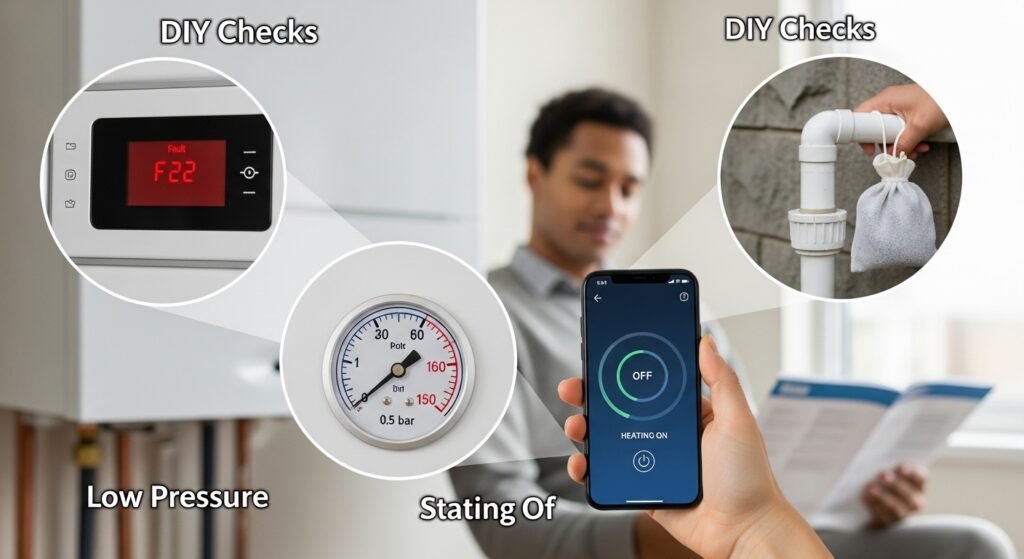
Check the Boiler Pressure
This is the most common cause of boiler breakdown in Hackney properties, particularly in Victorian conversions and flats. The pressure gauge is on the front of the boiler and shows a reading in bar.
- Normal cold pressure: 1 to 1.5 bar
- Too low (below 1 bar): the boiler may lock out and refuse to fire
- Too high (above 3 bar): the boiler’s safety valve may trigger
Pressure below 1 bar in a Hackney property is often caused by radiators having been bled recently, a small leak in the system, or simply an older system with weaker seals. If pressure is low and your boiler has a filling loop (a flexible connector usually near the bottom of the boiler), you can top it up using the manufacturer’s instructions in the boiler manual. The standard process is to open the filling loop valve until the pressure reaches 1.2 to 1.5 bar, then close it.
If you are not confident doing this, call an engineer. If the pressure drops again within a few days of being topped up, there is a leak in the system that requires professional diagnosis.
Look for a Fault Code on the Display
All modern boilers display an error or fault code when something goes wrong. This code is typically a letter and a number (such as F22, EA, or E1) shown on the boiler’s digital display.
Write down the code and look it up in your boiler manual or search for it online with your boiler brand. Common Hackney fault codes and what they usually mean:
- F22 / Low-pressure codes: Pressure drop in the system. Top up the pressure as described above.
- Ignition fault codes (varies by brand): The boiler cannot ignite. Can be caused by a gas supply interruption, a faulty electrode, or a blocked flue.
- Sensor fault codes: A temperature or flow sensor has failed. Requires an engineer.
- Pump fault codes: The circulation pump has failed or is jammed. Common in older Hackney properties with sludge buildup.
Many boiler lockouts can be cleared by pressing the reset button once, waiting 60 seconds, and allowing the boiler to fire. If the boiler fires and then locks out again within a short time, there is an underlying fault that requires an engineer. Do not keep resetting repeatedly, as this can mask the fault and, in some cases, cause further damage.
Check the Condensate Pipe
All modern condensing boilers have a condensate pipe, a white plastic pipe that usually exits through an external wall and runs to a drain or soakaway. In cold weather, this pipe can freeze, which causes the boiler to stop working.
The condensate pipe is typically 22mm in diameter, white plastic, and will feel cold or icy to the touch when frozen. You can safely thaw it by pouring lukewarm (not boiling) water along the external section of the pipe, or wrapping it with a hot water bottle. Once thawed, reset the boiler.
This is a very common fault in Hackney during cold snaps, particularly in properties where the condensate pipe runs along an external wall or is installed without lagging. Once you have resolved the immediate freeze, wrap the external section of the pipe with foam lagging to prevent a recurrence.
Check the Gas Supply
If your boiler is on a prepayment gas meter, check that it has sufficient credit. A boiler fault caused by an empty prepayment meter looks identical to a mechanical fault. Check the meter and top up if needed before calling an engineer.
If you have a credit meter, check whether other gas appliances in the property are working. If the gas cooker or hob is also not working, the issue may be with the gas supply rather than the boiler. Call Cadent on 0800 111 999 if you have no gas supply.
Check the Programmer and Thermostat
Sometimes what appears to be a boiler breakdown is actually a settings issue. Check:
- The thermostat is set above the current room temperature
- The programmer is set to “heating on” rather than “off” or “hot water only”
- A smart thermostat (Nest, Hive, or similar) has not been accidentally set to holiday or off mode via the app
A surprisingly common call-out in Hackney happens after a power cut: the boiler programmer resets to factory settings, the heating defaults to “off,” and the homeowner cannot work out why the boiler appears dead.
Step 3: When to Call an Emergency Engineer
If none of the above checks resolves the problem, you need a Gas Safe-registered engineer. The question is whether the situation requires an emergency same-day call-out or whether it can wait for a standard appointment.
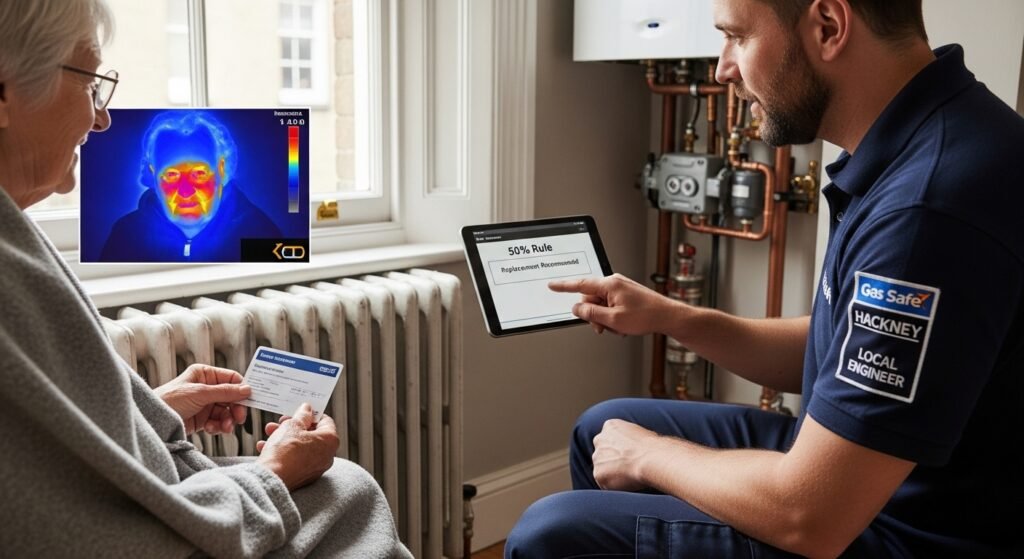
Call for Emergency Repair When:
- There is no heating, and the temperature outside is below 5°C
- You have elderly people, young children, or anyone with a medical condition in the property
- You are a landlord: tenants have a legal entitlement to heating and hot water, and Hackney Council can take action against landlords who fail to provide it
- The boiler is leaking water significantly
- There is a gas smell or CO concern (in these cases, call the National Gas Emergency line, not a plumber)
- The boiler is showing a fault that suggests a safety issue, such as an overheat or gas valve fault
Standard Appointment Is Fine When:
- It is summer or mild weather, and the lack of heating is not causing immediate hardship
- The fault is with the hot water only, with the heating working
- The boiler has a minor fault that does not affect habitability
What to Expect from an Emergency Boiler Engineer in Hackney
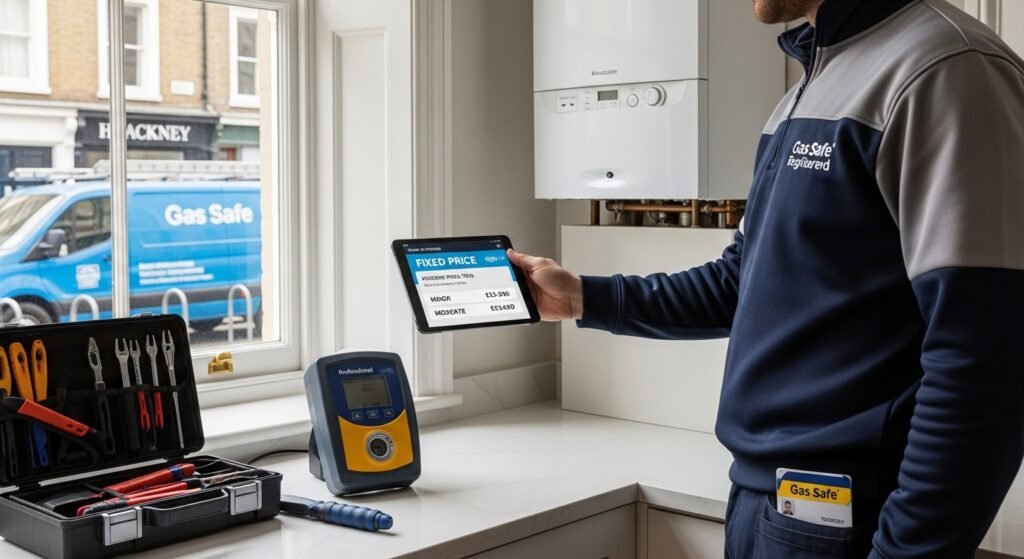
Response Times
Emergency boiler engineers in Hackney typically offer response times of 30 minutes to 2 hours during standard hours. In peak winter periods, particularly November to February, response times extend as demand surges across the borough. Weekend and overnight call-outs from large national companies may take longer.
Hackney’s road network and parking restrictions can slow engineers. Congestion around Dalston Junction, Mare Street, and Stoke Newington High Street is significant during peak hours. Engineers working in Hackney factor parking permit costs and delivery logistics into their rates.
What the Engineer Will Do
A Gas Safe engineer attending an emergency call-out in Hackney will follow this general process:
- Initial assessment: Check the boiler display for fault codes, assess system pressure, ask about the fault history and any recent changes to the system.
- Diagnostic checks: Use specialist equipment to assess boiler component performance, including combustion analysis, pump flow rate, and electronic board function.
- Fault identification and quote: Before any repair work begins, the engineer must give you a clear quote for the repair. Ask for a breakdown of parts and labour before agreeing.
- Repair or temporarily make safe: If the part is available and the repair is straightforward, the engineer will complete it in the same visit. If a specialist part is needed that is not on the van, they will make the boiler as safe as possible and return when the part arrives.
- Testing and sign-off: After completing the repair, the engineer will test the boiler under operating conditions and confirm the system is working correctly before leaving.
- Gas safety certificate: Any work on the gas system should be recorded. Ask for documentation confirming the work completed and the engineer’s Gas Safe registration number.
Emergency Boiler Repair Costs in Hackney
Emergency call-outs in Hackney carry a premium over standard appointment rates. London labour rates are already 20 to 37% above the national average, and emergency surcharges apply on top.
| Service | Typical Cost in Hackney |
|---|---|
| Emergency call-out fee (daytime) | £85 – £150 |
| Emergency call-out fee (evening/weekend) | £120 – £200 |
| Labour rate (per hour) | £80 – £120 |
| Minor repair (thermostat, sensor, pressure) | £150 – £300 |
| Moderate repair (diverter valve, pump) | £250 – £450 |
| Major repair (PCB, heat exchanger) | £400 – £800 |
| Full system powerflush | £400 – £700 |
Some engineers include the call-out fee in the repair cost if you proceed with the work. Always ask whether the call-out fee is deducted from the repair total or charged separately.
Get a written quote before authorising any repair. A verbal estimate that changes once the job starts is a common source of dispute. Request a fixed-price quote covering parts and labour before the engineer begins work.
Hackney-Specific Boiler Problems: Why Your Property Is More Vulnerable
Hackney’s housing stock creates specific boiler vulnerabilities that do not affect newer properties in the same way.
Hard Water and Limescale
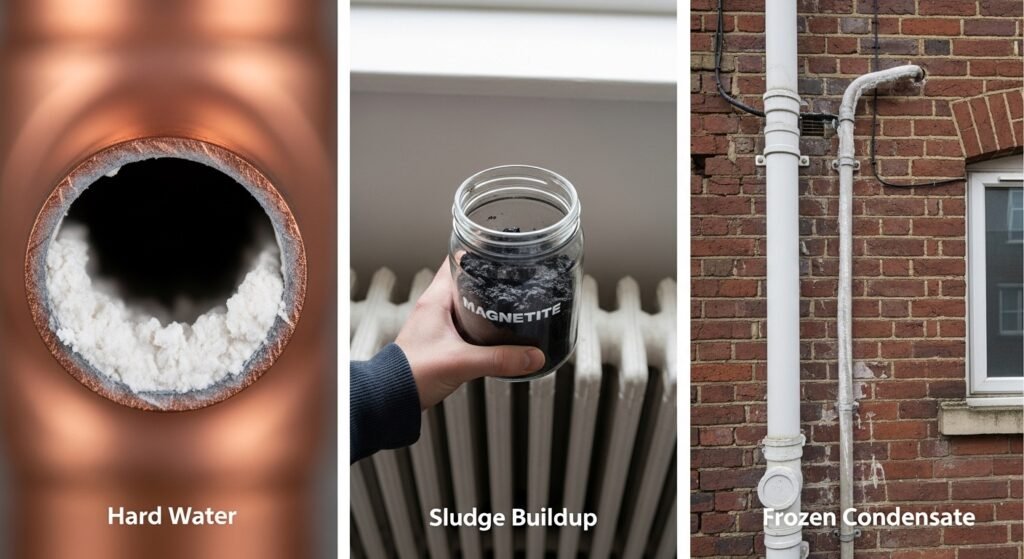
Hackney receives hard water from Thames Water. The water contains high concentrations of calcium and magnesium that deposit as limescale inside heat exchangers, pipes, and boiler components as it is heated. Over time, limescale buildup reduces efficiency, causes kettling sounds (a rumbling noise like water boiling in a kettle), and eventually blocks heat exchangers entirely.
Hackney, Camden, and Islington have particularly hard water, making limescale a more frequent cause of boiler fault and emergency repair here than in softer-water areas. Annual servicing with a scale inhibitor treatment, or the installation of an inline water softener, significantly reduces this risk. An engineer diagnosing a no-heat fault in a Hackney property will often find limescale as a contributing factor even when the presenting fault appears to be something else.
Sludge Buildup in Old Pipework
Victorian terraces in Clapton, Stoke Newington, and De Beauvoir Town contain original or partially original pipework that has accumulated years of magnetite sludge, a black iron oxide that circulates in heating systems and blocks pumps, heat exchangers, and radiator circuits. Sludge causes cold spots on radiators, reduced heat output, and pump failure.
An emergency fault presenting as “no heat” or “cold radiators despite the boiler firing” is often a sludge problem in Hackney’s older properties. The solution is a power flush, which clears the system under pressure, followed by magnetic filter installation to capture ongoing debris. A powerflush in a Hackney Victorian terrace costs £400 to £700, depending on the number of radiators.
Converted Flats and Shared Systems
Much of Hackney’s Victorian housing is divided into flats. This creates specific complications when a boiler breaks. If your flat has its own dedicated boiler, the responsibility is typically yours. If there is a communal heating system shared by multiple flats, the responsibility lies with the freeholder or management company.
Leasehold flat owners in Hackney should check their lease before calling an emergency engineer. The lease should specify whether the boiler and heating system is a leaseholder responsibility or a landlord/management company responsibility. Calling a private engineer when the boiler is the freeholder’s responsibility can create a dispute over who pays.
For tenants in Hackney, the landlord has a legal duty under the Landlord and Tenant Act 1985 to keep the heating and hot water installation in repair. If your landlord is unresponsive to a heating breakdown, report it to Hackney Council’s Private Sector Housing team, who have powers to enforce repairs.
Frozen Condensate Pipes in Exposed Positions
Many Hackney Victorian terraces have condensate pipes running along exposed external walls or through unheated spaces. In cold weather, these freeze more easily than pipes in protected positions. If the same pipe freezes every winter, it needs lagging or rerouting. An engineer attending an emergency call-out can usually identify whether the condensate pipe position is the underlying issue and advise on a permanent fix.
Parking and Access Challenges
Engineers attending emergency call-outs in Hackney deal with restricted parking zones, Congestion Charge boundaries, and ULEZ charges. Some charge these separately and some include them in the call-out fee. When calling for an emergency engineer, ask whether the quote includes parking and any London zone charges. These can add £30 to £50 to a standard call-out and should not appear as a surprise on the final bill.
Hackney Council Tenants: Your Rights and the Repairs Process
If you are a Hackney Council tenant and your boiler breaks, your rights and the process are different from those of private renters or owners.
Hackney Council operates a dedicated repairs service. Between 1 November and 30 April, the council operates a 24-hour response timescale for heating and hot water breakdown repairs during working hours. Outside working hours, emergency repairs covering situations of danger or where the property would be uninhabitable are handled on a call-out basis.
To report a heating or hot water breakdown as a Hackney Council tenant:
- First check that gas and electricity meters have credit and that the programmer is set correctly
- Report the repair by calling Hackney Council’s repairs line. Emergency repairs can be reported 24 hours a day, 7 days a week
- Keep a record of when you reported the fault and any reference number given to you
Hackney Council’s standard states that emergency repairs, including heating failures in winter, will be attended within 24 hours. If the council fails to meet this and the situation causes genuine hardship, tenants have the right to request compensation.
How to Find a Reliable Emergency Boiler Engineer in Hackney
Not all engineers calling themselves emergency boiler specialists in Hackney are equally trustworthy. These checks take less than five minutes and protect you from being overcharged or having unsafe work carried out.
Verify Gas Safe registration. All gas boiler work in the UK must be carried out by a Gas Safe registered engineer. Check the Gas Safe Register at gassaferegister.co.uk before authorising any work. You can search by postcode to find registered engineers in Hackney, or verify a specific engineer’s registration number. An engineer who cannot or will not provide their Gas Safe registration number should not touch your boiler.
Use Checkatrade, TrustMark, or the FMB directory. These platforms vet engineers and carry verified customer reviews. A local Hackney engineer with 50 reviews showing consistent emergency response and honest pricing is a better choice than a call centre that dispatches whoever is available.
Ask for a fixed-price quote before work starts. An emergency call-out for diagnosis and a quote does not obligate you to proceed with that engineer’s repair. If the quote seems high, you are entitled to get a second opinion, though this may mean waiting without heating. For major repairs (PCB or heat exchanger), getting a second opinion is worth the time if the situation allows.
Check for specific Hackney or East London experience. An engineer who regularly works in Hackney’s Victorian housing stock understands hard water, old pipework, and the specific boiler makes commonly installed in this area. This local knowledge speeds up diagnosis and reduces the likelihood of a misdiagnosis.
Temporary Measures While You Wait for the Engineer
If you are waiting for an emergency engineer or waiting for a part to arrive, these measures help maintain warmth and safety.
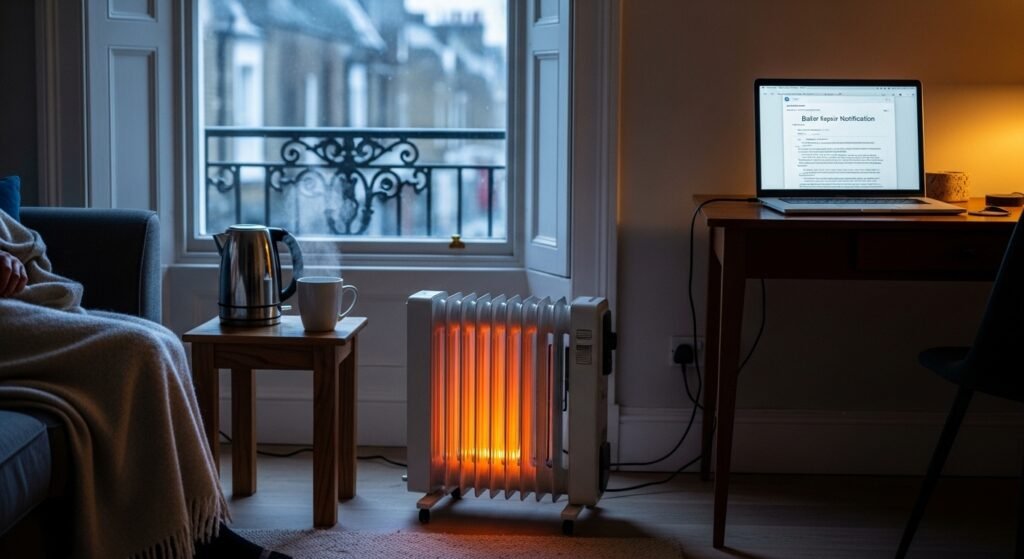
Electric plug-in heaters are the most practical temporary heating solution. Oil-filled radiators are safer than fan heaters for overnight use and produce more sustained heat. Do not use portable gas or propane heaters indoors, as they produce carbon monoxide.
An electric shower can provide hot water for bathing even when the boiler is not working, provided your property has one.
Boiling water in a kettle provides hot water for washing up and basic hygiene.
Report to your letting agent or freeholder if you rent, in writing (email is acceptable), the moment you discover the boiler has broken. This creates a dated record of when you notified them, which is important if the repair is delayed and you need to claim compensation.
Hackney Council’s warm hub network includes libraries, leisure centres, and community spaces across the borough that are open during the day and provide warmth for residents. Details are available on the Hackney Council website.
Preventing Future Emergency Breakdowns
Most emergency boiler call-outs in Hackney are preventable. These steps significantly reduce the risk of a breakdown, particularly in winter.
Annual boiler service. An annual service by a Gas Safe engineer costs £80 to £120 and catches developing faults before they become breakdowns. In Hackney’s hard-water zone, annual servicing is particularly important because limescale builds faster here than in softer-water areas. Servicing also keeps manufacturer warranties valid. An unserviced boiler often voids its warranty.
Magnetic filter. A magnetic filter fitted to the heating circuit captures the metallic particles that cause sludge buildup. If your system does not have one, ask your engineer to fit one at the next service or repair visit. Costs £100 to £250 fitted.
Carbon monoxide alarm. Fit a CO alarm with the EN 50291 standard marking in every room containing a gas appliance. Since October 2022, landlords in England are legally required to install CO alarms in rooms with gas boilers. Even for owner-occupiers where it is not currently a legal requirement, a CO alarm costing £25 to £40 is the most important safety investment in any home with a gas boiler.
Lag the condensate pipe. If your condensate pipe runs along an external wall, fit foam pipe lagging around the external section. This is available from any plumber’s merchant and takes 20 minutes to fit. It prevents the condensate freeze that causes a disproportionate number of winter emergency call-outs in Hackney.
Keep the heating ticking over in cold weather. Setting the heating to come on at 12°C overnight during cold snaps, rather than turning it completely off, prevents pipes from freezing and reduces the thermal shock on the boiler at startup, which is when most mechanical failures occur.
FAQ
Q: How quickly can an emergency boiler engineer reach me in Hackney?
During business hours, most Gas Safe-registered emergency engineers serving Hackney aim to arrive within 30 minutes to 2 hours. In peak winter periods, November to January, response times extend due to high demand across London. Overnight and weekend call-outs from independent local engineers typically respond faster than large national companies in Hackney, where local knowledge of the road network and parking restrictions matters.
Q: How much does an emergency boiler repair cost in Hackney?
Emergency call-out fees in Hackney range from £85 to £200 depending on time of day and whether the call-out is during business hours, evenings, or weekends. Labour runs £80 to £120 per hour. A simple repair (pressure issue, sensor, or condensate fault) may cost £150 to £300 all-in. A major repair involving a PCB or heat exchanger costs £400 to £800. Always ask for a written, fixed-price quote before work begins, and ask whether the call-out fee is deducted from the repair total.
Q: What should I do if I smell gas from my boiler in Hackney?
Leave the property immediately without operating any electrical switches or using a mobile phone indoors. Open windows and doors on the way out. Call the National Gas Emergency Service on 0800 111 999 from outside. Do not return until the emergency service has attended and declared the property safe. This service is free and available 24 hours a day.
Q: Who is responsible for fixing the boiler in a rented Hackney property?
In a privately rented property, the landlord is legally responsible under the Landlord and Tenant Act 1985 for maintaining the heating and hot water system in working order. Report the fault in writing immediately and keep a record of when you did so. If the landlord fails to respond within a reasonable time, contact Hackney Council’s Private Sector Housing team. If you are a Hackney Council tenant, report the fault to the council’s repairs line, which handles heating emergencies on a 24-hour basis between November and April.
Q: Why does my boiler keep breaking down in my Hackney flat?
Recurring breakdowns in Hackney properties are most often caused by three factors: limescale from Hackney’s hard water building up inside the heat exchanger; magnetite sludge from old pipework circulating through the system and blocking the pump; and pressure drops caused by micro-leaks in ageing copper pipework. If your boiler breaks down more than once a year, commission a powerflush to clear the system, fit a magnetic filter to capture ongoing debris, and ask your engineer whether a water softener is worth installing given local water hardness. Annual servicing is the most effective preventive measure.
Conclusion
A boiler breakdown in Hackney is stressful, but the right sequence of actions makes it manageable. Safety first: gas smells and CO alarms require an immediate call to 0800 111 999 and evacuation. Everything else, pressure drops, fault codes, frozen condensate pipes, can be checked and often resolved without an emergency call-out.
When you do need an engineer, verify their Gas Safe registration before letting them near the boiler, ask for a fixed-price written quote before agreeing to any repair, and understand the Hackney-specific factors, hard water, old pipework, converted flat complexity, that are often behind the fault.
For the longer term, an annual service, a magnetic filter, a lagged condensate pipe, and a carbon monoxide alarm are the four investments that prevent most of the emergency call-outs that Hackney engineers attend every winter. They cost less combined than a single emergency repair bill.

Tilly Bani is a renovation and roofing specialist with over 15 years of experience in construction and property refurbishment across North London. He specialises in roofing, structural repairs, and full home renovations, helping homeowners improve property value and safety.