
| Quick Answer A combi boiler suits most North London flats, one and two-bedroom properties, and smaller Victorian terraces with one bathroom and moderate hot water demand. A system boiler suits larger family homes with two or more bathrooms, properties where multiple people shower simultaneously, and homes being extended with a new bathroom through a loft conversion. North London’s hard water supply and Victorian housing stock add specific factors to this decision that a generic comparison guide will not cover. |
Introduction
North London’s housing is some of the most varied in the UK. A Victorian terrace in Islington sits on the same street as a converted maisonette. A four-bedroom Edwardian semi in Muswell Hill has completely different hot water demands from a one-bedroom flat in Camden Town. Choosing between a combi and a system boiler in this part of London is not just a technical decision. It is a decision shaped by your property type, your household size, your water pressure, and what you plan to do with your home.
This guide gives you a direct, North London-specific comparison, covering how each boiler type works, what each costs to install and run, how they perform in the specific property types common across boroughs like Islington, Camden, Hackney, Haringey, and Barnet, and the local factors that influence which one is right for your situation.
How Each Boiler Type Works
Understanding the functional difference between the two systems prevents the most common source of buyer regret: choosing the wrong boiler for how your household actually uses hot water.
How a Combi Boiler Works
A combination boiler is a single self-contained unit that heats water directly from the mains supply whenever you open a hot tap or turn on the central heating. There is no separate hot water cylinder or cold water storage tank. When you turn on the shower, the boiler fires, water passes through a heat exchanger, and hot water flows out within a few seconds.
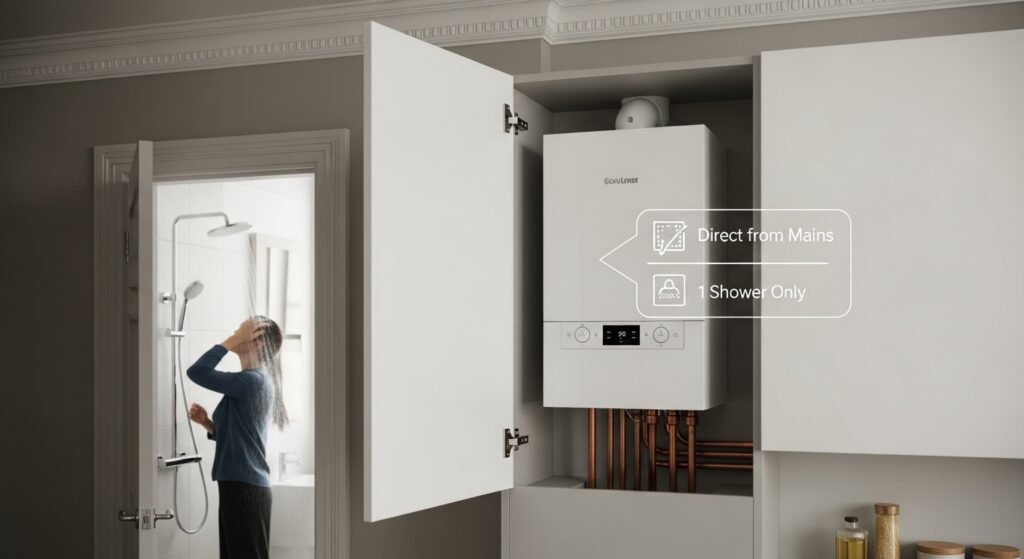
This makes combi boilers space-efficient and simple. The entire heating and hot water system sits in one compact unit, typically installed in a kitchen cupboard or utility area. There is no airing cupboard required and no loft tank to worry about.
The limitation is capacity. A combi boiler heats water on demand at a flow rate typically between 10 and 15 litres per minute, depending on the boiler’s output. This is sufficient for one shower running at a time. If two people are showering simultaneously, or if someone is having a bath while someone else uses the kitchen tap, a combi boiler will struggle to maintain pressure and temperature at both outlets.
How a System Boiler Works
A system boiler heats water and stores it in a separate hot water cylinder, typically an unvented pressurised cylinder installed in an airing cupboard. The boiler heats a fixed volume of water, and the cylinder retains it at a temperature, ready for immediate use whenever you turn on a tap.
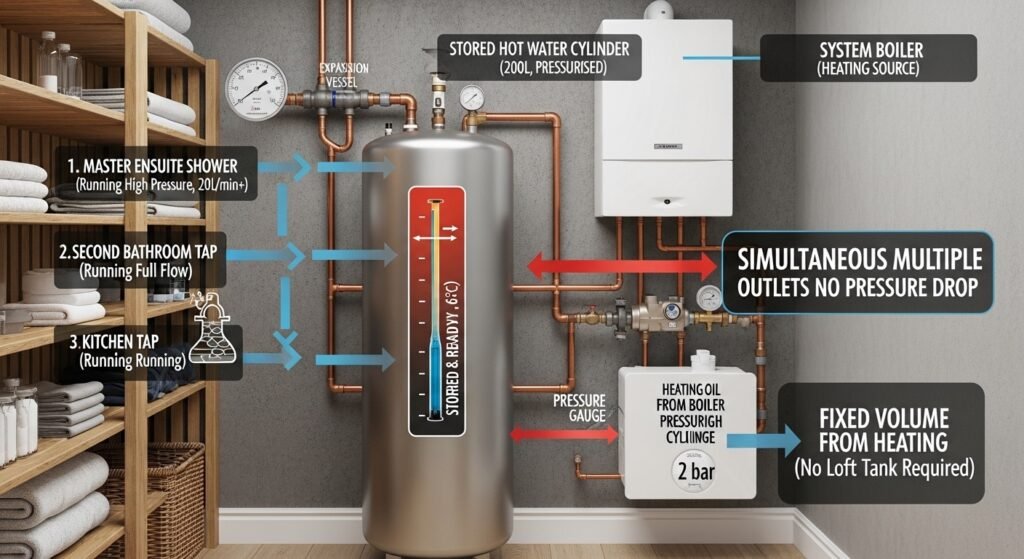
Because hot water is stored at pressure in the cylinder, multiple outlets can run simultaneously without a pressure drop. A 200-litre cylinder can supply 20 or more litres per minute to multiple outlets at once, which is far beyond what any combi boiler can match.
The trade-off is space. The cylinder occupies an airing cupboard of roughly 0.5 to 1 cubic metre. The system also takes 20 to 40 minutes to reheat the cylinder once it has been depleted, though in a correctly sized system, this should not happen under normal household use. A system boiler does not require a cold water storage tank in the loft, which distinguishes it from older conventional or regular boilers that need both a cylinder and a loft tank.
The Key Differences at a Glance
| Feature | Combi Boiler | System Boiler |
|---|---|---|
| Hot water delivery | On demand from mains | Stored in cylinder |
| Space required | Boiler unit only | Boiler unit plus cylinder |
| Simultaneous outlets | One comfortably | Multiple without pressure loss |
| Flow rate | 10 – 15 litres/minute | 20+ litres/minute |
| Reheat time | Instant (water on demand) | 20 – 40 min if cylinder depletes |
| Loft tank required | No | No |
| Compatible with solar thermal | No | Yes |
| Installation cost | Lower | Higher (cylinder adds cost) |
| Suitable for | Flats, 1–2 bedroom homes | Larger homes, 2+ bathrooms |
| Hard water impact | Higher (heat exchanger at risk) | Lower (less direct exposure) |
Costs: Installation and Running
Installation Costs in North London
Installation costs in North London run 10 to 25% above the national average due to higher labour rates, parking and logistics costs, and the complexity of working in period properties.
Combi boiler installed in North London: £2,800 to £4,500
This covers a like-for-like swap in an average property. Moving the boiler to a new position or upgrading old pipework adds £500 to £1,500.
System boiler installed in North London (including cylinder): £3,500 to £6,000
The additional cost reflects the cylinder purchase (£400 to £1,500 depending on size and specification), the extra pipework and space required for installation, and the longer installation time of 1.5 to 2 days versus one day for a combi.
Converting from a combi to a system boiler (or vice versa):
Converting from a system to a combi means removing the hot water cylinder and rerouting pipework. This adds £500 to £1,500 to the installation cost but frees up the airing cupboard space. Converting from a combi to a system requires finding space for a cylinder, which is not always straightforward in North London’s compact Victorian terraces.
Running Costs
Both combi and system boilers are available as modern A-rated condensing models operating at 90 to 94% efficiency, so the gap in running costs between the two types is small when both are correctly sized. The main differences are:
Combi boilers heat only the water you use. There are no heat losses from a stored cylinder. For a small household with moderate hot water use, this produces slightly lower gas bills than a system boiler.
System boilers have minor standing losses from the cylinder, even when well-insulated. Modern unvented cylinders lose a small amount of heat overnight, which marginally increases gas consumption. However, for larger households that regularly run multiple outlets, a system boiler is more efficient than a combi working at its limits, because a combi under heavy simultaneous demand runs continuously and at reduced efficiency.
Annual servicing costs are similar for both types, running £80 to £120 per year in North London. A system boiler cylinder should be inspected annually as part of the service, which adds marginally to the engineer’s time.
Which Boiler Is Right for Your North London Property Type?
North London’s housing stock falls into distinct categories, each with different heating requirements.
Victorian Terraces (Islington, Camden, Hackney, Haringey)
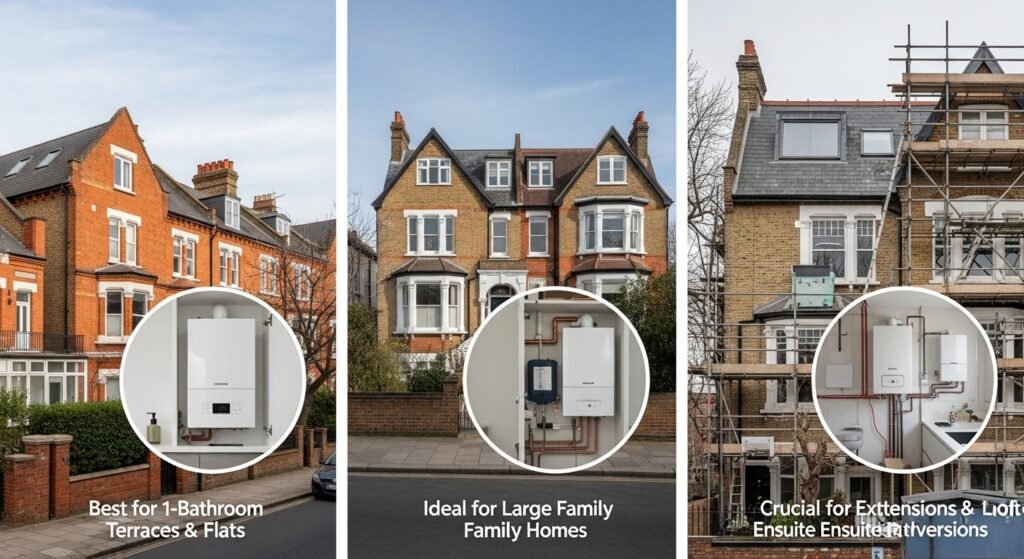
Victorian terraces form the backbone of North London’s residential streets. A standard two or three-bedroom Victorian mid-terrace in Islington or Kentish Town, with one bathroom and one kitchen, suits a combi boiler well. The compact layout benefits from combi’s space efficiency; there is no loft tank to deal with, and hot water demand from one bathroom does not exceed what a modern high-output combi can deliver.
However, many North London homeowners are extending their Victorian terraces, either with rear extensions creating new kitchen-diners or with loft conversions adding an extra bedroom and ensuite bathroom. If your terrace has or is gaining a second bathroom, particularly an ensuite on a new loft floor, the calculation changes. Two people running showers simultaneously in a morning routine is exactly the scenario where a combi boiler struggles and a system boiler excels.
A general guide for Victorian terraces:
- One bathroom, two to three bedrooms, one or two people: combi boiler
- Two bathrooms, three to four bedrooms, family of three or more: system boiler
- Loft conversion with ensuite in progress or planned: consider system boiler now rather than converting later
Converted Victorian Flats (Common Across All North London Boroughs)
Many of North London’s Victorian terraces have been divided into two or three flats. Most one and two-bedroom flats in converted Victorian houses are served by a single combi boiler serving one bathroom and a kitchen. This is the natural fit for a combi, and the compact installation suits properties where space is genuinely limited.
The exception is top-floor flats in converted terraces where a loft conversion has created a large flat with multiple bathrooms. These properties can benefit from a system boiler, but the cylinder placement requires careful planning in what is typically a limited-space conversion.
Larger Victorian and Edwardian Properties (Highgate, Muswell Hill, Hampstead, Crouch End)
The larger detached and semi-detached Edwardian and late Victorian properties in Highgate, Muswell Hill, Barnet, and Hampstead are consistently better served by system boilers. Three to five bedrooms, two or more bathrooms, and a family of four or more creates hot water demand that exceeds what any combi boiler can comfortably meet.
These properties also typically have the space for an airing cupboard housing a 200 or 250-litre unvented cylinder, and their age means the pipework often supports a system boiler without the rerouting complications that arise in smaller terraces.
Modern Apartments and New-Build Properties
North London’s new-build apartment developments in areas like King’s Cross, Old Street borders, and the regeneration zones of Haringey and Enfield are typically installed with combi boilers. Their compact layouts, single bathrooms, and mains-connected plumbing suit the combi’s design. For most flat-dwellers in these developments, replacing a combi like-for-like is the straightforward choice when the time comes.
Properties with Loft Conversions or Extensions
This is where the decision requires the most careful thought in North London. A Victorian terrace that previously had one bathroom and a combi boiler, after a rear extension and loft conversion, adding a new bedroom and ensuite, now has two bathrooms and potentially four or more residents. The combi boiler that was correctly specified for the original property may now be undersized for the expanded household.
If you are planning a loft conversion or rear extension in Islington, Camden, or Hackney, discuss the hot water implications with your heating engineer at the same time as your architect. Installing a system boiler at the point of the building work, when walls and floors are already open, is significantly cheaper than returning to do it separately six months later.
North London’s Hard Water: Why It Matters for Your Boiler Choice
Thames Water supplies hard water to all of North London. The water is classified as very hard in most of inner London, with high concentrations of calcium and magnesium that deposit as limescale inside boiler components as the water is heated.
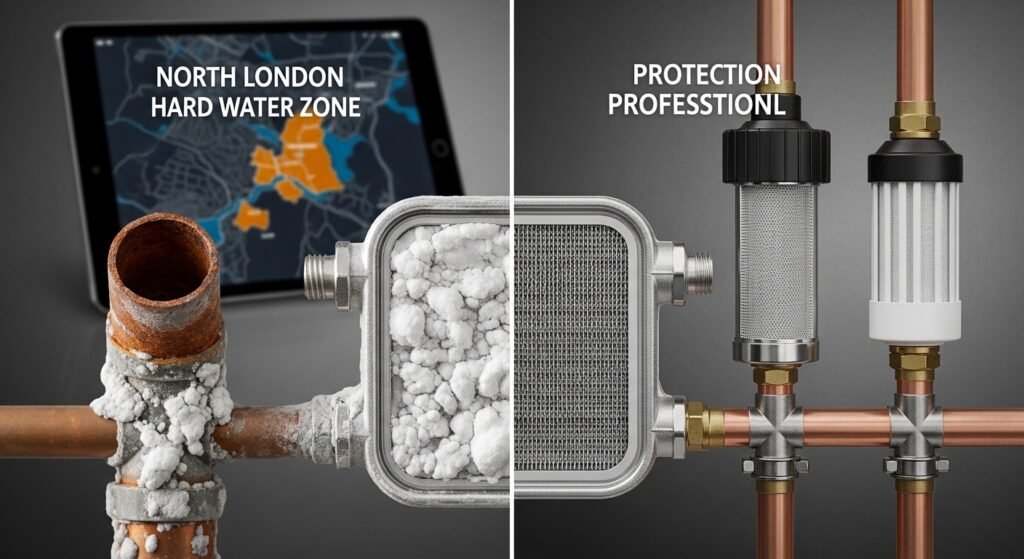
Limescale is a more significant issue for combi boilers than for system boilers, for a specific reason. In a combi boiler, mains water is heated directly through the heat exchanger every time you open a tap. The heat exchanger is in constant contact with hard mains water, and limescale builds up on its surfaces over time. This reduces heat transfer efficiency, causes the kettling sound (a rumbling like boiling water in a kettle), and eventually causes heat exchanger failure, which is one of the most expensive boiler repairs at £400 to £800.
In a system boiler, the mains water fills the cylinder once. The cylinder of water is then heated and circulated. Once the initial fill is done, the same water circulates repeatedly through the heating system without the continuous fresh-water contact that causes limescale in a combi heat exchanger.
For this reason, combi boilers in North London benefit significantly from the addition of a scale inhibitor fitted to the mains cold water feed, a device costing £150 to £300 that reduces limescale buildup. Annual servicing in a hard water area should include descaling treatment. Without these measures, combi boiler heat exchangers in North London typically show significant scale buildup within three to five years.
A magnetic filter is equally important for both boiler types. It captures the magnetite sludge from ageing pipework that circulates in North London’s older heating systems and damages pumps and heat exchangers over time.
Mains Water Pressure: A Critical Check for Combi Boilers
A combi boiler depends entirely on mains water pressure to deliver hot water at an acceptable flow rate. If mains pressure in your area is low, a combi boiler will deliver disappointing results regardless of its output rating.
North London’s water pressure varies considerably by location and property type. High-rise flats and properties at the top of hills, such as parts of Highgate and Muswell Hill, sometimes experience lower mains pressure than street-level properties in Islington or Camden. Older Victorian properties with narrow original pipework can further restrict flow even when the mains pressure is acceptable.
Before committing to a combi boiler installation, ask a Gas Safe engineer to measure your actual mains water pressure rather than assuming it is adequate. Most manufacturers recommend a minimum dynamic water pressure of 1.5 bar for a combi boiler to perform well. Below this, performance suffers noticeably.
If mains pressure is insufficient for a combi boiler but you want to avoid the space commitment of a full system boiler with a cylinder, a high-pressure combi or a combi with an integral expansion vessel and booster pump is an option worth discussing with your engineer.
A system boiler with an unvented cylinder operates at mains pressure once the cylinder is filled, so it is not dependent on mains pressure in the same moment-to-moment way as a combi. This makes system boilers a more reliable choice in properties or areas with variable mains pressure.
Solar Thermal and Future Heating Technologies
If you are considering solar thermal panels as part of an energy efficiency upgrade, or if you want to future-proof your heating for heat pump integration, the boiler type matters.
System boilers are compatible with solar thermal panels. A solar thermal collector on the roof heats water in a separate coil within the hot water cylinder, pre-heating the water before the boiler tops it up. In North London’s climate, solar thermal can contribute 40 to 60% of a household’s hot water energy through the summer months, meaningfully reducing annual gas bills.
Combi boilers are not compatible with solar thermal. Because there is no cylinder to accept solar-heated water, the solar benefit cannot be integrated with a combi system.
Heat pumps and hybrid systems are increasingly relevant in North London as the government’s 2035 phase-out of gas boilers in new-build properties approaches. Air source heat pumps work most efficiently with a hot water cylinder, making them more compatible with system boiler setups. A system boiler installation today that includes a quality unvented cylinder is more easily adapted to a heat pump in the future than a combi setup.
Boiler Sizing: Getting the Output Right
Choosing a combi vs a system boiler is only part of the decision. Getting the output rating (measured in kilowatts, kW) correct for your property is equally important.
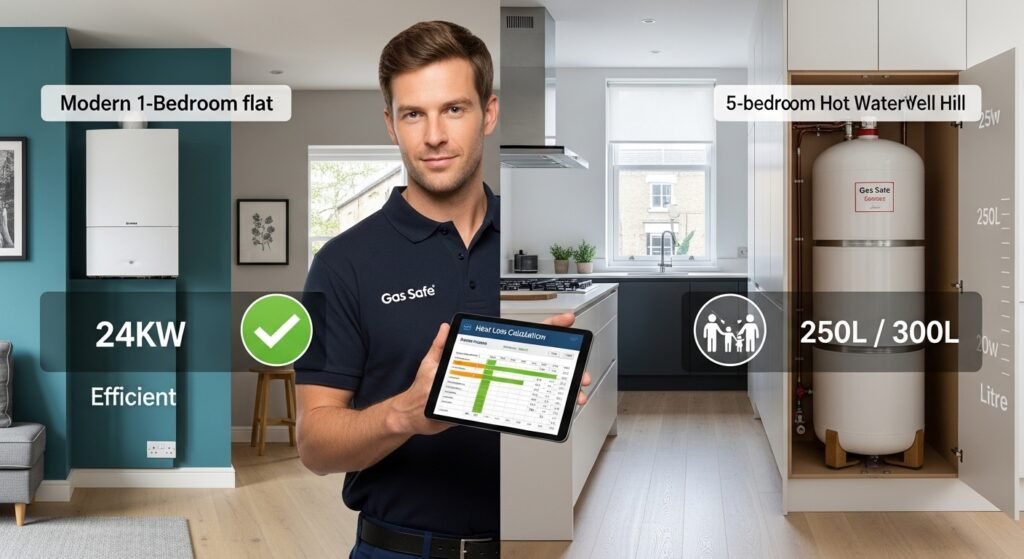
An undersized combi boiler for a larger home will run continuously, wear out faster, and deliver disappointing hot water temperatures. An oversized combi boiler for a small flat will short-cycle, wasting energy and wearing components unnecessarily.
Combi boiler sizing guide for North London properties:
- 1-bed flat, one person: 24 to 28kW
- 2-bed property, one bathroom, two to three people: 28 to 34kW
- 3-bed house, one bathroom, family of three: 34 to 38kW
- 3-bed house, one bathroom, but high hot water demand: 38 to 42kW
System boiler sizing guide for North London:
The boiler output for a system boiler is determined by the number of radiators and the heating load of the property, not primarily by hot water demand (which is handled by the cylinder size). A qualified heating engineer should conduct a heat loss calculation for your specific property before specifying the boiler output.
For the cylinder, sizing depends on household size:
- Two to three people: 150 to 180-litre cylinder
- Four people: 200-litre cylinder
- Five or more people: 250 to 300-litre cylinder
An undersized cylinder for a large North London family home is one of the most common complaints after a system boiler installation: someone always runs out of hot water. Get the cylinder sized correctly at the outset, even if it means a slightly larger airing cupboard is needed.
When to Switch from One Type to the Other
Some North London homeowners are considering switching from their existing boiler type rather than replacing it like-for-like. Here are the situations where switching makes sense.
Switch from system to combi if:
- The household has shrunk (children have left, you now live alone or as a couple)
- The property has been downsized and now has only one bathroom
- The airing cupboard space is needed for other use, such as a utility area
- The hot water cylinder is at the end of its life and replacement would cost more than converting
Switch from combi to system if:
- A loft conversion or extension has added a second bathroom
- The household has grown and morning showering is creating pressure problems
- You want to add solar thermal panels
- Your mains water pressure is too low for the combi to perform satisfactorily
- You regularly run out of hot water because the combi cannot keep up with demand
Finding the Right Installer in North London
The combi vs system decision should be confirmed by a Gas Safe registered engineer who has assessed your specific property, measured your mains water pressure, reviewed the existing pipework condition, and understood your household’s hot water pattern.
Be wary of any engineer who recommends a boiler type without asking about your household size, number of bathrooms, and what your property’s loft and extension plans are. The correct answer depends entirely on these factors and cannot be given from a phone call without a site visit.
For North London properties, prioritise engineers with experience in Victorian and Edwardian housing stock. Familiarity with hard water challenges, old pipework, and the access complexities of converted terraces means faster diagnosis and fewer surprises.
Always get at least three quotes from Gas Safe-registered engineers before making a decision. Prices for identical installations vary by £800 to £1,500 in North London, and the cheapest quote is not always the one that includes the right cylinder size, a magnetic filter, and proper scale protection for the mains supply.
FAQ
Q: Which is cheaper to install, a combi or system boiler in North London?
A combi boiler is typically £800 to £1,500 cheaper to install than a system boiler in North London, because it does not require a hot water cylinder (which adds £400 to £1,500 to the system cost) and the installation takes one day rather than one and a half to two days. For a like-for-like combi swap in a standard North London property, expect to pay £2,800 to £4,500. A system boiler with a new unvented cylinder in North London typically costs £3,500 to £6,000 installed.
Q: Can a combi boiler handle two bathrooms in a North London Victorian terrace?
A high-output combi boiler (38 to 42kW) can manage two bathrooms in a Victorian terrace if the bathrooms are used at different times. If both bathrooms are used simultaneously during a morning rush, with two people showering at the same time, even the highest-output combi will show a pressure and temperature drop at one outlet. For households where simultaneous bathroom use is a regular pattern, a system boiler with a properly sized cylinder delivers significantly better results.
Q: Does hard water in North London affect which boiler I should choose?
Yes. North London receives very hard water from Thames Water, which causes limescale buildup more rapidly than in softer-water areas. Limescale affects combi boilers more directly than system boilers because combi heat exchangers are in constant contact with fresh mains water. If you choose a combi boiler in North London, a scale inhibitor on the mains cold feed is strongly recommended. Annual servicing should include descaling treatment. A system boiler is less vulnerable to hard water damage because the same water is recirculated through the heating system rather than being continuously replaced with fresh mains water.
Q: What happens to my boiler when I do a loft conversion in North London?
A loft conversion that adds a new ensuite bathroom increases your property’s hot water demand. If your existing combi boiler is already at the upper end of its capacity, the additional bathroom may cause pressure problems. Before completing a loft conversion, discuss the heating implications with your engineer. In many cases, the sensible approach is to upgrade to a system boiler at the same time as the loft conversion, when pipework changes are already happening, and the combined disruption cost is lower. Converting from a combi to a system separately, after the loft conversion is complete, costs more because walls and floors need to be reopened.
Q: Are system boilers compatible with future low-carbon heating?
Yes. System boilers with unvented hot water cylinders are more compatible with future heating technologies than combi boilers. Solar thermal panels can connect to the cylinder to pre-heat water, reducing gas consumption. Air source heat pumps, which the government is promoting through the Boiler Upgrade Scheme with a £7,500 grant, operate most efficiently when heating water stored in a cylinder. A system boiler installation today creates a heating infrastructure that can be adapted to a heat pump in the future more easily than a combi system.
Conclusion
For North London homeowners, the combi vs system boiler decision maps directly onto the property type and household profile.
Combi boilers work well for flats, one and two-bedroom properties, smaller terraces with one bathroom, and couples or single occupants with moderate hot water demand. They are cheaper to install, space-efficient, and well-matched to the single-bathroom Victorian conversion that makes up a large proportion of North London’s housing stock.
System boilers are the better choice for larger Victorian and Edwardian family homes with two or more bathrooms, properties being extended with new bathroom facilities through loft conversions or rear extensions, and any household where two or more people regularly need hot water simultaneously. They also offer future compatibility with solar thermal panels and heat pump technology.
North London’s hard water supply means that whichever boiler type you choose, a scale inhibitor, a magnetic filter, and annual servicing are not optional extras. They are the maintenance practices that determine how long your boiler lasts and how much it costs to run.
Get a site survey from a Gas Safe registered engineer before making a final decision. The correct choice for your specific property in Islington, Camden, Hackney, Haringey, or Barnet depends on factors that a generic guide cannot account for but that an experienced local engineer can assess in a single visit.

Tilly Bani is a renovation and roofing specialist with over 15 years of experience in construction and property refurbishment across North London. He specialises in roofing, structural repairs, and full home renovations, helping homeowners improve property value and safety.