
| Quick Answer For most North London properties, the choice depends on the type of project. A modern flat roof installation is popular for extensions. Flat roofs suit single-storey rear and side extensions, where they cost less, allow roof lanterns for light, and keep the height below planning limits. Pitched roofs suit main dwelling roofs, loft conversions, and properties in conservation areas where local planning authorities typically require materials and forms that match the surrounding Victorian and Edwardian streetscape. Traditional homes often benefit from pitched roof installation for long-term value. The choice is rarely a pure preference: in North London, planning policy, conservation area restrictions, and the heritage character of the housing stock constrain it significantly. |
Introduction
Few decisions generate more confusion during a North London building project than the choice between a flat and pitched roof. Many owners speak with local roofing contractors before choosing a design. The two roof types serve different purposes, perform differently in North London’s specific conditions, cost different amounts over their lifetimes, and face different planning requirements in a borough like Camden, Islington, Hackney, or Haringey.
This guide gives you an honest comparison, grounded in the specific constraints of North London’s Victorian housing stock, its dense network of conservation areas, and the practical realities of building in a high-cost, high-regulation part of London. By the end, you will know which type is likely right for your specific project and what the key planning and cost factors are before you start.
How Each Roof Type Works
Flat Roofs
A flat roof is not completely level. All functional flat roofs in the UK are built with a slight fall, typically between 1:40 and 1:80, to direct rainwater toward drains or gutters. Without this gradient, water pools on the surface and eventually penetrates the membrane.
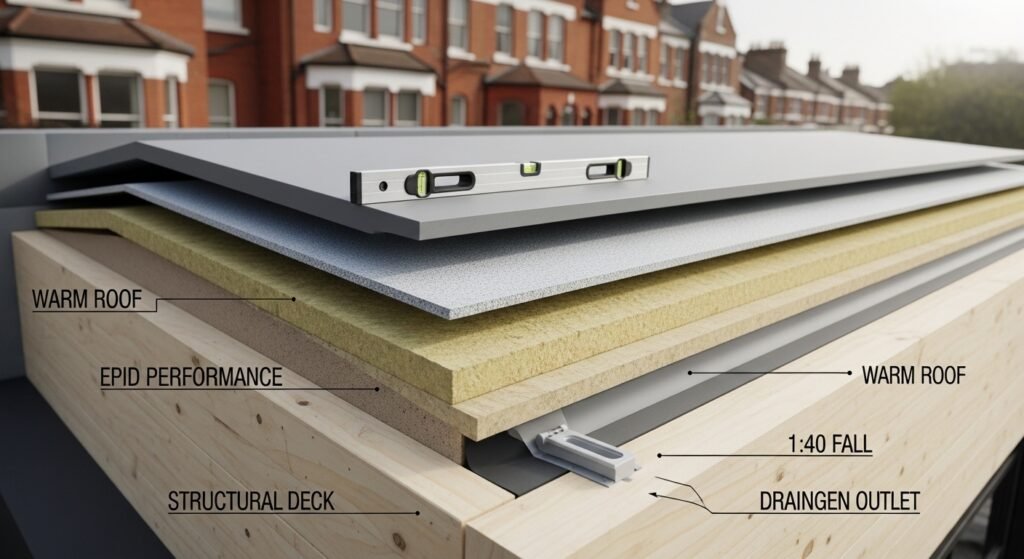
Modern flat roofs are built in one of two configurations:
- Warm roof construction: the insulation sits above the structural deck, below the waterproof membrane. This is the current best practice, compliant with Part L of the Building Regulations, and eliminates the condensation risk associated with older cold roof designs. Many projects choose durable EPDM roofing for low maintenance.
- Cold roof construction: insulation sits between the joists, with a ventilated air gap above. This is still used in some refurbishment contexts but carries a higher condensation risk and is more technically difficult to execute correctly.
The waterproof membrane on a modern flat roof is typically EPDM rubber, GRP fibreglass roofing, or a single-ply polymer membrane. These are a significant improvement over the bitumen felt roofs of the 1970s and 1980s, which gave flat roofs their historic reputation for leaking. Some garages still use updated felt roofing systems today.
Pitched Roofs
A pitched roof has two or more sloping surfaces meeting at a ridge, allowing rainwater to drain naturally by gravity. The pitch angle, typically between 30 and 60 degrees on UK residential properties, varies by design and historical period.
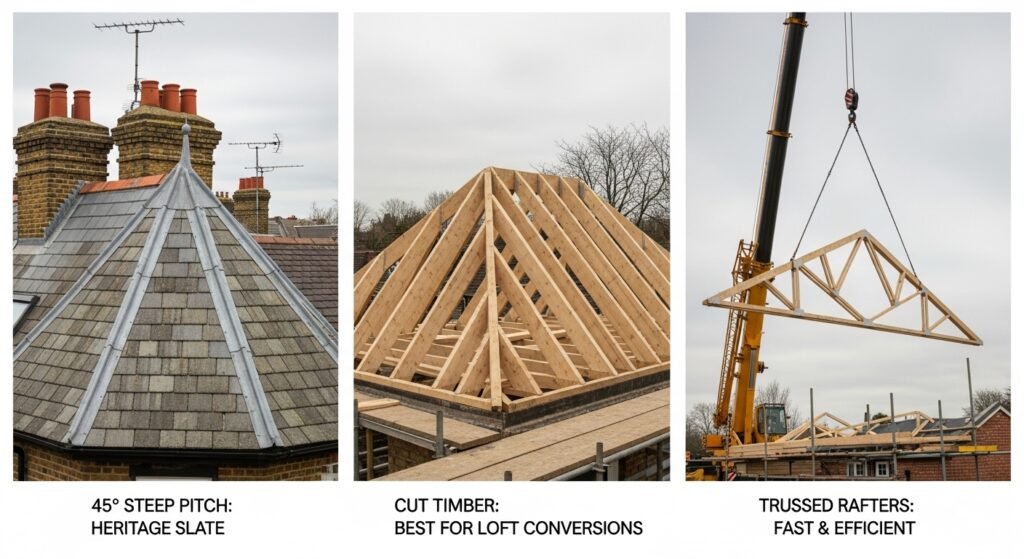
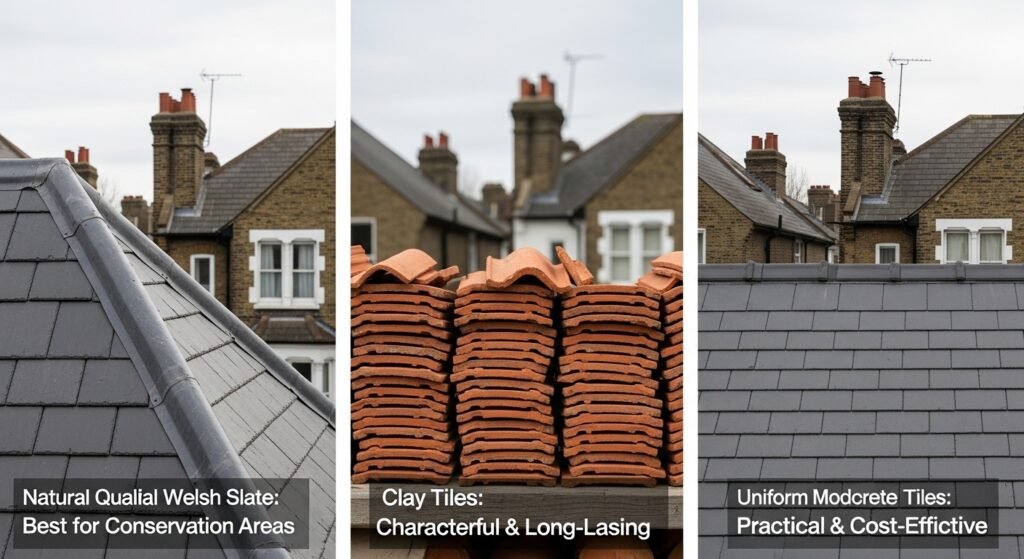
Victorian and Edwardian terraces throughout Islington, Haringey, and Camden have steep-pitched roofs clad in natural Welsh slate or clay tiles. Heritage homes frequently require premium slate roofing materials. These materials and forms are deeply embedded in the character of North London’s streets and are the primary reference point for planning policy in the borough’s many conservation areas.
Pitched roofs on new extensions and buildings use one of several structural approaches: cut timber roofs (traditional and adaptable), trussed rafter roofs (factory-made, fast, less adaptable for loft use), or steel structural frames for contemporary designs.
Cost Comparison: Flat vs Pitched in North London
Cost is the first question most homeowners ask. The genuine answer is more nuanced than the simple “flat is cheaper” summary most guides offer.
Installation Costs
Flat roofs cost less to install per square metre than pitched roofs because they require simpler structural framing, fewer layers of material, and less labour time. Many households compare flat roof replacement costs before upgrading.
Typical installed costs in North London in 2026:
| Roof Type | Material | Cost per m² (installed) |
|---|---|---|
| Flat | EPDM rubber | £70 – £110 |
| Flat | GRP fibreglass | £90 – £130 |
| Flat | Torch-on felt | £60 – £90 |
| Pitched | Clay or concrete tiles | £120 – £200 |
| Pitched | Natural Welsh slate | £180 – £275 |
| Pitched | Reclaimed slate (conservation areas) | £220 – £350+ |
Note that North London adds a 15 to 25% premium over these national benchmarks due to higher labour rates, parking and logistics costs, and the access complexity typical of Victorian terraces and converted flats.
For a typical 20m² single-storey rear extension, a flat EPDM roof in North London costs roughly £1,400 to £2,200, compared to £2,400 to £4,000 for a pitched roof with matching clay tiles.
Lifetime Costs
The installation cost comparison tells only part of the story. Routine flat roof repairs help extend service life. Flat roofs require more maintenance and have shorter lifespans than pitched roofs, which affects the total cost over the life of the building.
Flat roof lifespan by material:
- Bitumen felt: 10 to 20 years
- EPDM rubber: 25 to 40 years, up to 50 with careful maintenance
- GRP fibreglass: 30 to 50 years
- Single-ply membranes (TPO, PVC): 25 to 35 years
Pitched roof lifespan:
- Clay or concrete tiles: 50 to 100 years
- Natural slate: 80 to 150 years or more
A modern GRP flat roof and a natural slate pitched roof are both long-lasting options. But the operational difference matters: a pitched slate roof typically needs minimal intervention beyond periodic gutter clearance and occasional slate replacement. Regular gutter maintenance supports roof drainage. A flat roof needs annual inspection, prompt clearance of drainage outlets, and periodic professional assessment to catch any membrane degradation before it causes a leak.
In North London, where properties are densely packed, and internal damage from water ingress can be severe and expensive, the higher maintenance vigilance that flat roofs require is a real operational commitment.
Flat Roof Materials: What to Specify in 2026
The reputation flat roofs had for leaking in the 1970s and 1980s was deserved. The bituminous felt of that era was degraded by UV exposure, temperature cycling, and poor workmanship. Modern flat roofing materials are categorically different.
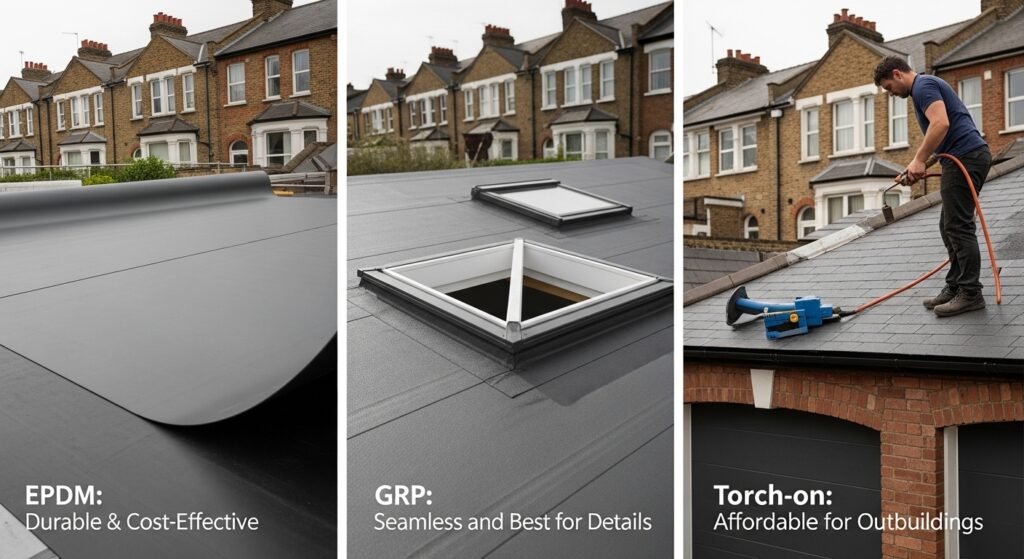
EPDM Rubber
EPDM (ethylene propylene diene monomer) is a single-ply rubber membrane supplied in large sheets, reducing the number of seams and therefore the number of potential leak points. It has good thermal movement tolerance, handling London’s freeze-thaw cycles without cracking. Expected lifespan is 25 to 40 years with annual inspection.
EPDM is the most cost-effective modern flat roofing system for larger surfaces and is appropriate for residential extensions in North London. Its appearance is plain black or grey, which may not suit all designs.
GRP Fibreglass
GRP (glass-reinforced plastic) is applied as a liquid resin over fibreglass matting and cures into a seamless, rigid surface. It can be moulded around complex shapes and edge details, making it particularly suitable for balcony decks, roof lights, and irregular roof perimeters common in North London’s converted properties.
GRP costs more per square metre than EPDM but produces a higher-quality finish and is available in a range of colours. Expected lifespan is 30 to 50 years. It requires skilled application under the correct weather conditions: GRP cannot be laid in wet or cold conditions, which can affect scheduling in North London’s autumn and winter.
Torch-on Felt
Modern torch-on felt, applied in two or three layers with a gas torch, is significantly better than the bituminous felt it replaced. Expected lifespan is 15 to 25 years. It remains the most affordable option and is widely used on garages, outbuildings, and budget-constrained projects. For a primary extension on a North London property, EPDM or GRP is the better long-term choice.
Pitched Roof Materials for North London
In North London’s Victorian housing stock, roof material is not purely a matter of preference. Conservation areas typically require materials that match or closely complement the existing streetscape, and planning applications for extensions or new dormer windows are assessed against this criterion.
Natural Welsh Slate
The original roofing material on most Victorian and Edwardian terraces across Islington, Camden, and Haringey is natural Welsh slate. It has unmatched longevity (80 to 150 years with good maintenance) and is the material most likely to gain conservation area approval. Reclaimed Welsh slate, salvaged from demolition, is the closest match to existing roofs and is often required in conservation area applications.
Welsh slate costs £180 to £275 per square metre installed for new stock, and £220 to £350+ for reclaimed material. The premium is significant, but it is often unavoidable on properties in Islington’s 40-plus conservation areas.
Clay and Concrete Tiles
Where natural slate is not required, clay or concrete plain tiles are a common pitched roof covering. They are appropriate for extensions outside conservation areas and for properties where the existing roof is already tiled rather than slated. Clay tiles are preferred over concrete for their appearance and longevity (50 to 80 years versus 30 to 60 years for concrete).
Costs run from £120 to £200 per square metre installed, significantly below natural slate.
Planning and Conservation Area Considerations
This is where the North London context most significantly shapes the choice between flat and pitched roofs. Understanding the planning framework before settling on a design saves significant time and money.
Conservation Areas Across North London
Islington has over 40 conservation areas, encompassing much of the borough including Barnsbury, Canonbury, Highbury, and the Angel. Camden covers major areas including Hampstead, Primrose Hill, Kentish Town, and Highgate. Hackney’s conservation areas include Stoke Newington and De Beauvoir. Haringey includes Crouch End, Muswell Hill, and Highgate.
In all conservation areas, permitted development rights are significantly curtailed or removed under Article 4 directions. Changes to the external appearance of a property, including the roof type, materials, and form of any extension, typically require a full planning application rather than operating under permitted development. Many owners combine approvals with wider home refurbishment plans. The local planning authority assesses these applications against design guides that generally require new development to be sympathetic to the existing architectural character.
In practice, this means that in most North London conservation areas:
- Loft conversions on the front slope of a Victorian terrace roof require planning permission and must not be visible from the street (rear dormers are assessed differently)
- Rear extensions may be permitted with a flat roof where they are single-storey and not visible from the street
- Materials for pitched roofs on main dwellings and extensions should match the existing roof or be sympathetic to it
- Flat roofs on rear extensions are generally more acceptable than attempts to pitch-roof them in a way that does not match the existing building’s scale and form
Permitted Development and Flat Roofs on Extensions
Outside conservation areas, single-storey rear extensions under Permitted Development rights can use flat roofs where the height, depth, and other parameters fall within the PD limits. For terraced and semi-detached houses, this means a maximum rear extension depth of 3 metres under standard PD (extendable to 6 metres under Prior Approval), maximum height of 4 metres at the eaves.
Flat-roofed extensions are routinely approved under PD in non-conservation area locations across Barnet, Enfield, and the outer parts of Haringey. Adding daylight is easier with skylight installation on flat roofs. They are less controversial than pitched roof extensions because they do not compete visually with the existing roof.
However, PD rights do not apply to flats and maisonettes, which form a large proportion of North London’s housing. All external alterations to flats, including roof extensions, require full planning permission regardless of conservation area status.
When Pitched Roofs Are Required by Planning
Planning authorities in North London may require or strongly prefer a pitched roof in the following circumstances:
- Two-storey rear or side extensions, where a flat roof can look incongruous against the pitched main roof
- Side extensions that are visible from the street and would break the pitched roofline character
- Any extension in a conservation area where the design guide references roof form as a key character element
- Dormer windows on loft conversions, where pitch and materials are typically required to match the main roof
The assumption that a flat roof is always easier to get permission for is incorrect. Some North London planning authorities view flat-roofed rear extensions in conservation areas more favourably than poorly-proportioned pitched alternatives, while others have specific policies requiring pitched roofs on all extensions. Checking the specific design guidance for your borough and conservation area before finalising the design is essential.
Which Roof Type Adds More Value?
Property value impact is a legitimate consideration in North London’s high-value market. The relationship between roof type and value depends heavily on the use case.
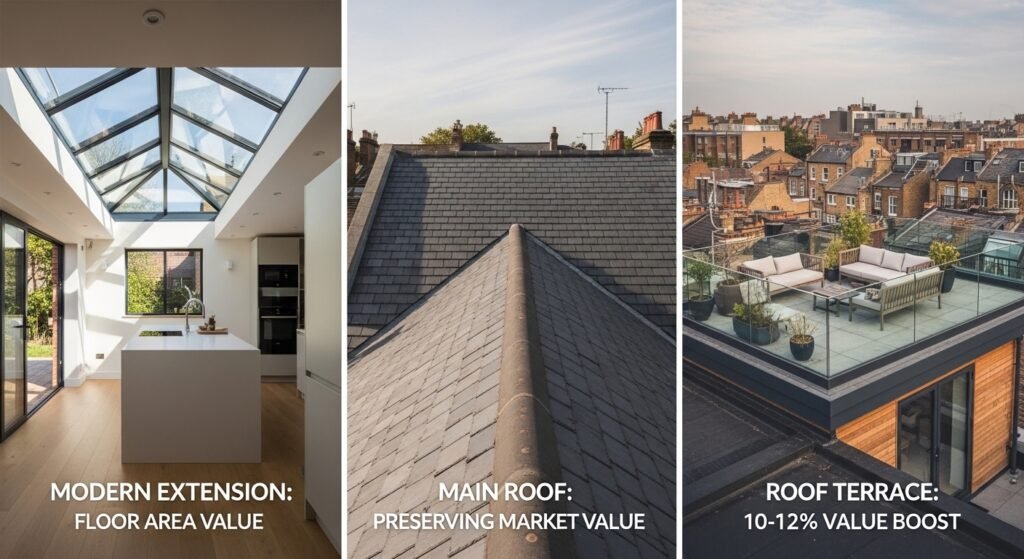
Flat Roof on a Rear Extension
A well-designed rear extension with a flat roof, roof lantern for natural light, and high-quality EPDM or GRP membrane adds meaningful value through additional floor area. Quality finishes often include expert interior finishing after the build. The roof type itself is neutral to buyers: what matters is the quality of the space, the quality of the waterproofing, and evidence of proper maintenance.
A flat roof with a 10-year-old membrane of unknown quality is a red flag in surveys. A flat roof with documented GRP installation from a reputable contractor, a manufacturer’s warranty still in date, and evidence of annual inspection is an asset rather than a liability.
Pitched Roof on the Main Dwelling
A pitched slate or tile roof in good condition adds no premium over expectation on a Victorian terrace because it is expected. A pitched roof in poor condition, with missing slates, failed flashings, or significant moss growth, is a negotiating point for buyers and reduces offers.
Flat Roof for a Roof Terrace
A well-designed flat-roofed extension that can be used as a roof terrace adds 10 to 12% to property values in North London, according to specialist sources. However, roof terraces require full planning permission in all North London boroughs, and approval is not guaranteed even where similar examples exist nearby. The process requires careful design to address overlooking and privacy concerns, high-quality structural support to carry people and furniture, proper balustrade installation (minimum 1.1 metres high), and fire safety compliance. Some terrace projects also need secure door installation and access.
The Right Roof for Common North London Scenarios
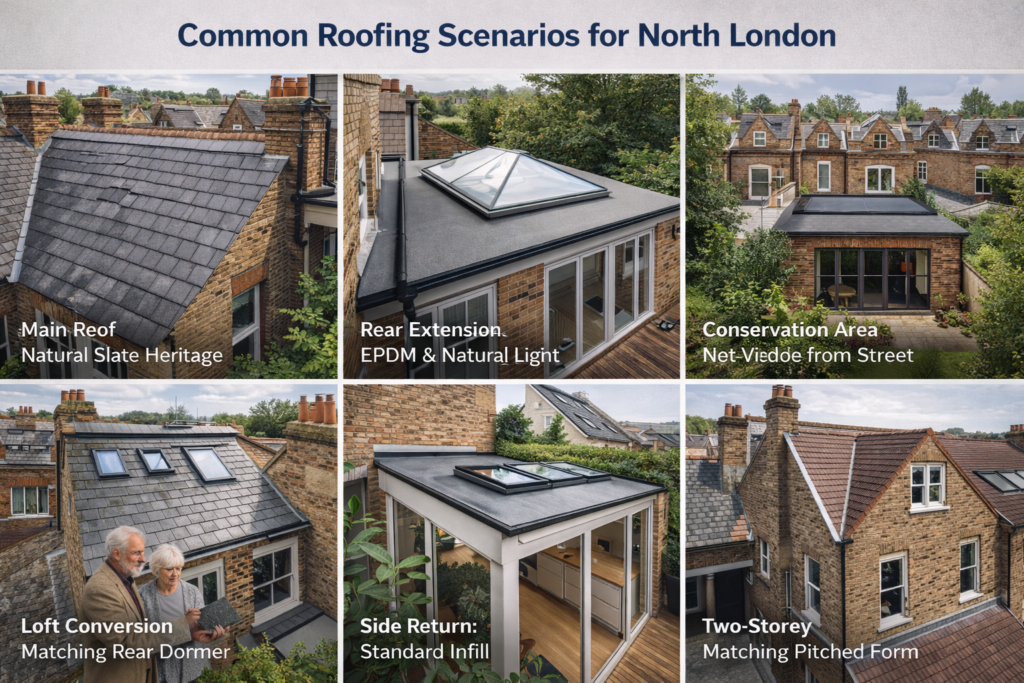
Victorian Terrace: Replacing the Main Roof
Natural Welsh slate, matching the existing character. Where damage exists, owners may need full roof replacement. A flat roof is not appropriate for the main dwelling roof on a Victorian terrace and would not receive planning permission in conservation areas. Reclaimed slate is preferred in conservation areas.
Single-Storey Rear Extension (Non-Conservation Area)
A flat roof is the better choice in most cases. Lower cost, no height restriction issues, ability to incorporate roof lanterns for natural light, and generally easier through planning. EPDM or GRP is recommended over felt for lifetime performance.
Single-Storey Rear Extension (Conservation Area)
Depends on the specific conservation area guidance. Many North London councils are comfortable with flat roofs on modest single-storey rear extensions in conservation areas, provided they are not visible from the street, and materials are appropriate. Check with the planning authority before designing.
Loft Conversion
The conversion structure should match the existing roof form. Rear dormers on Victorian terraces are common and may use felt or EPDM on the dormer roof itself, but the dormer cladding, cheeks, and any roof window arrangement should be consistent with what the conservation area guidance permits. Front dormers facing the street typically require planning permission and are often refused in conservation areas.
Side Return Extension
Most North London Victorian terraces have a rear side return, a narrow single-storey extension running alongside the rear of the property. Flat roofs with roof lanterns are the standard approach for infilling side returns, allowing natural light into what would otherwise be a dark internal space. This layout pairs well with modern kitchen installation projects.
Two-Storey Rear Extension
Planning permission required. Structural builds often involve certified electrical work as part of the project. The roof form at the top of a two-storey extension should relate to the existing building. Pitched roofs are more common and generally more acceptable planning-wise for two-storey extensions in most North London boroughs.
FAQ
Q: Is a flat roof or a pitched roof cheaper in North London?
Flat roofs cost less to install, typically £70 to £130 per square metre for EPDM or GRP versus £120 to £275 per square metre for clay or natural slate pitched roofing. For a typical 20m² rear extension in North London, a flat roof saves roughly £1,000 to £2,500 on the installation. However, flat roofs require more active maintenance and have shorter lifespans than quality pitched roofs, which erodes some of that initial saving over 30 to 50 years.
Q: Can I put a flat roof on an extension in a North London conservation area?
Often yes, for single-storey rear extensions that are not visible from the street. North London planning authorities generally tolerate flat roofs on modest rear extensions in conservation areas, provided the design is well-considered and the materials are appropriate. However, conservation area policies vary by borough and by specific area, and some explicitly prefer pitched roofs on extensions to match the existing character. Always check your local conservation area design guidance before finalising the design.
Q: How long does a flat roof last in North London?
Modern EPDM rubber roofs last 25 to 40 years. GRP fibreglass roofs last 30 to 50 years. Torch-on felt roofs last 15 to 25 years. The critical factor is the quality of installation and the quality of annual maintenance. A flat roof in North London that receives annual inspection and prompt drainage maintenance regularly achieves its rated lifespan. One that is ignored deteriorates faster, particularly in properties with overhanging trees from adjacent gardens.
Q: Does a flat roof on an extension reduce property value in North London?
Not inherently. A flat roof with documented quality installation, a valid warranty, and a history of maintenance does not reduce value. An old, poorly maintained flat roof with no documentation does reduce value, as it creates a survey concern and a buyer negotiating point. In North London’s high-value market, buyers expect documentation of any flat roof work and will ask their surveyor to assess the membrane condition.
Q: What roof should I use for a loft conversion in Islington?
Match the existing roof materials and form. For a Victorian terrace in Islington, this means natural Welsh slate or reclaimed slate on the dormer cladding, consistent pitch angles, and appropriate flashings. Rear dormers are generally more acceptable than front dormers in Islington’s conservation areas. Many properties in Islington sit within the borough’s 40-plus conservation areas, which means a full planning application is typically required rather than permitted development. Seek pre-application advice from Islington Council before finalising any loft conversion design.
Conclusion
The flat roof versus pitched roof question in North London is not primarily about preference. It is about matching the right roof type to the right project, navigating planning requirements in a borough with some of the most extensive conservation area coverage in London, and understanding the total lifecycle cost rather than just the installation price.
Flat roofs, specified correctly with modern EPDM or GRP membranes and maintained annually, are a sensible choice for single-storey rear extensions, side return infills, and projects where height limitations or planning considerations make them the more workable option. Pitched roofs, using materials that match the existing Victorian and Edwardian character, are the correct choice for main dwelling roofs, two-storey extensions, and anything visible from the street in a conservation area.
The most expensive mistake in North London roofing is specifying the wrong type for the planning context, designing something that gets refused, and then starting the process again. Getting planning advice early, from an architect or planning consultant who knows your specific borough’s policies, is an investment that pays back in time and cost.

Tilly Bani is a renovation and roofing specialist with over 15 years of experience in construction and property refurbishment across North London. He specialises in roofing, structural repairs, and full home renovations, helping homeowners improve property value and safety.