
| Quick Answer Both GRP fibreglass and EPDM rubber can last 25 to 50 years when installed correctly. GRP fibreglass is harder, more rigid, and more resistant to foot traffic and damage from sharp objects. EPDM rubber is more flexible, handles thermal movement better, and is generally cheaper to install. The material that lasts longer in practice is almost always the one that was installed better and maintained more consistently, not simply the one with the higher on-paper lifespan claim. |
Introduction
If you are replacing a flat roof on an extension, garage, or outbuilding, the choice between GRP fibreglass and EPDM rubber is where most homeowners get stuck. Many owners compare flat roof replacement options before deciding. Both materials have replaced old felt roofing as the UK’s dominant flat roofing systems. Both are marketed with impressive lifespan figures. And both are genuinely good when installed correctly. Modern homes now prefer specialist roofing services for longer lifespan systems.
The problem is that most comparisons focus on lifespan claims without explaining what drives the difference, what causes each material to fail early, how they behave differently under real UK weather conditions, and which one is the right fit for different types of projects.
This guide gives you a direct, technical comparison across lifespan, installation, failure modes, cost, maintenance, and repairability, so you can make the right choice for your specific project.
What GRP and EPDM Actually Are
GRP Fibreglass
GRP stands for glass-reinforced plastic. It is a composite material made by saturating layers of chopped strand glass fibre matting with polyester resin. When the resin cures, the combined material hardens into a rigid, seamless laminate that bonds permanently to the roof deck.
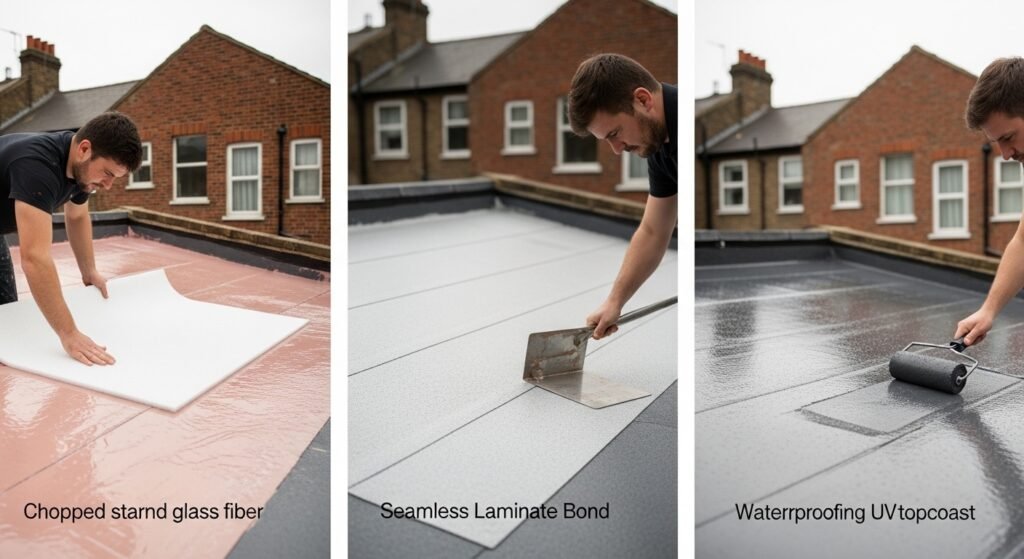
A GRP fibreglass roof installation involves three main stages. First, a base coat of catalysed polyester resin is applied to the prepared deck. Next, fibreglass matting is laid onto the wet resin and consolidated with a paddle roller to eliminate air bubbles. A second layer of resin is applied over the matting. Once the laminate has fully cured, a coloured topcoat (also called a flowcoat) is applied to the surface. This topcoat provides UV protection, gives the roof its final appearance, and acts as the outermost waterproofing layer. An annual roof cleaning service helps preserve the finish.
GRP has been used in marine applications, vehicle bodywork, water tanks, and industrial pipework for decades. Its use in domestic flat roofing grew significantly in the UK from the 1990s onwards, largely because it solved the seam and joint problem that caused older felt roofs to fail.
EPDM Rubber
EPDM stands for ethylene propylene diene monomer. Many garages benefit from affordable EPDM roofing systems. It is a synthetic rubber membrane manufactured from ethylene and propylene, with a diene comonomer that enables cross-linking during vulcanisation. The result is a flexible, sheet-form material with high resistance to UV radiation, temperature extremes, and weathering.
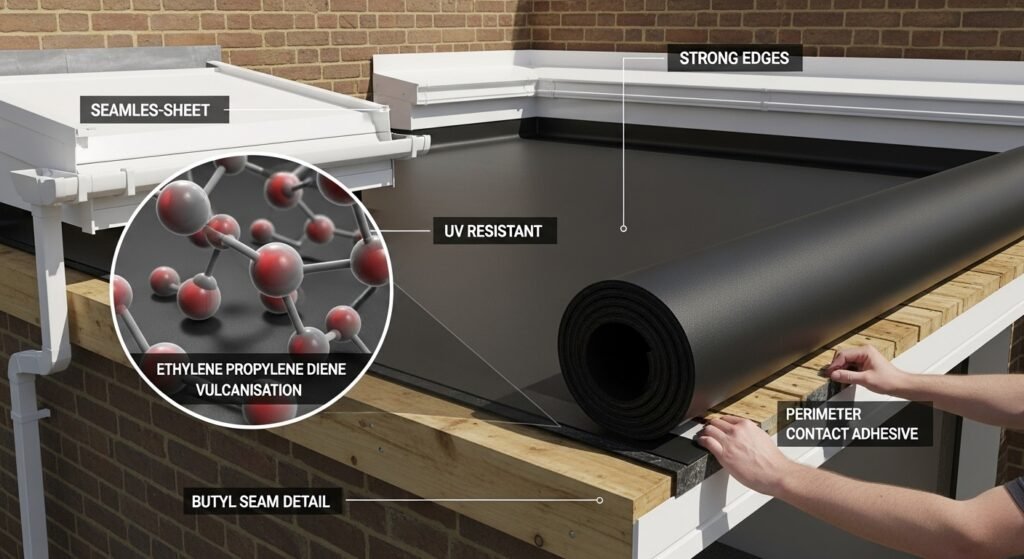
EPDM was first used as a roofing membrane in the early 1960s, predominantly in North America. It has been installed in the UK for decades. Modern EPDM is available in large single-sheet format, often covering an entire small roof without a single seam, and in multi-sheet configurations for larger areas.
Installation involves bonding the sheet to a prepared roof deck using contact adhesive around the perimeter and bonding adhesive across the field. Seams where sheets must join are made with butyl seam tape or a bonding agent and are the most technically demanding part of the installation. Perimeter trims are fixed around the edges to secure and weatherproof the membrane’s termination. Strong edges often include new fascias and soffits.
Lifespan: What the Data Actually Shows
The headline figures quoted for each material vary by source, but the evidence-based ranges are broadly consistent.
GRP fibreglass: 25 to 50 years. British Board of Agrément (BBA) tested systems have documented resistance to degradation beyond 30 years. Manufacturer warranties for approved GRP systems commonly run 20 to 25 years on the laminate itself.
EPDM rubber: 25 to 50 years. The field membrane material itself, when fully cured and properly installed, can remain functional beyond 50 years based on installations from the 1960s and 1970s still in service. Most manufacturers issue 20 to 25-year warranties on the membrane material.
These figures are not different enough to declare a clear winner. What the data shows more clearly is where each material fails when it does fail. Correct fitting by expert North London roofers matters most.
Where GRP Fails
GRP’s two primary failure mechanisms are cracking and pinhole formation, both of which stem from installation defects rather than material fatigue. Early defects may need prompt roof repair service.
Thermal cracking occurs when the topcoat is applied too thickly or when the laminate is not given enough time to fully cure before the topcoat is applied. As the roof heats and cools through seasonal cycles, expansion and contraction stresses appear in a topcoat that lacks the flexibility to accommodate them. Surface crazing and full-depth cracking follow.
Pinholes form when the topcoat layer is applied too thin, leaving small gaps in the waterproofing surface. These are often invisible until water ingress reveals them.
End-of-life delamination, sometimes called alligatoring, occurs when the topcoat reaches the end of its UV protection capacity and begins to break down. The laminate beneath retains its structural integrity for longer, but the outer surface loses its waterproofing function.
The critical point is that GRP’s structural laminate does not fail in the way felt or EPDM membranes fail. It does not develop seam failures, shrink away from edges, or degrade through UV exposure at the membrane level. Failures are almost always either installation-related (topcoat issues, pinhole formation, inadequate consolidation of the glass mat) or topcoat maintenance issues that could have been addressed with periodic recoating.
Where EPDM Fails
EPDM’s primary failure points are seams, shrinkage, and punctures. Older systems often require professional flat roof repairs.
Seam failure is the most common cause of EPDM roof leaks. Where two sheets must be joined, or where the membrane terminates at an upstand, flashing, or edge detail, the bond depends on adhesives. These adhesives perform well under normal conditions but degrade over time when exposed to prolonged ponding water, repeated freeze-thaw cycles, and long-term UV exposure. Modern butyl seam tape is more durable than earlier liquid adhesive systems, but seam integrity remains the primary variable in EPDM longevity.
Critically, analysis of EPDM end-of-life performance consistently shows that the field membrane, the large sheets covering the open areas of the roof, outlasts the seam details. A 40-year-old EPDM roof typically fails at the flashings and perimeter terminations while the open membrane is still structurally sound.
Membrane shrinkage develops when EPDM is installed under tension or exposed to sustained heat. Rubber contracts as it ages. When shrinkage occurs, the membrane pulls away from edges, flashings, and penetrations, opening gaps at the most vulnerable points. Modern installation practice requires allowing the membrane to relax fully before bonding, which reduces but does not eliminate this risk.
Punctures and tears occur more frequently on EPDM than on GRP because EPDM is a flexible rubber membrane rather than a rigid composite. Sharp objects, heavy foot traffic, and falling branches can puncture the membrane. These are repairable, but they represent a maintenance vulnerability that GRP does not share to the same degree.
Installation: Which Is More Straightforward?
This question matters because installation quality drives longevity for both materials. Hiring trusted Islington roofers reduces installation risk.
GRP Installation
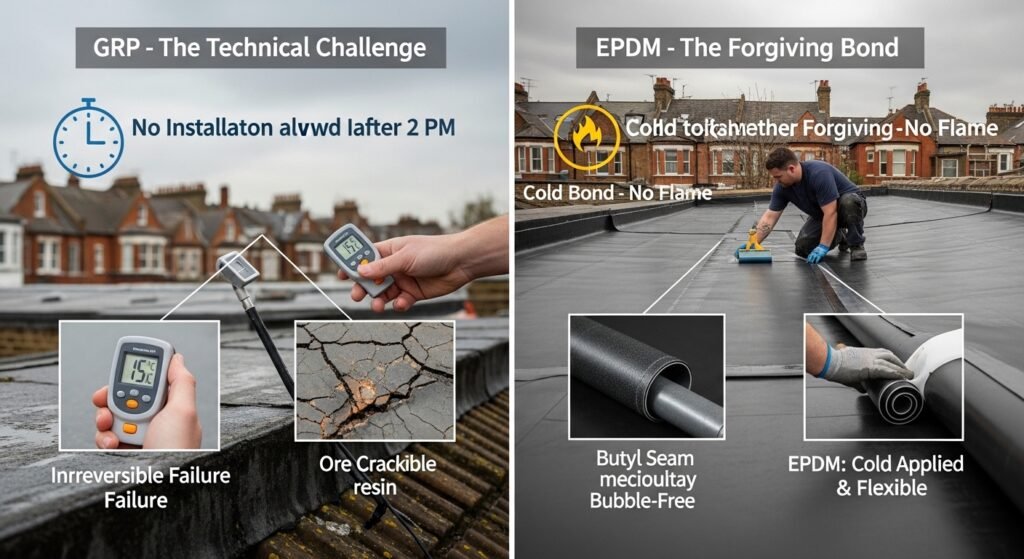
GRP installation is technically demanding and highly weather-dependent. Professional flat roof installation is recommended for GRP. Resin cannot be applied in wet conditions. Temperature matters: the resin must be above 5°C during application, and topcoating should not be done after 2 pm in winter months because the post-sunset temperature drop can prevent curing. In summer, the topcoat should be applied away from direct sunlight to prevent the wax component from melting and affecting the surface finish.
These constraints are real limitations in the UK, where autumn and winter installation windows are often restricted to short, dry spells. A contractor who applies GRP outside the correct temperature and moisture conditions, or who rushes the curing time between laminate and topcoat, creates the conditions for cracking and premature failure.
GRP installation should always be carried out by a specialist with documented experience. The consequences of poor GRP installation are largely irreversible, requiring cut-out and relay rather than surface repair.
EPDM Installation
EPDM installation is more forgiving of UK weather conditions. The membrane is bonded cold, using adhesive, without any heat or flame. This means it can be installed in a wider range of temperatures and conditions, provided the deck is dry and above the minimum temperature for the adhesive (typically 5°C).
The main technical challenge in EPDM installation is seam quality: ensuring complete, bubble-free adhesion across the full width of each seam and at every edge termination. Poor seam bonding is the most common installation defect and is not always visible immediately after installation.
EPDM is commonly described as accessible to competent DIYers for small, simple roofs. This is true for the field membrane application. The perimeter and seam details require the same level of care as professional installations, and errors at these points are where DIY EPDM roofs most often fail.
For residential extensions in the UK, both systems are well within the capability of an experienced flat roofing contractor. The choice of contractor, not the material, is usually the dominant factor in long-term performance.
Cost Comparison in the UK
Both materials offer better value than old felt roofing when measured over a 30-year period, but their upfront cost profiles differ. Adding insulation during work can improve roof insulation performance.
| Material | Typical UK Installed Cost per m² (2026) | Manufacturer Warranty | Expected Lifespan |
|---|---|---|---|
| EPDM rubber | £70 – £110 | 15 – 25 years | 25 – 50 years |
| GRP fibreglass | £90 – £130 | 20 – 25 years | 25 – 50 years |
| Torch-on felt | £60 – £90 | 5 – 10 years | 15 – 25 years |
For a 25m² extension roof in the UK:
- EPDM installed: roughly £1,750 to £2,750
- GRP installed: roughly £2,250 to £3,250
The £500 to £500 cost gap in favour of EPDM on a typical domestic extension is significant but not overwhelming, given a 25 to 50-year timeframe. Over that period, the material that requires fewer repairs will typically prove the more economical choice regardless of installation cost.
In London and the South East, add 15 to 25% to these figures for higher labour rates, parking and logistics costs, and access complexity typical of urban residential properties.
Maintenance Requirements
GRP Maintenance
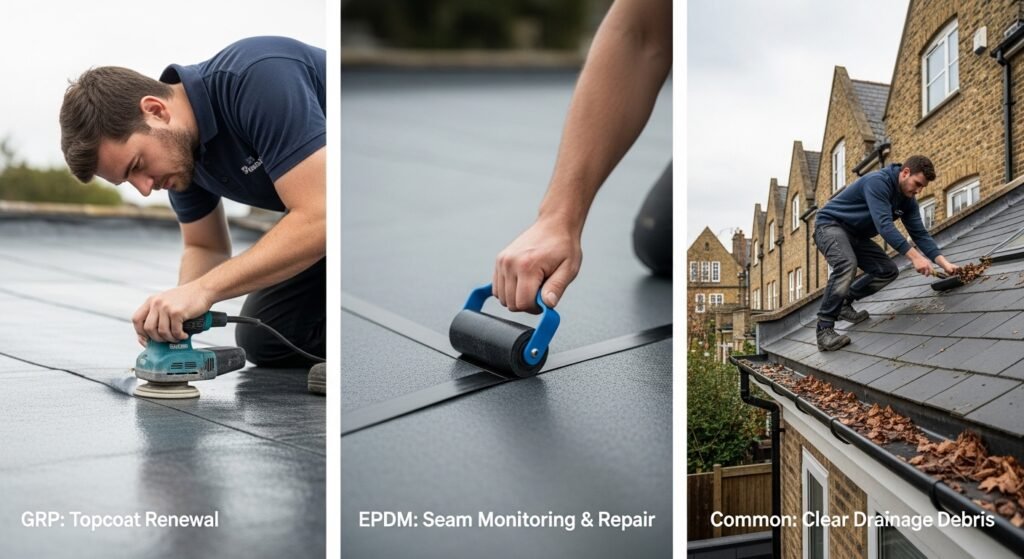
A well-installed GRP roof requires relatively little maintenance. Annual inspection is recommended to check for surface crazing, cracks, or any disruption to the edge trims and flashings. Regular checks help avoid expensive roof replacement later. Gutters and drainage outlets should be cleared of debris, as GRP is no more resistant to ponding water than any other flat roof material.
The main maintenance task that GRP roofs need over their lifetime is topcoat renewal. The topcoat is the outermost layer and the one exposed to UV and weathering. Over 10 to 20 years, depending on UV exposure and climate, the topcoat can chalk, fade, or begin to lose its protective properties. A fresh topcoat application, sometimes called a GRP restoration coating, renews the waterproofing surface without replacing the structural laminate underneath.
Topcoat reapplication is a relatively straightforward job: the surface is cleaned, abraded to remove loose material, and a new topcoat is brushed or rolled on. This typically costs £10 to £20 per square metre for the treatment and significantly extends the roof’s serviceable life.
EPDM Maintenance
EPDM also benefits from annual inspection, focusing on seam integrity, edge terminations, and flashings. The field membrane itself needs little attention beyond debris clearance.
The specific maintenance concern with EPDM is seam monitoring. Any seam that begins to lift, develop a gap, or show water staining in the adjacent area needs prompt attention. Small seam repairs using compatible butyl tape or lap sealant are inexpensive and quick when caught early. Left unaddressed, seam failures allow water under the membrane, where it is hidden until it causes damage to the deck or structure below.
A UV-resistant EPDM coating or sealant applied every 10 to 15 years can address surface oxidation and extend the membrane’s elasticity. This is a less established maintenance practice than GRP topcoat renewal, but is increasingly recommended by EPDM manufacturers.
Which Is Better for Foot Traffic?
This question is decisive for homeowners considering accessible flat roofs, roof terraces, or roofs that need to be regularly walked for maintenance.
GRP fibreglass wins clearly on foot traffic resistance. Its rigid, hard surface handles pedestrian use, furniture, plant pots, and incidental impacts without significant risk of puncture or deformation. GRP balcony decks are standard for roof terraces precisely because the material tolerates foot traffic well. Anti-slip additives can be mixed into the topcoat to improve grip. This makes it ideal for accessible roof access areas.
EPDM is vulnerable to puncture from sharp objects and sustained foot traffic, particularly from hard-soled footwear, stiletto heels, and sharp tool handles. For EPDM roofs that need to be accessed for maintenance, most installers recommend fitting rubber walkway pads or duckboarding over the membrane at access points and routes.
For any roof that will function as a terrace or receive regular human use, GRP is the correct material.
Which Handles UK Weather Better?
Both materials are well-suited to the UK’s pattern of persistent mild rain, occasional frost, and variable summer temperatures. Neither degrades in the same way that bituminous felt does under UV and freeze-thaw cycling.
EPDM has a clear advantage in thermal flexibility. The rubber membrane expands and contracts with temperature changes without cracking. EPDM installed in the 1960s and 1970s is still in service on roofs that have experienced thousands of freeze-thaw cycles. This thermal tolerance is intrinsic to the material, not dependent on installation quality.
GRP handles ponding water better when the laminate is intact. A fully cured GRP laminate is completely waterproof and does not degrade under standing water. EPDM is also waterproof, but prolonged ponding accelerates adhesive degradation at seams, which is the system’s primary vulnerability.
Both materials resist moss growth and biological fouling better than old felt, though neither is entirely immune to moss in a wet, shaded location.
Repairability: Which Is Easier to Fix?
EPDM is easier to repair. Small punctures and tears are repaired with EPDM-compatible lap sealant or a self-adhesive patch cut from EPDM sheet material. The repair bond integrates with the existing membrane and is flexible enough to move with it. Most small EPDM repairs can be carried out by a competent homeowner or a general roofing contractor without specialist equipment.
GRP repair requires more skill. Small pinholes can be filled with topcoat resin. Medium damage requires cutting out the affected area, grinding back 100mm in each direction, applying new resin and glass mat, allowing full cure, and reapplying topcoat. This is a multi-stage process that requires the correct products and application conditions. For significant damage, an inexperienced repair attempt risks a poor laminate bond that creates a bigger problem than the original damage.
GRP is less likely to be damaged in the first place, but when it is, the repair is more technically involved than the equivalent EPDM repair.
Head-to-Head Summary
| Factor | GRP Fibreglass | EPDM Rubber |
|---|---|---|
| Typical lifespan | 25 – 50 years | 25 – 50 years |
| Installation difficulty | Higher (weather-dependent) | Moderate |
| Installation cost | Higher | Lower |
| Foot traffic resistance | Excellent | Moderate (walkways needed) |
| Flexibility/thermal movement | Moderate | Excellent |
| Primary failure mode | Topcoat cracking (installation) | Seam and edge failure |
| Repairability | Moderate (skilled required) | Good (straightforward) |
| Appearance | Smooth, coloured, professional | Plain dark rubber |
| Best suited for | Extensions, balconies, visible roofs | Garages, outbuildings, large areas |
| Maintenance interval | Topcoat renewal every 10 – 20 years | Seam inspection annually |
Which Should You Choose?
The right choice depends on your specific project. These are the decision points that matter.
Choose GRP fibreglass if:
- The roof will be accessible as a balcony or terrace
- The roof has complex shapes, upstands, or multiple penetrations, where a seamless system is valuable
- Appearance matters, as GRP is available in a range of colours and produces a cleaner finish
- The installation will be carried out by a specialist with documented GRP experience
Choose EPDM rubber if:
- The roof is large and simple (garages, outbuildings, flat-roofed commercial premises)
- Budget is a primary constraint, and the roof will not be used for foot traffic
- The installation timeline is weather-sensitive, and you cannot wait for a guaranteed dry window
- The roof may need DIY repairs in future
For most UK domestic rear extensions and smaller projects where the roof will not carry regular foot traffic, both materials are appropriate, and the choice often comes down to installer preference and access to specialists. A contractor with extensive, documented GRP experience delivering a GRP roof will usually outperform a less-experienced contractor delivering EPDM, and vice versa.
FAQ
Q: Does GRP or EPDM last longer?
Both can achieve similar lifespans of 25 to 50 years under the right conditions. EPDM’s field membrane has a slight edge in raw material longevity, with installations from the 1960s still in service. GRP’s laminate is structurally robust but depends on topcoat maintenance for long-term performance. In practice, the installation quality and maintenance regime matter more than the material choice when comparing two properly specified systems.
Q: Which is cheaper, GRP or EPDM?
EPDM is typically £20 to £30 per square metre cheaper to install than GRP in the UK. On a 25m² domestic extension, this equates to a saving of roughly £500 to £750. GRP’s higher upfront cost reflects the more complex, weather-dependent installation process and higher material costs. Both systems offer significantly better long-term value than torch-on felt, which requires full replacement every 15 to 25 years.
Q: Can I walk on a GRP flat roof?
Yes. GRP is a rigid, hard surface that handles foot traffic well. For regular access, thicker laminate specifications (typically two layers of 450g chopped strand mat rather than one) and anti-slip additives in the topcoat are recommended. GRP is the standard choice for roof terraces and balconies in the UK precisely because of its foot traffic resistance.
Q: Does EPDM rubber leak?
Properly installed EPDM does not leak through the field membrane. The vast majority of EPDM roof leaks originate at seams, edge terminations, and flashings rather than through the open rubber sheet. Seam quality during installation and seam monitoring during annual inspections are the factors that determine EPDM leak performance over time.
Q: Which is better for a garage roof in the UK?
EPDM is generally the better choice for a UK garage roof. It is less expensive, easier to install, and well-suited to simple rectangular roof shapes without complex details. A 20 to 25m² garage roof with no foot traffic requirements is exactly the type of project where EPDM delivers better value than GRP. For a garage that will be used as a workshop with regular roof access, GRP is more appropriate.
Q: How do I know if my GRP roof needs recoating?
Signs that a GRP roof is due for topcoat renewal include surface chalking (a white powder residue when the roof is rubbed), colour fading, surface crazing (fine network cracks in the topcoat), and any areas that look dry or dull compared to when the roof was installed. Topcoat renewal should ideally be done before full topcoat degradation reaches the laminate beneath, typically within 10 to 20 years of installation, depending on UV exposure.
Conclusion
GRP fibreglass and EPDM rubber are both strong, modern flat roofing systems that have displaced old bituminous felt as the standard for UK residential extensions, garages, and outbuildings. Both are capable of lasting 25 to 50 years. Both are waterproof, UV-resistant, and suited to the UK climate when installed correctly.
The genuine differences are in rigidity versus flexibility, surface appearance, resistance to physical damage, installation conditions, and the specific ways each material fails when it does fail. GRP is harder, more professional-looking, and better suited to accessible or visible roofs. EPDM is more flexible, more forgiving in cold-weather installation, and easier to repair when damaged.
The most important decision in either case is not the material but the contractor. A specialist with documented experience in their chosen system, using quality materials from a reputable supplier, and installing in the correct conditions will produce a 30 to 50-year roof. An inexperienced contractor using either material in the wrong conditions will produce a roof that fails within a decade, regardless of the headline lifespan claim.

Tilly Bani is a renovation and roofing specialist with over 15 years of experience in construction and property refurbishment across North London. He specialises in roofing, structural repairs, and full home renovations, helping homeowners improve property value and safety.