
| Quick Answer Most roof repairs in Islington cost between £200 and £2,500, with the average for a moderate repair running around £700 to £900. Many homeowners compare roof repair costs before booking work. Minor jobs like replacing a few slipped slates or repointing a ridge cost £200 to £500. Simple slate issues are often fixed by trusted slate roofing experts. Larger jobs involving chimney flashing, flat roof resurfacing, or structural work cost £800 to £2,500 or more. Islington’s Victorian housing stock, 42 conservation areas, restricted parking, and high labour rates push costs 20 to 30% above the UK national average. |
Introduction
Islington roofs take a beating. The borough’s dense Victorian and Edwardian terraces were built with natural Welsh slate and lead flashings that are now 100 to 140 years old. Add London’s freeze-thaw winters, the proximity of neighbouring properties that make scaffold access complicated, and conservation area rules that restrict material choices, and you have a borough where roof repairs are consistently more demanding than anywhere outside inner London.
This guide breaks down roof repair costs in Islington specifically, Many residents first contact local Islington roofers for inspections, covering every common repair type, the factors that push prices up, what conservation area rules mean for your options, and how to get a fair quote without being overcharged.
Roof Repair Costs in Islington: By Job Type
These are 2026 prices for Islington and the surrounding inner North London area, reflecting the borough’s higher labour rates, material requirements, and access complexity.
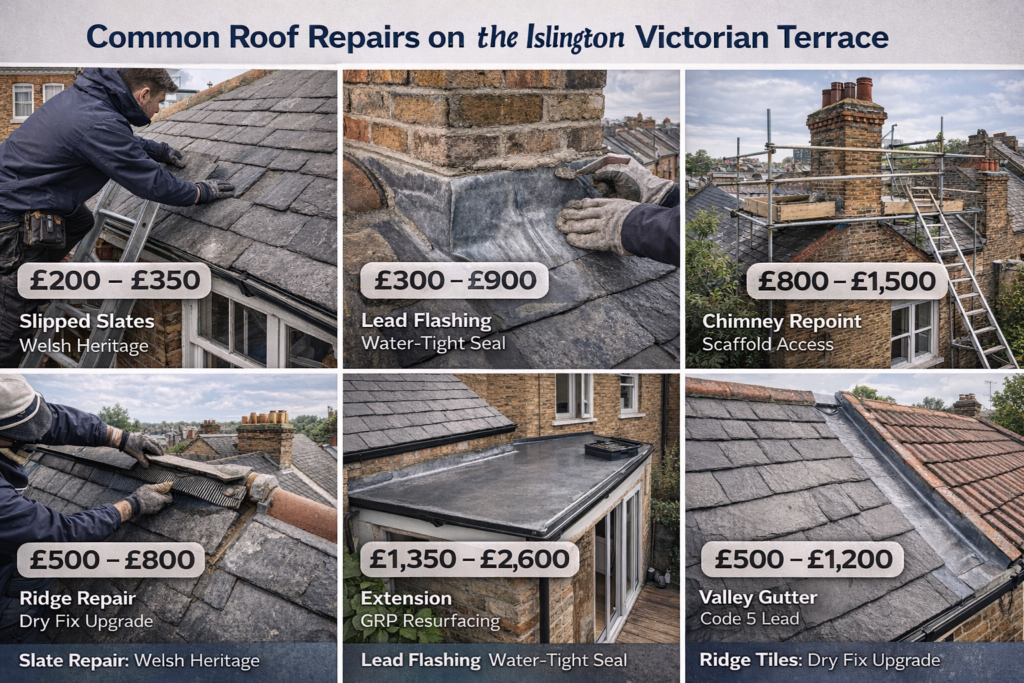
Replacing Slipped or Missing Slates: £200 to £500
Islington’s Victorian terraces are almost universally roofed in natural Welsh slate. Period homes usually need matching Welsh slate repairs. Slipped, cracked, or missing slates are the most frequent call-out and the most accessible repair for a roofer working from a ladder or mobile tower.
Replacing three to five slats on a standard two-storey terrace, where the roofer can work safely from an extending ladder, costs £200 to £350, including materials and disposal. If the repair area is higher, on a three-storey terrace in Highbury or Barnsbury, or the slates are in an area that cannot be safely accessed without scaffold, costs move to £350 to £500 before scaffolding is added.
One consistent finding on older Islington roofs: once a roofer accesses the roof to replace visible slates, they often find adjacent slates with failing fixings that need attention. The original iron nails used to fix Victorian slate have a lifespan of 80 to 120 years, after which the nails corrode and fail progressively across the roof. What looks like a one-slate repair sometimes reveals that a broader section is approaching end-of-life and needs an honest conversation about patch versus re-roof. At that stage, owners may need full roof replacement.
Lead Flashing Repair or Replacement: £300 to £900
Lead flashing seals the junction between the roof slope and vertical surfaces: chimneys, dormer walls, party walls, and parapet upstands. Persistent leaks often start around failed lead flashing areas. When flashing fails, it is the most reliable route for water into an Islington Victorian terrace. Mortar-pointed flashing cracks as the mortar shrinks and carbonates over the years. The lead itself can crack, corrode, or pull away if the upstand is too short.
Repointing existing lead flashing around a single chimney costs £300 to £500. Replacing the lead entirely with new code 4 or code 5 sheet lead costs £500 to £900 for a standard chimney, depending on the amount of lead and access difficulty.
In conservation areas and on listed buildings, flashing work requires lime mortar rather than modern sand and cement. Using the wrong mortar in historically significant masonry causes accelerated damage to the brickwork and will not be accepted by Islington Council’s conservation officers. Always confirm the roofer uses lime mortar for any pointed flashing work on an Islington period property.
Chimney Repair and Repointing: £400 to £1,500
Victorian chimney stacks in Islington suffer several predictable problems. Older terraces commonly require specialist chimney stack repairs. Mortar pointing erodes through weathering, leaving gaps that allow water into the masonry. Flaunching, the sloped mortar cap around chimney pots, cracks and allows water to track down into the stack. Chimney pots become loose as the mortar bedding deteriorates. Lead soakers and step flashings at the chimney base fail as the lead ages or the mortar holding the flashing into the masonry weathers out.
All chimney work requires scaffolding for safe access. This is not optional in Islington, where chimney stacks on three and four-storey terraces can be five to seven metres above eaves level. Scaffolding adds £600 to £1,200 to chimney repair costs, depending on the height and configuration.
A full chimney repoint with flaunching repair and scaffold costs £800 to £1,500 for a standard Islington Victorian terrace chimney. If the chimney stack also needs its lead flashings replaced and any loose or cracked brickwork repaired, costs move toward £1,200 to £2,000, including scaffold.
For properties in Islington’s conservation areas, any work that changes the visual appearance of the chimney, including removing pots, replacing them with different pot profiles, or rendering over masonry, may require planning permission. Like-for-like repairs, including repointing in matching lime mortar and replacing pots with identical profiles, do not typically require consent.
Ridge and Hip Tile Repair: £350 to £800
Ridge tiles at the apex of a pitched roof are bedded in mortar. Loose ridge lines can be upgraded with dry ridge systems. As the mortar ages and cracks, ridge tiles can shift, loosen, or become dangerous in high winds. Victorian terraces in Islington often have original ridge tiles that have been repointed several times over their lifetime, with patches of modern Portland cement mortar over older lime mortar below.
Re-bedding and repointing a section of ridge in a standard mortar mix costs £350 to £600 for a 3 to 6 metre run. A full ridge replacement using a modern dry fix system, which eliminates future mortar maintenance, costs £500 to £800 for the same length and adds significant longevity.
Scaffolding is generally required for ridge work on all but single-storey structures, as the ridge of a two-storey Victorian terrace is typically above the safe working reach of an extending ladder.
Flat Roof Repair (Extension or Outrigger): £300 to £2,000
Many Islington Victorian terraces have a flat-roofed rear extension or outrigger section that was either original to the house or added in the late 20th century. Rear additions often need expert flat roof repairs. Most of these flat roofs are either old bituminous felt systems nearing the end of their life, or have already been replaced with EPDM rubber or GRP fibreglass.
Small repairs, including patching a split seam on an EPDM roof, clearing a blocked drainage outlet, or applying a topcoat to a GRP roof that has developed surface crazing, cost £300 to £600. A full flat roof resurface on a 15 to 20m² extension using EPDM costs £1,050 to £2,200, and GRP costs £1,350 to £2,600, Premium projects often prefer GRP fibreglass roofing, reflecting both material and labour costs at the higher London rate. Many extensions choose durable EPDM roofing.
Felt roofs beyond 20 years old that are actively leaking are almost never worth patching in isolation. The membrane has reached end-of-life, and any repair will last months rather than years before an adjacent area fails. The honest conversation is about full replacement rather than continued patching.
Valley Gutter Repair or Relining: £500 to £1,500
Valley gutters run down the internal angles where two roof slopes meet. On Victorian terraces in Islington, valleys are usually lead-lined. Older lead valleys can develop cracks, holes, or weld failures that cause persistent leaks into the top-floor ceiling. The damp patch in the bedroom usually appears some distance from the actual leak point because water tracks along structural members before dripping.
Relining a valley with new code 5 lead costs £500 to £1,200 for a standard valley length, excluding scaffolding. If the existing valley boards beneath the lead have rotted, replacement adds £150 to £300 to the job.
Roof Structural Repair: £800 to £3,000+
Water ingress that has been unaddressed for months or years can cause rot in the roof structure, specifically the rafters, roof boarding, and sarking felt. On a Victorian terrace where the original roof covering was laid directly onto rafters without a separate felt layer, any long-term leak directly saturates structural timber.
The extent of structural damage is not visible from outside and often only becomes clear once slats are lifted. Replacing a single rotten rafter section costs £800 to £1,200. Replacing several rafter sections across a section of roof costs £1,200 to £3,000. Where structural damage is extensive, and the roof covering is already at end-of-life, a full re-roof is often the more economical route.
Scaffolding Costs in Islington: What to Expect
Scaffolding is the cost that most often surprises Islington homeowners. Large access jobs usually involve experienced roofing contractors. It is unavoidable for any chimney work, ridge repairs, valley gutter relining, or work on three-storey terraces.
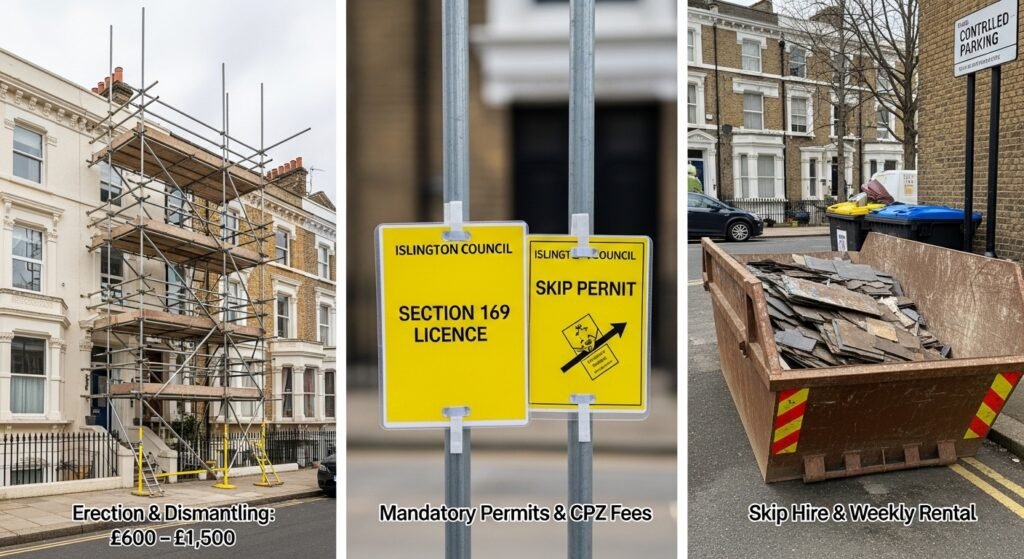
Scaffold erection and dismantling in Islington costs £600 to £1,500 for a standard two or three-storey terrace, depending on the footprint of the scaffold required. Weekly hire of the scaffold once erected runs an additional £200 to £300 per week.
Islington’s controlled parking zones add a mandatory skip permit and scaffold permit cost. A skip permit to place a skip on the public highway (necessary for disposing of old slates, lead, and membrane) costs £50 to £100 for two weeks. A licence to erect scaffolding that overhangs or sits on the public footway, required on most Islington terraces where the footway is directly against the building, requires a Section 169 licence from Islington Council, typically costing £100 to £250 plus processing time.
Some Islington roofers include scaffold and permit costs in their all-in quote. Others quote them separately. Always ask explicitly which is the case before comparing quotes.
Why Roof Repairs Cost More in Islington Than the UK Average
Islington roof repairs consistently run 20 to 30% above the national average. Many households compare nearby North London roofers for quotes. These are the specific factors behind that premium.
Victorian Slate Roofs and Specialist Materials
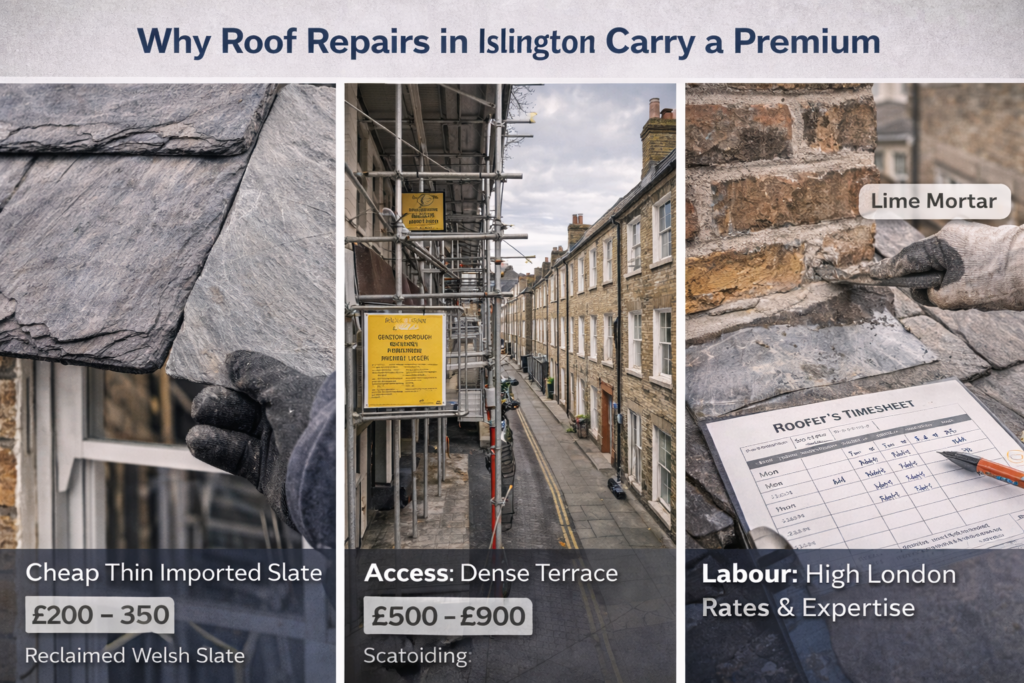
The majority of Islington’s housing stock is Victorian terraces with original Welsh slate. Welsh slate repairs require like-for-like matching materials. New Welsh slate is expensive, and conservation area rules often require reclaimed slate for visible repairs to match the aged appearance of the existing roof.
Reclaimed Welsh slate costs £1.50 to £4.00 per slate, depending on grade and size. New Welsh slate costs £2.00 to £5.00 per slate. Spanish or Chinese slate, while significantly cheaper, is typically not permitted on conservation area properties in Islington, and experienced roofers should not substitute it without discussing this explicitly with the homeowner.
42 Conservation Areas with Article 4 Directions
Islington has 42 conservation areas, and under Article 4 Directions, it has removed permitted development rights in 40 of them. This means that many alterations which would be permitted development elsewhere require a formal planning application in most of Islington.
For roof repairs, the practical effect is that like-for-like repairs, using the same material and profile, can generally proceed without consent. Changing material, even from one type of slate to another, or replacing traditional mortar bedding with a modern dry-ridge system in a visible location, may require prior approval. This does not necessarily prevent you from proceeding, but it does mean a conversation with Islington Council before changing from the existing specification.
The cost implication is twofold: specialist materials cost more, and roofers with genuine conservation area experience charge more because their knowledge has value. A roofer who uses Portland cement mortar on a listed building in Canonbury is doing the wrong job regardless of cost.
Dense Housing and Access Constraints
Most Islington Victorian terraces are mid-terrace properties on streets where neighbours are directly adjacent on both sides. Access to the rear is often through a narrow side passage or through the house. The scaffold must be erected from the front elevation. Tight access can increase labour for emergency roof repairs.
On many Islington streets, the footway between the building line and the carriageway is narrow. Scaffold must overhang the footway, requiring the Section 169 licence. On busy roads around Angel, Highbury, or Upper Street, erecting and dismantling scaffolds involves traffic management that adds cost and coordination time.
Higher Labour Rates
Roofing labour in Islington and inner North London runs £50 to £70 per hour per roofer, compared to £35 to £50 per hour in the Midlands and North. For a two-day chimney repair job requiring two roofers, the labour premium alone represents £180 to £280 above the national average for the same work.
Islington-Specific Roof Problems to Watch For
Understanding the most common failure patterns in Islington’s housing stock helps you identify problems early, before they become expensive.
Nail Sickness
The original iron nails used to fix Welsh slate on Victorian terraces have a finite lifespan of roughly 80 to 120 years. Once nails begin to corrode, slates start slipping progressively across the roof. The visible sign is slates that have tilted or dropped out of position in scattered patterns across the slope. Early inspection by Camden roofers can prevent wider failure.
Nail sickness cannot be solved by replacing individual slates. The underlying cause is the fixings failing across the whole slope. When this occurs, the only permanent solution is to strip the affected slope, replace all the battens and fixings, and re-lay the slates. This is essentially a partial or full re-roof rather than a repair. In Islington, re-slating a standard two-storey Victorian terrace costs £8,000 to £18,000, depending on the roof area, complexity, whether reclaimed or new slate is used, and scaffold requirements.
Failed Lead Valleys and Soakers
Most Victorian terraces in Islington with more complex rooflines, including those with rear extensions, dormers, or party wall returns, have lead in the valleys and as soakers under slate courses at abutments. Lead that was installed 50 or more years ago may be beyond its practical service life, particularly if it was under-gauge lead or was installed without adequate movement allowance.
Persistent water staining at the ceiling junction between the main roof slope and an extension roof is the classic sign. Repairs here are legitimate roofer work, not a cause for concern about the broader roof, but left unaddressed, they cause timber rot that escalates the cost significantly.
Flat Roof Outriggers
Victorian terraces in Islington frequently have a rear outrigger, a single-storey extension at the rear running alongside the main back addition. These outriggers are often flat-roofed and covered in old felt that is past its replacement date. If the top-floor rear bedroom or kitchen extension ceiling has water marks, the flat roof is the first place to look.
As noted above, patching old felt roofs is rarely cost-effective. A full replacement with EPDM or GRP, properly detailed at the parapet and internal gutter, delivers 30 to 50 years of reliable performance and is the right approach for outrigger roofs that are actively leaking. Many owners book complete flat roof replacement instead of patching.
Getting a Fair Quote in Islington
Three written quotes from established roofers are the baseline. Choose firms with proven Hackney roofing experience. For any Islington roof repair, these questions protect you from the most common pricing problems.
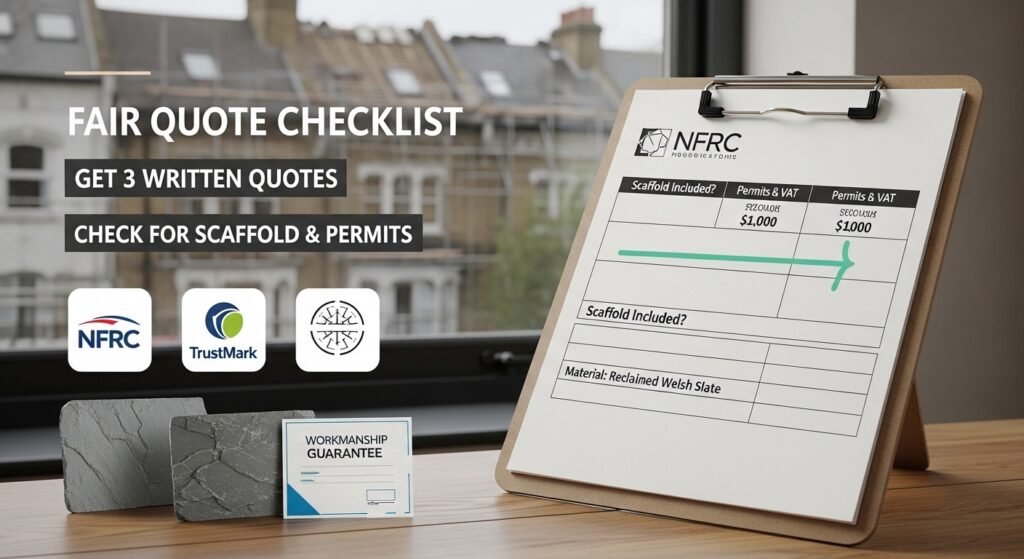
Is the scaffold included or excluded? The single biggest source of quote comparison confusion in Islington. A quote of £600 that excludes scaffold versus one of £900 that includes scaffold represents the same actual cost to you. Require every quote to specify the scaffold position explicitly.
Are permits included? Ask specifically whether the skip permit (if a skip will be used) and the Section 169 licence for scaffold on the footway are included.
What material is being specified? For slate repairs on a conservation area property, ask the roofer to confirm they are using Welsh or approved reclaimed slate, not Spanish or Chinese substitute. For mortar work on chimneys or ridge bedding, ask what mortar specification they are using.
Is VAT included? Smaller sole-trader roofers below the VAT threshold do not charge VAT. Limited companies and larger roofing contractors charge 20% VAT. A quote of £1,000 plus VAT costs £1,200. Ensure all quotes are on the same basis for comparison.
What is the workmanship guarantee? Reputable roofers typically offer a minimum one to two-year guarantee on repair work. Some offer five years. Get this in writing.
Are they members of a trade body? The NFRC (National Federation of Roofing Contractors) and TrustMark are the most relevant bodies for Islington roofing contractors. Membership is not a guarantee of quality but indicates a contractor who has submitted to external vetting.
When Repair Becomes Re-Roof
Repair is always cheaper in the short term. But there is a point at which repeated repairs cost more over five years than a full re-roof would, and the re-roof delivers decades of trouble-free performance rather than continued uncertainty.
The most common indicators that repair has reached its limit on an Islington Victorian terrace:
- Nail sickness is visible in scattered slipping slates across a roof slope
- Three or more separate leak incidents in the same two to three-year period
- The roofer finds structural rot when accessing for a repair
- The existing felt, battens, and fixings beneath the slate are all beyond reasonable life
- The property is being sold and a surveyor has flagged the roof condition
At that point, the conversation shifts from repair to re-roofing. A full re-roof in Welsh slate for a standard two-storey Islington Victorian terrace costs £10,000 to £20,000, depending on size and complexity. Natural slate at that price point offers a 100-plus year roof life, eliminating the repair cycle entirely for the next generation of owners.
FAQ
Q: Do I need planning permission for roof repairs in Islington?
Like-for-like repairs, replacing damaged slates with matching slates, repointing in matching mortar, or replacing a flat roof membrane with an equivalent system, do not require planning permission under Permitted Development rules. However, in Islington’s 42 conservation areas, Article 4 Directions remove some PD rights, meaning changes of material or specification on visible elevations may require consent. If you are on a listed building, any material change requires listed building consent regardless of scope. When in doubt, call Islington Council’s planning department for pre-application advice before committing to non-like-for-like materials.
Q: Why is my quote in Islington higher than the national average I found online?
National average figures for roof repair reflect costs across the UK, including low-cost areas in the North and Midlands. Islington labour rates, specialist slate and lead material costs, scaffold permits, controlled parking zone complications, and conservation area material requirements all contribute to a premium of 20 to 30% over national averages. For inner North London, the national figure should be treated as a floor rather than an expectation.
Q: How do I know if my Victorian terrace roof needs repairing or replacing?
A reputable roofer who accesses the roof for inspection will tell you both what needs repairing now and the honest state of the broader roof. Signs that lean toward re-roof rather than repair: widespread slipping slates indicating nail failure across the slope, felt and battens that are crumbling when touched, structural timber that is soft or discoloured from long-term dampness, and a repair history of three or more separate jobs in recent years. Signs that lean toward repair: isolated damage from a storm or impact, a specific failed flashing or valley, or a single section of ridge that has shifted while the broader roof is sound.
Q: How much does roof repair cost in Islington versus the rest of London?
Inner London boroughs like Islington, Camden, and Hackney sit at the higher end of London pricing due to labour rates, conservation area complexity, and access difficulty in dense terrace streets. Outer London boroughs like Barnet or Enfield typically run 10 to 15% below inner North London prices for the same job. National figures are 20 to 30% below Islington prices.
Q: Do I need to use reclaimed Welsh slate for repairs in a conservation area?
This depends on the specific conservation area and the location of the repair. In many of Islington’s conservation areas, the council’s guidance requires that repairs to visible roofslopes use matching materials. For a Victorian terrace with original Welsh slate, a like-for-like repair with new Welsh slate is generally acceptable. Using reclaimed slate provides a closer colour and texture match and is often preferred by conservation officers for prominent locations. Using Spanish or Chinese slate as a substitute is not acceptable in most Islington conservation areas where material matching is required, and may be flagged in a future survey.
Conclusion
Roof repair costs in Islington are genuinely higher than national guides suggest. Victorian slate, lead flashings, dense terrace access, 42 conservation areas with Article 4 restrictions, and inner London labour rates all combine to push a typical moderate repair to £700 to £1,200 before scaffolding, and to £1,500 to £2,500 once scaffold is included for chimney or ridge work.
The most important thing you can do before accepting any quote is to confirm exactly what is and is not included: scaffold, permits, VAT, material specification, and workmanship guarantee. Those five clarifications turn an opaque quote into something you can compare meaningfully against alternatives and against what is actually fair for your specific property and repair.
For most Islington homeowners, a well-maintained Victorian terrace roof repaired promptly when problems are small is significantly cheaper over a decade than a single delayed repair that has allowed water damage to spread to structural timber. Annual inspection, prompt response to missing slates or damp patches, and clear gutters are the maintenance habits that keep Islington roof repair bills manageable. Regular cleaning with guttering services helps prevent leaks.

Tilly Bani is a renovation and roofing specialist with over 15 years of experience in construction and property refurbishment across North London. He specialises in roofing, structural repairs, and full home renovations, helping homeowners improve property value and safety.