
| Quick Answer The most common roof problems on North London’s Victorian terraces are nail sickness (corroded iron fixings causing progressive slate slippage), failed lead flashing around chimney stacks, deteriorated ridge mortar, flat roof membrane failure on rear outriggers, and spray foam insulation that creates mortgage and structural complications. Most of these problems are cumulative and predictable. Knowing what to look for lets you intervene before a maintenance issue becomes a structural one. |
Introduction
Most of North London’s residential streets are Victorian. From the terraces of Islington and Hackney to the larger semis of Muswell Hill and Highgate, the housing stock was built between roughly 1860 and 1914, which means the roofs are now between 110 and 165 years old. Some have been re-roofed in the intervening decades; many have not.
This age profile creates a highly predictable set of roofing problems. Regular checks from skilled roofing contractors help reduce risk. The materials used to build Victorian roofs were generally excellent. Welsh slate, when it has not been disturbed or damaged, can last 150 years or more. Lead flashing, correctly installed, achieves 80 to 100 years of service life. The problem is not the original materials. The problem is the fixings, the joints, the secondary elements that age faster, and the well-intentioned interventions of previous decades that created new problems while solving old ones.
This guide covers every major roof problem specific to North London’s Victorian terraces, what causes each one, how to identify it before it becomes serious, and what a realistic repair involves.
Understanding the Victorian Terrace Roof
Before discussing specific problems, it helps to understand how a Victorian terrace roof differs from a modern one.
No Secondary Membrane
Victorian roofs were built with slates or tiles laid directly on battens over rafters. There was no secondary waterproofing layer beneath. The design relied on the overlapping coverage of the slates being sufficient to shed water, with any incidental water that got through the primary layer being expected to evaporate in a well-ventilated loft space. Modern Building Regulations require a breathable membrane beneath roof coverings on any new or re-roofed structure. Many upgrades include full roof replacement.
This absence of underlay has two consequences. First, when original slates are in good condition with intact fixings, the roof works as designed, and the loft ventilation that was built in by the Victorian builders keeps moisture from accumulating. Second, when any individual slate or fixing fails, there is nothing between the roof space and the outside world. A single slate failure on a Victorian roof without underlay is a more direct water ingress risk than the equivalent failure on a modern roof.
Iron Nail Fixings
Victorian slates were fixed with iron nails driven through holes in the slate into the timber batten. Iron corrodes. This is the fundamental problem driving the most common and widespread roof condition on Victorian terraces across North London: nail sickness. Older slate homes often need expert slate roof repairs.
Lead as the Primary Sealing Material
All junction waterproofing on Victorian terraces was done in lead: chimney flashings, valley linings, soakers between adjacent slates at abutments, bay window coverings, and parapet gutters where they exist. Lead was and remains the superior material for these applications. But lead is also approximately 100 to 150 years old on many North London properties, and it is approaching or past the end of its service life.
Problem 1: Nail Sickness
Nail sickness is the most widespread and most misunderstood condition affecting Victorian slate roofs in North London. It is the progressive corrosion of the original iron nails used to fix slates to battens. As nails corrode, they lose their grip, and slates begin to slip downward, rotating on their bottom edge. Initially, a few slates slip. Over time, as the same process occurs across the roof, slates slip progressively across the whole slope.
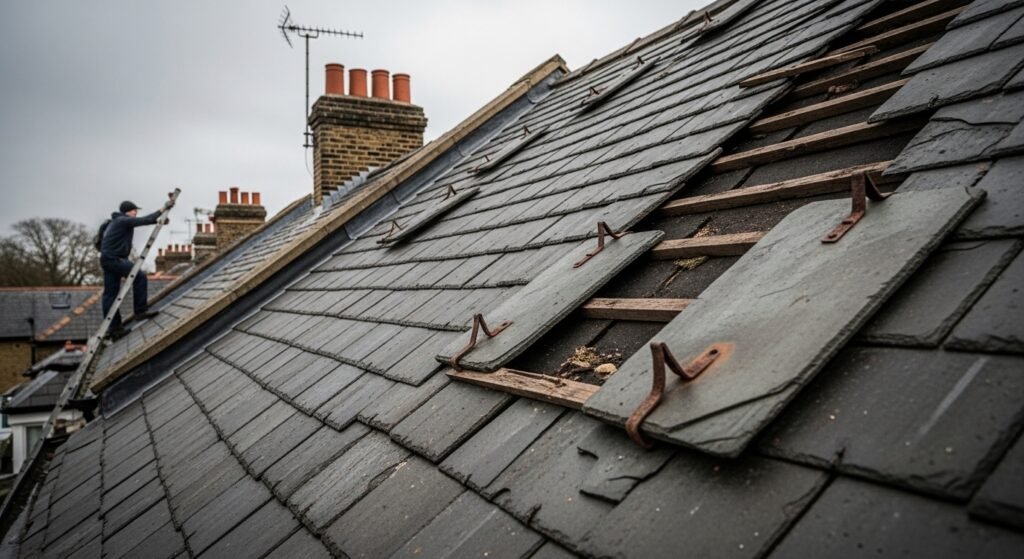
The visible sign of nail sickness is slates that have tilted or dropped out of position, leaving gaps or overlapping adjacent slates in a disorderly pattern. A more subtle sign is the presence of tingle clips, small lead or aluminium clips used to re-fix individual slipping slates without stripping the roof. A handful of tingles is normal roof maintenance. More than a handful on one slope suggests nail sickness is underway.
Why It Cannot Be Permanently Solved by Spot Repairs
Nail sickness is a condition affecting all the fixings on the roof, not just the ones that have currently failed. Once corrosion has progressed sufficiently to cause visible slipping, other nails on the same slope are typically at a similar stage. Re-fixing individual slates with tingles buys time but does not address the condition. The only permanent solution is to strip the affected slope, install a breathable membrane, lay new battens, and re-fix the slates (either the original ones if they are in good condition, or new Welsh slate if they are not). Many projects begin with a planned pitched roof renewal.
Cost and Planning Implications
For a standard two-storey North London Victorian terrace, re-slating one slope (typically the main rear slope or the main front slope) costs £4,000 to £9,000 depending on roof area, complexity, and material choice. Reclaimed Welsh slate to match the existing roof costs more than new but provides a better visual match and is often required in conservation areas. Matching materials are common in Islington properties.
In Islington, where Article 4 Directions apply in 40 of 42 conservation areas, any material change to the roof covering may require planning consent even if the structure is not listed. A like-for-like re-slating using matching material does not typically require consent. Changing from natural slate to concrete tiles or composite slate does. Always confirm with Islington Council or the relevant borough before specifying a material that differs from the existing one.
Buying a Property with Nail Sickness
If a building survey flags nail sickness on a property you are buying, take it seriously, but do not automatically treat it as a reason to withdraw. The roofer’s assessment of how far the condition has progressed determines whether you are dealing with a repair in the next two years or the next five to ten. Ask for a roofer’s report from an NFRC member, not just the surveyor’s assessment, to understand the timeline and cost.
Problem 2: Failed Lead Flashing
Lead flashing seals every junction between the roof covering and vertical surfaces. Leaks often start near damaged chimney flashing areas. On a typical Victorian terrace in North London, flashing appears at both sides of every chimney stack (step and back gutter flashings), the junction between the main roof slope and any rear addition (the party wall flashing), the sides and front of any dormer, and the abutment between the main roof and any flat-roofed outrigger section.
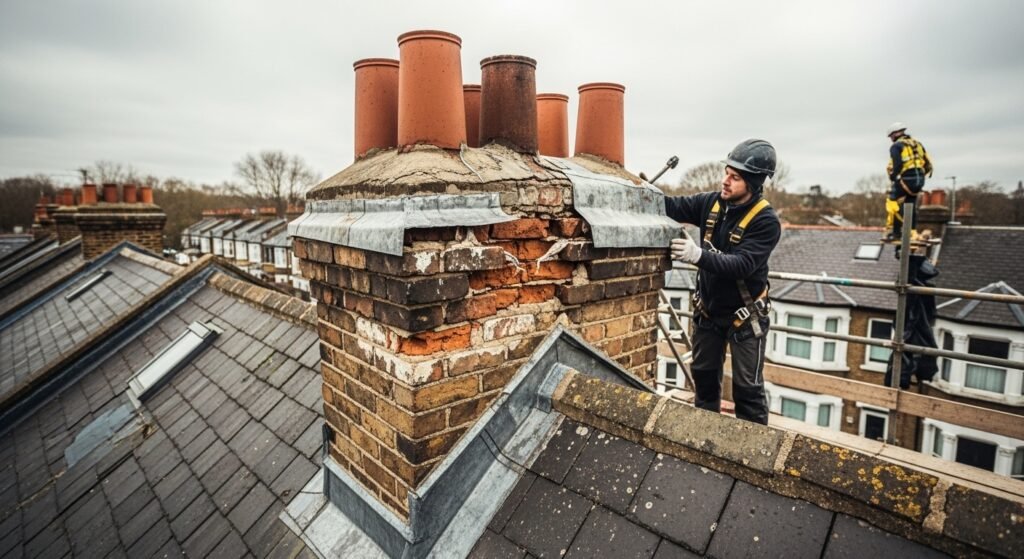
Lead installed at the time of construction has a theoretical service life of 80 to 100 years when installed to the specification now covered by BS 6915. Much of North London’s original lead flashing is now past or approaching that limit. Some have already been replaced, often with shorter-lived materials or with cement mortar fillets instead of lead, which creates its own problems.
Why Cement Mortar Fillets Fail
Cement mortar applied to seal a roof-to-wall junction as a cheap alternative to lead flashing is the single most reliable source of roof leaks on Victorian properties. Mortar is rigid. Lead is flexible. As the building moves slightly through thermal cycling and settling, mortar cracks. As it weathers, mortar shrinks and pulls away from the masonry. Every crack is a potential water entry point. Mortar fillets should be considered a temporary repair, not a solution. Many homes later need proper roof flashing repair. Where they exist on a North London terrace roof, they are a maintenance item that needs monitoring and eventual replacement with lead.
Signs of Flashing Failure
Visible signs from ground level include mortar that has partially fallen away from the chimney joint, lead that has lifted or pulled away from the masonry chase, or lead that shows surface cracking from thermal stress. Internal signs are water staining on the ceiling or walls of the top-floor room directly below or adjacent to the chimney. Chimney-related leaks on Victorian terraces frequently appear as staining on the back bedroom ceiling near the chimney breast rather than directly at the chimney breast itself, because water tracks along the rafter before dripping.
Flashing Repair Costs
Repointing existing lead flashing that has simply pulled out of its mortar joint costs £200 to £400 per chimney, depending on access. Replacing all the lead flashing around a single chimney stack, including step flashings, back gutter, and apron, costs £600 to £1,200, including scaffold. Full lead replacement is the correct long-term approach when the existing lead is cracked, over 60 years old, or when the property is being re-roofed anyway.
In North London, where hard water from Thames Water accelerates calcite scaling within lead joints, the deterioration timeline for older lead is faster than in softer-water areas. Lead around chimneys in Camden, Islington, and Hackney should be inspected more frequently than in equivalent properties elsewhere in the UK.
Problem 3: Ridge Tile Failure
The ridge tiles at the apex of a Victorian terrace roof are traditionally clay or terracotta, bedded in mortar. On most surviving Victorian properties in North London, the ridge mortar has been replaced at least once, sometimes with Portland cement rather than the original lime mortar. Portland cement is more rigid than lime, and it cracks as the ridge tiles expand and contract with temperature changes. Over time, the mortar degrades, and ridge tiles begin to lift, rock in high winds, or slide from their position. Loose ridges are safer with dry ridge systems.
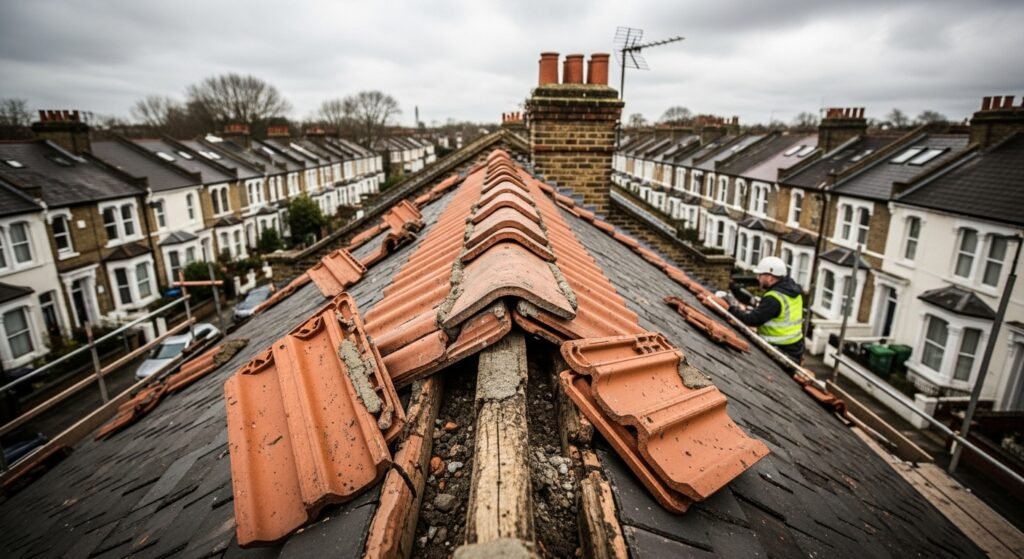
Loose ridge tiles are not just a waterproofing problem. A terracotta ridge tile weighs between 5 and 15 kg, depending on size. A loose ridge tile in high winds can fall from the apex of a roof. On densely packed North London terraces where pavements run directly alongside the front elevation, a falling ridge tile is a serious hazard.
Recognising Ridge Problems
From ground level, look for ridge tiles that appear to have shifted position, gaps in the mortar pointing between ridge tiles, or individual tiles that appear slightly tilted. After a storm, any of these signs warrants an urgent inspection. A roofer accessing the roof can assess whether individual tiles need re-bedding or whether the entire ridge run needs stripping and re-laying.
Dry Ridge Systems vs Re-Bedding
Traditional re-bedding in mortar restores the ridge but creates the same long-term maintenance cycle. Modern dry ridge systems use mechanical fixings and flexible foam bedding with a polymer weathering strip rather than mortar. They eliminate future re-bedding, resist wind uplift better than mortar bedding, and have a longer maintenance-free life. The upfront cost is higher than re-bedding, but the lifetime cost is lower.
Ridge repair costs for a typical North London Victorian terrace: re-bedding the full ridge run £400 to £900; dry ridge installation £700 to £1,400, depending on length.
Problem 4: Flat Roof Failure on Rear Outriggers
A significant proportion of North London’s Victorian terraces have a rear outrigger or back addition that extends the property beyond the main footprint. The ground floor of this outrigger is typically the original kitchen, and the first floor is often a bathroom or bedroom. The roof of the outrigger is usually flat or very low-pitched. Rear additions often need modern flat roof systems.
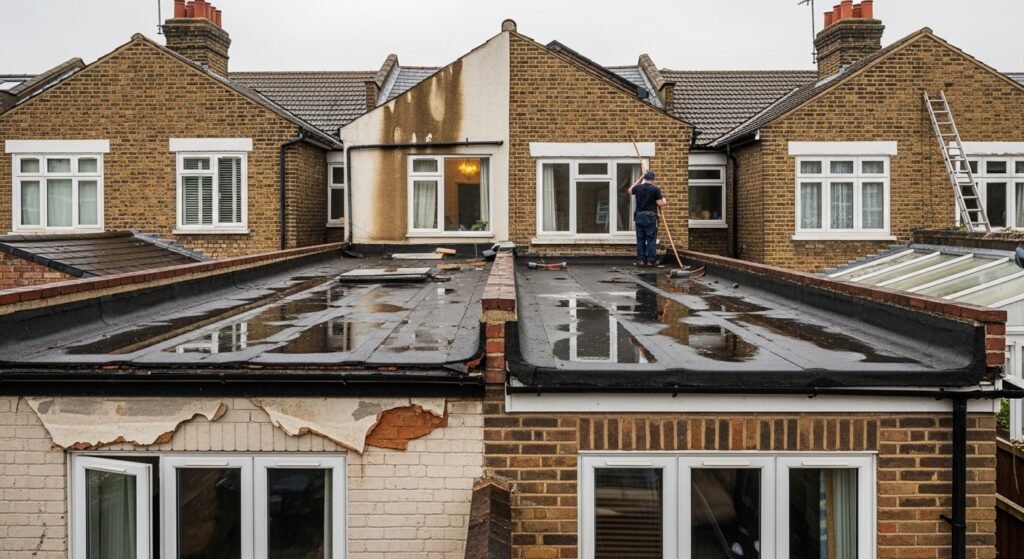
Most of these outrigger flat roofs were originally built with a lead covering or, in later Victorian properties, early bituminous felt. The majority have been recovered at some point, often in the 1970s or 1980s, with three-layer felt systems that are now at or past their replacement date.
Flat Roof Failure Modes
Old felt flat roofs on Victorian outriggers fail through several mechanisms: the felt blisters and splits as it ages, particularly at seams and laps; the drainage falls become inadequate as the roof structure settles; the flashing at the upstand where the flat roof meets the back wall of the main house deteriorates; and the material at the edge where the flat roof meets the parapet or fascia pulls away.
Active leaks from a failed outrigger flat roof typically appear as ceiling staining in the first-floor rear room, or in extreme cases as water tracking down the inside of the rear wall of the property.
The Right Solution for 2026
A like-for-like felt replacement is not the recommended approach for 2026. Modern EPDM rubber Roofing or GRP fibreglass roofing. systems both offer 25 to 50-year service lives and significantly outperform the three-layer felt they replace. A 15 to 20m² outrigger flat roof replacement in EPDM costs £1,200 to £2,200 installed in North London. GRP costs £1,500 to £2,800 for the same area.
Adding a roof lantern or fixed triple-glazed rooflight during a flat roof replacement is a worthwhile combination. Many upgrades include stylish rooflight installation. The scaffold and access costs are already in place, and a quality rooflight brings substantially more light into the rear ground-floor room. Budget an additional £800 to £2,000 for a quality fixed rooflight installed at the same time.
Problem 5: Parapet Gutters and Hidden Internal Gutters
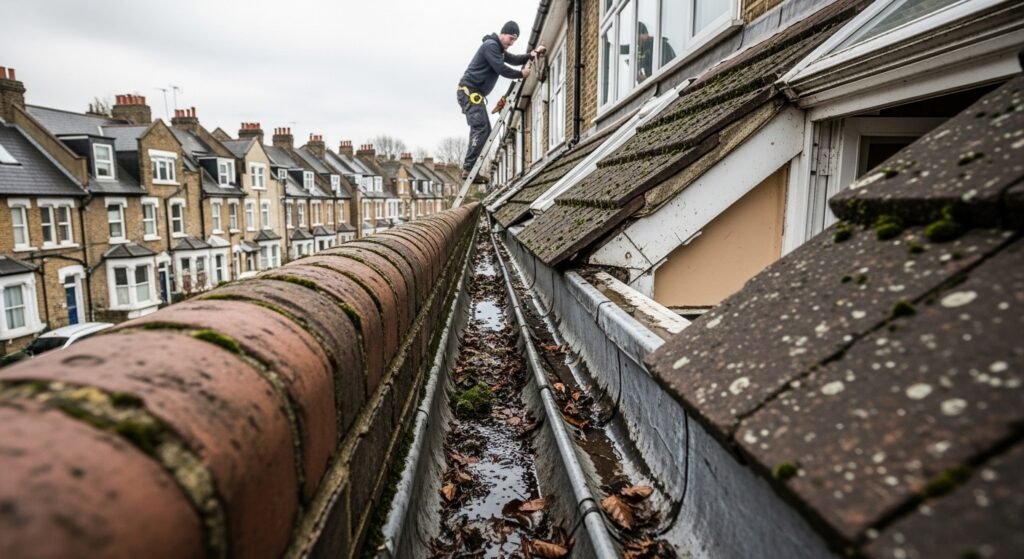
Many North London Victorian terraces, particularly those in more densely built rows in Islington, Hackney, and parts of Camden, have a hidden internal gutter behind the front parapet wall. These ‘London’ style roofs are invisible from the street, with the roof entirely concealed behind a brick parapet. The gutter runs along the back of the parapet and drains through outlets in the parapet wall or via downpipes hidden within the parapet.
Why These Gutters Are a Particular Risk
The “out of sight, out of mind” problem is acute. Because the roof cannot be seen from the street, many owners have no idea of its condition until water appears inside. Parapet gutters collect debris: leaves, moss, and general detritus from the roof surface above. Annual cleaning with guttering services prevents overflow. A blocked outlet in a parapet gutter creates a pond of standing water. The water eventually finds its way through the flat roof covering into the top-floor ceiling.
Original parapet gutters were often lined with lead. That lead is now 100 to 140 years old and may have developed holes or splits at bends and joints. Some have been replaced with felt or EPDM; some remain original lead.
Inspection and Maintenance
Annual inspection and clearance of parapet gutters is the single most effective maintenance action for ‘London’ style terrace roofs. The cost of clearing and inspecting a parapet gutter is £150 to £300. The cost of repairing water damage to the top-floor ceiling and redecorating after a blocked gutter has caused weeks of leakage is typically £800 to £2,500. The cost of re-lining a deteriorated parapet gutter in EPDM is £600 to £1,800, depending on length.
If you cannot access the parapet gutter yourself safely, commission a roofer to clear and inspect it each autumn before the heavy rainfall season begins.
Problem 6: Spray Foam Insulation
This is the most recent addition to the list of Victorian terrace roof problems, and it is creating significant difficulties for North London homeowners who are trying to sell or remortgage.
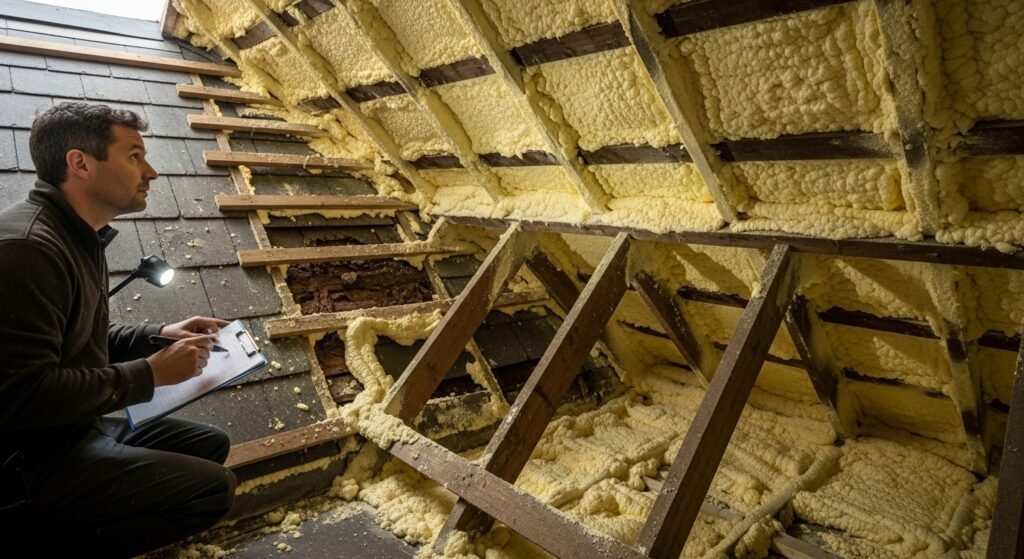
From roughly 2015 onwards, spray foam insulation was widely promoted as an energy efficiency measure for roofs, including through government schemes such as the Green Homes Grant and ECO4. Installers applied polyurethane foam directly to the underside of roof rafters or between rafters from inside the loft. The marketing proposition was compelling: improved thermal performance, no need to disturb the roof covering. Safer upgrades usually use proper roof insulation.
The Mortgage Problem
When a mortgage surveyor enters a loft and finds spray foam applied to the underside of the roof timbers, they face a fundamental problem: they cannot inspect the condition of the timber structure. The foam conceals the rafters, the battens, and any deterioration in the roof timbers. Under RICS standards, a surveyor who cannot inspect the roof structure must report this limitation, and most assign a condition rating that causes mortgage lenders to decline the application.
As of 2026, only around 25% of mainstream mortgage lenders will lend on properties with spray foam insulation. All equity release providers refuse. This means that a North London Victorian terrace with spray foam insulation is effectively non-standard security for lending purposes, which directly affects the pool of buyers and the achievable sale price.
Research by the Property Care Association (PCA) and HomeOwners Alliance found that 35% of properties inspected following spray foam installation had one or more defects caused by the foam. The PCA and HOA wrote to the government in February 2025, calling on it to remove spray foam from government-funded schemes.
The Structural Problem
Beyond the mortgage issue, spray foam creates a real structural risk on Victorian terraces, specifically because of their design. Victorian lofts were designed as cold, ventilated spaces where any moisture in the loft could evaporate through ventilation. When spray foam is applied to the underside of rafters, it eliminates this ventilation pathway. Moisture that would previously have evaporated now condenses against the cold face of the timber and the foam. Over time, this creates conditions for wet rot in the rafters. Because the rot develops hidden behind the foam, it is not visible during a routine inspection and only becomes apparent when the foam is removed.
What to Do if Your Property Has Spray Foam
If you have spray foam in your loft and are planning to sell or remortgage, you will need to have it professionally removed before listing the property. Professional removal by a specialist company costs £1,500 to £3,500 for a typical North London three-bedroom terrace, depending on the area of the loft and the type and thickness of foam. After removal, a post-remediation survey must confirm that the roof structure is sound and free from rot. If rot is found, it must be repaired before the lending criteria are satisfied.
If you are buying a Victorian terrace in North London and the loft inspection reveals spray foam, treat this as a significant negotiating point and commission a specialist spray foam assessment before exchanging contracts. The cost to the seller of removal may be £2,000 to £4,000, and the presence of foam may have concealed structural problems that would further increase repair costs.
Problem 7: Bay Window Roof Coverings
The majority of Victorian terraces in North London have a bay window at the front, either single-storey or rising to the first floor. The bay roof is typically covered in lead, in a configuration involving timber rolls (raised ridges running from back to front of the bay) with lead dressed between them. Older fronts may require specialist Camden roofers. This is a complex piece of leadwork that requires a skilled plumber or leadworker to install correctly.
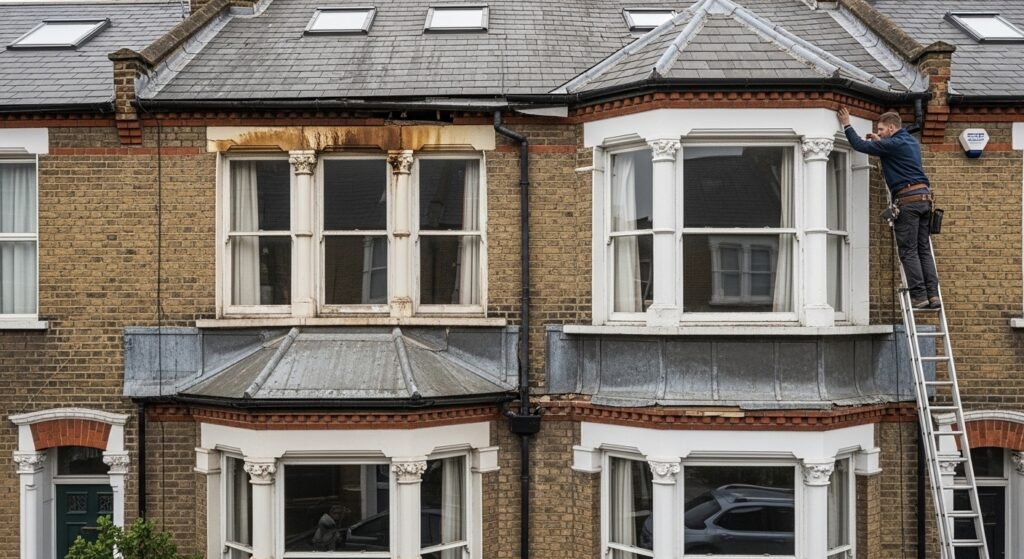
Original bay lead coverings on Victorian properties are 100 to 140 years old. The most common failure modes are splits along the lead sheet (from thermal expansion cycling over decades), failed flashings where the bay roof meets the front wall above, and cracked or failed lead at the guttering junction.
Signs of bay roof lead failure are brown water staining on the ceiling or cornice of the first-floor bay window room, damp patches on the wall immediately above the bay roof, and visible cracks or splits in the lead from street level.
Bay lead replacement costs £800 to £1,800 for a standard single-storey front bay, depending on size and access.
Preventive Maintenance: What North London Homeowners Should Do
The most cost-effective way to manage a Victorian terrace roof is consistent, scheduled maintenance rather than reactive repairs. A roof that receives attention every one to two years rarely produces the £5,000 to £15,000 bills that ignored roofs generate.
Annual inspection. Commission a roofer to access the roof and inspect the condition of the slate or tile covering, all flashings, ridge mortar, gutters, and parapet outlets. An annual inspection costs £150 to £300. Fast response helps avoid emergency roof repairs. It typically pays for itself multiple times over by catching deteriorating mortar, lifting flashings, or blocked gutters before they cause water ingress.
Autumn gutter clearance. Clear all gutters and downpipes in October or November before heavy winter rainfall. Blocked outlets can damage fascias and soffits. Blocked gutters cause overflow that saturates fascia boards, penetrates the roofline, and in parapet gutter situations, creates roof ponds. Gutter clearance costs £80 to £200 for a standard terrace.
Loft inspection after storms. After any storm with recorded wind speeds above 50 mph, access the loft with a torch and look for daylight through the roof structure, any signs of moisture on the timbers, or debris that may have been displaced. This costs nothing and takes 10 minutes.
Document all roof work. Keep all invoices, specifications, and guarantees for any roof work. This documentation is valuable at the point of sale or remortgage and can prevent disputes about the condition of the roof.
When to Re-Roof vs When to Repair
This is the central question for most Victorian terrace owners in North London, and there is no universal answer. These are the conditions that tip the balance toward re-roofing rather than continued repair:
Nail sickness across more than a quarter of a slope. If multiple tingles are present and the roofer’s inspection finds that the nails across the whole slope are at a similar stage of corrosion, re-slating the slope is more economical over a five-year horizon than continued individual repairs.
Repeated re-bedding of the same ridge section. If the same section of ridge has been re-bedded twice in five years, the underlying problem is the mortar cycle, and a dry ridge system is a better investment.
Second or third repair of the same flat roof area. A flat roof that has been patched twice in ten years needs replacement, not another patch. Many owners then book flat roof replacement.
Pre-sale or pre-remortgage survey that flags roof condition. If a survey has flagged the roof as a significant concern, addressing it before listing the property typically produces a better outcome than price reductions and delayed completion.
For most situations, a roofer who has assessed and inspected the roof can give an honest assessment of how many more years the current covering is likely to give before a full re-roof becomes unavoidable. That assessment, combined with how long you plan to stay in the property, drives the repair vs re-roof decision.
FAQ
Q: How long do Victorian slate roofs last in North London?
Welsh slate itself can last 150 years or more and is frequently reused when a roof is stripped. The limiting factor is the iron nail fixings, which typically last 80 to 120 years before corrosion causes progressive slate slippage. North London Victorian terraces built in the 1880s to 1900s are now at or approaching the end of their nail fixing life. The condition of the fixings, not the slates, determines whether repair or re-roofing is appropriate.
Q: What is the difference between lead flashing and cement mortar flashing?
Lead flashing is a flexible sheet metal that moves with the building and lasts 80 to 100 years. Cement mortar applied as a sealing fillet is rigid, cracks as the building moves, and should be considered a temporary measure. The vast majority of chimney and abutment leaks on North London Victorian terraces are caused by failed cement mortar rather than failed lead. Where cement mortar exists, it should be replaced with lead at the next appropriate opportunity.
Q: Will spray foam insulation affect my ability to sell my Victorian terrace?
Yes, significantly. In 2026, only approximately 25% of mainstream mortgage lenders will lend on properties with spray foam insulation. This severely restricts the pool of buyers, who must either be cash purchasers or find one of the minority of willing lenders. The practical effect is a reduced achievable sale price and an extended selling timeline. Professional removal and post-remediation certification typically restores normal lending criteria. Factor spray foam removal into the sale preparation budget if your property is affected.
Q: Do I need planning permission to replace the roof on my North London Victorian terrace?
A like-for-like replacement using matching materials is generally permitted development and does not require planning permission. However, in Islington’s conservation areas (covering most of the borough under Article 4 Directions), Camden’s many conservation areas, and equivalent designations across Hackney and Haringey, any visible change to the roof material, profile, or appearance may require prior approval or full planning consent. Changing from natural slate to concrete tiles or composite slates in a conservation area is typically refused. Always check with the local planning authority before specifying a material that differs from the existing roof covering.
Q: How much does it cost to repair a Victorian terrace roof in North London?
Common repair costs in North London in 2026: replacing a few slipped slates from ladder access £200 to £400; chimney flashing replacement, including scaffold £800 to £1,400; ridge re-bedding £400 to £900; outrigger flat roof replacement in EPDM or GRP £1,200 to £2,800; full re-slating of one slope £5,000 to £10,000. London prices run 20 to 30% above the UK national average due to higher labour rates, scaffold complexity, and conservation area material requirements.
Conclusion
Victorian terrace roofs in North London are ageing, predictable, and manageable with the right maintenance approach. The materials used to build them were excellent. The problems that affect them now, nail sickness, failing lead, deteriorating ridge mortar, aged flat roof membranes, and the more recent problem of spray foam insulation, are all well-understood and have established repair routes.
The homeowners who get caught off guard by large, unexpected roof bills are almost always those who have not looked at their roof for ten years. Annual inspection by a qualified roofer, prompt attention to reported issues, and awareness of the specific vulnerabilities of North London’s Victorian housing stock collectively keep repair costs manageable and prevent the structural consequences of undetected water ingress. Choose reliable Hackney roofers for regular checks.
If you have recently bought a Victorian terrace in North London, or if you are planning to sell one, commissioning a specialist roofer’s inspection alongside the standard survey is money well spent. The standard surveyor’s report identifies the presence of concerns; the roofer’s inspection tells you what they will cost and how long you have before they become urgent.

Tilly Bani is a renovation and roofing specialist with over 15 years of experience in construction and property refurbishment across North London. He specialises in roofing, structural repairs, and full home renovations, helping homeowners improve property value and safety.