
Quick Answer
A bathroom renovation in Islington typically costs £8,000 to £20,000 for a full remodel, and takes three to five weeks from strip-out to completion. Most homeowners begin by comparing bathroom renovation costs and local contractor availability. The 12 steps that keep projects on track are: set a realistic budget with contingency, confirm planning and building regulations requirements, decide on layout before ordering anything, assess the existing plumbing and electrics, hire your trades in the right order, strip out the old bathroom, address any hidden problems before proceeding, waterproof the shower and wet areas, first fix plumbing and electrics, tile and floor, second fix plumbing and sanitaryware, and sign off with building control where required.
Introduction
Bathroom renovations in Islington sit at the intersection of two things that make them more complex than anywhere else in the UK: Victorian plumbing infrastructure that is often unpredictable once you open the walls, and one of the most tightly controlled conservation planning environments in London. Many households start with trusted bathroom fitters who understand older properties.
The good news is that a bathroom remodel is almost always an internal project and rarely needs planning permission. The complications are practical rather than bureaucratic: the soil pipe position limits your layout options, the hard London water accelerates scale on new fittings, the party walls of a mid-terrace create noise constraints, and the age of the property means that what you see before you start rarely matches what you find once the tiles come off.
This 12-step checklist is designed specifically for Islington Victorian terrace homeowners. Follow it in order and you avoid the most expensive and most common mistakes.
Step 1: Set a Realistic Budget With a Contingency
Budget is where most Islington bathroom renovations go wrong, and they go wrong in a predictable direction: the initial budget is too low, and the contingency is not set aside separately. For a complete project, owners often compare bathroom installation packages before starting.

For a full bathroom remodel in Islington in 2026, realistic budget bands are:
- Budget renovation (standard white suite, ceramic tiles, basic chrome fittings, layout unchanged): £8,000 to £12,000
- Mid-range renovation (quality sanitaryware, porcelain or natural stone, wet room shower, layout unchanged): £12,000 to £18,000
- High specification (bespoke joinery, luxury fixtures, large-format stone, layout change): £18,000 to £25,000+
These figures reflect London labour rates, which run 20 to 30% above the national average. They include strip-out, plumbing, electrics, waterproofing, tiling, sanitaryware, and basic decoration. They do not include unforeseen structural or drainage issues.
Set a contingency of 15% on top of your target spend before you start. Victorian terraces in Islington consistently reveal surprises once walls and floors are opened: corroded pipework, failed joist centres, unexpected soil pipe positions, inadequate existing drainage falls. The contingency is not pessimism. It is the cost of accuracy.
Step 2: Confirm Planning and Building Regulations Requirements
Most Islington bathroom renovations are fully internal and require no planning permission. Converting an existing bathroom, replacing all fittings in the same positions, and adding a new suite without changing the room does not require any council approval. Use qualified contractors for electrical work and plumbing heating so certification is handled correctly.
Building Regulations are a different matter. You need Building Regulations approval if:
- You are moving the WC, bath, or shower to a new position, which creates new drainage or waste plumbing runs
- You are converting a bedroom or other room into a new bathroom
- You are altering the electrical layout, including adding new circuits, moving light fittings, or installing a new extractor fan circuit
- You are removing a structural wall between the bathroom and an adjacent room
If your property is listed (Islington has approximately 4,500 listed buildings), any internal alteration that affects the character of the building requires Listed Building Consent, even if planning permission is not needed.
For most standard Islington Victorian terrace bathroom renovations, your plumber and electrician will self-certify their work through a competent persons scheme. Your plumber should be Gas Safe registered for any boiler or gas work, and should certify plumbing work under the WaterRegs UK competent person scheme. Your electrician should certify electrical work under Part P, through NICEIC, NAPIT, or a similar scheme. Keep copies of all certificates.
Step 3: Decide on Layout Before Ordering Anything
In an Islington Victorian terrace, the bathroom layout is constrained more than homeowners expect. If space is tight, many homeowners choose compact vanity units to improve storage. The dominant constraint is the soil and vent pipe (SVP), which is the large-bore vertical pipe that carries waste from WC and bath to the underground drainage. Moving the WC away from the SVP run increases the bore and complexity of the waste pipe dramatically, and there are practical limits on how far fixtures can be located from the SVP before siphonage risk requires special anti-siphon valves. If you plan a wet room layout, expert shower installation is essential.
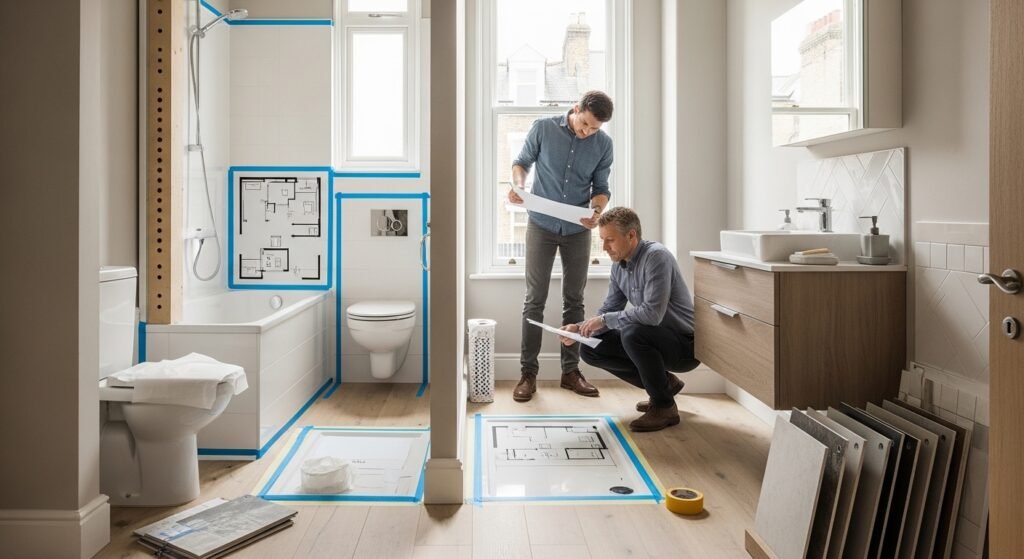
Identify where your soil pipe runs before designing the layout. In most Islington mid-terraces, the soil pipe runs vertically through a boxed column or built into the external rear wall, discharging through the external wall into the underground drain. Any layout where the WC stays close to this run is simpler and cheaper than any layout that moves it.
Keeping all fixtures in their original positions is the cheapest approach. Moving the basin or bath, but not the WC, is moderately more complex. Moving the WC requires a significant plumbing reroute and should be costed specifically before committing.
Once you know what the soil pipe permits, use painter’s tape on the floor to mark the footprint of every fixture before finalising the layout. A 550 to 600mm basin, a standard 1700 x 700mm bath, a 900 x 900mm shower tray, and a WC with 200mm clearance from side walls all need to fit with comfortable movement between them.
Step 4: Assess the Existing Plumbing and Electrics
Victorian terraces in Islington were built with iron pipe drainage that is now 100 to 140 years old. The supply pipework may be original lead or early copper, depending on when it was last updated. Neither performs well under modern demands, and both are commonly found in properties that have not had a full renovation.
Before any tiles are ordered or any contractor is committed, have a plumber assess the existing infrastructure. The questions that matter:
- Are the supply pipes lead or copper, and are they adequately sized for modern pressure and flow?
- What is the condition of the waste runs, and do they fall at the correct gradient?
- Is the existing soil pipe cast iron, which may be corroded, or modern plastic?
- Where does the existing drainage connect to the underground drain, and is there any evidence of existing blockages or restricted flow?
Islington’s mains water supply is very hard. This accelerates scale deposition in shower heads, on taps, inside boilers, and on heating elements. If your renovation includes a new shower or bath with quality fittings, budget for a water softener or scale inhibitor. Failure to do so means expensive fixtures degrade faster and are harder to clean.
The electrical assessment is equally important. Victorian terraces often have consumer units that were last updated in the 1970s or 1980s. Adding the electrical demand of a new heated towel rail, underfloor heating, IP-rated lighting, and a shaving socket from a consumer unit that is not rated for the additional load is a fire risk. A qualified electrician should assess the consumer unit capacity and the condition of existing wiring before any new circuits are added.
Step 5: Hire Your Trades in the Right Order
The order in which trades are hired and sequenced is the most common source of delay and cost overrun in bathroom renovations. It is worth checking for hidden leaks with leak detection before works begin. The correct sequence is:

- Main contractor or project manager (if using one) appointed first
- Plumber appointed and program confirmed
- Electrician appointed and the program has been confirmed
- Tiler appointed for after first fix
- Bathroom fitter or plumber for second fix sanitaryware
Do not order sanitaryware or tiles before the plumber has confirmed the layout is achievable and the first-fix positions are agreed. This sounds obvious and is routinely ignored. Tiles ordered before the tiler has assessed the wall condition end up as the wrong quantity or wrong format because the walls are not as flat or as square as assumed.
In Islington, reliable trades with Victorian terrace experience book several weeks in advance. Contact your plumber and electrician before you finalise any start date. Their availability should dictate the program, not your ideal start date.
Get three written quotes for each trade. In North London, plumber day rates run £350 to £500 per day. Electrician day rates run £300 to £450. Tiler day rates run £200 to £350. A full bathroom remodel typically takes two to three days of plumbing (first and second fix), two days of electrical work, and three to five days of tiling depending on the wall area and tile format.
Step 6: Strip Out the Old Bathroom
Strip-out is the most straightforward step but the one most likely to reveal problems. Do not proceed through strip-out too quickly. Once the old bathroom is removed, inspect the walls and floors carefully. Water damage behind baths or showers is common. If walls are uneven, you may need wall skimming before tiling.
Remove all sanitaryware, tiles, and flooring. Once tiles are off, inspect the walls for any evidence of water damage, rot in timber studwork, or failed tanking behind the shower area. In Victorian terraces, the walls are typically solid brick or lime-plastered brick. Solid walls that have suffered persistent moisture ingress behind a shower can have deteriorated render or eroded lime pointing that needs to be made good before new tanking is applied.
Check the floor condition once the floor covering is removed. Suspended timber floors in Victorian terraces can have compromised joists in the bathroom from long-term shower and bath leak damage. A joist that has been wet for years is often structurally compromised. Test every joist in the bathroom with a bradawl or screwdriver before proceeding. Soft, spongy timber needs replacing before any new floor tile is laid. Laying large-format porcelain on a bouncy or rotten subfloor results in cracked tiles and an expensive redo.
Dispose of all waste through a licensed skip or waste removal service. In Islington, a skip permit from Islington Council is required to place a skip on the public highway. This typically takes two to three working days to arrange and costs approximately £50 to £100.
Step 7: Address Hidden Problems Before Proceeding
The gap between strip-out and first fix is the moment to address every problem that the strip-out revealed. Do not press on past this point with outstanding structural, damp, or drainage issues.
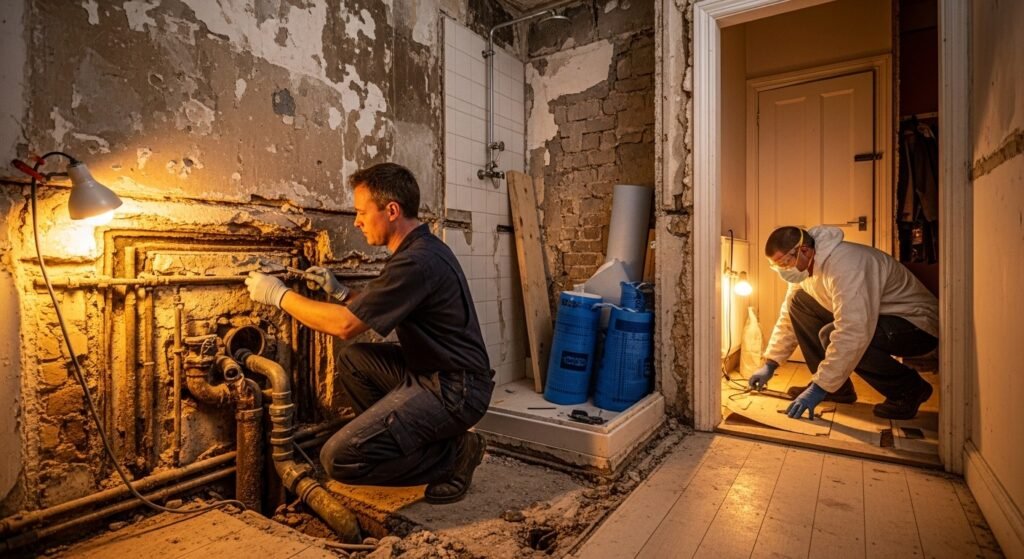
Common hidden problems in Islington Victorian bathroom renovations:
Corroded or lead supply pipes: If the cold water supply to the bathroom is via lead pipe, replace it now. Lead supply pipes are a public health risk and no longer legal in new or replacement plumbing. Replacing a lead pipe run to the bathroom while the floor and walls are already open costs far less than coming back to it later.
Inadequate drainage falls: Victorian drainage runs sometimes settled or were installed with inadequate gradient. A drain that falls less than 1:40 will not self-clear reliably and will produce persistent blockage and odour problems. If the existing drain runs are inadequate, they must be re-routed with correct gradient before any new connections are made.
Failed or absent tanking behind the shower: If there was a shower in the previous bathroom, check whether the wall behind it was properly tanked. Discovering that the previous shower was installed directly onto plaster without a waterproof membrane explains any damp patches in the room below or in adjacent walls. New tanking is the correct fix, not patching the damp from the other side.
Asbestos: Victorian terraces rarely contain asbestos. However, if the bathroom was updated in the 1970s or 1980s and contains textured ceiling coatings, old floor vinyl, or old pipe insulation, get these tested before disturbing them. If asbestos is identified, a licensed removal contractor must remove it.
Do not proceed to first fix until every item identified at this step is resolved. Doing so creates the conditions for problems to recur beneath the new finishes.
Step 8: Waterproof the Shower and Wet Areas
Waterproofing is the step most commonly skimped on in bathroom renovations, and the consequences appear a year or two after the renovation is completed when water has found its way through grout joints or board junctions into the structure behind. Proper waterproofing is essential. Tanking systems should be installed behind showers and wet zones before tiling begins. Many homeowners book waterproof tanking as a separate stage.
In an Islington Victorian terrace with solid brick walls, the correct waterproofing approach is a tanking system applied to the walls and floor of the shower area before tiling. Modern tanking systems use a cementitious or polymer membrane applied directly to solid wall backgrounds, with fabric tape at all internal angles and wall-to-floor junctions. Allow the full curing time specified by the manufacturer before tiling begins.
For walk-in shower areas and wet rooms, the floor must be structurally prepared to carry tile without any flex. Large-format tiles on a slightly bouncy timber subfloor will crack. If the existing timber floor cannot be adequately stiffened, a layer of tile backer board over the existing subfloor creates a stable, moisture-resistant substrate. Do not tile directly onto original floorboards.
The shower tray junction and waste connection are specific waterproofing risks. Seal the waste connection with a collar or appropriate waterproof seal before tiling. The junction between the shower tray and wall tile is the single most common point of water ingress in bathroom renovations: use silicone rather than grout at this junction, and allow the silicone to be compressed slightly by the tiles rather than running it as an exposed surface bead.
Step 9: First Fix Plumbing and Electrics
First fix is the stage at which all pipe runs and cable runs are installed in the wall and floor before the surfaces are closed up. This is the last opportunity to make changes to positions and routing without major cost. This stage installs hidden pipe runs and cable routes before surfaces are closed. Heated towel rails, lighting, extractor fans, and showers must all be planned in advance. Underfloor systems may need heating wiring support.
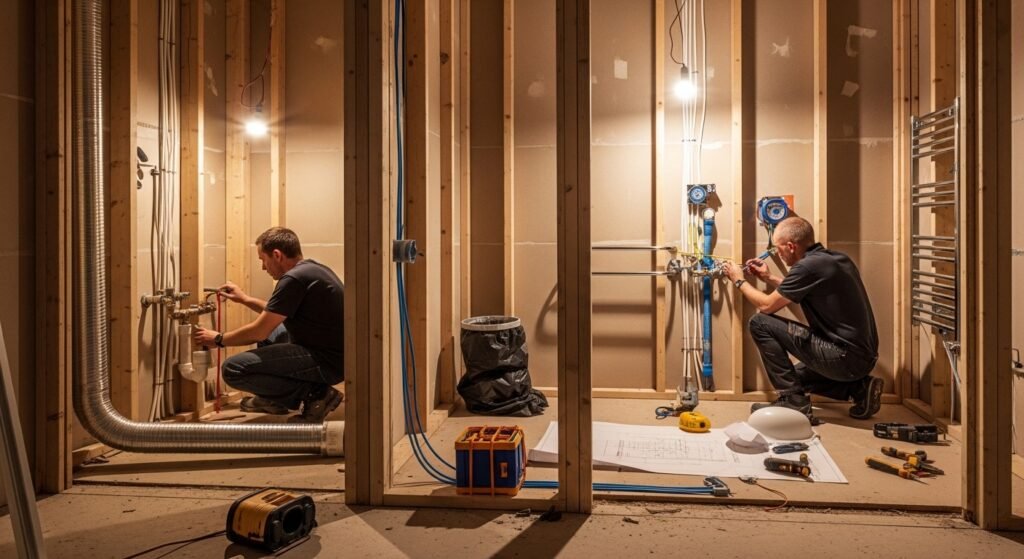
For the plumbing first fix, confirm the exact positions of all supply connections and waste outlets for each fixture before anything is boxed in or the walls are closed. The supply positions will be capped off and tiled over, and the waste outlets will be set at the correct height for the sanitaryware you have selected. Check these positions against the actual sanitaryware you have purchased before proceeding.
For the electrical first fix, all cable runs for lighting circuits, extractor fan, heated towel rail, underfloor heating mat thermostat, and shaving socket must be in place. In bathrooms, the IP zones apply to all electrical installations. Lighting must be IP44 minimum in Zone 1 (above the bath or shower to 2.25m height) and IP65 recommended. No sockets are permitted in bathrooms except shaving sockets that comply with BS EN 61558-2-5, positioned outside Zone 1 and Zone 2.
The extractor fan is mandated by Building Regulations Part F. For a bathroom with a bath or shower, the fan must extract at 15 litres per second minimum with a 15-minute overrun after the light is switched off. For a WC-only room, 6 litres per second is required. In a Victorian terrace without external wall access, the fan must be ducted through the ceiling into the loft and from there through a roof vent. Do not allow a contractor to duct a bathroom fan into the loft void without a vent to outside: this creates condensation and potential rot in the roof structure.
Step 10: Tile and Floor
Tiling is where the visual quality of the renovation is established. The choices made at this stage persist for 15 to 20 years, so the specification deserves more time than it typically receives. Tiling defines the final appearance of the room. Many projects include bathroom tiling on walls plus tile flooring for durability.
For wall tiles in an Islington Victorian terrace bathroom, the most common period-appropriate choices are full-height white ceramic metro tiles (75 x 150mm or 100 x 200mm), large-format porcelain in stone effect, or handmade zellige-style tiles for a more bespoke feel. Consider the scale of the tiles relative to the room size: large-format tiles (600 x 600mm and above) make small rooms appear larger and have fewer grout joints to clean, but they require an extremely flat and rigid substrate.
For floor tiles, porcelain with a slip resistance rating of R10 or better is the minimum for wet areas. Natural stone on bathroom floors needs sealing before use and regular resealing every one to two years in Islington’s hard water environment where mineral deposits accumulate on porous surfaces.
The choice of grout colour has a significant practical impact. White grout in a shower area stains and is genuinely difficult to keep clean in London’s hard water conditions. Matching or near-matching grout colours, or using epoxy grout which is non-porous and hard water resistant, are worth the additional cost in the shower zone specifically.
Allow 48 hours after tiling before walking on floor tiles, and follow the adhesive and grout manufacturer’s drying times before exposing the area to water.
Step 11: Second Fix Plumbing and Sanitaryware
Second fix connects all the sanitaryware to the pre-installed pipe runs and waste connections. This is typically a one to two-day visit for the plumber after tiling is complete. Once tiling is complete, sanitaryware is fitted and connected. This often includes shower installation, basins, taps, toilets, and heated towel rails.
Install sanitaryware in this order: wall-hung WC frame and wall-hung furniture first, then bath, then shower enclosure, then basin and vanity unit. The shower enclosure is the final piece in the spatial puzzle and benefits from everything else being in position to confirm exact measurements.
In Islington’s Victorian terraces, the water pressure at the top floor is often lower than expected because the property relies on the mains supply pressure rather than a pressurised system. If the shower you have selected requires a minimum dynamic pressure that the mains supply cannot deliver, you will need a pump or an unvented hot water cylinder. Confirm the water pressure before ordering a power shower or any shower that specifies a minimum flow rate.
Heated towel rails in Victorian terraces work best connected to the central heating circuit. This means the towel rail provides heat only when the heating is on. An electric element within the towel rail, fitted in addition to the central heating connection, allows it to run independently in summer. If you choose an electric-only towel rail, it is simpler to install but the running costs are higher.
Step 12: Sign Off, Test, and Document
The final step is signing off the completed work and ensuring all documentation is in place. This step is often skipped and costs homeowners money when they come to sell.
Collect all certificates before paying final invoices:
- Plumbing compliance certificate from your plumber confirming the work meets Building Regulations Part H (drainage) and Part G (water supply and sanitation)
- Electrical installation certificate from your electrician confirming all electrical work meets Part P
- Gas Safe certificate if any boiler or gas work was carried out
- Building Regulations completion certificate if a formal application was made for layout changes
For larger upgrades, some homeowners also consider nearby kitchen renovation works at the same time. Test everything before signing off: run the shower on full for five minutes and inspect beneath the shower tray for any evidence of leakage at the waste seal. Flush the WC and run every basin tap for evidence of adequate flow and drainage. Check the extractor fan is extracting at adequate rate by holding a paper towel near the grille to confirm suction.
Photograph the plumbing runs and electrical routes within the walls before they are closed up. This documentation is useful for future maintenance and is increasingly requested by buyers’ solicitors during conveyancing.
Keep the maintenance manual for the shower, WC cistern, taps, and any underfloor heating system in a file with the certificates. These documents have real value when the boiler breaks or a tap needs servicing and you no longer remember what brand or model you specified.
Islington-Specific Factors to Build Into Your Plan
Beyond the 12 steps, several factors specific to Islington Victorian terraces affect how the renovation proceeds.
Hard water protection: Thames Water’s supply to Islington is very hard, with calcium carbonate levels that accelerate scale on shower heads, taps, and heating elements. Specify a water softener or inline scale inhibitor at the mains supply. Chrome shower heads with anti-scale nozzles are a minimum specification.
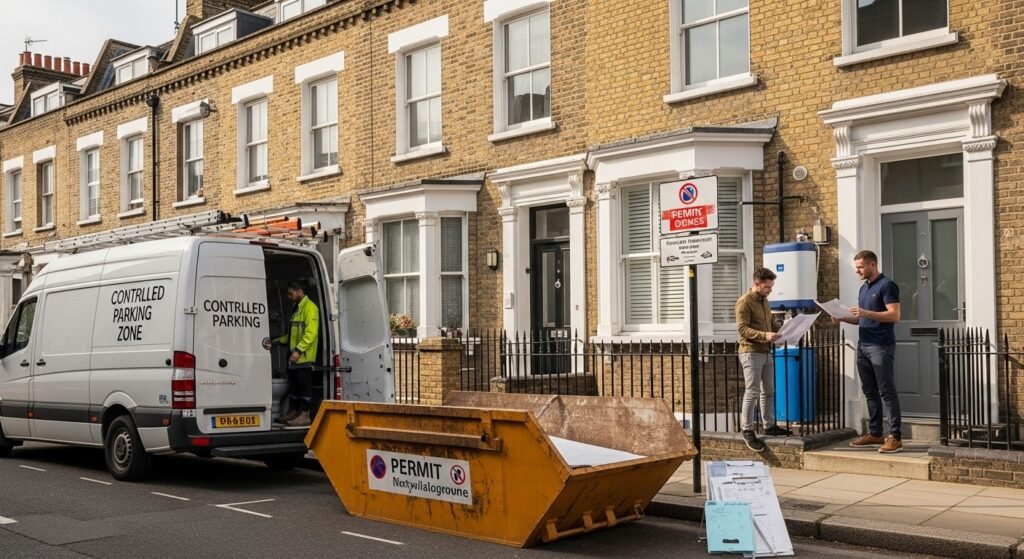
Parking and access: Most Islington streets are in controlled parking zones. Your contractor will need a trade parking permit or will need to pay for daily permits. This adds £15 to £30 per vehicle per day to the project cost and should be factored into quotes. Confirm whether any contractor quote includes or excludes parking.
Skip permits: As noted above, placing a skip on the public highway in Islington requires a permit from the council. Allow two to three working days for the application and include the permit fee (approximately £75 to £100 for two weeks) in the project budget.
Party wall considerations: A bathroom renovation that involves cutting into or connecting to a party wall shared with a neighbour may engage the Party Wall Act 1996, requiring you to serve a party wall notice on the adjoining owner before work begins. If you are boxing in pipework against a party wall or drilling through it for pipe runs, confirm with your contractor whether a party wall notice is needed.
Noise constraints: Islington has strict residential noise controls. Noisy demolition and mechanical work is restricted to 8 am to 6 pm Monday to Friday, and 8 am to 1 pm on Saturdays. No noisy work on Sundays or bank holidays. Build this into the program.
FAQ
Q: How long does a bathroom renovation take in Islington?
A straightforward bathroom renovation in an Islington Victorian terrace, where the layout is unchanged and there are no hidden problems, takes three to four weeks from strip-out to completion. This includes two to three days of strip-out, one week for first fix plumbing and electrics, two to three days for waterproofing and substrate preparation, three to five days for tiling, and two days for second fix and sanitaryware. Add one to two weeks if hidden problems are found at strip-out that need addressing.
Q: Do I need planning permission for a bathroom renovation in Islington?
In almost all cases, no. Internal bathroom renovations that do not change the external appearance of the property, add a new window, or alter the structure of the building are not development and do not require planning permission. Building Regulations approval is required if you are moving fixtures to new positions (creating new drainage runs), converting a room into a bathroom, or making alterations to electrics. If the property is listed, Listed Building Consent is required for any material alteration regardless of planning permission status.
Q: What is the most expensive mistake in Islington bathroom renovations?
Moving the WC to a position that is far from the soil pipe run. This single layout decision can add £1,000 to £3,000 to the plumbing cost and creates a more complex drainage installation that is harder to access and maintain. The second most expensive mistake is failing to adequately waterproof the shower area, which results in water ingress into the structure and a full redo of the shower within two to five years.
Q: Should I use a main contractor or manage trades myself for an Islington bathroom renovation?
For a straightforward bathroom remodel with layout unchanged, managing trades yourself is feasible and saves the main contractor margin of 15 to 25% on top of the trade costs. The trades you need to coordinate are plumber (first fix, second fix), electrician (first fix, second fix), and tiler. The risk of self-management is that if one trade overruns, it delays the next, and rebooking in London’s busy trades market adds time and sometimes additional cost. For a project with layout changes, structural elements, or a complex specification, a main contractor with bathroom project experience reduces the coordination risk significantly.
Q: How much should I budget for an Islington bathroom renovation in 2026?
A full remodel of a standard Victorian terrace bathroom (typically 4 to 6 square metres) with mid-range sanitaryware, porcelain tiling, and layout unchanged costs £10,000 to £16,000 all-in, including labour, materials, and a 15% contingency. Budget renovations with standard ceramic tiles and basic sanitaryware can reach completion at £8,000 to £12,000. Higher specification projects with natural stone, bespoke joinery, or luxury fixtures run £18,000 to £25,000 or more.
Conclusion
A bathroom renovation in an Islington Victorian terrace is not a complex project when it is planned correctly. The 12 steps in this checklist address the specific risks that trip up North London homeowners: the soil pipe constraints that limit layout options, the hard water that degrades fixtures, the Victorian plumbing that hides problems until walls are opened, and the building regulations requirements that create paperwork issues at the point of sale if they are ignored.
Work through the steps in order. Do not skip the planning steps to get to the exciting design decisions faster. The two to three weeks spent on Steps 1 through 5 before any physical work begins are where the project is either protected or exposed. Get that right and the rest follows a predictable path.

Tilly Bani is a renovation and roofing specialist with over 15 years of experience in construction and property refurbishment across North London. He specialises in roofing, structural repairs, and full home renovations, helping homeowners improve property value and safety.