
| Quick Answer The most common repairs in North London Victorian terraces are damp treatment, roof maintenance, sash window restoration, electrical rewiring, drainage clearance, and chimney and chimney breast repairs. Most of these stem from the age of the building stock, which dates from 1860 to 1910, and from decades of incompatible modern materials being applied to structures designed to breathe. Costs range from £300 for a CCTV drainage survey to £25,000 for subsidence underpinning. |
Introduction
Victorian terraces in North London are among the most sought-after properties in the country. Streets in Islington, Hackney, Haringey, and Camden are lined with solid-brick mid-terraces that have been family homes for over a century. But owning one comes with a predictable set of maintenance challenges. Many owners plan these works through wider full refurbishment upgrades over time.

These properties were built with materials and methods that are now 120 to 160 years old. The lead supply pipes, iron drainage, slate roofs, lime plaster walls, and timber floors all require specialist knowledge to repair correctly. This often means hiring contractors with broad building services experience in older homes. Understanding the most common repairs, what causes them, and what they cost in 2026 helps owners plan their budgets and avoid the expensive mistakes that come from using the wrong materials or the wrong contractors.
Rising Damp and Penetrating Damp
Damp is the single most common repair issue in North London Victorian terraces. Many cases are discovered during bathroom or bathroom installation upgrades. These houses were built with solid brick walls designed to absorb and release moisture through a process called vapour diffusion. The original lime mortar and lime plaster allowed water to move through the wall and evaporate safely.
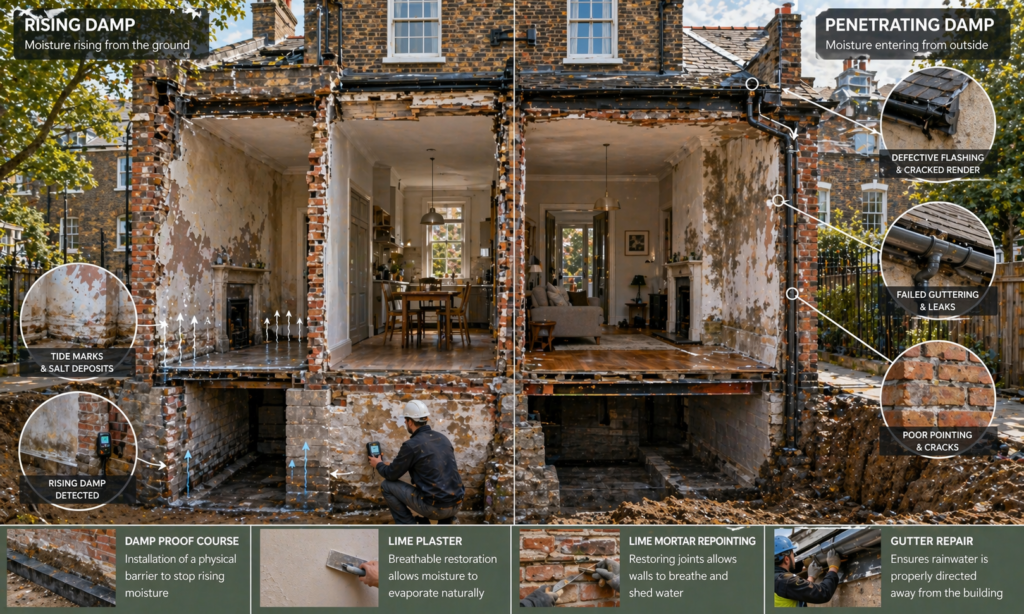
Problems begin when modern cement renders, vinyl paints, or plastic-based masonry treatments are applied to the outside or inside of solid brick walls. These materials block moisture movement. Water becomes trapped behind the surface, leading to salt deposits, spalling brickwork, peeling plaster, and mould growth.
Rising damp occurs when groundwater travels upward through the base of a wall. The original slate damp-proof course (DPC) in many Victorian terraces has deteriorated over 100 years and no longer functions as a barrier. Signs include tide marks on lower walls up to 1.5 metres high and white salt crystals on plaster surfaces.
Penetrating damp enters through defective pointing, cracked render, blocked gutters, or failed flashings. It is more common on rear elevations and outrigger walls in North London terraces where maintenance access is limited.
What the repair involves:
- Damp survey from a Property Care Association (PCA) qualified surveyor: £300 to £600
- Repointing with lime mortar (not cement): £30 to £50 per square metre
- Removal of impermeable render and replacement with hydraulic lime render: £60 to £120 per square metre
- Chemical DPC injection for rising damp: £800 to £2,500, depending on wall length
- Replastering with breathable lime plaster after damp is resolved: £35 to £60 per square metre. Damaged walls are often finished with full replastering once dry.
The most common mistake is treating damp with a chemical injection or tanking membrane before fixing the external cause. Water will always find another route if the source of ingress remains.
Roof Repairs: Nail Sickness, Flashing, and Ridge Tiles
The original slate roofs of North London Victorian terraces fail in predictable ways. Many owners book specialist roofing services for inspections and repairs. The most widespread problem is nail sickness, which occurs when the iron nails holding Welsh slate tiles in place corrode and snap. Individual tiles begin slipping, leaving gaps that allow water to enter. A roof where nail sickness is widespread cannot be repaired tile by tile indefinitely. The slates themselves are often still serviceable, but all must be removed, the nails replaced, and the slates rehung.
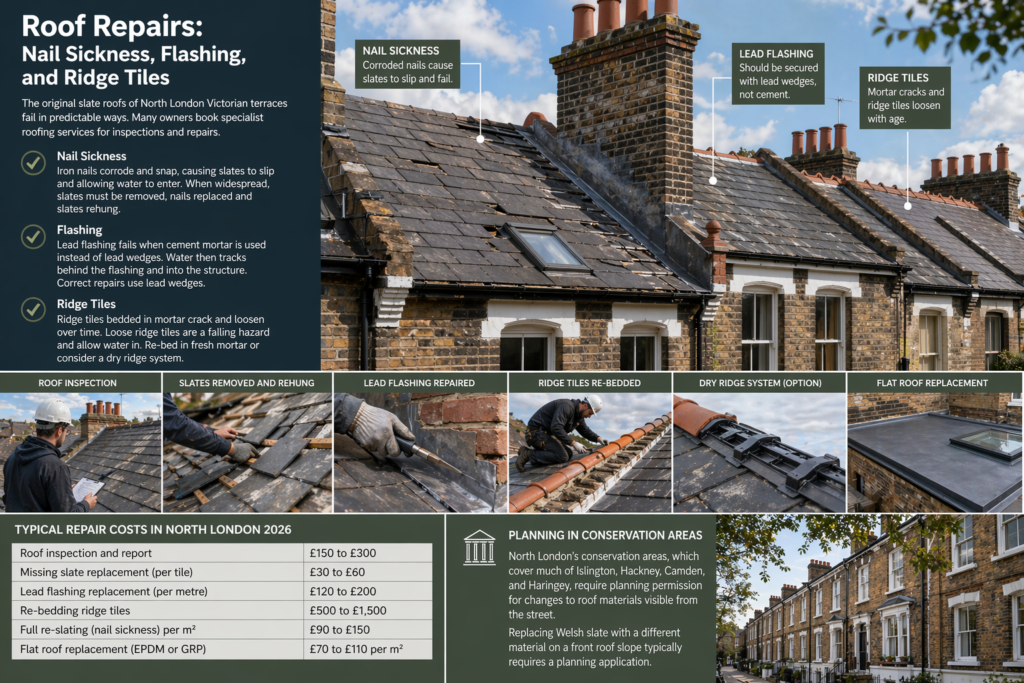
Lead flashing at chimney bases, valley gutters, and abutments fails when cement mortar is used instead of lead wedges to secure it. Older roofs may also need related chimney repairs at the same time. Cement pointing shrinks and cracks within years. Water then tracks behind the flashing and into the roof structure. The correct repair uses lead wedges hammered into the mortar joints, not surface-applied cement.
Ridge tiles on Victorian terraces are bedded in mortar on a sand base. After decades of thermal expansion, the mortar cracks and the ridge tiles loosen. In a storm, loose ridge tiles become a falling hazard and allow water into the roof structure below. Re-bedding ridge tiles in fresh mortar costs £500 to £1,500 depending on ridge length. Dry ridge systems, which use mechanical fixings rather than mortar, cost more upfront but are more durable.
Typical repair costs in North London 2026:
| Repair Type | Typical Cost |
|---|---|
| Roof inspection and report | £150 to £300 |
| Missing slate replacement (per tile) | £30 to £60 |
| Lead flashing replacement (per metre) | £120 to £200 |
| Re-bedding ridge tiles | £500 to £1,500 |
| Full re-slating (nail sickness) per m² | £90 to £150 |
| Flat roof replacement (EPDM or GRP) | £70 to £110 per m² |
North London’s conservation areas, which cover much of Islington, Hackney, Camden, and Haringey, require planning permission for changes to roof materials visible from the street. Replacing Welsh slate with a different material on a front roof slope typically requires a planning application.
Sash Windows: Draught, Rot, and Failed Cords
Sash windows are one of the defining features of North London Victorian terraces, and one of the most commonly neglected maintenance items. Many period owners prioritise sash window repair over full replacement. Original single-glazed timber sash windows require more attention than modern windows, but they are also more repairable and more valuable architecturally.
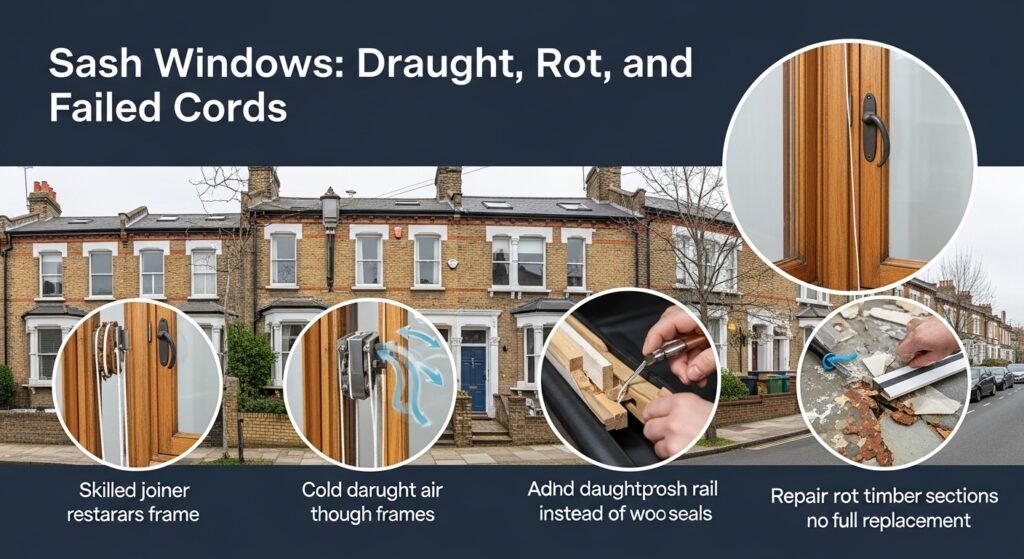
The three most common sash window problems are:
Failed sash cords. The cotton or hemp cords that counterbalance the sashes run over pulleys inside the box frame and attach to cast iron weights. These cords fail over time, causing the sash to drop and the window to be stuck or difficult to operate. Replacing cords requires opening the box frame, which takes a skilled joiner two to three hours per window. Cost: £100 to £200 per window.
Draught. Original sash windows were never airtight, and decades of paint and use widen the gaps around the sashes and between the meeting rails. Professionally draught-proofed sash windows, using machined channels and brush pile seals, reduce air infiltration by up to 86% according to Historic England research. Cost: £250 to £550 per window. VAT is zero-rated on draught-proofing of existing windows.
Timber rot. The lower rail of the bottom sash is the most vulnerable point. It sits closest to the external sill, catches rainwater, and on properties where the paint has not been maintained, moisture penetrates and causes wet rot. Minor rot can be repaired with epoxy consolidant and filler, preserving the original timber. Severe rot in the lower rail requires a new section to be scarf-jointed in, which takes longer but is far preferable to replacing the entire window in a conservation area.
In Islington, Hackney, and Camden, replacing original timber sash windows with uPVC requires planning permission and is almost never approved in conservation areas. Maintaining and draught-proofing original windows is both the correct conservation approach and the most cost-effective long-term strategy.
Electrical Rewiring
Most North London Victorian terraces that have not been renovated in the last 25 years have electrical installations that are either unsafe, non-compliant with current standards, or inadequate for modern demand. A full rewire should always be completed by qualified electrical work contractors. Original installations used rubber-insulated wiring, which degrades and becomes brittle over time. Early 1970s and 1980s rewires used PVC wiring that may now be 40 to 50 years old.
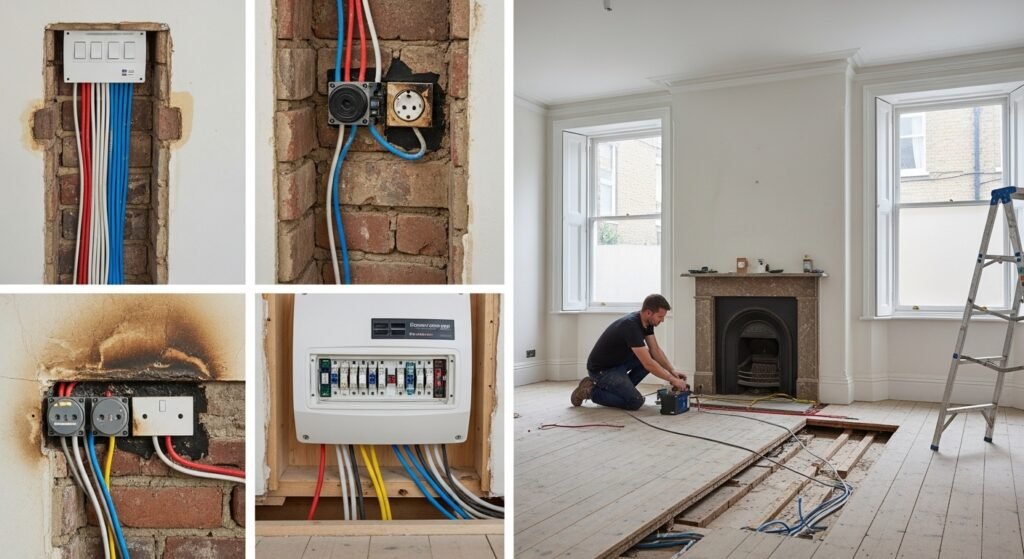
Indicators that rewiring is needed:
- Round-pin sockets or bakelite switches (pre-1960s wiring)
- Fuse box with ceramic fuses rather than a modern consumer unit with residual current devices (RCDs)
- Only one or two sockets per room
- Frequent blown fuses or tripped circuits
- Burning smell from outlets or scorching around socket faces
Rewiring a North London Victorian terrace is more disruptive and expensive than rewiring a modern property. Solid brick walls must be chased to route cables, original cornicing and plaster must be protected where possible, and the suspended timber floors must be lifted to run cables between floors. An experienced electrician working in Victorian terrace stock will plan cable routes to minimise damage to original features.
Rewiring costs in North London 2026:
| Property Size | Typical Cost |
|---|---|
| 2-bedroom Victorian terrace | £6,000 to £9,000 |
| 3-bedroom Victorian terrace | £8,000 to £12,000 |
| 4-bedroom Victorian terrace | £10,000 to £15,000 |
All electrical work in dwellings must be certified under Part P of the Building Regulations. A qualified electrician must issue an Electrical Installation Certificate on completion. Keep this document, as it is required by buyers’ solicitors on conveyancing.
Drainage: Blocked, Cracked, and Root-Invaded Pipes
North London Victorian terraces typically have clay drainage pipes that are 100 to 130 years old. Many systems now need CCTV checks and drainage repairs. Clay pipe drainage was the standard until the 1970s and is broadly durable, but fails in specific ways.

Tree root intrusion is the most common problem in streets with mature street trees, including large parts of Haringey, Hackney, and Islington. Fine roots from plane trees, limes, and London plane enter clay pipe joints and grow inside the pipe, restricting flow and eventually causing blockage or collapse.
Settlement causes pipe misalignment at joints. London clay is a reactive subsoil that expands when wet and contracts when dry. Over decades, this movement causes clay pipes to shift at their joints, creating step defects that accumulate debris and block.
Internal pipe corrosion is less common in clay pipes than in iron pipes, but cast iron underground drainage that was replaced in the 20th century sometimes remains in service and is now heavily corroded internally.
Diagnosis and repair costs:
- CCTV drainage survey: £150 to £350 (produces a report showing exact pipe condition and defect locations)
- High-pressure jetting (blockage clearance): £100 to £300
- Patch repair lining (localised defect): £150 to £400
- Full CIPP (cured-in-place pipe) relining (no excavation): £80 to £150 per metre
- Excavation and pipe replacement: £200 to £400 per metre plus reinstatement costs
Thames Water took responsibility for shared private sewers in 2011. Any sewer serving more than one property is now a public sewer and is Thames Water’s responsibility to maintain. If a blocked or collapsed drain serves only your property, it is yours to repair. A CCTV survey confirms which drains are shared and which are private.
Chimney and Chimney Breast Repairs
Victorian terraces were built with fireplaces in most rooms, served by shared chimney stacks running up through the party walls. As central heating replaced solid fuel fires from the 1960s onward, chimney maintenance declined. Many North London Victorian terrace chimneys are now in poor condition. Safe restoration often includes specialist chimney repairs and repointing.
Common chimney problems:
Spalling and eroded brickwork at the chimney stack above the roofline. Exposed to frost, rain, and thermal cycling, the stack brickwork deteriorates faster than the protected areas below. Soft or eroded brick faces on exposed stacks are common in Islington and Hackney.
Failed flaunching. The sloped mortar collar around the chimney pots (the flaunching) cracks and allows water to enter the chimney. This leads to internal damp in the rooms adjacent to the chimney breast. Reflaunching costs £300 to £800 depending on the number of pots and scaffold access requirements.
Chimney pot displacement. Loose or fallen chimney pots are a safety risk and allow water and bird entry into the flue.
Chimney breast removal. Many North London Victorian terrace owners remove chimney breasts to gain floor space. This is structural work that requires a steel beam to support the chimney stack above, and a party wall notice if the chimney breast is on or adjacent to the party wall (which it almost always is). Cost for a ground-floor chimney breast removal including steel and making good: £2,500 to £5,000.
Chimney pointing. The mortar joints on chimney stacks should be maintained with lime mortar, not cement. Cement pointing on a Victorian chimney traps moisture and accelerates brick deterioration through frost action.
Lead Supply Pipes
North London Victorian terraces with original supply plumbing often retain lead supply pipes from the water main connection to the property. Lead pipes were standard until the 1970s and remain in service in a significant number of properties in Islington, Hackney, and Camden.
Lead in drinking water is a public health concern. The World Health Organisation states there is no safe level of lead exposure. Replacing lead supply pipes is not elective maintenance. It is a health priority, particularly in properties with young children.
Thames Water runs an Assisted Lead Pipe Replacement scheme for the section of lead pipe from the water main to the property boundary. Replacement of the internal section from the boundary to the internal stop tap and through the property is the homeowner’s responsibility.
Lead pipe replacement within a Victorian terrace typically costs £1,500 to £3,500, depending on pipe run length and access. This work is commonly combined with wider pipework replacement upgrades. This work is best carried out when other works are already open, for example during a bathroom or kitchen renovation when floors and walls are already disrupted.
Subsidence and Foundation Movement
North London sits largely on London clay, a reactive subsoil that causes the most problematic form of foundation movement in the region. London clay shrinks during dry summers and expands during wet winters. Properties built on shallow Victorian strip foundations move with this seasonal cycle.
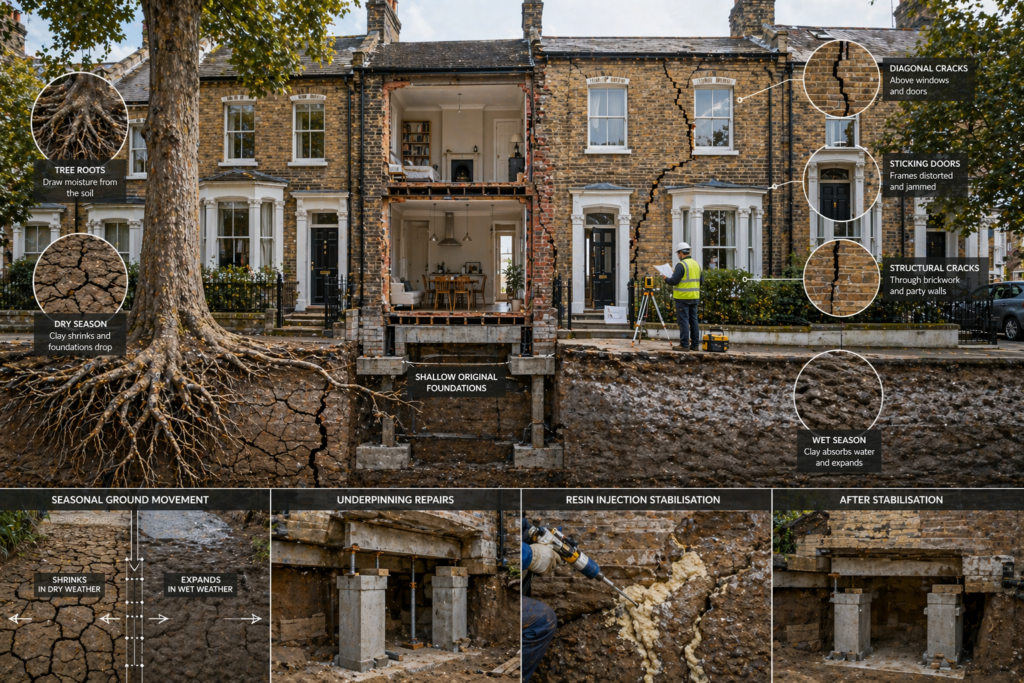
Most Victorian terrace movement is benign and cyclical. Diagonal cracks at window and door corners, slightly sticking doors in summer, and hairline cracks that open and close seasonally are all typical of London clay movement in buildings that are otherwise structurally stable.
Serious subsidence is distinguished by progressive cracking that does not close up, cracking that is wide at the top and narrow at the bottom (indicating rotation), or cracks that run through structural elements such as lintels. Subsidence in North London is most often caused by roots from nearby trees drying out the clay soil below the foundations.
Repair approach:
- Structural engineer inspection: £500 to £1,500
- Underpinning (traditional mass concrete): £15,000 to £25,000 for a North London terrace
- Resin injection underpinning: £10,000 to £20,000 (less disruptive, faster)
Buildings insurance covers subsidence damage in most standard home insurance policies, but subsidence claims increase premiums significantly and require disclosure to future buyers. Before claiming, get an independent structural engineer’s assessment. Not all cracking requires underpinning, and insurers’ preferred contractors sometimes recommend more extensive remediation than the structural situation warrants.
FAQ
Q: How much does it cost to repair a Victorian terrace in North London?
The cost depends entirely on what needs repairing and how much has been deferred. A cosmetic overhaul of an otherwise sound property runs £1,200 to £1,800 per square metre. A mid-range renovation, including rewiring, plumbing, damp treatment, and roof repairs, runs £1,800 to £2,500 per square metre. A full structural renovation with extension runs £2,500 to £4,000 per square metre in inner North London boroughs. Always add 15 to 20% contingency for Victorian terraces, where opening walls and floors routinely reveal additional issues.
Q: What is the most common problem in Victorian terraces in London?
Damp is the most frequently encountered issue. It affects a significant proportion of Victorian terraces that have been treated with impermeable modern materials, such as cement render or vinyl paint, which trap moisture in solid brick walls. The second most common issue is roof defects, particularly failing lead flashings at chimneys and nail sickness in original slate roofs. Both are caused by deferred maintenance rather than fundamental structural failure.
Q: Do I need planning permission to repair my Victorian terrace in Islington or Hackney?
Most internal repairs do not need planning permission. Like-for-like external repairs, such as replacing damaged slates with matching Welsh slate or repointing brickwork, also do not require permission. However, in the 40 conservation areas in Islington covered by Article 4 Directions, and in Hackney’s conservation areas, any change to the external appearance of the property including window replacement, render changes, or new rooflight installation requires a planning application. Always check with the council before changing external materials.
Q: Should I use lime mortar or cement mortar for Victorian terrace repairs?
Lime mortar for all repairs to Victorian brickwork and plasterwork. Victorian terraces were built with lime mortar, which is softer and more flexible than cement. Cement mortar is stronger than the brick itself and causes accelerated brick deterioration through frost action and moisture entrapment. Pointing or plastering a Victorian terrace with cement is the single most common cause of accelerated external wall deterioration in North London’s period housing stock. Use NHL 3.5 hydraulic lime mortar for external pointing and bedding.
Q: How do I know if cracks in my Victorian terrace are serious?
Cracks that are wider than 5mm, that are wide at the top and narrow at the bottom, that run through structural elements such as lintels or structural brickwork, or that are progressing consistently over several months warrant a structural engineer’s inspection. Hairline cracks at window corners and cracks that open in summer and close in winter are characteristic of normal London clay movement and are not structural emergencies. Photograph cracks and mark their ends with pencil and date before deciding whether to call an engineer. If there is no progression over three months, the movement is likely cyclical.
Q: What is nail sickness in a Victorian terrace roof?
Nail sickness occurs when the iron nails holding original Welsh slate tiles corrode and snap. The nails used in Victorian roof construction were wrought iron, not stainless steel. After 100 to 130 years, corrosion weakens the nails and they fracture, causing slates to slip or fall. Individual slates can be rehung using modern stainless steel nails or lead-headed nail fixings. When nail sickness is widespread across the roof, re-slating is more cost-effective than continuous patch repairs. The existing Welsh slates are usually still serviceable and can be cleaned and rehung on new battens.
Conclusion
Victorian terraces in North London are durable, well-built properties that with correct maintenance will stand for another century. The best outcomes usually come from trusted London builders with period property experience. The repairs that arise are predictable: damp from impermeable modern materials, roof failures from deferred maintenance, sash window deterioration from neglected paintwork, outdated electrical systems, ageing drainage, and chimney defects from decades of reduced use.
The consistent thread through all of these repairs is that using the wrong materials, specifically cement where lime is needed, or uPVC where timber should be maintained, creates more problems than it solves. North London Victorian terrace owners who invest in correct, breathable, period-appropriate repairs consistently spend less over time than those who apply quick modern fixes that must be undone and redone within a decade.
Find contractors with demonstrable Victorian terrace experience in North London, specifically. Ask to see their work on comparable properties. Confirm they use lime mortar, not cement. And budget for a 15 to 20% contingency, because Victorian terraces reliably reveal additional issues once the walls come down.

Tilly Bani is a renovation and roofing specialist with over 15 years of experience in construction and property refurbishment across North London. He specialises in roofing, structural repairs, and full home renovations, helping homeowners improve property value and safety.