
Quick Answer
Victorian terraces suffer from three main types of damp: rising damp, penetrating damp, and condensation. Rising damp comes from ground moisture moving up through solid brick walls that often have no working damp-proof course. Penetrating damp enters through damaged brickwork, pointing, or roofing. Condensation forms when warm, moist air meets cold walls in poorly ventilated rooms. Treatment costs in North London typically range from £600 for a single wall to £4,000 for a full damp proof course and re-plaster, with London labour rates running 15 to 25 percent above the national average.
Introduction
A tide mark is creeping up the skirting board. Paint that bubbles no matter how many times you repaint it. A musty smell in the front room that never quite goes away. If any of this sounds familiar, you are dealing with one of the most common problems in North London’s Victorian and Edwardian housing stock.
These homes were built between roughly 1837 and 1910, mostly with solid brick walls and no cavity. That construction style looks beautiful and holds up structurally, but it behaves very differently from a modern cavity wall when it comes to moisture. Understanding which type of damp you actually have is the first step to fixing it properly, and it is also the step most homeowners get wrong.
This guide breaks down the three types of damp found in period terraces, how to tell them apart, and what treatment and cost to expect in 2026. Damp is also a common trigger for cracked walls in a Victorian house, since moisture damage and structural movement often show up together in solid brick properties.
Why Victorian Terraces Are Especially Prone to Damp
Victorian and Edwardian terraces share a set of features that make them more vulnerable to damp than newer housing.
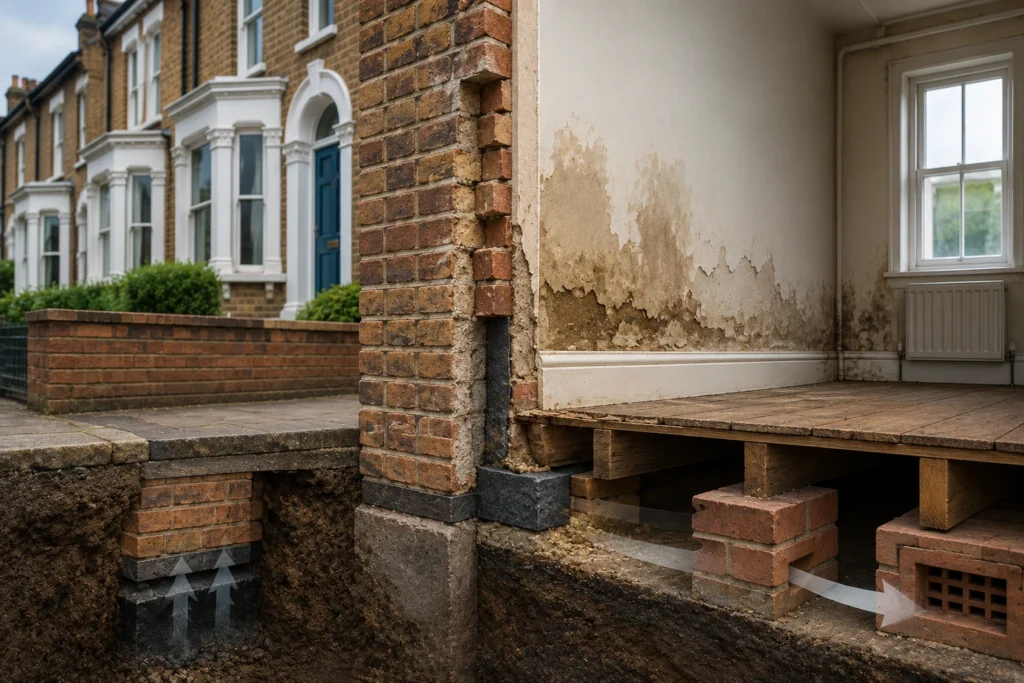
Solid brick walls, usually one brick thick, absorb and transmit moisture more readily than the cavity walls used in construction after the 1920s. There is no air gap to stop moisture from crossing from the outside face to the inside face of the wall.
Many of these properties also have a damp proof course, a physical barrier built into the wall to stop ground moisture rising, but it was often made from slate or bitumen felt. After 100 to 150 years, that original damp-proof course can crack, fail, or simply stop working.
Suspended timber ground floors, common in this era, create a void beneath the floorboards that needs airflow through air bricks to stay dry. When those air bricks get blocked, painted over, or buried under a raised patio or driveway, the timber underneath can rot.
External ground levels have also often risen over a century of paving, patios, and flower beds, sometimes to the point where they sit higher than the internal damp proof course. This bridges the barrier and lets moisture straight through, regardless of how sound the damp proof course originally was. In some cases, defects that require professional roofing services can also contribute to moisture problems within older properties.
The Three Types of Damp
Damp is not one problem. It is three distinct problems with three different causes, and treating the wrong one wastes money without fixing anything.
Rising Damp
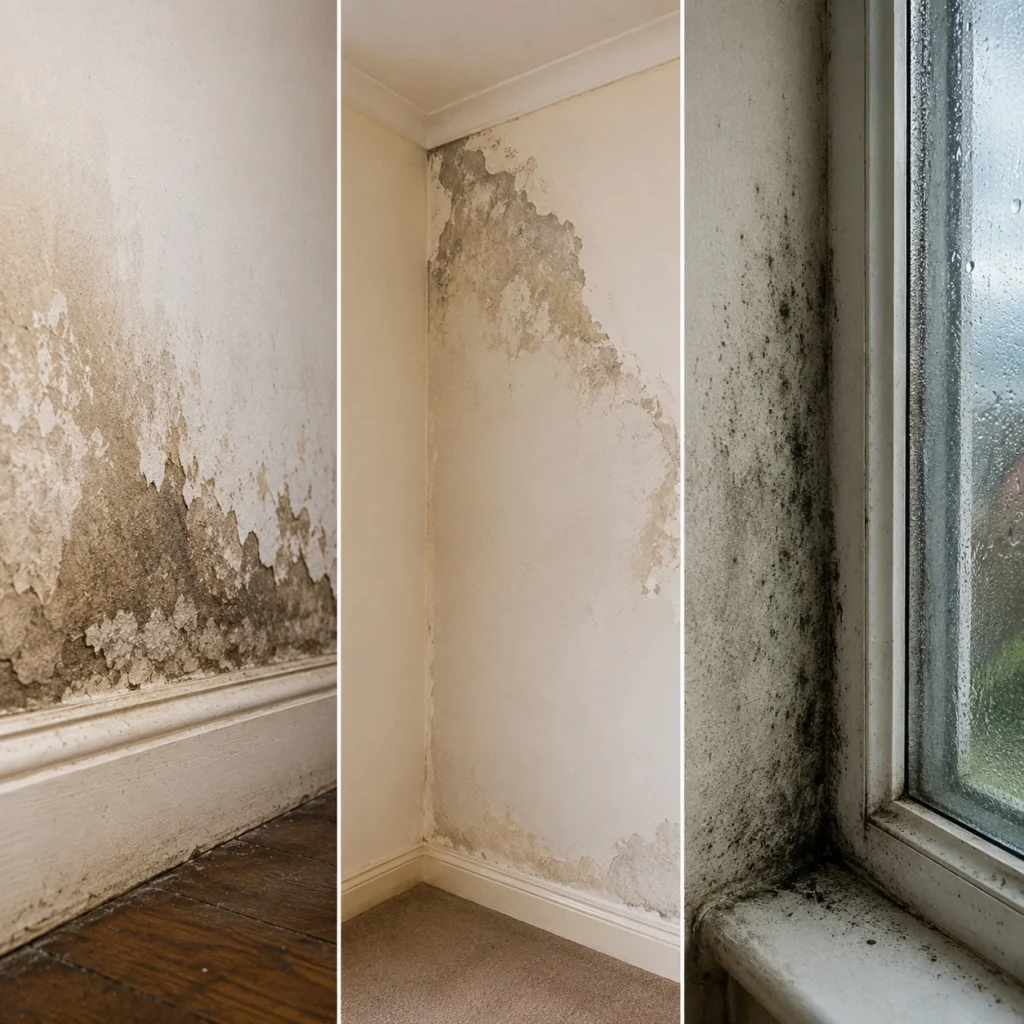
Rising damp happens when ground moisture travels upward through a wall by capillary action, the same way water climbs through a paper towel dipped in a tray. It typically affects the bottom of a wall, rising to around one metre in most cases, and rarely much higher.
Signs of rising damp include a tide mark or staining low on internal walls, crumbling or salt-stained plaster, and a persistent musty smell at skirting board height. Because rising damp carries mineral salts from the ground into the brickwork, those salts stay in the wall even after the moisture source is dealt with, which is why replastering with a salt-resistant finish usually follows treatment.
Penetrating Damp
Penetrating damp enters a building horizontally, through a defect somewhere in the external fabric. Common causes in a Victorian terrace include cracked or missing pointing between bricks, a damaged roof or flashing, blocked or leaking gutters, and render or brickwork that has failed.
Unlike rising damp, penetrating damp can appear at any height on a wall, including upstairs, and often follows a specific pattern, such as a patch directly below a broken gutter or around a window reveal where the seal has failed.
Condensation
Condensation is the most common type of damp in any London property, Victorian or otherwise. It occurs when warm, moisture-laden air, produced by cooking, showering, drying laundry indoors, or simply breathing, meets a colder surface such as a single-glazed sash window or an external solid wall, and the water vapour turns back into liquid.
It shows up as black mould in corners, on north-facing walls, and around window frames, particularly in bathrooms, kitchens, and bedrooms with poor ventilation. Condensation is usually the cheapest of the three to resolve, often through improved ventilation rather than chemical treatment. If you are renovating a kitchen to improve airflow and moisture control, professional worktop installation services can form part of a wider upgrade alongside extractor fans and ventilation improvements.
How to Tell the Difference: Diagnosis Signs?
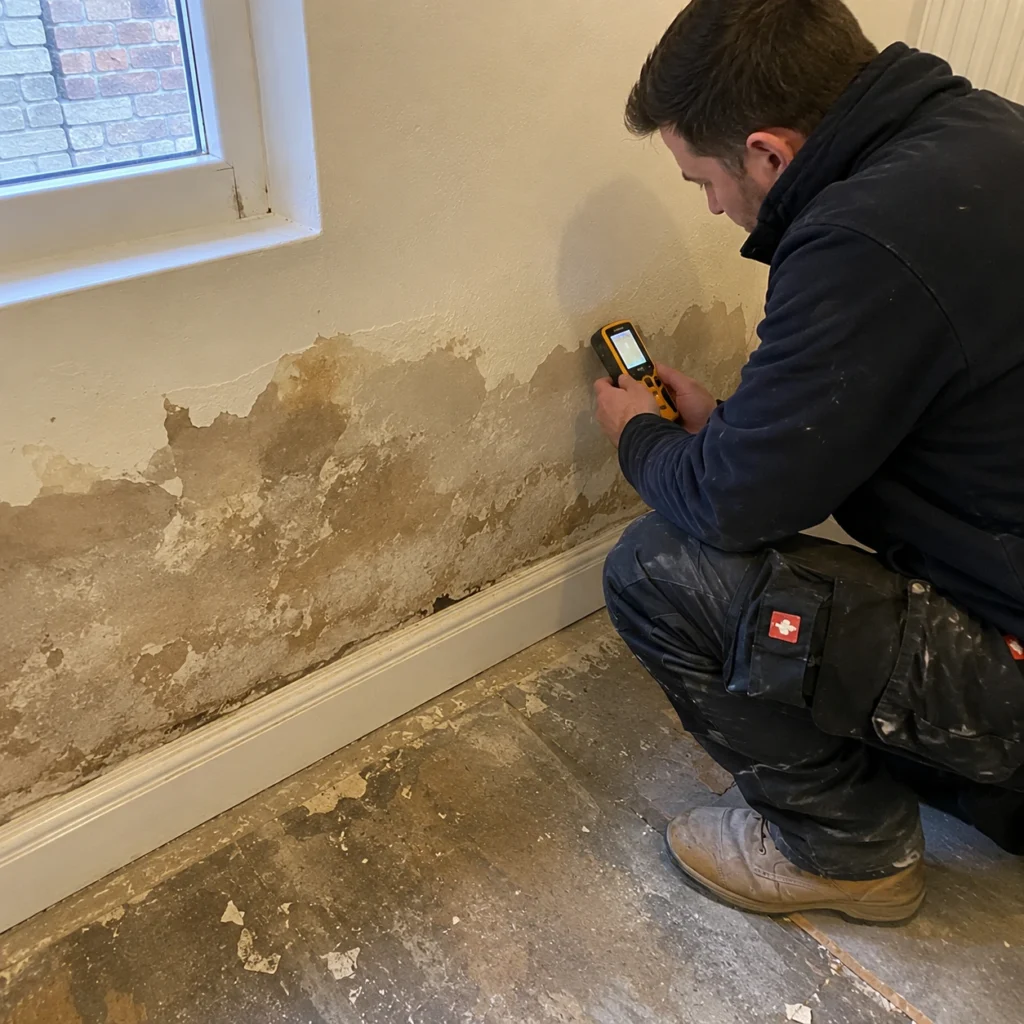
Misdiagnosis is the single biggest reason homeowners overpay for damp treatment. A specialist should always survey before quoting, but this table gives a starting point.
| Sign | Rising Damp | Penetrating Damp | Condensation |
|---|---|---|---|
| Height on the wall | Up to around 1m | Any height | Any height, worse in corners |
| Pattern | Even band along the skirt | Localised patch | Widespread, follows cold surfaces |
| Season | Fairly constant | Worse after heavy rain | Worse in winter, poor ventilation |
| Smell | Musty, earthy | Musty | Mouldy, mildew |
| Salts on plaster | Common | Rare | None |
| Typical cause | Failed or bridged DPC | Defect in the external fabric | Lifestyle and ventilation |
Damp Treatment Options and 2026 Costs
Once the type and cause are confirmed, treatment falls into a few standard categories. London prices sit consistently above the national average because of higher labour rates and the extra care period properties need, typically 15 to 25 percent higher across the board.
| Treatment | What It Involves | London Cost Range (2026) |
|---|---|---|
| Damp survey | Independent assessment before any work starts | £150 to £350 |
| Chemical DPC injection | Injecting a damp-proof cream into the base of the wall | £70 to £120 per linear metre |
| Single wall, DPC plus re-plaster | Injection and salt-resistant replastering, one wall | £600 to £1,200 |
| Whole-house DPC plus re-plaster | Full ground-floor treatment and reinstatement | £1,500 to £4,000 |
| Penetrating damp repair | Repointing, render repair, gutter or flashing fix | £2,000 average, varies with cause |
| Basement or cellar tanking | Membrane or cementitious waterproofing system | £4,000 to £14,000 |
| Timber treatment | Woodworm or rot treatment where damp has reached the joists | £400 to £1,000 |
| Ventilation upgrade (condensation) | Extractor fans, positive input ventilation (PIV) unit | £400 to £1,200 |
Replastering usually makes up 40 to 60 percent of the total bill on a rising damp job, because contaminated plaster has to come off before the wall can be finished properly. A quote that only covers the injection line and skips reinstatement is not a complete quote. See our full replastering service for typical timelines and what salt-resistant reinstatement involves.
Types of Damp Proof Course Explained
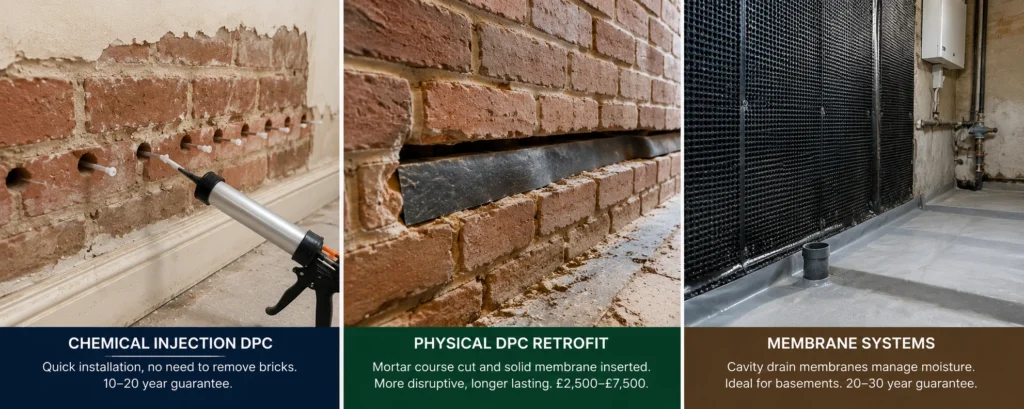
Not every damp proof course is the same product. Contractors quote three different systems, and mixing them up is a common source of confusion when comparing quotes.
Chemical Injection DPC
The most common method used in Victorian terraces today. A silicone or cream-based damp proofing fluid is injected through a row of drilled holes near the base of the wall, spreading through the brickwork to form a water-repellent barrier. It is quick to install, does not require removing brickwork, and typically comes with a 10 to 20-year guarantee.
Physical DPC Retrofit
Where a chemical injection is not suitable, usually in very thick or damaged walls, a physical damp proof course can be retrofitted. This involves cutting into the mortar course and inserting a solid membrane, such as slate or a polythene strip, as a barrier. It is more disruptive and expensive than chemical injection, typically £2,500 to £7,500, but can outlast chemical treatments in difficult cases.
Membrane Systems
Used mainly in basements, cellars, and severe rising damp cases where chemical injection alone will not hold back the volume of moisture. A cavity drain membrane is fixed to the wall and floor, creating a void that channels moisture away rather than trying to stop it entirely. This is the standard approach for basement tanking and typically carries a longer guarantee, often 20 to 30 years, because the system manages water rather than depending on a chemical barrier staying intact.
Preventing Damp From Coming Back
Treatment fixes the immediate problem, but a few maintenance habits reduce the chance of damp returning, particularly for condensation and penetrating damp.
- Keep air bricks clear. Never block, paint over, or render across an air brick, since it ventilates the void under a suspended timber floor.
- Check external ground levels twice a year. Paving, flower beds, or a raised patio should sit at least 150mm below the internal damp proof course.
- Clear gutters and check pointing annually, ideally before winter. A blocked gutter or a single missing patch of pointing is one of the most common causes of penetrating damp in Victorian terraces.
- Run extractor fans in the kitchen and bathroom during and after cooking or showering, and keep trickle vents on windows open where fitted. If your current bathroom lacks adequate ventilation, investing in professional bathroom installation services can help improve airflow, reduce excess moisture, and lower the risk of condensation-related damp problems.
- Avoid drying laundry on radiators indoors without ventilation, since this is one of the single biggest contributors to condensation in London flats and terraces.
Damp in Shared Party Walls: A Terrace-Specific Issue
Terraced houses share a party wall with the property on each side, and damp does not always respect that boundary. Rising damp or a failed damp proof course in one property can sometimes affect the neighbouring wall too, particularly where the row was built at the same time with a continuous damp proof course running along the terrace.
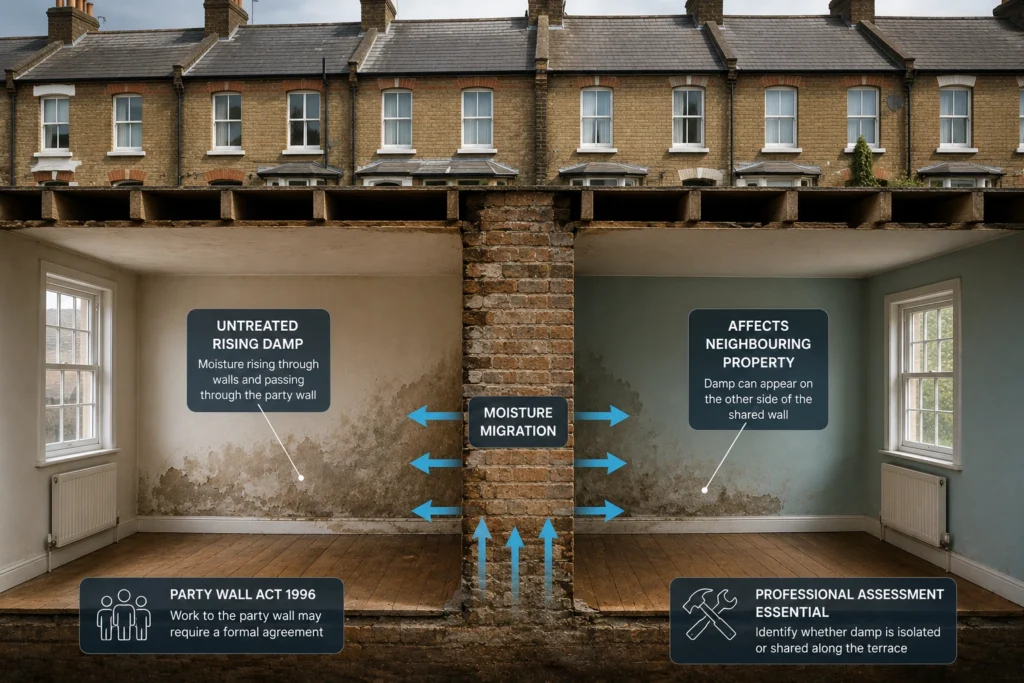
This matters for two practical reasons. First, if a neighbour’s property has untreated rising damp, moisture can migrate through the shared wall regardless of what you do to your own side. Second, any work that involves cutting into or injecting a party wall, including a physical DPC retrofit, may fall under the Party Wall etc. The Act of 1996 and require a party wall agreement before work starts.
A specialist working on a mid-terrace property should always check whether the damp source is isolated to one house or shared along the row, since treating only one side of a party wall problem rarely solves it long-term. Where damp has already caused damage to skirting boards, floor joists, or other timber features, professional carpentry and joinery services may be required as part of the restoration process.
The Cost of Ignoring Damp
Damp rarely stays the same size. What starts as a faint tide mark or a patch of peeling paint tends to spread while the underlying cause goes untreated.
Left long enough, rising and penetrating damp can reach timber joists and skirting boards, leading to wood rot that is significantly more expensive to fix than the original damp issue. Persistent condensation encourages mould growth, which has documented health effects, particularly for children and anyone with asthma or a respiratory condition. In older properties, investing in sash window draught proofing can also help reduce cold spots around windows where condensation commonly forms.
Untreated damp is also a common reason for a lower survey valuation or a delayed sale. Buyers’ surveyors flag damp as standard practice, and an unresolved damp report gives a buyer leverage to negotiate the price down, often by more than the treatment would have cost in the first place.
Choosing a Damp Specialist in North London
Look for a contractor who diagnoses before they quote. Anyone who offers a fixed price for DPC injection over the phone, without inspecting the property, either inside or outside, is guessing.
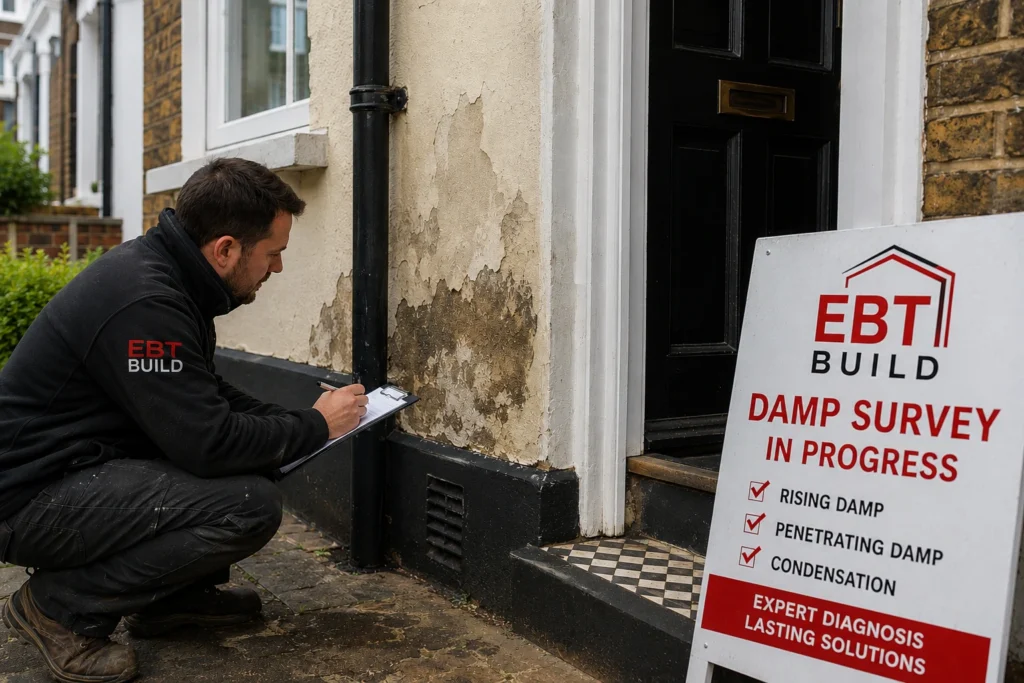
A proper survey checks external ground levels against the internal damp proof course, inspects pointing, gutters, and flashing for penetrating damp, and only recommends chemical injection once rising damp is actually confirmed. Membership of the Property Care Association (PCA) is a reasonable trust signal, since PCA members follow an industry code of practice for damp diagnosis and treatment.
In Islington, Camden, and Hackney’s older terraced streets, penetrating damp is frequently misdiagnosed as rising damp because the two can look similar at first glance. The fix is completely different, and getting it wrong means paying for a chemical DPC that never addresses the actual source of the moisture. Our Islington damp proofing guide covers borough-specific planning and property considerations in more depth.
EBT Build surveys, diagnoses, and treats all three types of damp across North London’s Victorian and Edwardian terraces, with quotes that separate treatment from reinstatement, so there are no surprises once the plaster comes off. For general wall and ceiling repair work alongside damp treatment, see our plastering and decorating service.
Frequently Asked Questions
Q: How do I know if it’s rising damp or condensation?
Rising damp stays roughly level along the base of a wall, rarely climbing higher than a metre, and often leaves white salt deposits on the plaster. Condensation appears at any height, is worse in corners and on north-facing walls, and shows up as black mould rather than salt staining. A damp meter reading alone is not enough. Get a full survey if you are unsure.
Q: Can I treat rising damp myself?
Minor condensation can often be improved with better ventilation and extractor fans without a specialist. Rising and penetrating damp involve diagnosing the actual cause, which usually requires professional equipment and experience. DIY chemical injection kits exist, but incorrect application is one of the most common reasons rising damp treatments fail and need redoing.
Q: How long does damp treatment take in a Victorian terrace?
A single-wall DPC injection and re-plaster usually takes 3 to 5 days, including drying time before decoration. A whole ground-floor treatment can take 1 to 2 weeks. The room typically needs to stay unoccupied and undecorated for several weeks after plastering to allow the new plaster to dry fully before painting.
Q: Does building insurance cover damp?
Most standard building insurance policies do not cover rising damp or condensation, since these are classed as gradual deterioration rather than sudden damage. Penetrating damp caused by a specific insured event, such as storm damage to a roof, may be covered. Always check the policy wording and speak to your insurer before assuming a claim will be accepted.
Q: Will damp proofing stop mould coming back?
It depends on the cause. If the mould was caused by rising or penetrating damp and the source is properly fixed, mould should not return in that area. If the mould was caused by condensation, treating the wall alone will not solve it. Ventilation and heating habits also need to change, or the mould will come back regardless of any chemical treatment applied.
Q: How much does a damp survey cost in London?
An independent damp survey in London typically costs between £150 and £350. This is separate from any treatment cost and should always come first. A survey from a company that also carries out the treatment work can create a conflict of interest, so an independent second opinion is worth considering for a large or ambiguous job.
Conclusion
Damp in a Victorian terrace is rarely one simple problem. Getting the diagnosis right, rising, penetrating, or condensation, determines whether the treatment actually works or whether the same tide mark reappears a year later. If you are seeing signs of damp in an Islington, Camden, or Hackney terrace, book a proper survey before agreeing to any treatment, and ask exactly what the quote includes beyond the injection line.
EBT Build offers damp surveys and treatment across North London’s period properties. Get in touch for a free site assessment and a quote that covers the full job, not just the parts that are easy to price.

Tilly Bani is a renovation and roofing specialist with over 15 years of experience in construction and property refurbishment across North London. He specialises in roofing, structural repairs, and full home renovations, helping homeowners improve property value and safety.