
| Quick Answer Most single-storey rear kitchen extensions in Hackney do not need planning permission, provided the extension stays within 3 metres in depth for a terraced or semi-detached house, does not exceed 4 metres in height, and the property is not in a conservation area or covered by an Article 4 Direction. Many homeowners begin by consulting kitchen renovation specialists before finalising drawings or submitting plans. If your property is in a conservation area or Article 4 zone, extra rules may apply. Side return extensions on Victorian terraces are also generally permitted development within the same depth limits. The Larger Home Extension scheme allows extensions up to 6 metres deep on terraced properties, subject to a neighbour consultation process. If your property sits in one of Hackney’s 35 conservation areas, additional rules apply. |
Introduction
Hackney is one of the most popular boroughs in London for kitchen extension projects. Victorian and Edwardian terraces in Dalston, Stoke Newington, Hackney Wick, Victoria Park, and Broadway Market have the side returns and rear gardens that make open-plan kitchen-diner extensions genuinely transformative. A dark, cramped ground floor becomes a bright, connected space that reaches into the garden. Many owners also compare local kitchen fitters when planning the build.
The planning question is the first thing most Hackney homeowners hit: do I need permission, and if so, how complicated will this be? The answer depends on your property type, its conservation area status, the depth and height of the proposed extension, and whether you are converting a Hackney Victorian terrace or something else entirely. Some projects are bundled into wider full refurbishment works for better value.
This guide covers the specific rules that apply in Hackney in 2026, including the conservation area complications, the Larger Home Extension scheme, what happens if you do need full planning permission, and what a kitchen extension realistically costs across different specification levels.
The Basic Rule: Permitted Development for Rear Extensions
Under national permitted development rules, a single-storey rear extension often does not need planning permission if size and height limits are met. Many extensions also require new flat roof installation or rooflight work.
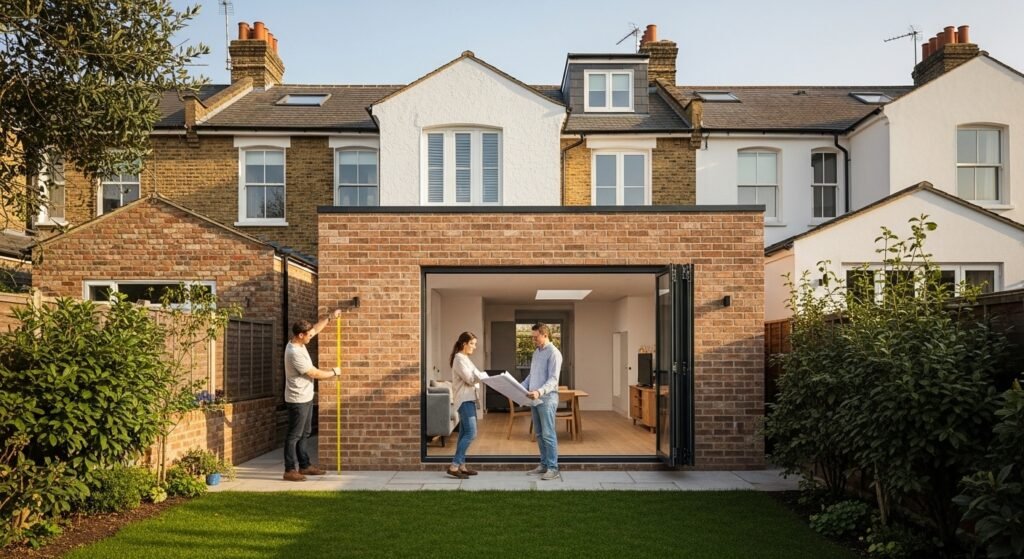
- The extension does not extend beyond the rear wall of the original house by more than 3 metres for a terraced or semi-detached house, or 4 metres for a detached house
- The maximum height of the extension does not exceed 4 metres (or 3 metres if within 2 metres of the property boundary)
- The extension covers no more than half the garden area of the original house
- The materials used are similar in appearance to the existing house
- There are no verandas, raised platforms, or balconies
These limits apply to the “original house”, which is defined as the house as it stood on 1 July 1948, or as it was first built after that date. Any extensions already added to the property count against the permitted development limits, even if they were built before you owned it.
For most Victorian terraces in Hackney, a standard 3 metre rear extension fits within permitted development. Internal layouts are often improved with stud wall construction once the shell is complete. Many Hackney kitchen extensions go 3 metres beyond the original rear wall of the house (not the existing rear addition or outrigger, which is typically 4 to 6 metres deep already), meaning the actual extension from the garden is shallower than you might assume.
The Larger Home Extension Scheme (Prior Approval)
The Larger Home Extension scheme, made permanent in 2019, allows bigger single-storey rear extensions than standard permitted development limits, using a lighter-touch Prior Approval process rather than a full planning application. Many homeowners use this option when creating larger kitchen-diners with bespoke kitchen units.
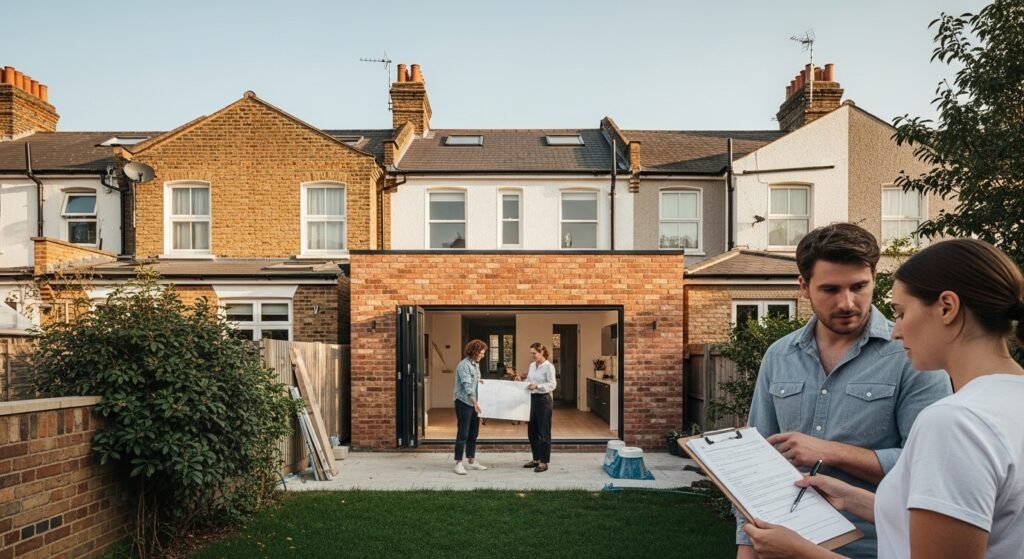
Under this scheme:
- Terraced and semi-detached houses: Up to 6 metres deep (instead of 3m standard PD)
- Detached houses: Up to 8 metres deep (instead of 4m standard PD)
- The maximum height remains 4 metres for single-storey
- The extension must not exceed half the garden area
To use this route, your builder or architect notifies Hackney Council of the proposed development. Hackney then contacts your adjacent neighbours, who have 21 days to object. If no objections are raised, the extension can proceed. If objections are raised, the council assesses whether the extension would have an unacceptable impact on the amenity of adjoining properties.
For Hackney kitchen extensions that need to go deeper than 3 metres but do not need full planning permission, this Prior Approval route is the correct process. It is considerably faster and cheaper than a full application, and approval is the typical outcome where the design is considered, and neighbours are consulted early.
Important: The Larger Home Extension scheme does not apply in conservation areas. If your property is in a conservation area, the standard 3-metre limit (for a terrace) applies to permitted development.
Conservation Areas in Hackney: Where the Rules Tighten
Hackney has 35 designated conservation areas. These cover major swaths of the borough, including Victoria Park, Broadway Market, Albion Square, De Beauvoir Town, Stoke Newington, Dalston Lane, Clapton Common, Clapton Square, Lordship Park, Hackney Wick, Hoxton Street, Mare Street, and many more streets and neighbourhoods across east and north Hackney. Owners often work with experienced Hackney builders familiar with council requirements.
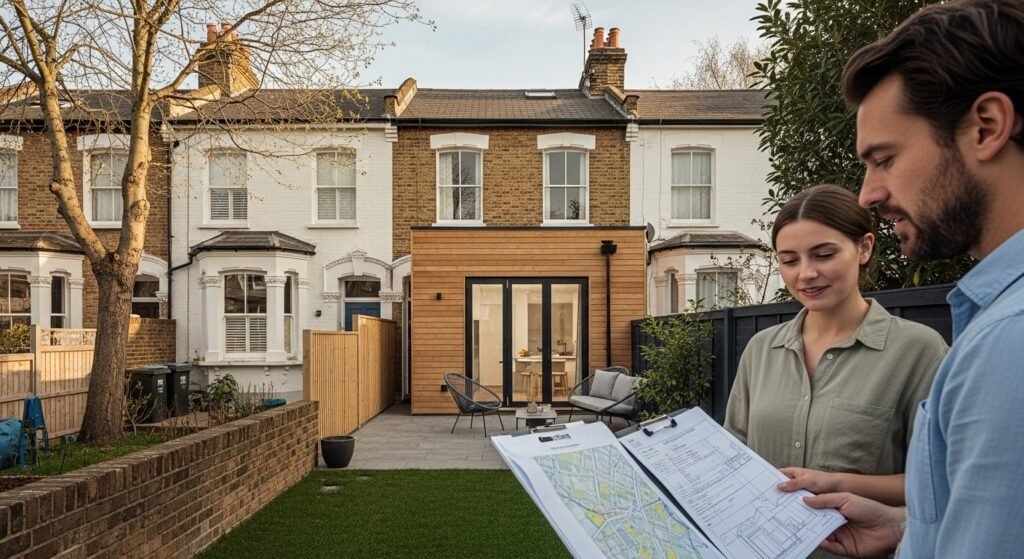
If your property is in a conservation area, the standard national permitted development rules still apply to single-storey rear extensions, with one important difference: side extensions are not permitted development on designated land (which includes all conservation areas). Any extension to the side of your house in a conservation area requires a full planning application.
For rear extensions in conservation areas, the depth limits remain 3 metres for a terrace or semi, but the materials and design are assessed more carefully because any extension must preserve or enhance the character of the conservation area. Matching finishes like door installation and heritage details can help create a stronger application. This does not mean you must build in period style, but it does mean that the design, materials, and impact on the surrounding area will be assessed against Hackney’s conservation area guidelines.
Article 4 Directions in Hackney
On top of the standard conservation area rules, some Hackney conservation areas have Article 4 Directions in place that remove further permitted development rights. Many owners seek advice before booking bathroom renovation or kitchen renovation together. The conservation areas currently subject to Article 4 Directions affecting householder works include:
- Brownswood Conservation Area
- Beck Road Conservation Area
- Well Street Conservation Area
- De Beauvoir Conservation Area (check specific direction)
- St Mark’s Conservation Area (check specific direction)
In these areas, works that would normally be permitted development elsewhere in Hackney require a planning application. For kitchen extensions specifically, this means that even a standard 3-metre rear extension may need formal planning permission in these areas, depending on the specific rights removed by the direction.
Always check the Hackney Council planning map before assuming permitted development applies to your property. The interactive map at hackney.gov.uk confirms both conservation area status and any applicable Article 4 Directions.
Side Return Extensions and Planning in Hackney
The side return is the narrow passage that runs alongside the rear outrigger of a Victorian or Edwardian terrace. It widens the rear of the house and creates space for a larger kitchen. Popular upgrades include bespoke worktop installation and modern glazing. On a typical Hackney terrace, this passage is 0.9 to 1.8 metres wide and runs the length of the ground-floor kitchen extension at the rear.
Filling in the side return and connecting it to the existing ground floor space is one of the most popular home improvement projects in Hackney. The result is a significantly wider kitchen or kitchen-diner, often with a glazed roof section that brings natural light into the heart of the ground floor.
For houses outside conservation areas in Hackney: A single-storey side return extension is permitted development provided it does not extend beyond the side wall of the house by more than half the width of the original house, does not exceed 4 metres in height, and uses materials that match the house. In practice, most Victorian terrace side returns in Hackney meet these criteria without needing planning permission.
For houses inside conservation areas: Side extensions are not permitted development on designated land. A planning application is required. Hackney’s planning officers generally support well-designed side return extensions in conservation areas, but the design must be considered, and materials must be sympathetic. A contemporary flat-roof glass extension is frequently approved where it does not harm the character of the conservation area. Plain brick matching the existing house is also commonly accepted.
For houses in Article 4 Direction areas, A planning application is required regardless of whether the extension would meet permitted development criteria elsewhere. In these areas, Hackney’s planning team applies the full conservation area assessment to the proposal.
When You Definitely Need Full Planning Permission
Beyond conservation areas and Article 4 zones, a kitchen extension requires a full householder planning application in any of these scenarios:
- The extension is two storeys rather than single-storey, or it exceeds 4 metres in height
- The extension exceeds the standard permitted development depth limits (3m for a terrace under standard PD)
- The property is a flat rather than a house. Flats and maisonettes do not benefit from permitted development rights. Any extension to a flat in Hackney requires planning permission.
- The extension materially changes the external appearance of the property in a way that falls outside the permitted development criteria
- A previous planning condition on the property has removed permitted development rights (check the original planning permission if your property was built or significantly extended after 1948)
- The property is listed. Hackney has over 1,300 listed buildings. Any extension to a listed building requires both planning permission and Listed Building Consent, regardless of its size or position.
Listed homes may also need heritage-sensitive window frames sills upgrades during works.
Making a Householder Planning Application in Hackney
If a full planning application is required, here is what the process involves in Hackney in 2026.

Application fee: The current householder application fee is £258 for extensions and alterations to a single dwelling house.
What you need to submit:
- Completed application form (via Hackney’s planning portal or Planning Portal)
- Location plan showing the site boundary at 1:1250 scale
- Site plan showing the existing and proposed footprint at 1:500 or 1:200 scale
- Existing and proposed floor plans at 1:50 or 1:100 scale
- Existing and proposed elevations at 1:50 or 1:100 scale
- Design and access statement (required for larger extensions or conservation area applications)
- Heritage statement (required if in a conservation area or if the property is listed)
Timeline: Hackney Council’s target is 8 weeks for householder applications. In practice, well-prepared applications in Hackney are typically decided within this window. Applications involving conservation areas or heritage assets may take longer, particularly if a heritage statement is required and requires iteration with the conservation officer.
Pre-application advice: Hackney offers a pre-application advice service for householder applications. This service provides written feedback from a planning officer on a proposed design before the formal application is submitted. For conservation area extensions or larger projects, pre-application advice is worth the cost because it identifies issues before you incur drawing fees and application costs for a scheme that may need significant revision.
Success rates: The vast majority of well-designed householder applications in Hackney are approved. Refusals are concentrated in cases where the extension is materially harmful to a conservation area’s character, overshadows neighbouring properties significantly, or is disproportionate to the original house in scale.
Build Over Agreements and Public Sewers
Many Victorian terraces in Hackney have public sewers running beneath the rear garden or close to the proposed extension footprint. If building close to them, a Build Over Agreement may be needed. Drainage checks sometimes uncover the need for drainage repairs. Under Thames Water’s sewerage network, if your extension will be built within 3 metres of a public sewer, or over one, you need a Build Over Agreement from Thames Water before construction begins.
This is a separate requirement from planning permission and building regulations, and is one that many homeowners discover late in the process. Thames Water charges approximately £350 to £450 for a standard Build Over Agreement, and the process takes four to six weeks.
Your architect or structural engineer should identify whether any sewers are within the relevant distance during the design stage. Thames Water has an online sewer map that allows you to check sewer locations by address.
Party Wall Agreements
Any kitchen extension in Hackney that involves excavating foundations within 3 metres of a neighbour’s property, cutting into or building on a shared boundary wall, or working on an existing party structure requires a Party Wall Notice to be served on affected neighbours at least two months before work begins.
The Party Wall etc. Act 1996 governs this process. Serving a notice does not mean your neighbour can block the extension. It triggers a formal process that protects both parties. Your neighbour can either consent to the works (in which case no further formal process is needed) or appoint a surveyor, which leads to a Party Wall Award documenting how the works will be carried out.
Party Wall surveyors in Hackney typically charge £700 to £1,500 per owner they represent, for a standard kitchen extension project. The Party Wall Award takes four to eight weeks to conclude once a surveyor is appointed.
Most kitchen extension projects in Hackney on a terrace involve at least one shared boundary wall. Build this into the program from the beginning. Notices should be served early to avoid delays. Some owners also coordinate neighbouring upgrades like tile flooring or joint access arrangements.
What a Hackney Kitchen Extension Costs in 2026
Kitchen extension costs in Hackney reflect inner London labour rates, which run 20 to 30% above the national average. These are realistic cost ranges for 2026. Costs depend on size, access, structure, and specification. Build budgets often increase when adding extras like lighting installation or premium appliances.
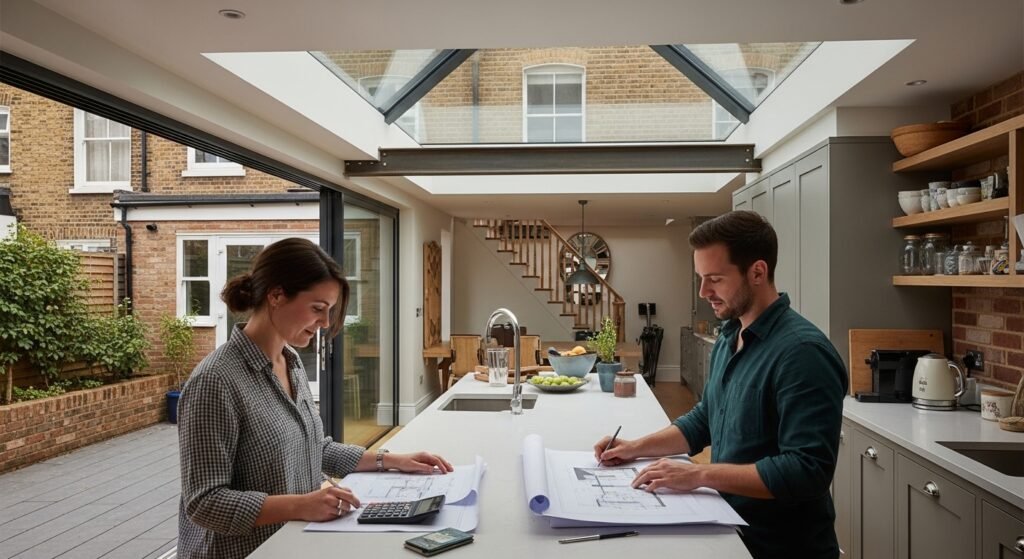
Single-Storey Rear Extension (Kitchen-Diner Shell Only)
| Extension Size | Build Cost (excl. kitchen fit-out) |
|---|---|
| Small (12 to 15m²) | £40,000 to £60,000 |
| Standard (20 to 25m²) | £60,000 to £90,000 |
| Larger (25 to 35m²) | £85,000 to £130,000 |
Build costs are at £3,000 to £4,500 per m² for a well-specified single-storey extension in Hackney, reflecting the borough’s inner East London rates. These figures include structural work, roofing, glazing (bi-fold or sliding doors, rooflights), internal finishes to the shell, and connecting services. They exclude kitchen furniture and appliances.
Side Return Extension Only
| Side Return Size | Build Cost |
|---|---|
| Small (10 to 15m²) | £35,000 to £50,000 |
| Typical (15 to 22m²) | £45,000 to £70,000 |
Side returns are typically more expensive per square metre than pure rear extensions because of the structural complexity at the corner junction, the narrow access for materials, and the glazing typically specified for the roof (to bring light into the interior).
Combined Side Return and Rear Extension (Wrap-Around)
The most popular configuration for a Hackney Victorian terrace kitchen. The total project, combining the side return infill with a rear projection, typically runs £75,000 to £140,000 for the extension shell, depending on size, specification, and whether the rear of the house is being opened up significantly.
Kitchen Fit-Out
Add separately to the extension cost:
- Mid-range kitchen (quality units, integrated appliances): £15,000 to £30,000
- High specification (bespoke joinery, premium appliances): £30,000 to £60,000+
Professional Fees
- Architect: 6 to 10% of the build cost for design through to site completion
- Structural engineer: £1,500 to £3,500 for most kitchen extensions
- Planning application fee: £258
- Building regulations: £800 to £1,500 (council or approved inspector)
- Party Wall surveyor: £700 to £2,000, depending on the number of neighbours affected
- Thames Water Build Over Agreement: £350 to £450 (if applicable)
Practical Steps Before Starting Your Hackney Kitchen Extension
Before starting, check planning maps, sewer locations, and conservation status. Then appoint professionals with local experience. Many clients also compare quotes for electrical work and kitchen plumbing at the same time.
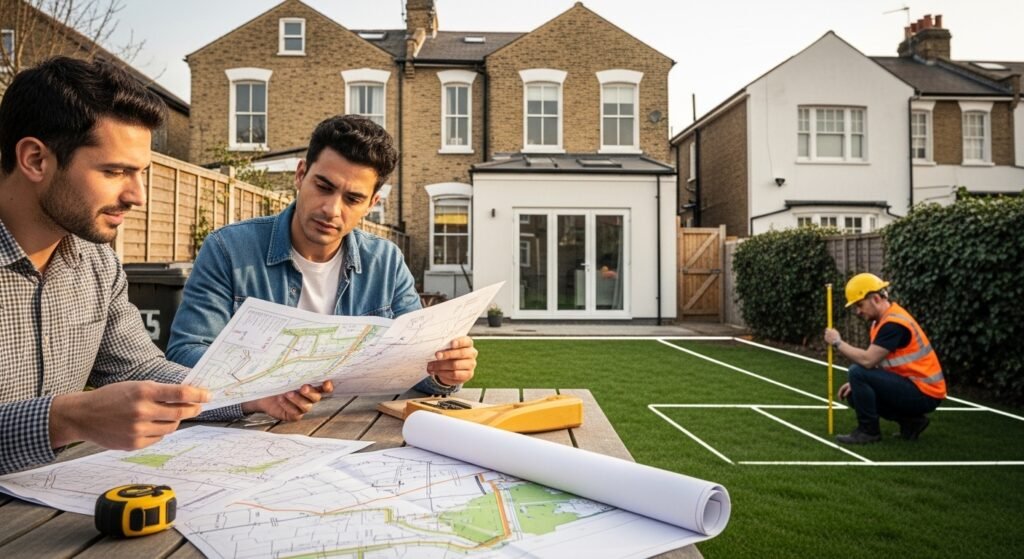
1. Check your conservation area and Article 4 status. Use Hackney Council’s online planning map at hackney.gov.uk. This takes five minutes and determines your entire planning route.
2. Check for public sewers. Use Thames Water’s sewer map to identify any sewers within 3 metres of your proposed extension footprint.
3. Commission an architect early. Hackney’s planning officers respond well to well-drawn, clearly thought-through proposals. An architect with Hackney experience will know the conservation area guidelines and will design to them from the start. This reduces the risk of planning objections and speeds up the process.
4. Use pre-application advice for conservation area projects. If your property is in a conservation area or listed, paying for pre-application advice from Hackney’s planning team before submitting an application is money well spent. It typically costs £100 to £200 for written feedback and significantly reduces the risk of refusal.
5. Serve party wall notices early. Identify affected neighbours before the planning application is submitted. Two months’ lead time is required. Delays in party wall consent are the most common cause of construction program overruns on Hackney kitchen extension projects.
6. Factor in the build programme. A standard kitchen extension in Hackney takes 12 to 20 weeks from contractor mobilisation to completion. Larger or more complex projects run 20 to 30 weeks. The planning and design phase typically takes a further 12 to 24 weeks before construction begins, depending on whether planning permission is needed.
FAQ
Q: Does my rear kitchen extension need planning permission in Hackney?
If your property is a house (not a flat) outside a conservation area, and the extension is single-storey, no more than 3 metres deep, and no higher than 4 metres, the answer is almost certainly no. You can proceed under permitted development. If you want to go deeper than 3 metres, the Larger Home Extension scheme (up to 6 metres for a terrace) provides a lighter-touch Prior Approval process. If your property is in a conservation area or Article 4 area, check the specific rules for your area using Hackney’s planning map.
Q: Can I build a side return kitchen extension without planning permission in Hackney?
If your property is a house outside a conservation area, yes, a single-storey side return extension is generally permitted development provided it does not exceed half the width of the original house and stays within height limits. In a conservation area, side extensions always require planning permission. In Article 4 Direction areas (Brownswood, Beck Road, Well Street, De Beauvoir, St Mark’s), a planning application is required for alterations that would be PD elsewhere.
Q: How long does planning permission take in Hackney?
Hackney’s target determination period for householder applications is 8 weeks from the date the application is validated. In practice, straightforward applications in Hackney are frequently decided within this window. Conservation area applications, or those requiring a heritage statement and conservation officer input, may take 10 to 14 weeks. Pre-application engagement with Hackney’s planning team before submitting reduces the risk of delays caused by information requests or design iterations.
Q: What does a kitchen extension cost in Hackney in 2026?
A standard single-storey rear kitchen extension shell in Hackney costs approximately £3,000 to £4,500 per square metre at a mid-to-high specification, reflecting inner East London labour rates. A 20m² extension shell runs approximately £60,000 to £90,000. A side return extension runs £45,000 to £70,000 for the build. Kitchen fit-out adds £15,000 to £60,000, depending on specification. Professional fees add a further 10 to 15% of the build cost.
Q: Do I need a party wall agreement for a kitchen extension in Hackney?
Almost certainly yes. Any foundation work within 3 metres of a neighbouring structure, any work on a shared boundary wall, and any work on an existing party wall all trigger the Party Wall etc. Act 1996. On a typical Hackney Victorian terrace, a kitchen extension involves at least one shared boundary wall and typically triggers obligations to both neighbours. Party wall notices must be served at least two months before work begins. Build this into the project timeline from the very start.
Conclusion
Most single-storey rear kitchen extensions in Hackney do not need planning permission, and this is one of the reasons the borough has become a hub for kitchen-diner extensions over the past decade. The Victorian terrace stock lends itself perfectly to side return and rear extension projects, and Hackney’s planning team is experienced with these applications when they do require permission.
The two factors that trip up Hackney homeowners most consistently are conservation area status, which many people do not check until late in the design process, and party wall requirements, which extend the project timeline significantly when they are discovered after design work has already been commissioned.
Checking the planning map first, appointing an architect with Hackney conservation area experience, serving party wall notices early, and building a realistic program that includes the planning and notification lead times makes the difference between a project that completes smoothly and one that overruns by months.

Tilly Bani is a renovation and roofing specialist with over 15 years of experience in construction and property refurbishment across North London. He specialises in roofing, structural repairs, and full home renovations, helping homeowners improve property value and safety.