
| Quick Answer A kitchen renovation in London takes between 6 and 16 weeks on site, depending on the scope. A like-for-like replacement with no structural work takes 2 to 4 weeks of actual building work. A full renovation involving plumbing moves, new electrics, wall removal, and structural changes takes 6 to 12 weeks. Add 8 to 20 weeks of planning, design, ordering, and lead time before a single cabinet is removed, and the total project from first conversation to finished kitchen runs 4 to 9 months for most London homes. |
If you ask three different London kitchen companies how long a renovation takes, you will get three meaningfully different answers. One might say six weeks. Another might say four months. Neither is wrong. They are describing different phases of the same process. Many London homeowners start by comparing London builders and local renovation teams.
The confusion is that “kitchen renovation” describes everything from swapping cabinet doors in a Hackney flat to removing load-bearing walls and extending a Victorian terrace in Islington. The on-site building phase is only one part of the total time. The design phase, ordering phase, and trades lead time all sit in front of it, and they are often longer than the building work itself. Some owners combine the project with wider full refurbishment upgrades.
This guide gives you an honest, phase-by-phase breakdown of how long a kitchen renovation takes in London in 2026, covering the specific factors that extend timelines in the capital, including Victorian property complications, bespoke cabinetry lead times, trade booking windows, and the logistics of working in dense urban terraces.
The Four Phases of a London Kitchen Renovation
Every kitchen renovation, however simple or complex, passes through four phases. Understanding all four is the only way to plan an accurate timeline.
Phase 1: Design and Decision-Making

Typical duration: 4 to 12 weeks
This is the phase where most timelines are lost, and where most homeowners underestimate the time required. Design and decision-making cover everything from the first conversation with a kitchen company or architect to the final sign-off on every item that will be ordered.
This phase involves layout decisions, material selections, appliance specifications, worktop material, tile and flooring choices, lighting plan, and any structural decisions about wall removal or extension. Many homeowners begin by consulting kitchen renovation specialists for layout planning. Each decision depends on prior ones. You cannot specify a worktop until the cabinet layout is confirmed. Premium worktop installation depends on final measurements. You cannot confirm the cabinet layout until the plumbing and electrical positions are agreed. You cannot agree on those until a structural engineer has confirmed what walls can move.
In London, this phase runs long for two reasons. First, the good kitchen designers and architects in the city are busy. Booking an initial consultation can take two to four weeks, and then revisions and sign-offs add more time. Second, London homeowners tend to renovate kitchens in Victorian terrace properties where the existing layout is constrained and requires more design iteration to achieve an open-plan result. A kitchen that involves removing a wall, adding a side return extension, or relocating the hob to a new island takes longer to design than one that replaces units in the same position.
The fastest this phase runs is four weeks for a straightforward like-for-like replacement in a modern apartment where the layout does not change. For a Victorian terrace renovation with an extension, it runs twelve to sixteen weeks.
Phase 2: Ordering and Lead Times

Typical duration: 6 to 16 weeks (running concurrently with other phases)
Once the design is signed off, materials must be ordered. Bespoke kitchen units often have the longest lead time. In an ideal world, this phase runs in parallel with Phase 1 from the point decisions are made. In practice, many homeowners are reluctant to commit to orders before the full design is confirmed, which means ordering begins late and extends the total timeline.
The dominant lead time factor is cabinetry. Delays are common when cabinet fitting dates are booked late. This is where London kitchen renovations frequently stall.
In-stock and semi-custom cabinetry from suppliers like IKEA, Howdens, Wickes, and Wren is typically available within one to four weeks. These systems use standardised dimensions and are held in warehouse stock.
Bespoke and handmade cabinetry, which accounts for a significant proportion of London kitchen renovations in Victorian terraces where non-standard dimensions and custom finishes are required, typically has a lead time of 8 to 16 weeks. Some high-end London cabinet makers quote 20 weeks for fully bespoke painted timber units.
Other lead times to account for:
- Natural stone worktops (granite, marble, quartz): templating only happens after cabinets are installed, and then fabrication takes one to two weeks. Plan for a gap of two to three weeks between cabinet installation and worktop arrival.
- Bespoke windows and rooflights (relevant if the kitchen includes an extension): 8 to 14 weeks for bifold or sliding doors from quality manufacturers.
- Range cookers from certain brands: 4 to 10 weeks, depending on specification and model.
- Undermount sinks: must be ordered with worktop dimensions confirmed. Many projects also schedule appliance installation during this stage.
The golden rule in London kitchen renovations is to order the item with the longest lead time first, even if other decisions are still outstanding. Starting the cabinet order is the critical path decision. Everything else waits for cabinets.
Phase 3: On-Site Building Work
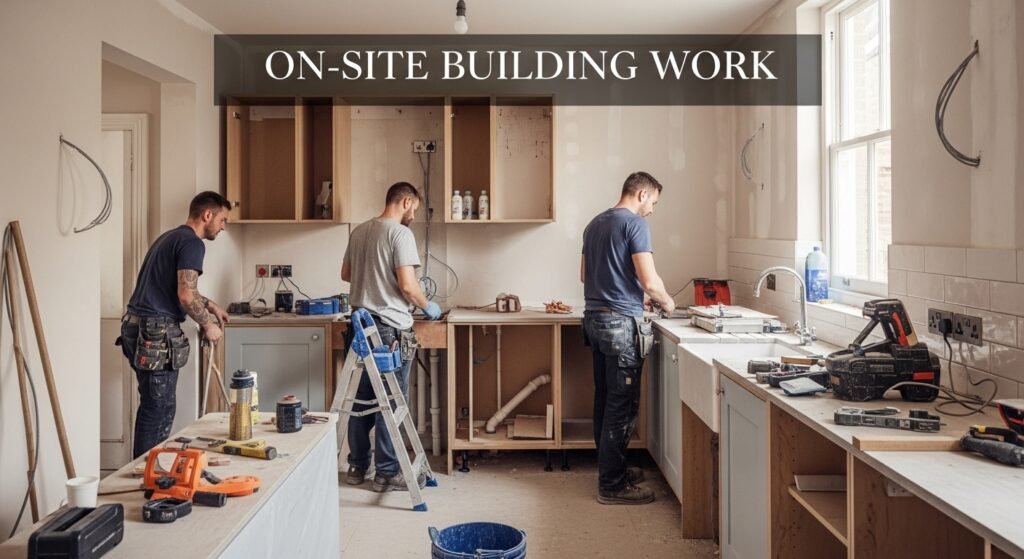
Typical duration: 2 to 16 weeks, depending on the scope
This is the phase most people think of when they ask, “How long does a kitchen renovation take?” It covers the physical work from strip-out to the day the new kitchen is functionally complete. This often includes certified kitchen plumbing and first-fix services.
The duration varies enormously based on what the renovation involves:
| Renovation Type | On-Site Duration |
|---|---|
| Like-for-like replacement, same positions | 1 to 3 weeks |
| Full replacement with minor service moves | 3 to 5 weeks |
| Full renovation with wall removal, new layout | 6 to 10 weeks |
| Kitchen extension included | 12 to 20 weeks |
| Kitchen extension plus full remodel | 16 to 28 weeks |
For most Victorian terrace kitchen renovations in London, without a structural extension, the on-site phase runs 4 to 8 weeks. Many owners also combine this with electrical work upgrades. This accounts for strip-out, first fix plumbing and electrics, plastering, cabinet installation, worktop templating and installation, tiling, second fix, and finishing. Uneven floors may require floor levelling before fitting begins.
Phase 4: Snagging and Sign-Off

Typical duration: 1 to 2 weeks
The snagging phase is where defects, incomplete items, and alignment issues are identified and corrected. On a quality project, snagging is brief. On projects where trades have been rushed or poorly coordinated, snagging can reveal significant issues that extend the timeline.
Electrical sign-off from a qualified electrician (Part P certification) and gas appliance commissioning from a Gas Safe registered engineer are legal requirements that happen during this phase. Both must be completed before the kitchen is used. Budget a few days for each trade to attend for sign-off.
London-Specific Factors That Extend Timelines
The timeline ranges above are realistic for the UK generally. In London, several factors push consistently toward the upper end of those ranges.
Trade Booking Lead Times
Reputable builders, plumbers, electricians, and kitchen fitters in London are busy. The best contractors in inner London boroughs like Islington, Hackney, Wandsworth, and Camden are booked three to six months in advance. This is not hyperbole. If you begin contacting contractors in January for a summer renovation, you may find that quality trades are unavailable until October.
This means the design phase must happen earlier than most homeowners expect. The contractor booking decision should happen in parallel with the design process, not after it. Secure a contractor’s slot tentatively based on a rough specification, then refine the design within the booked program. Waiting until the design is complete to start contractor conversations adds months to the total timeline.
Victorian Property Complications
London’s inner boroughs are dominated by Victorian and Edwardian terraces. These properties have specific structural characteristics that add time to kitchen renovations.
Hidden drainage. The soil pipe and underground drainage system on a Victorian terrace is often not where you would put it in a new build. Unexpected issues can lead to drainage repairs mid-project. Relocating a sink or dishwasher sometimes reveals that the waste run requires more extensive rerouting than the design assumed. This is discovered at strip-out and can add one to two weeks to the program.
Non-standard dimensions. Victorian kitchens, particularly in outrigger rear additions, are rarely the rectangular, square-cornered rooms that standard kitchen layouts assume. Chimney breasts, alcoves, varying ceiling heights, and sloping floors all require the cabinet installation to be adjusted on site. This takes longer than a straightforward installation in a modern apartment.
Unexpected structural findings. Some homes also need stud wall construction or framing changes. Removing kitchen tiles and units in a Victorian property routinely reveals dampness from historic leaks, pipe runs that do not match the assumed position, or timber framing that has suffered rot. These discoveries require remediation before the new kitchen installation proceeds. Allow a two to three-week contingency for this in any Victorian property renovation program.
Building fabric. The solid brick walls of a Victorian terrace take longer to chase for pipe and cable runs than the stud partition walls of a modern build. First fix plumbing and electrics in a Victorian property typically takes one to two days longer than the same job in a newer home.
Access and Logistics
Most London kitchen renovations happen in terraced properties where access to the rear is through the house. All materials go in through the front door, through the hallway, through the living room. All waste comes back the same way. This creates constraints on delivery scheduling, skip placement, and the pace at which materials can be moved.
Controlled parking zones in inner London mean skip permits must be obtained from the local council before skips can be placed on the public highway. Permit processing takes two to three working days, and permit costs run from £50 to £100 for two weeks. Kitchen deliveries to terraced properties in London often require deliveries timed around parking restrictions, or handbrake off-loading from the end of the street, which adds time.
Noise restrictions in residential London allow mechanical and noisy work only between 8 am and 6 pm Monday to Friday, and 8 am to 1 pm on Saturdays. This limits the hours available for demolition, cutting, and loud power tool use, and extends the strip-out phase compared to a commercial or non-residential site.
Party Wall Processes
Any kitchen renovation that involves structural work on a wall shared with a neighbouring property, or excavation within 3 metres of a neighbour’s structure, requires a Party Wall Notice to be served at least two months before work begins. This is a statutory requirement under the Party Wall etc. Act 1996.
If a neighbour consents to the notice, work can proceed at the end of the two-month window. If a neighbour requires a Party Wall Award, the process takes four to eight additional weeks. Many London kitchen renovation programs have been extended by two to four months because party wall notices were served late. Serve them as early as possible in the design process.
Timeline by Renovation Type
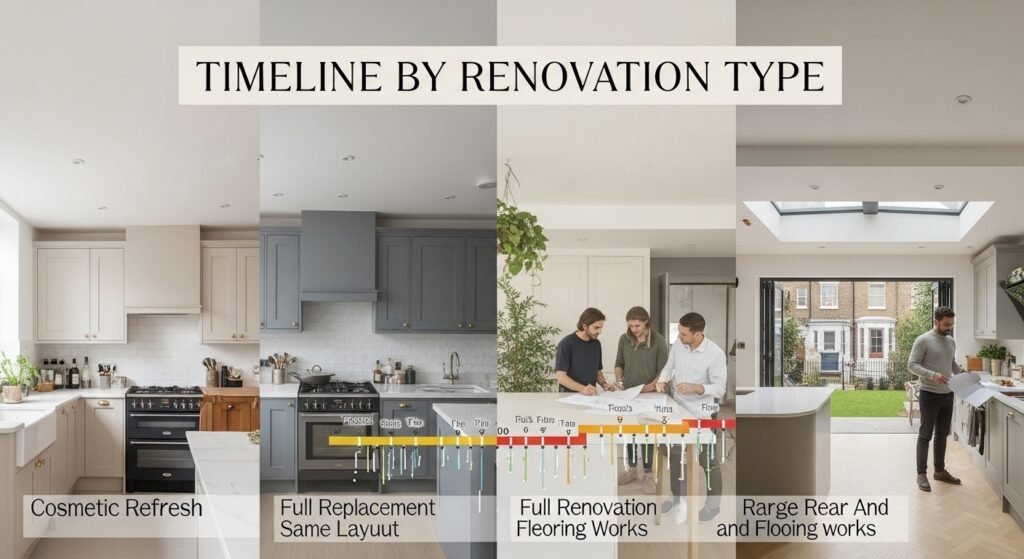
Cosmetic Refresh (No Structural Work)
Replacing cabinet doors, worktops, appliances, and splashback while keeping everything in exactly the same position.
- Design and selection: 2 to 4 weeks
- Ordering and delivery: 2 to 6 weeks
- On-site work: 1 to 2 weeks
- Total from first decision to completed kitchen: 6 to 12 weeks
Full Replacement (Same Layout)
Stripping everything back to the walls, replumbing in the same positions, rewiring the same circuit layout, fitting a complete new kitchen.
- Design and selection: 4 to 8 weeks
- Ordering and delivery: 6 to 12 weeks
- On-site work: 3 to 6 weeks
- Total from the first decision to a completed kitchen: 3 to 6 months
Full Renovation With Layout Changes
Moving the sink, relocating the hob, removing a non-structural wall, changing the plumbing and electrical circuits, new flooring, and new plastering. Finishes may include tile flooring or modern surfaces.
- Design and selection: 8 to 14 weeks
- Structural engineer sign-off and any building regulations notification: 2 to 4 weeks
- Ordering and delivery: 8 to 14 weeks
- On-site work: 6 to 10 weeks
- Total from the first decision to the completed kitchen: 5 to 8 months
Kitchen Extension and Renovation
Single-storey rear or side return extension combined with a complete kitchen renovation. Many London homes choose full Hackney kitchen renovation packages with extensions.
- Design and planning phase (including planning permission if needed): 12 to 20 weeks
- Structural engineer, building regulations application: 6 to 10 weeks
- Ordering and delivery: 10 to 16 weeks.
- On-site work (extension build plus kitchen fit): 16 to 28 weeks
- Total from the first decision to the completed kitchen: 9 to 18 months
These ranges are realistic. The lower end of each range requires prompt decision-making, trades available at short notice (which typically means lower quality or higher cost), standard lead time materials, and no significant problems discovered at strip-out. The upper end reflects the typical experience of a thoughtful renovation where good trades are booked ahead, bespoke elements are specified, and Victorian property complications are discovered and addressed properly.
The Critical Path: What Actually Controls Your Timeline
Understanding which decision or event controls the overall timeline tells you where to focus your attention.
In most London kitchen renovations, the critical path runs through cabinetry. The day the cabinet design is confirmed and the order is placed, determines, almost entirely, when the kitchen can be installed. Everything else, the builder’s program, the plumber’s schedule, the tiler’s availability, must be arranged to be ready for cabinet delivery.
If bespoke cabinetry has a 12-week lead time and you order it in week four of the design process, cabinets arrive in week 16. Building work should start in week 12, so the first fix is complete when the cabinets arrive. That means the building start date is determined by working backwards from the cabinet delivery.
The second critical constraint is the structural engineer. If a wall is being removed, the structural calculations must be complete before the building notice is submitted to building control, and the steelwork must be on order before the builder starts. Steel beam lead times are typically three to six weeks from order.
Planning ahead and making decisions that commit you to the order sequence is the difference between a smooth project and an extended one.
How to Reduce Your Kitchen Renovation Timeline
These actions consistently shorten London kitchen renovation timelines without compromising the result.
Finalise all selections before any order is placed. The most common cause of delay is discovering mid-project that an appliance the design was built around is out of stock or has a longer lead time than expected. Confirm availability and lead time for every appliance before placing cabinet orders.
Secure your contractor early. Book a quality builder’s slot based on a rough specification and a realistic start date. Refine the design within the available lead time. Waiting for a complete design before approaching contractors costs months. Many homeowners compare trusted kitchen fitters before booking.
Serve party wall notices immediately. As soon as you know the building works will affect a party wall, serve the notice. Two months is the statutory minimum. Early serving means earlier resolution, whether by consent or Award.
Use a main contractor rather than self-managing multiple trades. A single main contractor who coordinates plumbers, electricians, plasterers, and tilers from one program diary prevents the gaps that accumulate when individual trades are managed separately. In London, where individual trade diaries are unpredictable, these gaps consistently run to days or weeks.
Order worktops for templating the week the cabinets are installed. Worktop templating cannot happen before cabinets are fixed in position, but many projects lose a week or two because the worktop company is not booked in advance and has no slot available immediately. Book the templating appointment for the week the cabinets are completed.
Coping Without a Kitchen
For a full renovation, you will be without a functioning kitchen for between two and eight weeks, depending on the scope. In a London terraced property, you cannot continue cooking normally during the building work.
Practical arrangements that London homeowners use:
A microwave, a kettle, and a small fridge in the dining room or a bedroom make basic self-catering possible. A temporary plywood worktop with a single camping hob extends this considerably. Both arrangements work better in warm, dry weather.
Eating out or relying on deliveries is the realistic expectation for most of the building phase. Budget approximately £50 to £150 per day for a family, depending on how often they eat out and the cost level they choose. Over six weeks, this is a high additional cost that is rarely included in renovation budgets.
Some London homeowners use the renovation as the trigger to take a planned holiday. Two to three weeks away during the most disruptive phase, particularly the strip-out and first-fix period, reduces stress without extending the timeline.
FAQ
Q: How long does a typical kitchen renovation take in London?
For a full replacement renovation in an inner London property, with design, ordering, building work, and snagging, the realistic total timeline from first decision to completed kitchen is four to six months. This assumes standard lead-time cabinetry, trades booked in advance, and no significant unexpected discoveries at strip-out. A Victorian terrace renovation with layout changes typically runs six to eight months. A kitchen extension combined with renovation runs nine to eighteen months.
Q: How long will I be without a functioning kitchen?
This depends on the scope. A like-for-like replacement can be managed with two to three weeks without a kitchen. A full renovation with plumbing and structural changes typically leaves you without a functioning kitchen for four to eight weeks. An extension project involves a significantly longer period without access to the original kitchen space.
Q: What is the most common cause of kitchen renovation delays in London?
Late ordering of long lead-time items, especially bespoke cabinetry, is the most common cause. Bespoke kitchens from quality London makers have lead times of 8 to 16 weeks. If the order is placed four weeks after the design is agreed, the kitchen cannot be installed until week 20 at the earliest. Projects that order cabinetry in week one or two of the design process consistently complete faster than those that wait for complete design sign-off.
The second most common cause is party wall delays. Kitchen renovations that involve party wall works and serve notices late frequently experience two to three-month program extensions that could have been avoided with earlier notice service.
Q: Can I renovate my kitchen while living in the house?
Yes, and most London homeowners do. The building phase is disruptive but manageable with a temporary kitchen setup in another room. The most challenging period is strip-out, which is typically one to two weeks of heavy demolition and mess. After that, the work becomes progressively less invasive as the build proceeds. Set up the temporary kitchen before strip-out begins and establish clear rules with the contractor about end-of-day cleanup, dust protection, and access routes through the house.
Q: Is a kitchen renovation faster in London or the rest of the UK?
The on-site building work takes the same time in London as anywhere else. What extends London timelines is the higher proportion of Victorian properties (which add complexity and discovery risk), the longer trade lead times in a busy construction market, the logistics of working in dense terraced streets with restricted access, and the higher proportion of bespoke cabinetry specified in London renovations. Expect London kitchen renovations to run toward the upper end of any given timeline range.
Conclusion
The honest answer to “how long does a kitchen renovation take in London” is longer than most people expect and longer than most renovation companies initially project. The four to six months that a full replacement renovation takes is not a failure of planning. It is the accurate reflection of a process that includes design iteration, materials ordering, trade coordination, building work, and compliance sign-off, all happening in a city where quality tradespeople are in demand and Victorian properties add complexity at every stage.
The homeowners who have the least stressful renovation experiences are those who start the process earlier than they think necessary, book trades before the design is complete, place the cabinetry order at the earliest possible point, and serve any party wall notices immediately. Those who wait until every decision is made before starting any of these parallel processes consistently find the total timeline longer than they planned.
Plan for longer than you hope. Allow a two to three-week contingency on the building phase. Set up a temporary kitchen before strip-out begins. The project will take the time it takes, and knowing that in advance is the first step to managing it calmly.

Tilly Bani is a renovation and roofing specialist with over 15 years of experience in construction and property refurbishment across North London. He specialises in roofing, structural repairs, and full home renovations, helping homeowners improve property value and safety.