
| Quick Answer The most striking bathroom transformations in Islington Victorian terraces share a consistent pattern: a dark, cramped, outdated bathroom becomes a light-filled, efficiently laid-out space that works with the building’s proportions rather than against them. The biggest single impact comes from layout reconfiguration, not just new fixtures. Replacing avocado suites, rerouting drainage, replacing corroded lead pipework, and installing underfloor heating and proper mechanical ventilation deliver results that cosmetic refreshes alone cannot match. Budget £10,000 to £18,000 for a genuinely transformative result in a typical Islington terrace bathroom. |
Introduction
Islington’s Victorian terraces hold some of the most distinctive housing stock in London. The tall, narrow rooms, original cornicing, and period detailing that make these properties architecturally special also create a specific set of bathroom challenges: rooms that were never designed for modern plumbing, pipework running in unexpected places, and floor plans that often made sense in 1890 but defeat contemporary living. Many period homes use experienced bathroom fitters for older layouts.
The bathrooms in these properties fall into predictable states. An avocado suite from the 1970s refurbishment. White tiles are badly grouted, bulging where the walls are not square. A bath taking up the entire room with almost no shower. A toilet positioned where it lands rather than where it functions. Condensation on every cold surface every winter morning. And often, a persistent smell from a drainage system that has never been properly overhauled.
The after states are equally consistent in their impact. They are not all the same look. Some Islington homeowners go for dark, moody tiles and industrial fittings that deliberately contrast with the Victorian bones of the house. Others prefer a cleaner, simpler aesthetic with natural stone or white metro tile that references the period. But what all the successful transformations share is correct structural preparation, honest plumbing, adequate ventilation, and a layout that fits how people actually use the room. Most full projects also involve professional bathroom installation services.
This article walks through the most common before-and-after transformation stories in Islington Victorian terraces: what was there, what decisions were made, what the result looks like, and what it cost.
The Standard Before: What Most Islington Victorian Terrace Bathrooms Look Like
Before any renovation conversation begins, it helps to understand what makes Islington’s Victorian terrace bathrooms specifically challenging compared to newer properties.
The room is usually in the wrong place. Victorian terraces were not built with bathrooms. Indoor plumbing was retrofitted, typically in the 1950s and 1960s, and the bathroom was placed wherever it was logistically easiest rather than where it would work architecturally. In a standard Islington mid-terrace, this meant either a small room created by sacrificing the rear bedroom landing, or a bathroom positioned in the back addition at first floor with the soil pipe running down the external wall.
The floor plan is rarely square. Victorian properties move. The solid brick walls have settled over 130 years, and rooms that were square when built are now trapezoids with walls out of plumb by 20 to 30mm. Standard bathroom fittings assume square rooms with parallel walls. Installing them in a non-square Victorian bathroom means gaps, misalignments, and tiling that looks correct at installation but shows errors as you look along any grout joint.
The existing plumbing is old. Many homes need upgraded bathroom plumbing before refitting. Many Islington Victorian terraces retain lead supply pipes, iron waste pipes, and drainage that was installed before modern Building Regulations. Water from a lead pipe tastes different and poses a long-term health risk. Iron waste pipes that are 60 years old corrode from the inside, restricting flow and eventually failing. Renovating the bathroom without replacing the supply and waste infrastructure underneath is, in effect, renovating the surface while the structure below continues to deteriorate.
Ventilation is inadequate. The original bathroom retrofit added a window if there was an external wall available. Where there was not, there is often either no ventilation at all or an extractor fan that vents into the loft void rather than through to the outside. Some renovations also include certified electrical work for extractor fans. Condensation in these bathrooms is extreme in winter, and chronic mould at the ceiling junctions and window reveals is a consequence of inadequate extraction that no amount of bathroom cleaning will permanently resolve.
Transformation 1: The Back Bedroom Bathroom That Became a Proper Family Bathroom
The before: A Barnsbury terrace, bought in 2022. The first-floor bathroom was created by partitioning the smallest bedroom decades earlier, resulting in an L-shaped room approximately 4.5 square metres in usable area. The bath ran along one wall, the toilet was squeezed into the return of the L, and the basin was positioned on the wall opposite the door, where it caught the light from the single window. The suite was white but 25 years old, the wall tiles were 1990s beige, the vinyl floor had lifted at the edges, and the extractor fan sat on the internal wall venting horizontally into the adjacent bedroom void.
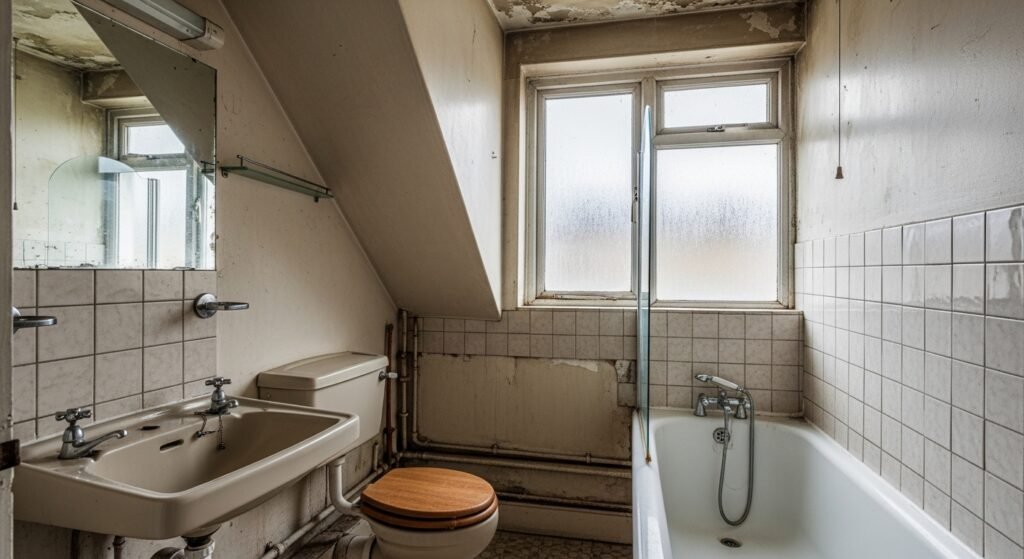
There was no shower. The owners chose a full shower installation to improve daily use. A bath-mounted mixer with a flexible hose was the only showering option. The toilet cistern leaked at its base, staining the vinyl and suggesting a long-term moisture problem beneath the floor.
The decisions: The homeowners commissioned a bathroom specialist to assess the layout before any design work began. The assessment identified the L-shape as an inherited constraint from the partitioning rather than a structural necessity. Removing the redundant partition and taking the bathroom to the full original bedroom footprint of 6.5 square metres transformed the available space.
The drain position was assessed by a plumber at the same time. Moving the toilet to the newly available wall was achievable with a 3.5-metre waste run to the existing soil pipe, within the limits that avoid siphonage risk.
The supply pipework led from the rising main to the bathroom level. Both homeowners had young children, and replacing the lead supply was non-negotiable. A qualified plumber replaced the lead supply pipe and installed a thermostatic valve at the manifold, providing better control over hot water temperature.
The extractor fan was rerouted through the ceiling into the loft and out through a new tile vent on the rear roof slope. An overrun timer was fitted so the fan runs for 15 minutes after the light is switched off, meeting Building Regulations Part F.
The after: The bathroom is now 6.5 square metres with a separate bath and a 1,400mm x 900mm walk-in shower enclosure. The toilet is positioned on the wall that was previously the room partition, with clear space on both sides. The basin and vanity run along the window wall, making use of the natural light. Slim vanity units also added extra storage without crowding the room. Underfloor heating replaces the old towel rail. The tiling is a dark forest green porcelain on the lower walls and white metro tile to ceiling height, referencing the Victorian period without being a pastiche recreation.
The costs: Building works including partition removal, plumbing rerouting, lead pipe replacement, extractor fan rerouting, and underfloor heating installation: £6,800. Bathroom suite, tiles, and fittings at mid-range specification: £5,200. Total: £12,000.
Transformation 2: The Ground-Floor Outrigger Bathroom That Became an Ensuite
The before: A Canonbury mid-terrace, bought as a buy-to-let investment in 2019 and converted to owner occupation in 2023. The bathroom was on the ground floor in the rear outrigger, positioned between the kitchen and the garden. This layout is characteristic of a specific generation of Islington Victorian terrace conversion, and is one of the most disliked features of these properties. Entering the bathroom required walking through the kitchen, cutting off views of the garden and breaking the flow of the ground floor.
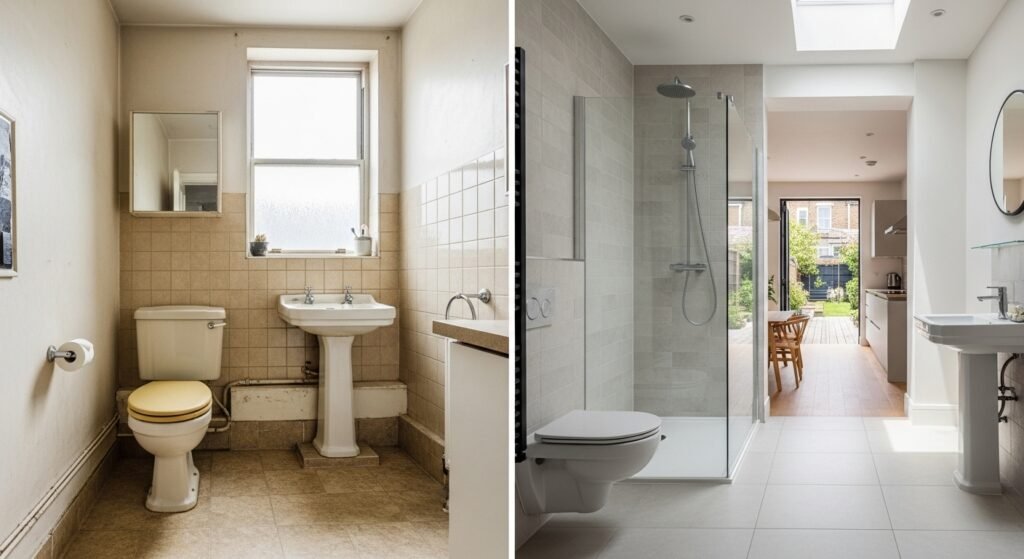
The bathroom itself was functional but dark, with no natural light source and a single overhead bulb. The suite was serviceable but coloured a pale harvest gold, original to a 1980s refurbishment.
The decisions: The homeowners decided to relocate the bathroom entirely. The ground-floor outrigger space was incorporated into the kitchen to create an open-plan kitchen-diner-garden room. This kind of redesign is common in larger kitchen renovation projects. A new bathroom was built in the first-floor rear bedroom, which was subdivided to create an ensuite bathroom of 4 square metres and a smaller primary bedroom.
The soil pipe from the ground-floor bathroom was a 100mm cast iron stack running down the external rear wall. Connecting the new first-floor bathroom to this stack required extending the connection upward, which the plumber achieved using a new UPVC connection into the existing stack.
The gold suite was demolished and disposed of. The replacement formed part of a full bathroom refurbishment. The extractor fan is wall-mounted with an external duct to the rear elevation.
The after: The new ensuite bathroom at first floor is compact but properly proportioned. At 4 square metres with a walk-in shower, wall-hung WC, and pedestal basin, it functions correctly for two people. The primary bedroom is slightly smaller but gains the benefit of an attached bathroom, which was absent from the property previously.
The ground floor transformation, incorporating the old bathroom space into the kitchen, created a 6-metre kitchen-diner running from the front of the house to the garden doors. The property value increased from this reconfiguration, combined with the ensuite addition, was assessed by a local Islington estate agent at approximately £45,000 to £55,000 above the pre-renovation value.
The costs: Ground floor bathroom demolition and incorporation into kitchen space: included in the kitchen project. First-floor bathroom new build, including partition wall, soil pipe connection, all plumbing, electrics, and waterproofing: £8,500. Bathroom suite, tiles, and fittings: £4,200. Total bathroom costs: £12,700. Additional kitchen costs are not included.
Transformation 3: The Cramped One-Bathroom House That Added a Second Bathroom
The before: A three-bedroom Highbury terrace occupied by a family of four with a single bathroom. The bathroom was well-maintained but small, approximately 4 square metres, with a bath and no separate shower. For a family of four using a single bathroom in the morning rush, the constraint was obvious and daily.
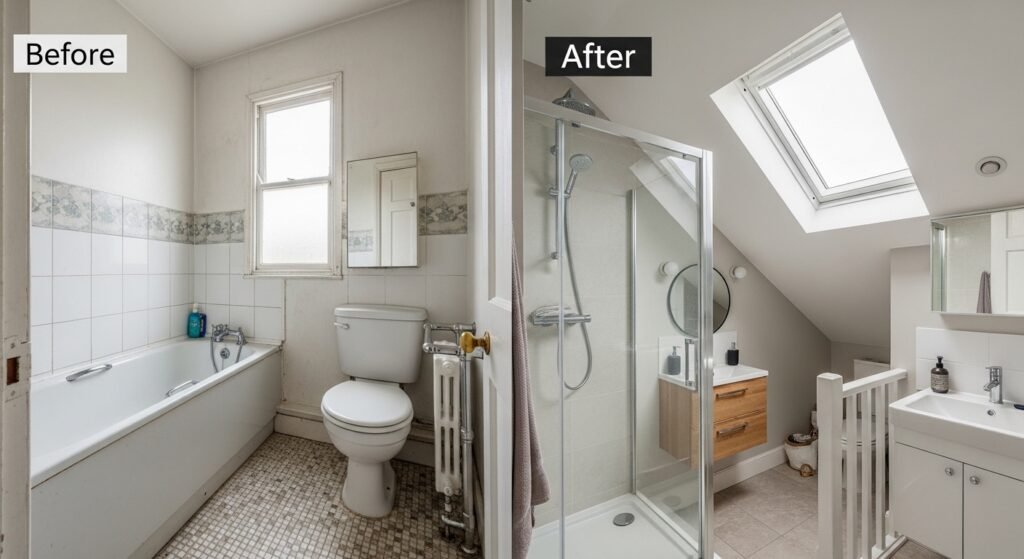
The loft had not been converted. Creating the new room required internal stud wall construction and layout changes. The first floor had three bedrooms and the single bathroom on the landing.
The decisions: A loft conversion was commissioned. The loft conversion design included a new fourth bedroom and a second bathroom of 3.5 square metres under the eaves. The new bathroom was positioned to connect to the existing soil pipe via a new waste run through the loft floor, achieving the necessary gradient to the stack below.
The existing ground-floor bathroom was also refurbished at the same time, replacing the suite and tiles but retaining the layout and position. Walls were repaired first with full replastering where needed. New extractor fan with external duct to outside, replacing the unit that had vented into the roof void.
The after: The property gained a second bathroom at loft level serving the new fourth bedroom. The existing bathroom was refreshed to a contemporary standard. The family of four now has two bathrooms, eliminating the morning scheduling problem entirely.
At the time of the project, the Islington estate agent’s assessment was that adding a fourth bedroom with an ensuite bathroom at loft level in a terrace of this type would add between 12% and 15% to the property value. The renovation was driven primarily by lifestyle improvement, but the value uplift was a significant secondary benefit.
The costs: Loft conversion including structural engineering, building regulations, and contractor build: £65,000. New loft bathroom suite, tiles, fittings, and plumbing: £8,000. Existing bathroom refurbishment: £9,500. Total bathroom-related costs within the project: £17,500 (excluding loft conversion structure).
Transformation 4: The Cosmetically Updated Bathroom That Was Still Fundamentally Broken
The before: A Clerkenwell flat, top floor of a Victorian terrace conversion. The bathroom had been renovated by the previous owner approximately 10 years before purchase. The tiles were white and in good condition. The basin and toilet were modern. The mirror was lit. The shower enclosure was a quadrant with a sliding door.
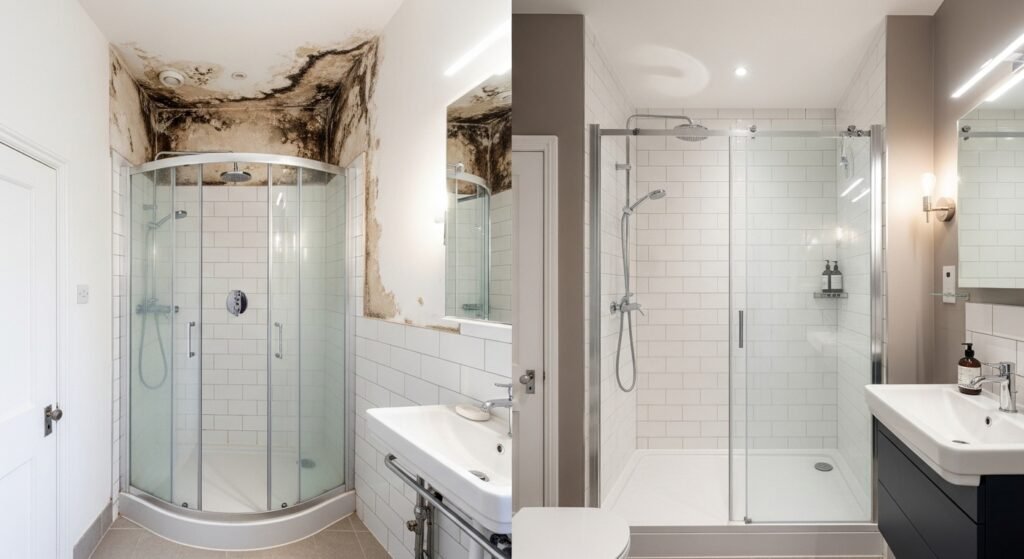
And yet the bathroom was deeply unsatisfactory. The drain was positioned under the quadrant shower in a corner, but the floor of the shower did not slope toward the drain uniformly, so water pooled to the side and back. Every shower left standing water that took 20 minutes to drain. The extractor fan hummed and made a show of extracting, but the duct behind it had disconnected from the external vent, so it was simply circulating air within the ceiling void. Mould had developed on the ceiling and at the top of the tiled walls. The tiles were lifting on the shower wall where water had tracked behind them through a failed grout joint.
This was a cosmetically renovated bathroom that had never been properly constructed underneath.
The decisions: Full strip-out was the only option. The rebuild started with proper waterproofing tanking behind walls and floors. The lifting tiles confirmed that the waterproofing behind the shower had not been applied, or had been applied incorrectly, and water had been tracking into the wall structure for the entire 10 years since the previous renovation. Mould remediation was needed at the wall substrate level before new work could proceed.
The drain position was assessed. Moving it to the centre of the shower zone allowed a correctly sloped floor to be constructed, with a consistent 1 to 2% fall from all sides to the central drain. A pre-formed XPS former was used to create the gradient accurately rather than relying on screed, which had failed in the previous installation.
The extractor fan was replaced and properly ducted through the external wall of the flat to the outside. The existing duct was surveyed and found to be disconnected at the point where it passed through the ceiling void. Reconnecting the existing duct and replacing the fan unit restored correct ventilation.
The after: The bathroom looks broadly similar to the previous renovation in style. The tiles are similar (white metro), and the suite is modern white. New bathroom tiling completed the finish. But the underlying construction is now correct. The shower floor drains completely within seconds. There is no condensation on the ceiling after six months of use. The tile grout is intact and shows no sign of water tracking.
The homeowner’s assessment: the previous renovation had cost the previous owner approximately £8,000 and lasted 10 years before producing visible failure. The correct renovation cost £10,500 and came with a contractor guarantee.
The costs: Full strip-out including mould remediation: £2,200. Plumbing rerouting and new drain position: £1,800. Full waterproofing system (floor and walls): £1,500. Tiling (floor and walls): £2,000. Sanitaryware, shower, and fittings: £2,200. Extractor fan replacement and rerouting: £350. Total: £10,050.
What Every Successful Islington Bathroom Transformation Shares
These four case studies are different in scale and specification, but they share structural principles that define successful bathroom transformations in Victorian terraces.
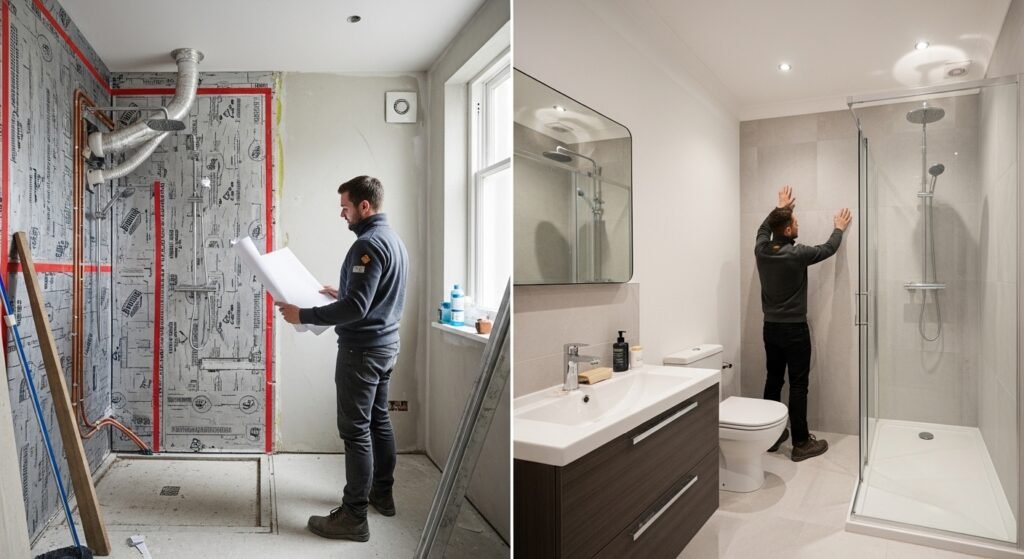
A layout change produces a bigger impact than a fixture change. The bathrooms that look most transformed are the ones where the position of fixtures changed, not just the fixtures themselves. Moving a toilet, adding a shower where there was none, or connecting a bathroom to an adjacent bedroom produces results that a new suite in the same position cannot replicate.
Plumbing infrastructure is always part of the budget. Every one of these transformations involved replacing or significantly modifying the existing plumbing. In a Victorian terrace in Islington, assuming the existing plumbing is adequate and just capping it off at the new fixture positions is consistently the cause of problems in five to ten years. Budget for the infrastructure.
Waterproofing is the one thing you cannot see and cannot cut. That is why quality bathroom remodelling focuses on preparation first. The Clerkenwell case study makes this most explicit, but it is the underlying lesson of every bathroom renovation. Cutting corners on tanking in the shower zone, because it is hidden behind tiles, is the most reliable way to produce a bathroom that fails visibly within five to ten years.
Ventilation is structural, not cosmetic. An extractor fan that vents into the ceiling void rather than to outside air is not ventilation. It is a condensation and mould generator. Every bathroom transformation in a Victorian terrace must include a properly routed mechanical extractor meeting the 15 litres per second minimum for a bathroom with a bath or shower.
Uneven walls are not invisible under tiles. Any tiler working in an Islington Victorian terrace knows that a 30mm wall deviation across the shower zone requires battening out the wall to a true plane before tiling. A tile laid onto a bowed wall looks wrong from the moment of installation and gets worse as the grout shifts. Wall preparation time is in every quality bathroom estimate. It is not in the estimates from contractors who price to win and then request variations.
What These Transformations Cost in Islington
The Islington premium on bathroom renovation costs is real. London labour rates run 20 to 30% above national averages, and the specific challenges of Victorian terrace work, solid brick walls that take longer to chase for pipe runs, lead pipe replacement that is more frequently needed than in newer properties, and uneven floors and walls that require more preparation time, push costs toward the upper end of London ranges.
Realistic costs for bathroom transformations in Islington Victorian terraces in 2026:
- Cosmetic refresh (same layout, new suite, tiles, fittings): £5,000 to £8,000
- Full refurbishment (same layout, full strip-out, new plumbing connections, waterproofing, new suite, tiles): £9,000 to £14,000
- Transformation with layout change (moving WC, adding shower, reconfiguring room): £12,000 to £18,000
- New bathroom created from existing room (e.g., bedroom subdivision or loft conversion, ensuite): £9,000 to £16,000 for the bathroom element
These costs include bathroom suite, tiles, and fittings at mid-range specification. They do not include kitchen-level plumbing relocations, loft conversion structural costs, or high-specification bespoke joinery and fixtures.
The most common budget mistake is underestimating the building works relative to the fixtures. The bathroom suite itself typically represents 25 to 35% of the total budget. The remaining 65 to 75% is labour: plumbing, electrics, waterproofing, tiling, and all the preparation work that makes those elements last.
The Value Argument: Does a Bathroom Renovation Pay Back in Islington?
Mid-range bathroom renovations typically return 60 to 70% of their cost at the point of resale. In Islington’s property market, where properties trade frequently, and buyers have strong expectations around bathroom quality, the calculation is more favourable than the UK average.
An outdated bathroom in an Islington Victorian terrace does not just fail to add value. It actively reduces the speed of sale and the achievable price. Estate agents in Islington consistently report that properties with avocado or harvest gold suites, with clearly mouldy grouting, or with obvious shower drainage problems take longer to sell and achieve lower offers.
Adding an ensuite bathroom to a property that does not have one is the highest-value bathroom investment in Islington. The estate agent assessment in the Canonbury case study, suggesting £45,000 to £55,000 of value addition from the combined bathroom relocation and kitchen expansion, reflects the premium buyers place on reconfigured ground floors and added bathroom facilities.
For a property where a bathroom renovation is being considered before sale, the relevant calculation is not whether the renovation returns 100% of its cost, but whether the post-renovation property achieves a higher price than the pre-renovation property by more than the renovation cost. In Islington’s market, a £12,000 bathroom transformation that enables a £20,000 higher sale price is a straightforward investment decision.
FAQ
Q: Do I need planning permission to renovate a bathroom in Islington?
No, in almost all cases. Internal bathroom renovations, including fitting replacement sanitaryware, retiling, and changing fixtures, are not development and require no planning permission. Moving a bathroom to a different room, or adding a new bathroom to the property, also does not require planning permission, provided no external work is involved. Building Regulations approval is required when the work involves new drainage connections, new electrical circuits, or structural changes. Your plumber and electrician should self-certify their work through competent persons schemes.
Q: How long does a bathroom transformation take in an Islington Victorian terrace?
A full bathroom transformation with layout changes typically takes three to five weeks on-site. This includes strip-out, plumbing first fix, any structural work (partition removal or addition), waterproofing, tiling, and second-fix plumbing and sanitaryware. The preparation period, including design decisions, ordering fixtures (four to eight weeks for quality sanitaryware and tiles), and booking trades, adds two to four months before any on-site work begins. Total from the first decision to a completed bathroom: three to six months.
Q: What is the single most impactful change in a Victorian terrace bathroom transformation?
Layout reconfiguration, specifically moving the toilet and adding a dedicated shower. The ability to take a proper shower rather than a bath-mounted hose, and having the toilet positioned where it belongs in the room rather than where the soil pipe dictated in 1960, transforms the daily experience of the bathroom more than any change of tile colour, fitting quality, or new suite. This is also the change that requires the most planning and typically the most cost, but it produces results that cosmetic renovation cannot replicate.
Q: Why do so many Islington Victorian terrace bathroom renovations fail within 10 years?
The most common failure is inadequate waterproofing in the shower zone. Standard plasterboard, even water-resistant types, is not a waterproof substrate. Water tracking behind tiles from a failed grout joint or an unsealed tile-to-tray junction will reach the plasterboard within weeks and begin to cause mould and structural damage from that point. Correct waterproofing requires a tanking system applied before any tiles are fixed. The second most common failure is an extractor fan that does not actually extract to outside air, which produces persistent condensation and mould regardless of how frequently the bathroom is cleaned.
Conclusion
The bathroom transformations that work in Islington Victorian terraces are not defined by their look. They are defined by decisions made before a single tile is chosen: whether the layout changes, whether the plumbing infrastructure is replaced, whether the waterproofing is correct, and whether the ventilation works.
Islington’s Victorian terraces present specific challenges. The rooms were not designed for plumbing. The walls are solid brick and not square. The existing infrastructure is often older than anyone assumes when buying the property. The drainage position constrains the layout in ways that require a plumber’s assessment, not just a designer’s instinct.
The homeowners who achieve genuinely transformative results in these properties are the ones who spend their budget on structural preparation and infrastructure before they consider tiles. Many trust experienced Islington builders for this type of specialist renovation.
The visual result follows from the structural foundation. Get the foundation wrong, and the tiling over the top will be beautiful for five years and problematic for the next fifteen.
Get it right, and the bathroom becomes one of the most used and most valued rooms in the house, functioning correctly every day for decades without the condensation, mould, drainage issues, and creaking infrastructure that characterise the Islington Victorian terrace bathrooms that have never been properly renovated.

Tilly Bani is a renovation and roofing specialist with over 15 years of experience in construction and property refurbishment across North London. He specialises in roofing, structural repairs, and full home renovations, helping homeowners improve property value and safety.