
| Quick Answer A single-storey rear extension in Islington typically costs £75,000 to £135,000 and adds 8 to 12% to the property value. A double-storey extension costs £110,000 to £200,000 and can add 12 to 20%. Double-storey extensions deliver a lower cost per square metre but always require full planning permission in Islington. For most Victorian terraces in the borough, the single-storey rear extension is the more practical starting point, while double-storey works better when the budget, garden depth, and planning circumstances align. |
Introduction
Islington homeowners weighing up a single vs double storey extension face a decision that is more nuanced than the price tags suggest. Both extension types add real value to Victorian terraces in Barnsbury, Canonbury, Highbury, and Tufnell Park. But they serve different households, suit different budgets, and navigate Islington’s planning system in very different ways. Most families compare options alongside trusted full refurbishment contractors.
The comparison is not just about which option costs more. It is about which option returns more for your specific property, your family’s needs, and your timeline. This guide works through the costs, the value uplift, the planning realities, and the scenarios where each option makes most sense.
What Each Extension Type Actually Delivers
Understanding what you get from each option is the starting point. The numbers only make sense once you know what each type of extension changes about the property.
Single-Storey Rear Extension
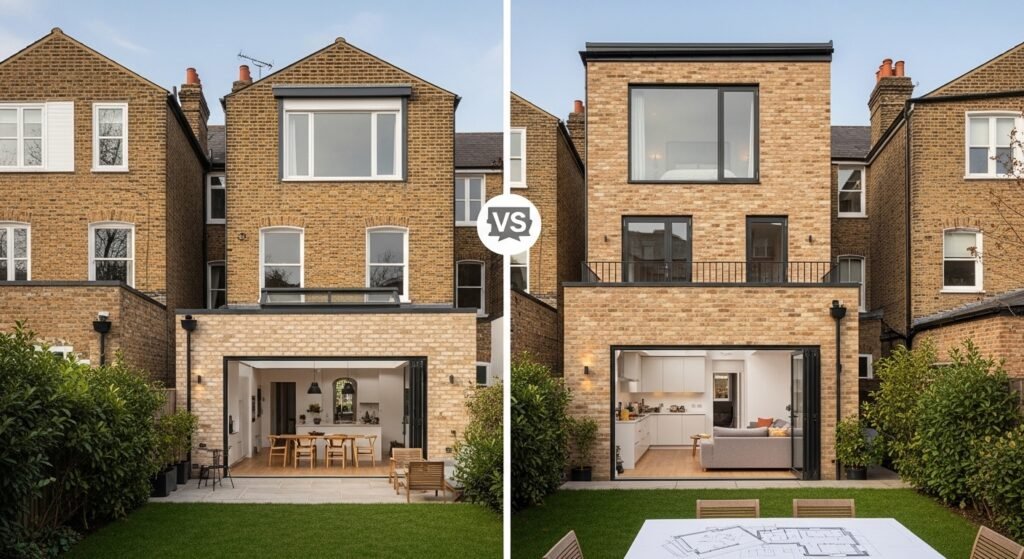
A single-storey rear extension projects from the back of the house at ground level, typically adding 3 to 6 metres of depth and creating a new or enlarged kitchen-diner, family room, or playroom. It does not add any bedroom count. Many owners finish this space with a modern kitchen installation.
In a typical Islington mid-terrace, this transforms the ground floor from a series of disconnected rooms into an open-plan space connected to the garden. Light enters from rear glazing and, in many designs, from a rooflight above. Some layouts also include skylight installation for extra daylight. This is the most transformative change to the daily lived experience of the house, and the one that buyers respond to most consistently during viewings.
A single-storey does not solve a bedroom deficit. If the property has two bedrooms and you need three, this extension does not help that problem.
Double-Storey Rear Extension
A double-storey rear extension adds both a ground-floor room and a first-floor room, sharing foundations and roof across both levels. The ground floor typically provides the kitchen-diner or living extension. The first floor delivers a bedroom, bathroom, or ensuite. Many projects also include new bathroom installation as part of the added floor space.
This solves both space problems simultaneously. It addresses the bedroom count and the living space in one project. The cost per square metre is lower than building the same floor area as a single-storey, because foundations, scaffolding, and roofing costs are shared across two levels.
The trade-off is that double-storey extensions are larger, more visually impactful on the streetscape and on neighbours, and always require full planning permission in Islington. They also take longer to build and are more disruptive. Because of the scale, owners often appoint one team for complete building services.
Cost Comparison in Islington: 2026 Figures
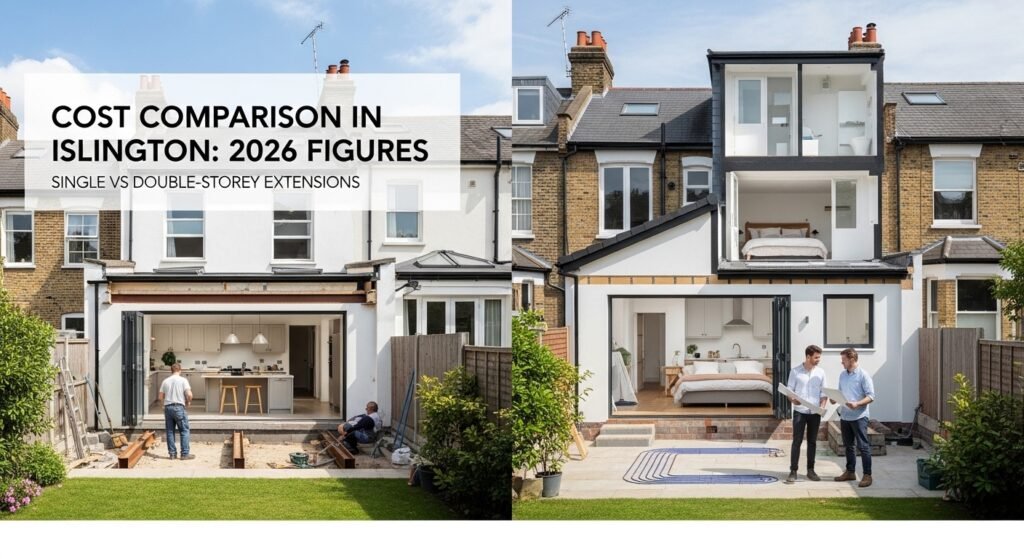
Islington sits at the premium end of the inner London extension market. Conservation area density, labour costs, and the complexity of working on Victorian terrace infrastructure push costs toward the upper end of London averages. Older homes frequently need upgraded plumbing heating systems during extension works.
Single-Storey Rear Extension Costs
| Extension Size | Mid-Range Spec | High Spec |
|---|---|---|
| 15 to 20m² | £55,000 to £80,000 | £80,000 to £105,000 |
| 20 to 30m² | £75,000 to £110,000 | £105,000 to £140,000 |
| 30m²+ | £105,000 to £135,000 | £135,000 to £165,000+ |
These figures include VAT at 20%, architect fees, structural engineering, building regulations, and a typical kitchen fit-out allowance. Premium finishes may also include bespoke kitchen units. They exclude landscaping, party wall surveyor costs (typically £1,500 to £4,000 depending on how many neighbours are affected), and any structural complications discovered at build.
Cost per square metre for a single-storey rear extension in Islington: £3,500 to £5,000 depending on specification.
Double-Storey Rear Extension Costs
| Total Floor Area | Mid-Range Spec | High Spec |
|---|---|---|
| 30 to 40m² (both floors) | £110,000 to £145,000 | £145,000 to £175,000 |
| 40 to 50m² (both floors) | £140,000 to £175,000 | £175,000 to £215,000 |
| 50m²+ (both floors) | £170,000 to £205,000 | £205,000 to £250,000+ |
Cost per square metre for a double-storey extension in Islington: £3,200 to £4,500 depending on specification. The lower per-metre figure reflects the economies of shared foundations and roofing across two floors. Higher-spec homes often add efficient underfloor heating at this stage.
The Per-Square-Metre Advantage of Going Double
If you need 40 square metres of new floor area, building it as a single-storey costs significantly more per metre than building it as a double-storey. But most Islington Victorian terraces cannot accommodate a 40m² single-storey extension, partly because of garden depth limits and partly because permitted development does not cover extensions beyond 3 metres without a planning application.
The economies of the double-storey format only benefit you if you genuinely need the first-floor space. Adding an unwanted bedroom to save money on a per-metre basis is not a sound argument unless that bedroom adds value to the property.
Value Added: Which Extension Increases Your Property Value More?
This is where Islington’s specific market conditions matter. Average property values in Islington exceed £650,000. In Barnsbury, Canonbury, and Highbury, mid-terrace Victorians typically range from £800,000 to £1.4 million for a three to four-bedroom house.
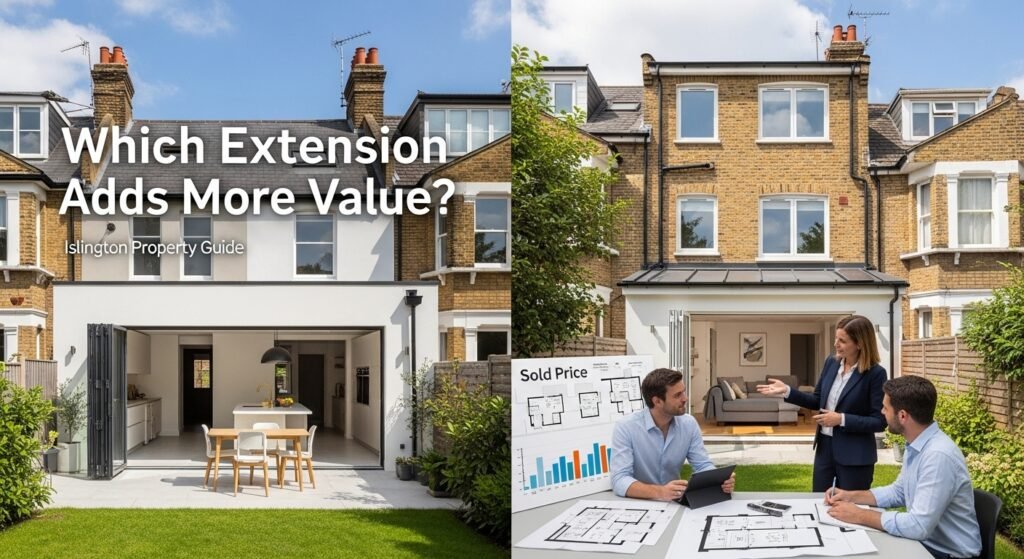
At these price points, the value arithmetic of extensions is more compelling than in most parts of the country.
Single-Storey: Value Uplift
A well-executed single-storey rear extension that creates a quality open-plan kitchen-diner in an Islington Victorian terrace consistently adds 8 to 12% to the property’s market value. On a house worth £900,000 before extension, that is £72,000 to £108,000 of added value.
An extension costing £100,000 that adds £85,000 to £108,000 of value is broadly cost-neutral at the point of sale, while delivering years of improved living in the property. That is the standard case for an Islington single-storey rear extension.
Estate agents in Islington consistently report that the open-plan kitchen-diner is the single most impactful feature during viewings. Buyers also value quality finishes installed by skilled kitchen fitters. Buyers pay more, and offer faster, for a Victorian terrace that already has this transformation done. Properties without it are priced lower and attract buyers who budget for the renovation themselves.
Double-Storey: Value Uplift
A double-storey extension that adds a bedroom or ensuite to the first floor, combined with the ground-floor extension, can add 12 to 20% to property value in Islington. The reason the range is wider is that the value impact depends strongly on the bedroom count before the extension.
Adding a fourth bedroom to a three-bedroom Victorian terrace in Islington is the highest-return move in the double-storey category. An added ensuite can further increase appeal through smart bathroom renovation. A four-bedroom terrace in Barnsbury or Canonbury commands a price premium over a three-bedroom on the same street that frequently exceeds £150,000 to £200,000. If the double-storey extension delivers that bedroom count change, the value uplift can substantially exceed the build cost.
Adding a third bedroom to a two-bedroom terrace is similarly high-impact. Islington’s buyer market for two-bedroom properties is different from the market for three-bedroom properties, with the latter attracting family buyers at significantly higher price points.
Which Returns More?
The honest answer is: it depends on what the property was before.
If the property already has three or four bedrooms and the buyer market is satisfied, a single-storey kitchen extension adds more proportional value per pound spent, because the kitchen transformation is what buyers respond to most in a well-bedroomed property.
If the property has two bedrooms and the bedroom deficit is what holds the price down, a double-storey extension that adds bedroom count typically delivers a stronger absolute value uplift, even at higher cost.
Planning Permission: The Key Difference in Islington
This is where single vs double storey diverge most sharply in Islington’s specific planning context.
Single-Storey: What Is and Is Not Permitted Development
Under national permitted development rules, a single-storey rear extension of up to 3 metres depth from the rear wall of the original house does not require planning permission for a terraced or semi-detached property. The Larger Home Extension scheme extends this to 6 metres with neighbour notification.
However, Islington has issued Article 4 Directions across 40 of its 42 conservation areas. These directions remove some permitted development rights. In practice, even a standard single-storey rear extension within the 3-metre limit can require a full planning application in many Islington conservation areas, depending on the specific direction in force.
Check the Islington Council interactive planning map before assuming permitted development applies to your address. Many owners also seek early advice from local London builders before applying.
For properties outside conservation areas (a minority of Islington’s housing stock), a single-storey rear extension within the depth limits can proceed without planning permission, subject to height conditions.
Double-Storey: Always Needs Planning Permission
A double-storey rear extension in Islington always requires a full householder planning application. The national permitted development rules for double-storey extensions are restrictive: the extension must not exceed 3 metres depth, must be more than 7 metres from the rear boundary, and must not exceed the height of the existing roof. Most Islington terraces cannot meet all these conditions simultaneously.
Planning applications for double-storey extensions in Islington are assessed against the borough’s Local Plan and conservation area design guidelines. Islington’s planning team applies a consistent principle that extensions should be visually subservient to the existing house and should not cause unacceptable harm to the amenity of neighbouring properties through loss of light, overlooking, or bulk.
A double-storey extension that reduces a neighbouring property’s daylight below the BRE Guidelines threshold (the 45-degree rule or the 0.2 vertical sky component standard) will be refused. This is the most common planning constraint on double-storey extensions in Islington’s densely built Victorian terrace streets.
The planning fee for a householder application from April 2026 is £548. The typical determination period is 8 to 12 weeks in Islington, with conservation area applications toward the longer end. Pre-application advice from Islington Council costs £150 to £300 for written feedback and is recommended for any double-storey project.
Timeline: How Long Each Takes
Both extension types in Islington require a planning and design phase before any building work begins. The total timeline from initial decision to completed extension differs.
Single-Storey Timeline
If permitted development applies and no planning application is needed, the timeline is:
- Architect appointment and design: 4 to 8 weeks
- Structural engineering: 2 to 3 weeks (concurrent with design)
- Contractor booking: 4 to 12 weeks ahead of start date
- Building Regulations approval: 2 to 4 weeks
- On-site construction: 10 to 16 weeks
Total from first decision to finished extension: 4 to 7 months. Interior finishing often includes painting decorating near completion.
If a planning application is needed, add 10 to 14 weeks for the application process. Total: 6 to 10 months.
Double-Storey Timeline
A full planning application is always required. The timeline is:
- Architect appointment and design: 6 to 10 weeks
- Pre-application advice from Islington (recommended): 4 to 6 weeks
- Planning application and determination: 8 to 12 weeks
- Structural engineering and building regulations: 4 to 6 weeks
- Contractor booking: 4 to 16 weeks ahead of start date
- On-site construction: 16 to 24 weeks
Total from first decision to finished extension: 10 to 16 months. Larger builds may also need new tile flooring or upgraded finishes.
For households with young children starting school in September, or with a planned sale, the double-storey timeline needs to be factored into the decision early.
Which Is Right for Your Islington Home? A Decision Framework
Use these factors to guide the decision for your specific circumstances.
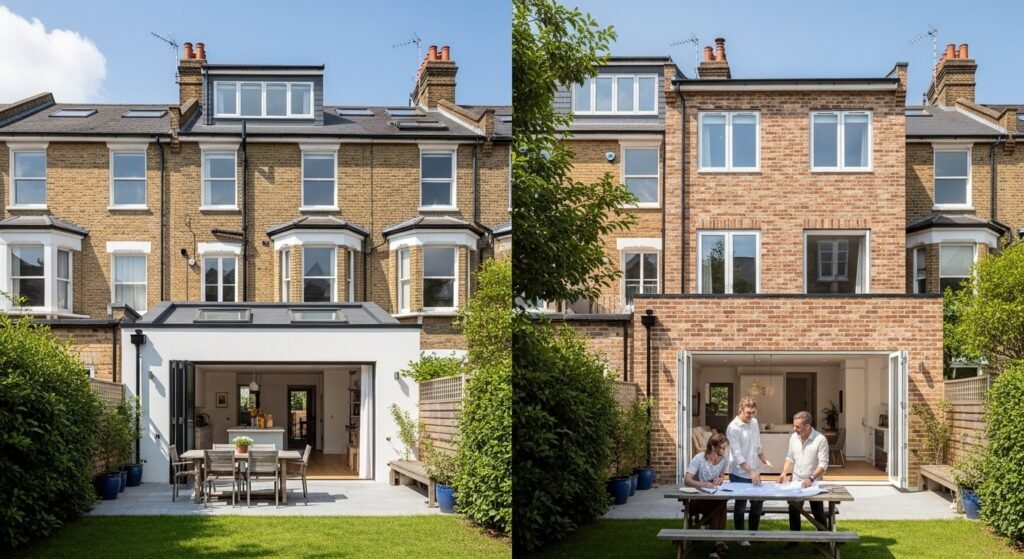
Choose a single-storey if:
- Your property already has three or more bedrooms and bedroom count is not the constraint on value
- Your budget sits below £120,000 all-in
- You want the project completed within 12 months
- Your garden depth limits how far you can extend at ground floor (and a double-storey going 3 metres deep is not worth the planning risk)
- Your property is in a conservation area with a tight single-storey precedent and a harder route for double
Choose a double-storey if:
- Your property has two bedrooms and adding a third would move you into a significantly higher price bracket at sale
- Your budget extends to £150,000 to £200,000 all-in
- You have garden depth that keeps the rear wall more than 7 metres from the rear boundary
- The first-floor addition adds a room you would genuinely use (ensuite, bedroom, home office with height)
- Your property is outside a conservation area or has a planning precedent from nearby double-storey approvals
Consider both stages separately if:
- You cannot fund the double-storey now but want it eventually. Some households phase the work and start with structural stud wall construction changes first. A well-designed single-storey extension can be structurally prepared for a future upper floor at modest additional cost during the initial build. The foundations can be over-engineered and the rear wall can be built in blockwork rather than timber frame to support a future first-floor addition.
FAQ
Q: Can I build a double-storey extension without planning permission in Islington?
Almost never in practice. Double-storey rear extensions in Islington require full planning permission in virtually all cases. National permitted development rules for double-storey extensions require the extension to be no deeper than 3 metres and no closer than 7 metres to the rear boundary, conditions that most Islington terraces cannot satisfy simultaneously. Victorian properties built before 1948 also cannot use upward extension permitted development rights introduced in 2020. Assume planning permission is needed and budget accordingly.
Q: How long does it take to get planning permission for a double-storey extension in Islington?
Islington’s statutory determination period is 8 weeks from the date an application is validated. In practice, conservation area applications and those requiring neighbour consultation take 10 to 12 weeks. Adding the pre-application design phase (6 to 10 weeks) and any pre-application advice consultation (4 to 6 weeks), expect 5 to 7 months from architect appointment to planning decision. Budget for the full timeline when setting your project start date.
Q: Does a double-storey extension always add more value than a single-storey?
Not always. In Islington, the value of any extension depends primarily on what the property was missing before the build. Adding a fourth bedroom via double-storey to a three-bedroom house in Canonbury can add £150,000 to £200,000 to the asking price, far exceeding the build cost. Adding the same extension to a five-bedroom house adds much less, because the bedroom count was already strong. For most Islington terraces, the ground-floor kitchen-diner transformation is what buyers pay most for, and a single-storey often delivers that at lower cost and less planning risk.
Q: Will a double-storey extension overlook my neighbours and cause planning problems in Islington?
Overlooking and daylight loss are the two most common reasons double-storey extensions are refused in Islington. First-floor rear windows in a double-storey extension look directly into the rear gardens and windows of properties behind. Islington’s planning officers apply the BRE Guidelines for daylight and sunlight to assess these impacts. If the extension materially reduces the vertical sky component of a neighbour’s main habitable room windows below 0.2, it is likely to be refused. An architect with Islington conservation area experience can assess this risk during the design stage before an application is submitted.
Q: Can I build a single-storey now and add a second storey later?
Yes, and this is an approach some Islington homeowners take when the budget does not support a double-storey at the outset. The initial single-storey extension should be designed and built with the future second storey in mind: foundations sized for the additional load, rear wall built in blockwork rather than lightweight construction, and a structural engineer’s calculation confirming the scheme is achievable. The second-storey addition will require a fresh planning application when the time comes. The combined cost of the two stages is typically higher than building both together in one project, but it allows the investment to be phased.
Q: How much does a planning application cost in Islington in 2026?
The householder planning application fee from 1 April 2026 is £548, following the annual CPI-linked indexation increase. This covers the council’s processing fee and applies to extensions and alterations to a single dwelling house. Professional fees for an architect to prepare and submit the application are additional, typically £2,000 to £5,000 depending on the complexity of the scheme and whether a design and access statement or heritage statement is required.
Conclusion
The single vs double storey extension decision in Islington comes down to what your property needs, not which option costs more per square metre. A single-storey rear extension delivers the open-plan kitchen-diner that Islington buyers respond to most strongly, at lower cost and with fewer planning complications. A double-storey earns its higher cost when it adds bedroom count that shifts the property into a materially higher market bracket.
In a borough where property values regularly exceed £800,000 for a Victorian terrace and planning regulations require careful navigation of 42 conservation areas, the right extension is the one that fits your specific property’s constraints and your household’s genuine needs. Get that assessment right, and either option can deliver a positive return. Get it wrong, and you can spend more than the market will reward.
Work with an architect who knows Islington’s planning context before committing to either route. The best results usually come from experienced Islington builders who understand local planning and Victorian homes.

Tilly Bani is a renovation and roofing specialist with over 15 years of experience in construction and property refurbishment across North London. He specialises in roofing, structural repairs, and full home renovations, helping homeowners improve property value and safety.