KOINSLOT X RESTORING VICTORIAN FIREPLACES AND COVING tampil sebagai Game Online PC yang dirancang untuk pengalaman bermain praktis dan aman. Platform ini menghadirkan akses cepat, antarmuka ringan, dan layanan customer service aktif 24 jam untuk mendukung setiap sesi permainan KOINSLOT x Restoring Victorian Fireplaces and Coving: A Complete Guide - Home Refurbishment & Roofing Specialists.
Sebagai situs resmi, KOINSLOT X RESTORING VICTORIAN FIREPLACES AND COVING menghadirkan berbagai pilihan Game Online Mobile dengan performa server stabil, metode transaksi fleksibel, dan bonus yang relevan dengan kebutuhan pemain aktif. Setiap fitur disusun agar pemain dapat fokus mengejar peluang maxwin tanpa hambatan teknis.
Pengalaman bermain di koinslot x restoring victorian fireplaces and coving semakin nyaman dengan pola permainan transparan dan tips manajemen modal yang mudah diterapkan. Pemain yang ingin eksplorasi Game Online terkait KOINSLOT x Restoring Victorian Fireplaces and Coving: A Complete Guide - Home Refurbishment & Roofing Specialists bisa langsung memulai dari halaman resmi KOINSLOT X RESTORING VICTORIAN FIREPLACES AND COVING dan menyesuaikan strategi sesuai gaya bermain masing-masing.
KOINSLOT X RESTORING VICTORIAN FIREPLACES AND COVING — Restoring Victorian Fireplaces and Coving: A Complete Guide
Quick Answer
Restoring a Victorian fireplace typically costs £300 to £1,200 to open up a boarded or bricked-up opening, with a further £600 to £1,000 for a new chimney liner if you plan to burn wood or coal. Coving and cornice restoration ranges from small crack repairs at £30 to £80 up to full replacement at £4 to £15 per metre plus labour, depending on whether original plaster of Paris profiles are matched or a modern equivalent is used. Both jobs are usually straightforward from a permissions standpoint, though listed buildings and some conservation areas add extra steps worth checking before work starts.
Why Victorian Fireplaces and Coving Matter in Period Properties
Original features are one of the main reasons buyers pay a premium for a Victorian or Edwardian terrace over a modern equivalent, and fireplaces and ceiling detailing are usually the two most visible examples in any front reception room, alongside the wider plastering and decorating work that ties a restored room together.
Cast Iron Surrounds
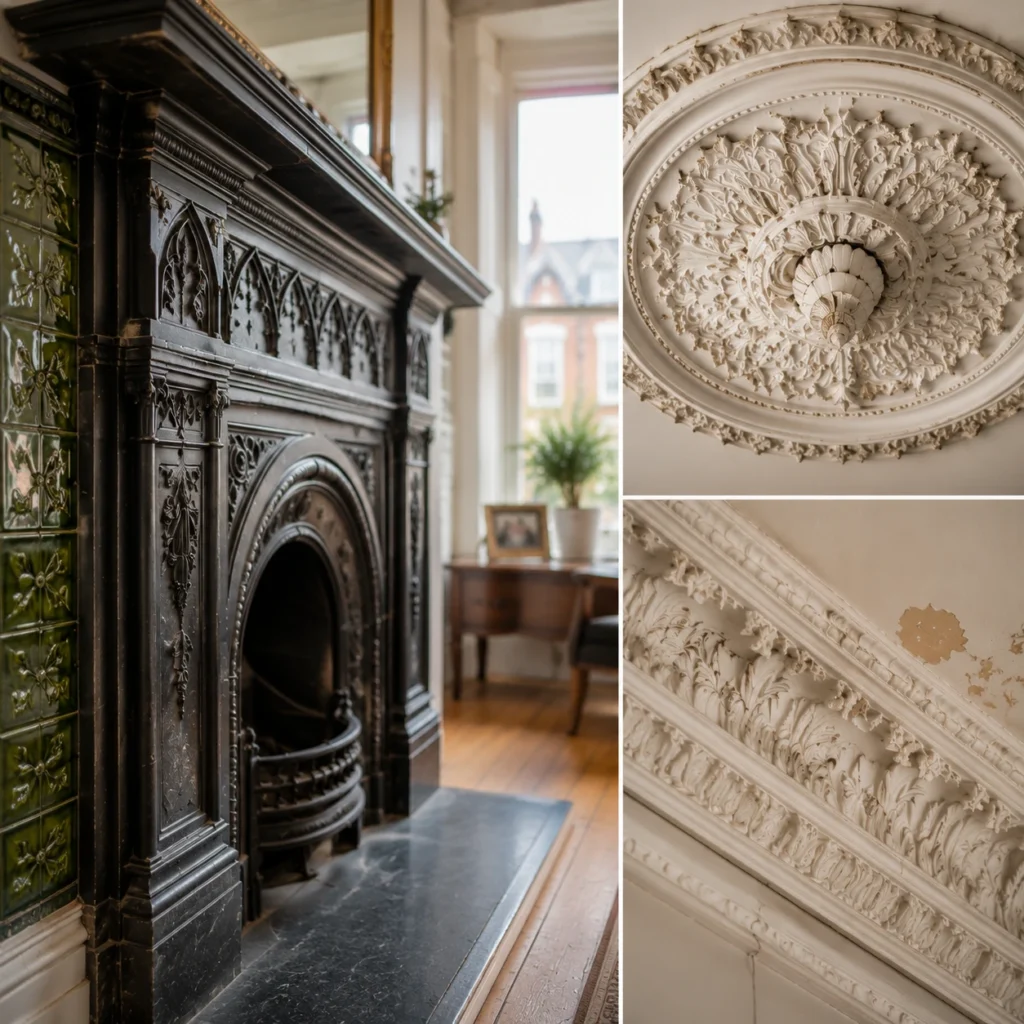
Cast iron fireplace surrounds were mass-produced from the 1850s onward and remain common throughout North London’s terraced housing stock, often in Georgian-influenced or Gothic Revival patterns depending on when the street was built. Many surviving surrounds have been painted over multiple times, sometimes concealing genuinely ornate detailing entirely, or covered by decades of soot and rust that make the original design difficult to judge without proper cleaning.
Ceiling Roses and Cornicing
Coving, cornicing, and ceiling roses were produced from decorative plaster moulds, typically plaster of Paris cast on site or pressed from timber and composition moulds for repeating runs. A ceiling rose sits at the centre of a room, historically surrounding a gas or early electric light fitting, and cornicing runs around the wall-ceiling junction, often varying in profile depth and pattern between a front reception room and a rear or upstairs room in the same house, reflecting which rooms the original builder considered most important to impress visitors.
Restoration vs Replacement: How to Decide
Deciding between restoring an original feature and replacing it with a reproduction depends on the extent of damage, the rarity of the specific pattern, and the budget. When planning wider interior restoration work, understanding skimming costs in London can help homeowners estimate the additional expense of creating smooth, finished walls around restored period features.
Genuine restoration is worth pursuing where the underlying casting or plasterwork is structurally sound, since cast iron rarely fails outright and most coving damage is limited to cracking, missing sections, or paint buildup rather than complete loss of the profile. Replacement becomes the more sensible option where a fireplace surround is cracked through in a structural area, missing large sections entirely, or where a previous owner has already removed the original feature and only a reproduction can fill the gap. Matching an existing pattern elsewhere in the house, or in a neighbouring property on the same street built by the same original developer, is often possible and gives a more historically accurate result than a generic reproduction.
Opening Up a Blocked Fireplace
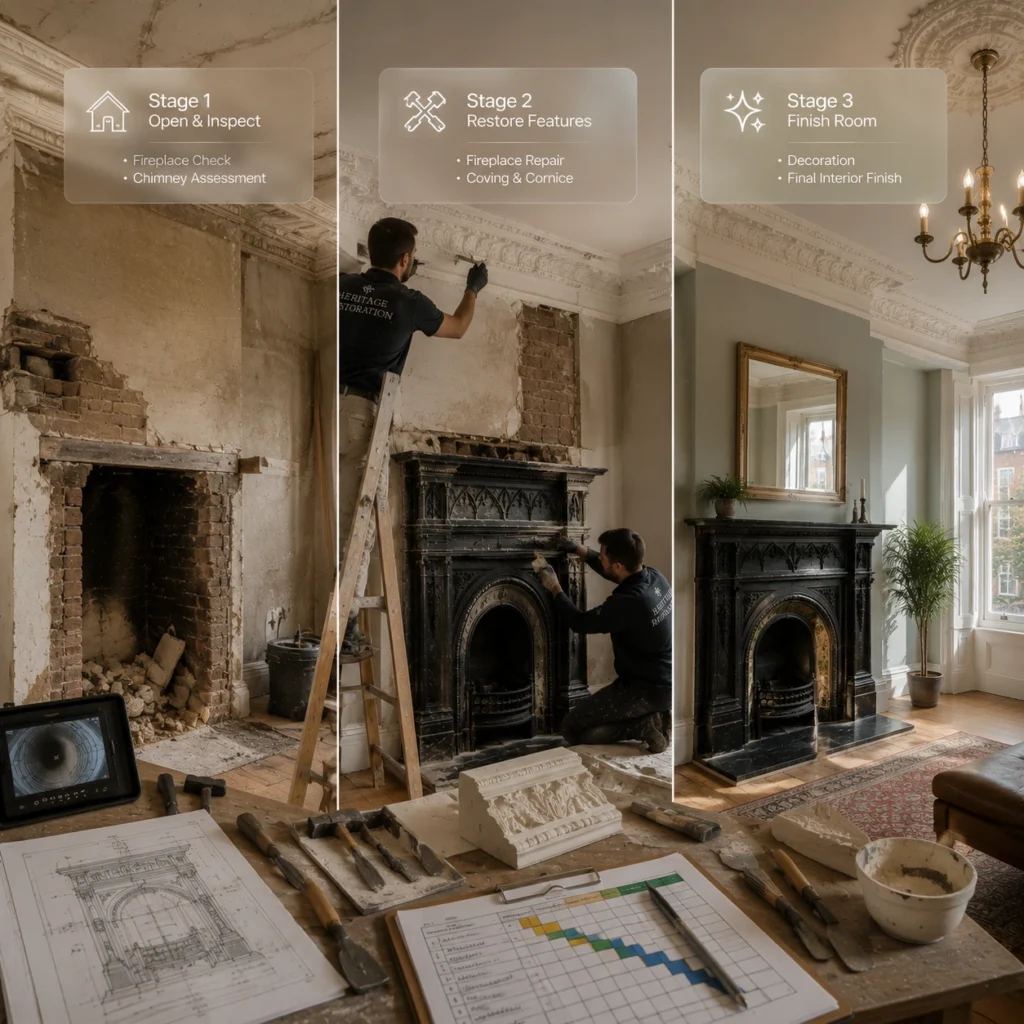
Many Victorian terraces had their original fireplaces boarded or bricked up decades ago, usually when central heating was installed, and reopening one is often the first step in any fireplace restoration project.
Signs a Fireplace Has Been Boarded vs Bricked Up
A boarded fireplace typically sounds hollow when tapped and may have a visible seam or panel edge under wallpaper or paint. A bricked-up fireplace feels solid throughout and has usually been plastered over completely, making it harder to identify without removing some surface finish or having a specialist inspect it.
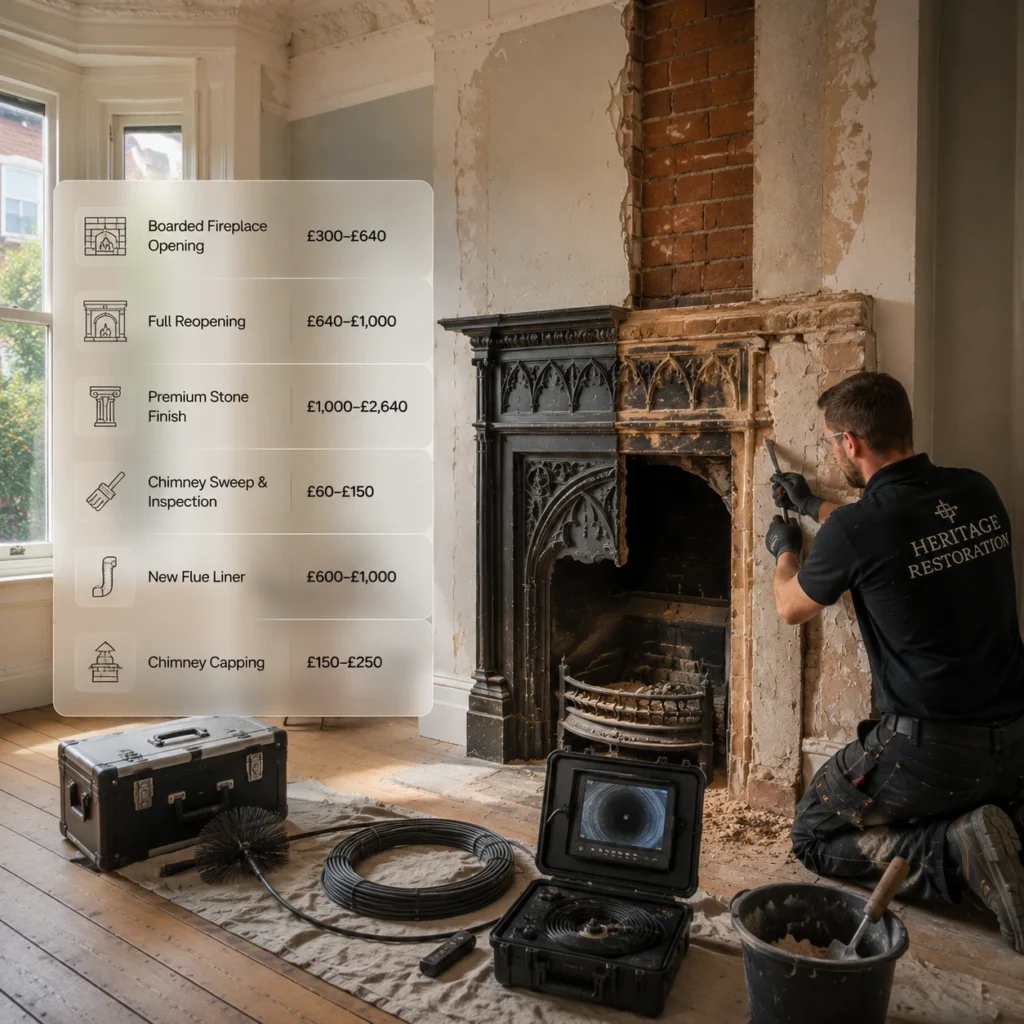
Job
Typical Cost (2026)
Straightforward unblocking, boarded opening
£300 to £640
Full reopening, low-end reinstatement materials
£640 to £1,000
Full reopening, premium stone or brick finish
£1,000 to £2,640
Chimney sweep and inspection
£60 to £150
New flue liner
£600 to £1,000
Chimney capping, per pot
£150 to £250
Reopening cost depends heavily on whether the fireplace was simply boarded, which is comparatively quick, or fully bricked and plastered over, which involves more rubble removal and a proper condition check on the flue before anything is finished.
Chimney and Flue Requirements Before Using a Restored Fireplace
A restored fireplace that looks complete is not automatically safe to light, and skipping the chimney and flue checks is one of the most common and dangerous mistakes in period fireplace restoration. Before starting any wider renovation work, homeowners should also understand related replastering costs in London, especially when restoring older properties with damaged walls and traditional features.
Every flue intended for use should be swept and inspected before first use, and a chimney that has been unused for years, common in a property where central heating replaced the original fires decades ago, needs this check regardless of how sound it looks from the room side. A camera inspection of the flue is often recommended before committing to a full reinstatement, since it identifies cracks, blockages, or structural issues inside the chimney that are invisible from either end.
If you intend to burn wood, coal, or install a wood-burning stove, a flue liner is generally required, both for safety and to meet building regulations, and should be installed by an installer registered with a competent scheme such as HETAS for solid fuel appliances. This work, along with fitting a new stove or rebuilding a chimney stack above roof level, requires building regulations sign-off, unlike routine repointing or flaunching repair, which are typically classed as maintenance and do not trigger the same requirement.
Coving and Cornice Restoration
Coving and cornice work sit at the more delicate end of plastering, and the right approach depends heavily on the extent and type of damage present.
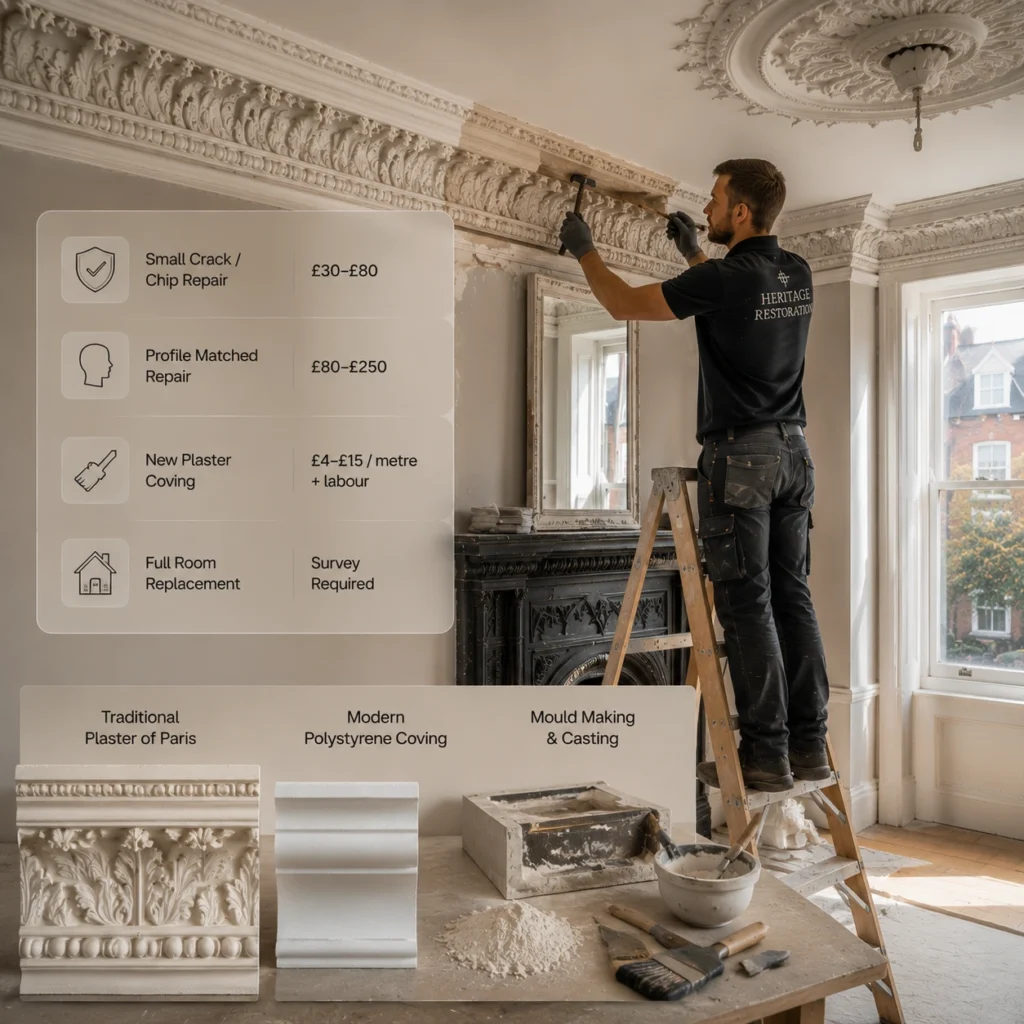
Job
Typical Cost (2026)
Small crack or chip repair
£30 to £80
Larger section repair, existing profile matched
£80 to £250 per section
New coving, plaster, per metre supplied
£4 to £15 per metre, plus labour
Full room replacement, plaster profile
Priced per project after survey
Plaster of Paris vs Modern Materials
Original Victorian coving was almost always cast in plaster of Paris or lime plaster, both of which allow a wall to breathe and were chosen for their durability and fine detail reproduction. Modern polystyrene coving is far cheaper and easier to fit, but reads visibly differently in a period room, both in profile sharpness and in how it catches light compared with traditional plaster. Where surrounding wall or ceiling surfaces also need attention, a fresh skim finish alongside the coving work gives a more even, consistent result than treating the coving in isolation. For a room where matching the original character matters, a specialist working in the traditional plasterwork process, taking a mould from an intact section elsewhere in the house, generally gives the most convincing result, even where the per-metre cost is higher than a standard modern alternative.
Ceiling Roses: Restoration Considerations
A ceiling rose in reasonable condition is usually straightforward to clean and repaint, but one hidden under decades of paint layers can lose fine detail entirely, since each repaint slightly softens the sharpness of the original casting.
Where a rose has been damaged by a previous light fitting installation, common where a heavier modern pendant was hung without proper support, or where structural movement above has caused cracking, a specialist can usually cast a replacement section from an intact area of the same rose or a matching example elsewhere in the property. Where damage extends beyond the rose itself into the surrounding ceiling, this is often combined with a wider full replastering of the affected area rather than treating the rose as an isolated repair. This is more cost-effective and historically accurate than sourcing a generic reproduction rose that will not match the exact scale and pattern of the room.
Listed Buildings and Conservation Areas
Most fireplace and coving restoration is internal work with no external impact, which generally keeps it outside planning control, even in a conservation area.
Listed building status changes this picture significantly, since original internal features such as fireplaces, cornicing and ceiling roses are frequently part of what makes a property architecturally significant in the first place, and removing or substantially altering them can require Listed Building Consent even where the work is entirely internal. This is a different and separate consent from the planning permission rules or Article 4 restrictions that primarily control external changes, so a property can face no external planning restriction at all while still needing consent for internal fireplace or plasterwork alteration if it happens to be listed.
Chimney breast removal, sometimes considered alongside a fireplace restoration project where a homeowner is deciding whether to keep or remove the feature entirely, raises its own structural and neighbourly considerations, particularly on a shared party wall in a mid-terrace property, since the chimney breast on your side often supports or interacts with the equivalent structure next door. Removing a chimney breast also changes how sound travels through that wall, so it’s worth checking against our guide to soundproofing party walls if noise transfer between properties is already a concern.
Common Mistakes When Restoring a Period Fireplace
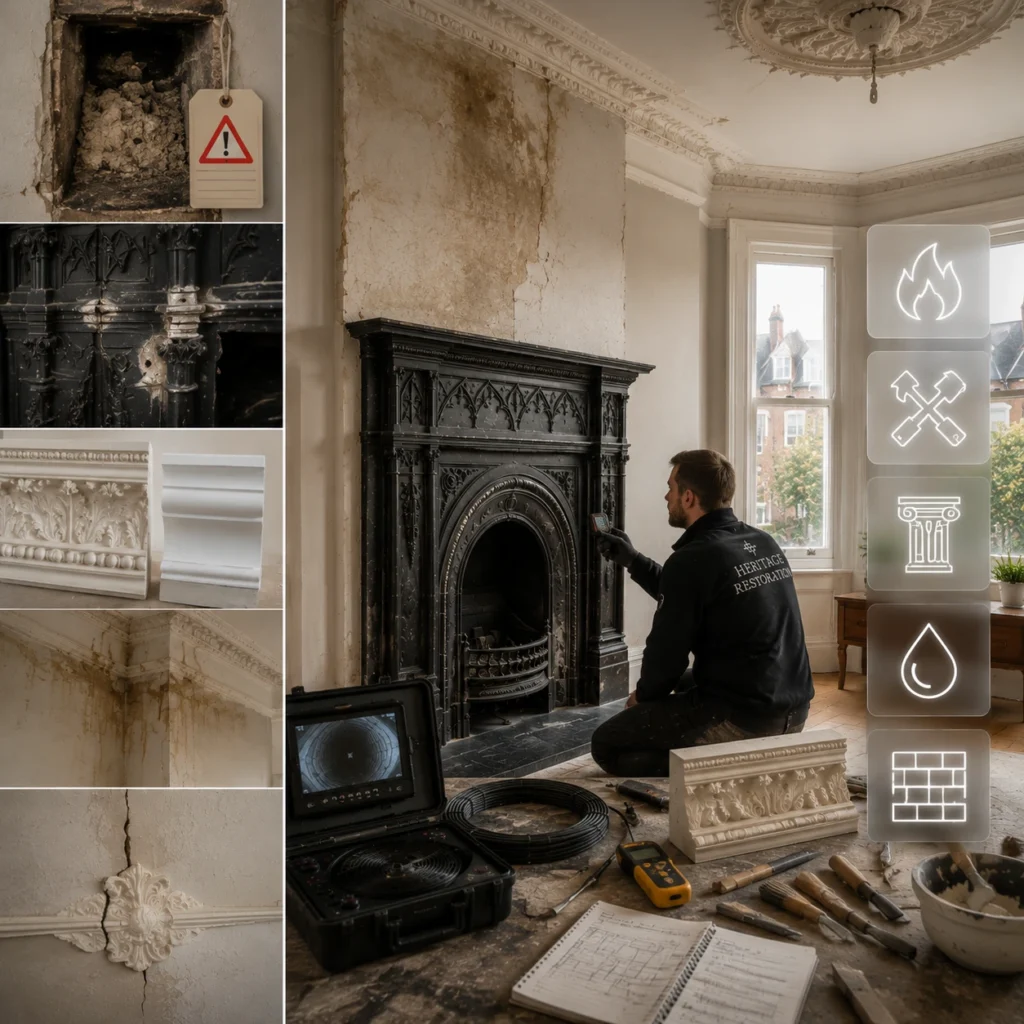
A handful of avoidable errors come up repeatedly on Victorian fireplace and coving projects, and each one is worth checking before work begins.
Lighting a fire before the flue has been swept and inspected, even where the fireplace looks structurally complete, risking smoke ingress or a chimney fire from built-up creosote or an undetected blockage.
Stripping cast iron with an aggressive method that damages fine detailing, such as harsh mechanical grinding, rather than a controlled approach suited to the specific finish and casting.
Assuming polystyrene coving will look acceptable in a front reception room with other original period features intact, when the visual mismatch is often more noticeable once fitted than expected from a sample.
Skipping a check for damp near the chimney breast, since a chimney is a common source of penetrating damp, and restoring decorative plasterwork on a wall with an unresolved moisture problem risks the same cracking and staining returning within a year or two, a pattern covered in more depth in our guide to damp in Victorian terraces.
Not checking for structural movement before ordering replacement coving, since new plasterwork fitted over a wall with active settlement, of the kind discussed in our guide to cracked walls, is likely to crack again, regardless of how well it was installed.
Lighting a Restored Room Correctly
A ceiling rose was originally built around a light fitting, and getting the lighting right is often the difference between a restoration that reads as authentic and one that looks like a museum piece nobody actually uses.
Hanging a heavy modern pendant directly from an old rose without proper support is a common cause of the cracking and detachment discussed earlier, since the original fixing point was rarely designed for anything beyond the light fittings available at the time. A qualified electrician can fit a proper ceiling hook or reinforced support independent of the decorative plasterwork, so the rose carries no structural load itself. This is also a sensible moment to review the room’s wider lighting installation, since a restored fireplace and coving generally look better under a layered scheme, a rose pendant, picture lights over the mantel, and dimmable wall lighting, than under a single bright ceiling fitting.
Before mounting anything new to a rose or running fresh cable near a restored fireplace, it is worth confirming the property’s existing wiring is actually sound, particularly in an older room that has not been touched in decades. Our guide to house rewiring costs covers what to check before committing to new fittings in a room with genuinely old electrics.
Where the wiring itself is fine but the fuse box behind it is not, a consumer unit upgrade is often the more targeted fix rather than a full rewire, particularly if the rest of the property’s electrics have already been checked and found sound.
Combining Fireplace and Coving Work With a Wider Renovation
Fireplace and coving restoration rarely happens in complete isolation, and sequencing it correctly against other work in the same room saves both time and money.
Open up and assess the fireplace before finalising a room’s redecoration plan, since reopening an unexpectedly bricked-up chimney can generate more dust and mess than anticipated, and it is far better to discover this before fresh paint goes on rather than after. Coving and cornice work should also be completed before final decoration, not squeezed in afterward, since any dust, plaster splash, or minor touch-up work around the ceiling junction is much easier to manage before the walls are finished.
Where fireplace and coving restoration form part of a larger project, a loft conversion, extension, or full room-by-room refresh, coordinating trades through a single full refurbishment approach avoids the period features being an afterthought squeezed in around other work, and typically produces a more cohesive result across the whole room.
Frequently Asked Questions
Q: Can I keep my chimney if I never plan to use the fireplace?
Yes, a chimney with no active fireplace or stove connected still needs periodic maintenance, but at a lower cost than one in regular use. If the chimney genuinely serves no purpose and repair costs are becoming a recurring expense, removal is a reasonable option, though this is a structural decision worth discussing with a builder familiar with the property’s construction first.
Q: How do I know if my Victorian fireplace is original or a later addition?
Original cast iron surrounds typically show casting marks, foundry stamps, or period-appropriate pattern styles consistent with the property’s construction date. A specialist restorer or an experienced period-property builder can usually date a surround reasonably accurately from its pattern and construction, which is useful both for restoration decisions and for understanding what you actually have before deciding whether to restore or replace it.
Q: Is it worth restoring coving if I’m planning to sell?
Original, well-restored coving and fireplaces are consistently cited by estate agents as features that help a period property stand out, particularly against a neighbouring house where these details have been stripped out or covered over. It is not usually possible to isolate the exact value uplift, but well-presented original features generally support a smoother, faster sale in a competitive period property market.
Q: Do I need building regulations approval to restore coving or a fireplace surround?
Restoring existing coving or a fireplace surround without structural alteration generally does not require building regulations approval. Work that triggers this requirement includes fitting a new flue liner, installing a wood-burning stove, or rebuilding a chimney stack above roof level, all of which involve genuine structural or fire-safety implications rather than purely decorative restoration.
Q: How long does fireplace restoration typically take?
A straightforward reopening and cleaning of an existing cast iron surround can be completed in one to two days. A full project including chimney lining, sweep and inspection, and coordinated coving restoration in the same room commonly takes a week or more, particularly where plaster needs time to dry fully between stages before final decoration.
Q: What’s the difference between coving and cornicing?
The terms are often used interchangeably, but cornicing traditionally refers to the more elaborate, deeper decorative moulding found in higher-status Victorian rooms, while coving describes a simpler, shallower curved profile. In practice, most period property specialists and homeowners use the terms without strict distinction, and the correct choice for a specific room comes down to matching what survives elsewhere in the house.
Q: Can I paint a cast-iron fireplace surround myself?
Basic repainting after professional cleaning and any necessary rust treatment is a reasonable DIY task for a competent homeowner. Stripping decades of old paint, treating rust properly, and any structural repair to cracked or damaged castings is better suited to a specialist, since incorrect stripping methods can permanently damage fine detailing that took considerable skill to originally cast.
Q: Will restoring my fireplace affect my home insurance?
Insurers generally want to know if you are reinstating an open fire or wood-burning stove, since this changes the fire risk profile of the property, and most require confirmation that the chimney has been swept and, where relevant, that a HETAS-registered installer fitted any stove or liner. Always update your policy before first use rather than after, since an unreported change to fire risk can complicate a claim later.
Q: My coving is a different pattern in each room. Is that normal?
Yes, this is common and usually intentional rather than a sign of later alteration. Victorian builders frequently specified more elaborate cornicing in the front reception rooms visitors would see, with simpler, shallower profiles in bedrooms and service areas, reflecting the relative importance assigned to each room at the time the house was built.
Conclusion
Restoring a Victorian fireplace or original coving is one of the more rewarding period property projects, since the visual impact is significant relative to the cost, particularly compared with structural work elsewhere in the house. Get the chimney properly inspected before any fireplace goes back into use, and check for damp or structural movement before committing to new plasterwork, since restoring a feature on top of an unresolved underlying problem tends to undo the work within a year or two. Coordinating fireplace and coving work with wider renovation planning avoids finishing a room twice if other structural or electrical work is still to come.
EBT Build restores original coving and cornice moulding and coordinates fireplace reinstatement across North London’s Victorian and Edwardian terraces, matching original profiles from intact sections elsewhere in the property wherever possible.
Tilly Bani is a renovation and roofing specialist with over 15 years of experience in construction and property refurbishment across North London. He specialises in roofing, structural repairs, and full home renovations, helping homeowners improve property value and safety.