
| Quick Answer Most Islington homeowners have significantly fewer permitted development rights than homeowners elsewhere in England. Islington has removed permitted development rights in 40 of its 42 conservation areas using Article 4 Directions. This means that extensions, loft conversions, window changes, and even painting brickwork that would require no permission in most of the country will need a full planning application in the majority of Islington properties. Flats and maisonettes have no permitted development rights regardless of location. Houses outside conservation areas do retain standard national rights. |
Introduction
Permitted development rights allow homeowners to build extensions, convert lofts, and make alterations without applying for planning permission. In most of England, these rights are a practical shortcut that saves months and hundreds of pounds. For larger internal upgrades, homeowners often combine work with full refurbishment plans. In Islington, they are the exception rather than the rule.
The borough’s Article 4 Directions, layered across almost every conservation area, strip back rights that apply everywhere else. A homeowner in Barnsbury, Canonbury, or Highbury who assumes they can build a rear extension under permitted development without checking may discover they need planning permission for work that would not require it in Hackney, Haringey, or most other North London boroughs. This is especially common when planning a new kitchen renovation with rear extension works.
This guide explains exactly what permitted development means in Islington, what the Article 4 Directions remove, what remains, and how to check what applies to your specific address before spending money on design or building.
What Permitted Development Rights Are
Permitted development rights (PD rights) are a standing grant of planning permission issued by Parliament through the Town and Country Planning (General Permitted Development) (England) Order 2015, known as the GPDO. They allow certain categories of work to proceed without a planning application, subject to conditions and limits.
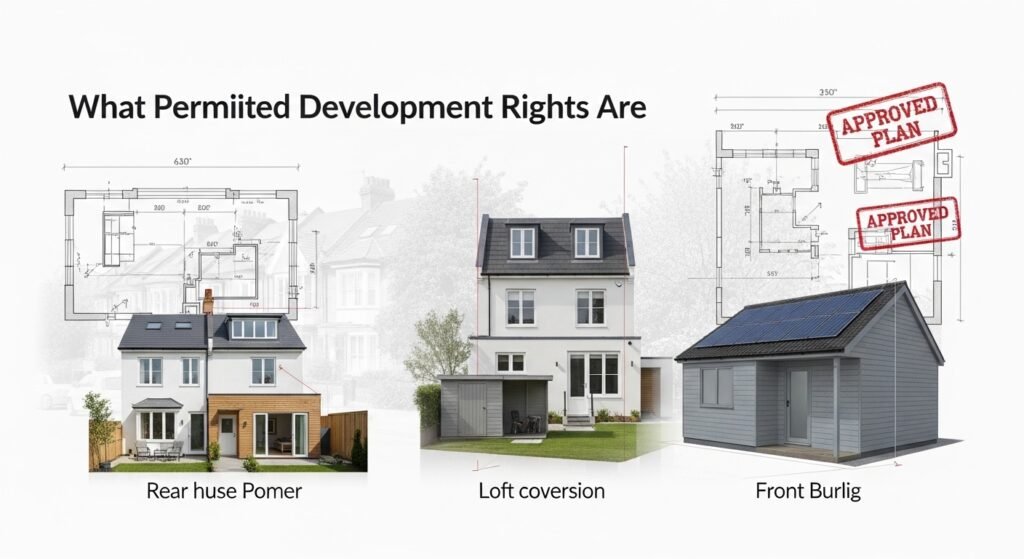
For residential householders, the most commonly used permitted development rights cover rear extensions, loft conversions with dormers, outbuildings in the garden, porches, and solar panels. Many rear extensions later include full kitchen installation as part of the upgrade. These rights exist to reduce the administrative burden of minor home improvements that have limited impact on the surrounding area.
They are not a blank cheque. Each category comes with specific dimensional limits, height restrictions, and conditions on materials. Exceeding any one of these limits removes the right, and planning permission is needed instead.
In Islington, a further layer of restrictions applies on top of the national limits, which narrows what can be done without a planning application to a much smaller set of works.
The Article 4 Problem: Why Islington Is Different
An Article 4 Direction is a legal mechanism that allows a Local Planning Authority to withdraw permitted development rights that Parliament has otherwise granted. Islington Council has used this tool extensively.
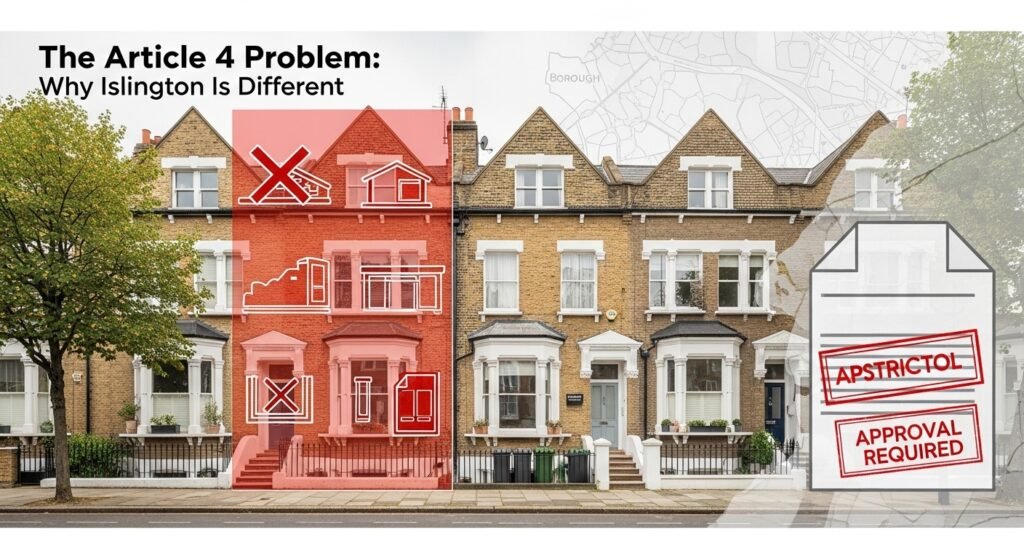
Islington has removed permitted development rights in 40 of its 42 conservation areas. The directions apply to householder works, meaning changes to individual houses including extensions, loft alterations, changes to windows and doors, and external finish changes. In affected areas, works that would be permitted development in most of England require a full planning application in Islington.
The practical effect is substantial. Even simple upgrades like windows or doors may need permission, especially during wider door installation or exterior works. Changing the front door to a different style, replacing windows with double glazing, painting unpainted brickwork, adding a rear dormer, or building a single-storey rear extension within the national permitted development limits all require planning permission in the 40 conservation areas covered by Article 4 Directions.
Islington’s 42 conservation areas include some of the borough’s most densely populated residential streets. Barnsbury, Canonbury, Tufnell Park, Highbury Fields, Clerkenwell, Thornhill Square, Lonsdale Square, Mildmay, De Beauvoir, Newington Green, and many others are all designated conservation areas. Only two conservation areas in the entire borough do not have Article 4 Directions in place.
This is not a technicality. The majority of Islington Victorian terraces that homeowners assume have standard PD rights do not. The only way to confirm your specific address is to use Islington Council’s interactive planning map.
What Permitted Development Looks Like for Houses in Islington
Even within the constraints of Article 4 Directions, some permitted development rights do survive in Islington. Understanding which rights remain and which are removed requires knowing whether the specific Article 4 Direction in your conservation area removes Part 1 rights (householder development) or a narrower set.
Outside Conservation Areas
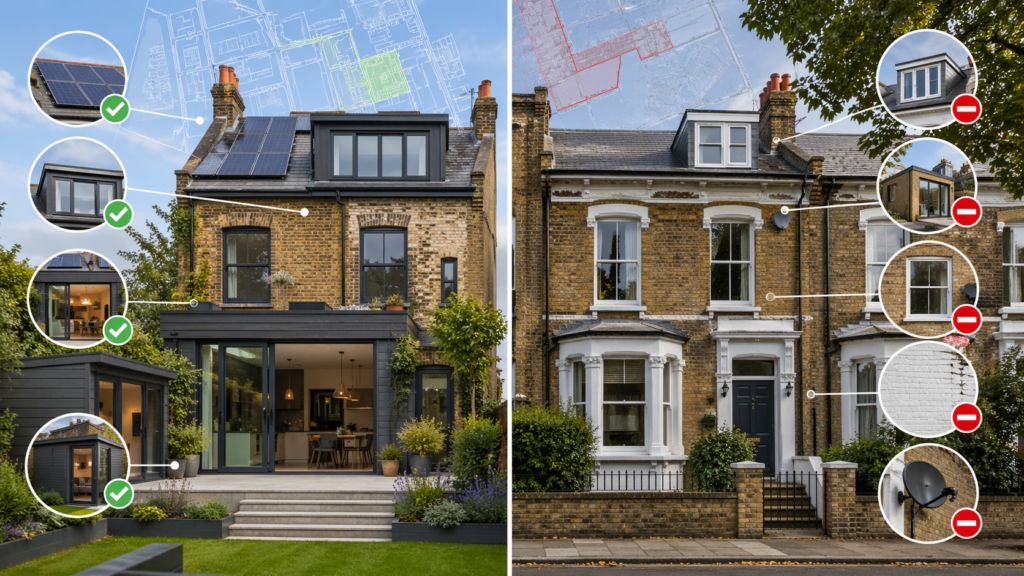
If your Islington property is one of the minority that sits outside a conservation area, national permitted development rights apply in full. This means:
Rear extensions: A single-storey rear extension is permitted development if it extends no more than 3 metres beyond the rear wall of the original house (for a terraced or semi-detached property) or 4 metres for a detached house. Maximum height 4 metres. The Larger Home Extension scheme (Prior Approval) allows up to 6 metres for a terraced house subject to neighbour notification.
Loft conversions: A rear dormer loft conversion is permitted development if the additional roof space created does not exceed 40 cubic metres for a terraced house or 50 cubic metres for a semi-detached or detached house. Many loft projects also include extra bathroom installation for added value. The dormer must not project forward of the principal roof slope facing a highway. Materials must match the existing house in visual appearance.
Outbuildings: A garden outbuilding is permitted development if it is single-storey, no taller than 4 metres with a dual-pitch roof or 3 metres otherwise, covers no more than 50% of the garden area, and sits no closer to the public highway than the principal elevation of the house.
Solar panels: Installing solar panels on a roof is generally permitted development for houses outside conservation areas. Roof upgrades are often combined with other roofing services where access is already in place.
Inside Conservation Areas (With Article 4 Directions)
For houses within the 40 conservation areas covered by Article 4 Directions, the situation is more restricted. Planning permission is required for:
- Any rear extension, regardless of size
- Any loft alteration involving external changes, including dormers and rooflights on rear slopes
- Changes to windows or external doors
- Painting previously unpainted brickwork or stonework
- Adding a satellite dish visible from a highway
- Side extensions (which require permission in all conservation areas nationally anyway)
- Cladding the exterior in any material
Some internal works and certain small-scale alterations may still not require planning permission, but any external change that is visible from outside the property should be assumed to need permission until confirmed otherwise by the council’s duty planner service.
Flats and Maisonettes: No Permitted Development Rights at All
This is the most important and most widely misunderstood point about permitted development in Islington.
Flats and maisonettes have no householder permitted development rights anywhere in England. It does not matter whether the flat is in a conservation area or not. It does not matter whether it is in a Victorian conversion or a purpose-built block. Flats do not benefit from the GPDO householder development rights.
This matters enormously in Islington because a substantial proportion of the borough’s housing stock consists of Victorian houses that have been converted into flats and maisonettes. A three-storey Victorian terrace converted into three flats contains no properties with permitted development rights. Internal modernisation may still proceed, such as new bathroom renovation or kitchens, subject to lease terms. Each flat owner who wants to alter their property, install a new window, or add a rooflight needs a full planning application.
Additionally, in a Victorian conversion flat, the lease often restricts alterations independently of planning law. Freeholder consent is typically required for structural alterations, and the lease document should be checked before any planning inquiry is made.
The Larger Home Extension Scheme: Prior Approval in Islington
The Larger Home Extension scheme allows houses to build single-storey rear extensions larger than the standard PD limits, using a Prior Approval process rather than a full planning application. For terraced and semi-detached houses, the maximum depth under this scheme is 6 metres. For detached houses, 8 metres.
This scheme requires the homeowner to notify the council and give adjacent neighbours 21 days to object. If no objections are raised, or if objections are not considered material to amenity, the extension can proceed.
Critically, this scheme does not apply in conservation areas. Islington’s 40 conservation areas with Article 4 Directions are all designated land under national legislation, which excludes them from the Larger Home Extension scheme. For properties in those areas, the maximum depth achievable under any non-application route is not available. A planning application is always the correct route.
For the small number of Islington houses outside conservation areas, the scheme is available and functions as it does elsewhere in England.
What Still Does Not Need Planning Permission in Islington
Despite the restrictions, some works remain outside the planning system for Islington houses. These are not affected by Article 4 Directions:
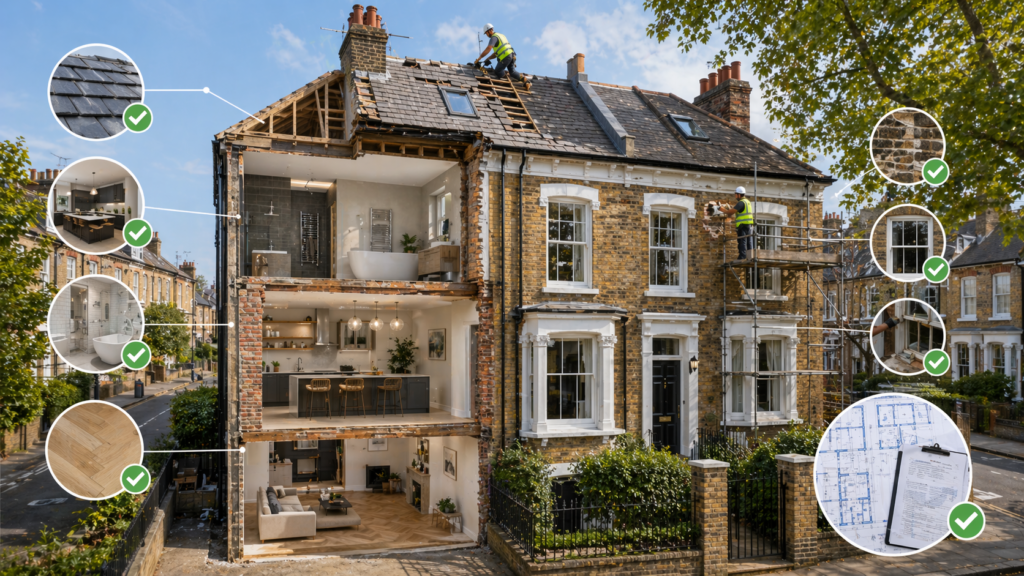
Interior alterations: No planning permission is needed for interior work, including removing non-structural internal walls, redecorating, fitting new kitchens or bathrooms in the same position, or replacing flooring. These works often involve electrical work and certified upgrades. Building Regulations approval may still be needed for structural or electrical work.
Like-for-like repairs: Repairing a roof with matching materials, replacing a window with an identical window, or repointing brickwork does not require planning permission even in conservation areas. Many owners use this route for timber sash window repair rather than full replacement.
Permitted repair and maintenance: General maintenance and repair of the existing building fabric does not require permission.
Replacement windows matching the original exactly: In most cases, replacing a window with an identical replacement in the same position does not require planning permission, even in conservation areas, provided the frame material, colour, and dimensions match. However, in Islington’s conservation areas under Article 4, changing from single-glazed timber sash windows to double-glazed units of different appearance does require permission, because the change of appearance constitutes development.
It is worth noting that even works not requiring planning permission may still need Building Regulations approval. Planning permission and Building Regulations are entirely separate systems. A rear extension that is permitted development still needs a Building Regulations application for the structural, drainage, and energy efficiency elements of the construction.
Listed Buildings: An Additional Layer on Top
Islington has approximately 4,500 listed buildings. These include Grade I, Grade II*, and Grade II structures across the borough.
Listed buildings do not benefit from permitted development rights regardless of whether they are in a conservation area or not. More significantly, any works to a listed building that affect its character, including internal alterations, require Listed Building Consent in addition to any planning permission that may apply.
This means that a Victorian terrace that happens to be listed in Barnsbury requires not only a planning application for an extension but also Listed Building Consent. These are separate applications with separate fees. The conservation officer will be involved in assessing both.
If your property is listed, assume that any alteration inside or outside requires Listed Building Consent and proceed accordingly. Specialist contractors with heritage experience are strongly recommended for any building services work. The Historic England National Heritage List is the authoritative source for checking listbuilding status.
How to Check Whether Your Islington Property Has Permitted Development Rights
There are three definitive checks to run before spending any money on design work or contractor quotes.
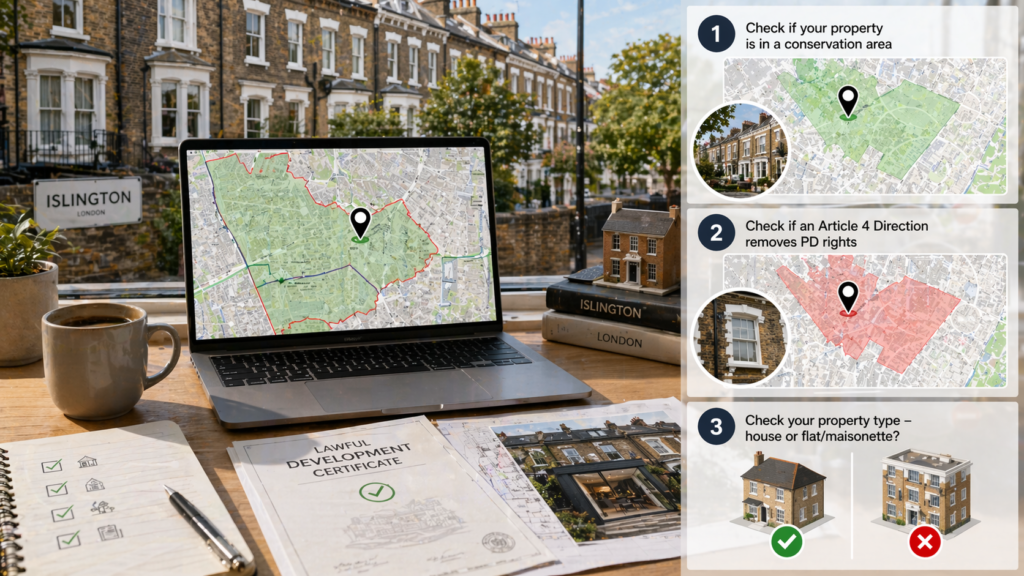
Step 1: Check conservation area status. Use Islington Council’s interactive planning map at islington.gov.uk. Search your address and confirm whether it falls within a designated conservation area. The map shows all 42 conservation areas and their boundaries.
Step 2: Check Article 4 Direction status. On the same map, confirm whether an Article 4 Direction applies to your property. This is a separate overlay from conservation area status. In Islington, 40 of the 42 conservation areas have Article 4 Directions in place, but the specific rights withdrawn can vary. The Islington Council planning pages list each direction and what it removes.
Step 3: Confirm property type. If your property is a flat or maisonette, permitted development rights do not apply regardless of the outcome of steps 1 and 2. If it is a house (a single dwelling), the outcome of steps 1 and 2 determines your position.
If you remain uncertain after these checks, Islington Council offers a duty planner service that provides free general advice on whether works require planning permission. For confirmation in writing, a Lawful Development Certificate application costs £86 and provides formal confirmation that proposed works are lawful without planning permission.
Getting a Lawful Development Certificate
A Lawful Development Certificate (LDC) is a formal legal document from the council confirming that a proposed development is lawful under permitted development rights. It is not planning permission. It is confirmation that permission is not needed.
In Islington, an LDC for proposed works costs £86. The application requires the same documentation as a planning application: plans, elevations, and a description of the works. The council has 8 weeks to determine it.
An LDC is not legally required before building. If works genuinely fall within permitted development rights, they can proceed without it. However, an LDC provides certainty, protects against future enforcement, and is increasingly expected by buyers’ solicitors during property conveyancing. Many homeowners secure this before starting a larger kitchen fitters or extension project. If you are building under permitted development and plan to sell the property within the next ten years, obtaining an LDC at the time of the works is strongly recommended.
FAQ
Q: Do I need planning permission for a rear extension in Islington?
Almost certainly yes, if your property is in a conservation area, which covers the majority of Islington’s residential streets. Islington has Article 4 Directions across 40 of its 42 conservation areas that require planning permission for rear extensions that would be permitted development elsewhere. For the small minority of Islington houses outside conservation areas, a single-storey rear extension within 3 metres depth does not need planning permission. Always check the Islington Council interactive map before assuming either way.
Q: Does Islington’s Article 4 Direction apply to all properties in the borough?
No. Article 4 Directions in Islington apply to 40 of the borough’s 42 conservation areas. Properties outside conservation areas are not affected by the householder Article 4 Directions and retain standard national permitted development rights. However, only a small proportion of Islington’s residential properties are outside conservation areas. The vast majority of Victorian terraces in Barnsbury, Canonbury, Tufnell Park, Highbury, and similar areas are covered.
Q: I live in a converted flat in a Victorian terrace in Islington. Do I have any permitted development rights?
No. Flats and maisonettes have no householder permitted development rights anywhere in England, regardless of conservation area status or Article 4 Directions. Any works to your flat that involve changes to the exterior of the building require a full planning application. Interior alterations that do not affect the structure or shared elements of the building may not require planning permission, but your lease should also be checked independently of planning law.
Q: Can I build a loft conversion without planning permission in Islington?
If your Islington property is a house in one of the two conservation areas without an Article 4 Direction, a rear dormer may qualify as permitted development within the 40 cubic metre volume limit for terraced houses. In the 40 conservation areas with Article 4 Directions, any external roof alteration including dormers and rooflights requires planning permission. Internal loft conversions that create no external change can proceed without planning permission in all areas, though Building Regulations approval is still required for the structural and fire safety elements.
Q: What is a Lawful Development Certificate and do I need one in Islington?
A Lawful Development Certificate (LDC) is formal written confirmation from Islington Council that proposed works are lawful without planning permission. It costs £86 and takes up to 8 weeks. It is not legally required before building under permitted development rights, but it provides certainty, protects against enforcement action, and satisfies buyers’ solicitors during conveyancing. For any Islington property where permitted development rights do apply, obtaining an LDC before the works begin is worth the modest cost and time investment.
Q: How many conservation areas does Islington have?
Islington has 42 designated conservation areas as of 2026. Article 4 Directions removing householder permitted development rights are in place in 40 of these areas. The conservation areas include Barnsbury, Canonbury, Tufnell Park, Highbury Fields, Duncan Terrace, Colebrooke Row, Clerkenwell, Thornhill Square, Lonsdale Square, De Beauvoir, Mildmay, Newington Green, and many others covering the majority of the borough’s Victorian terrace streets.
Conclusion
Permitted development rights in Islington apply to far fewer properties than homeowners typically expect. The combination of 40 conservation areas with Article 4 Directions and a large proportion of flats with no rights at all means the realistic answer for most Islington homeowners is that planning permission is required, not optional.
The practical consequence of getting this wrong is significant. Building without planning permission when it is required exposes the homeowner to enforcement action, including demolition orders, and creates complications when selling the property. Buyers’ solicitors routinely identify unpermitted works during conveyancing and require either retrospective planning applications or indemnity insurance.
The correct approach is to check the Islington Council interactive map, confirm your property type, and, if in any doubt, contact the duty planner service before commissioning any design work. Taking advice early from trusted London builders can prevent costly mistakes later. For works that genuinely fall under permitted development, a Lawful Development Certificate provides the written confirmation that removes uncertainty for the long term.

Tilly Bani is a renovation and roofing specialist with over 15 years of experience in construction and property refurbishment across North London. He specialises in roofing, structural repairs, and full home renovations, helping homeowners improve property value and safety.