
| Quick Answer Repair your boiler if it is under 10 years old, the fault is a single minor component, and the repair cost is below 25 to 50% of what a new boiler would cost to install. Replace your boiler if it is over 12 years old, has needed multiple repairs in the past two years, is a non-condensing pre-2005 model running below 80% efficiency, or if a single repair costs more than half the price of a replacement. When in doubt, the repair-or-replace decision comes down to age, repair history, efficiency loss, and the cost of the specific fault. |
Introduction
A boiler fault never arrives at a convenient moment. It is always a cold morning, always a weekend, and always when you have something else to deal with. The pressure to make a quick decision is real, and the financial stakes are significant either way. Many homeowners first compare trusted London specialists before deciding.
The problem is that the wrong decision costs you money in both directions. Repairing an old, inefficient boiler keeps you in a cycle of recurring breakdowns and rising energy bills. Replacing a relatively young boiler that needed only a minor fix is spending money you did not need to spend.
This guide gives you a clear, practical framework for making the right call. Older homes often combine heating works with a full home refurbishment. It covers real 2026 repair costs for the most common faults, the conditions that point firmly toward replacement, how to use the 50% rule that heating engineers apply, what the long-term financial difference looks like, and how to avoid the most common mistakes homeowners make in the heat of the moment.
The Core Question: What Is Your Boiler’s Current State?
Before looking at any numbers, answering three questions will point you in the right direction on most boiler faults.
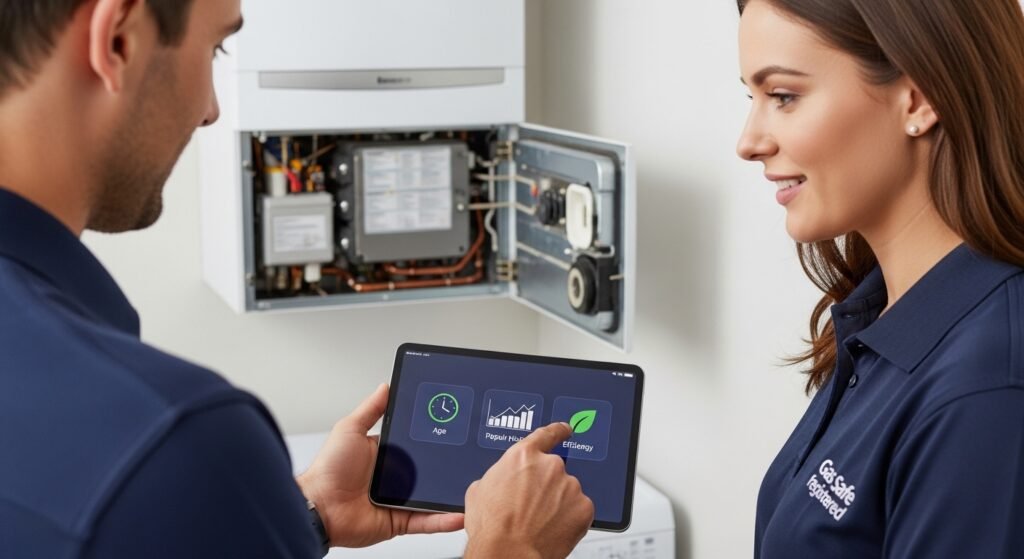
How old is it? A boiler under 8 years old with a single fault is almost always worth repairing. A boiler over 12 years old with a significant fault is usually better replaced. The 10 to 12-year window is where the decision becomes genuinely ambiguous and needs a closer look at the specific fault and repair history. If systems are ageing, ask qualified heating engineers for advice.
How often does it break down? A boiler that has needed one repair in its lifetime is different from one that has needed three repairs in two years. Repeated breakdowns, even if individual repairs are cheap, signal a system entering terminal decline. The cumulative repair cost adds up faster than homeowners realise.
Is it running efficiently? Non-condensing boilers installed before 2005 operate at below 80% efficiency, wasting 20p or more from every pound spent on gas. Modern A-rated condensing boilers operate above 90% efficiency. For a household spending £1,200 a year on gas heating, that gap is £180 to £360 per year in wasted energy before a fault even occurs. An inefficient old boiler is costing you money every day it runs, not just when it breaks. Poor efficiency may improve after a modern boiler installation.
What Boiler Repairs Actually Cost in 2026
Understanding what specific faults cost to fix is essential to applying the repair-or-replace decision correctly. These are the most common boiler faults and realistic UK repair costs in 2026, including parts and labour.
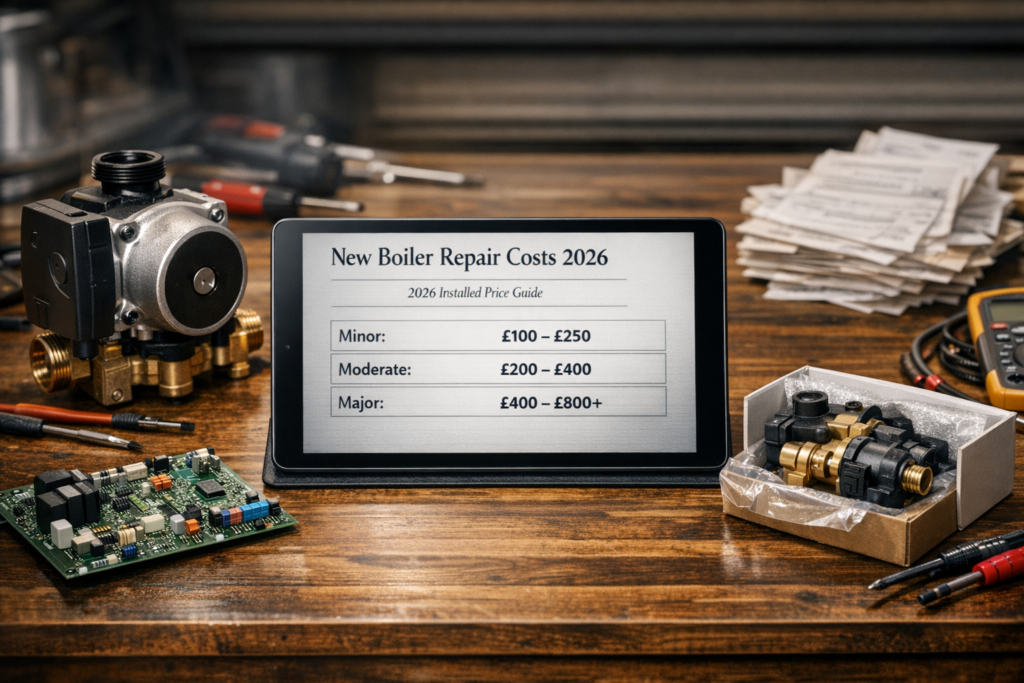
| Fault | Typical Repair Cost | Severity |
|---|---|---|
| Low pressure/pressure loss, Pressure faults may stem from hidden water leaks. | £100 – £200 | Minor |
| Thermostat or sensor replacement | £100 – £250 | Minor |
| Frozen or blocked condensate pipe | £90 – £175 | Minor |
| Ignition electrode replacement | £150 – £220 | Minor |
| Gas valve replacement, Gas components must be handled by certified Gas Safe engineers. | £180 – £280 | Moderate |
| Diverter valve replacement | £180 – £350 | Moderate |
| Expansion vessel replacement | £180 – £280 | Moderate |
| Circulation pump replacement. Some systems also benefit from new radiator upgrades. | £200 – £400 | Moderate |
| Fan replacement | £200 – £380 | Moderate |
| Printed Circuit Board (PCB), Electrical faults may require broader electrical upgrades. | £300 – £550 | Major |
| Heat exchanger replacement | £400 – £800 | Major |
| Multiple component failures | £500 – £900+ | Major |
Labour rates in the UK run from £60 to £100 per hour for a standard daytime call-out. Emergency call-outs, weekend appointments, and evening visits add £50 to £150 to the bill. In London and the South East, labour rates run 20 to 37% above the national average.
Most standard boiler repairs, covering single component failures of moderate severity, cost £200 to £400 all-in. Once a repair moves into PCB or heat exchanger territory, costs typically land at £400 to £800, which is the range where the repair-or-replace question becomes financially significant.
The Hidden Cost of Cheap Repairs
A pattern of cheap repairs on an old boiler is often more expensive over time than a single upfront replacement. Three repairs at £200 to £300 over two years, totalling £600 to £900, and leaves you with the same old boiler, still running inefficiently, still at risk of the next breakdown. That budget often covers part of a new boiler repair plan. The same £600 to £900 applied toward a new boiler reduces the net replacement cost significantly while resetting the clock on reliability and warranty.
The 50% Rule: The Most Reliable Decision Framework
Heating engineers use a straightforward rule to guide repair-or-replace decisions. There are slightly different versions of it, but the underlying principle is the same.
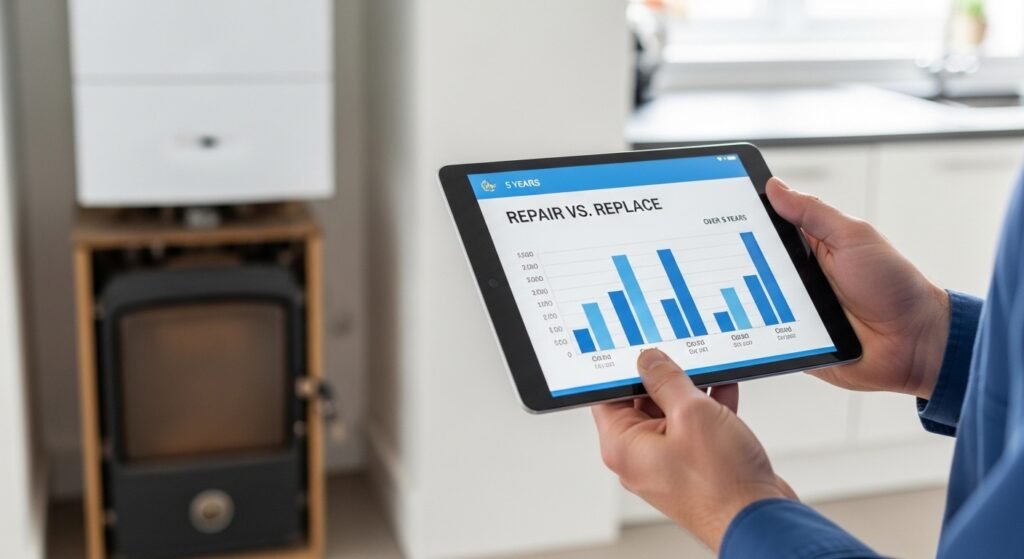
The 50% Rule: If a single repair costs more than 50% of the cost of a new equivalent boiler installed, replacement is almost always the better financial decision.
The 25% Rule (stricter version): Some engineers and financial advisors apply a tighter threshold of 25% for boilers over 10 years old, reflecting the increased probability of further faults in an ageing system.
In practice, applying this to real numbers:
A new combi boiler installed in a typical UK home costs £2,800 to £4,000. Always compare quotes for full boiler replacement. Applying the 50% rule, any single repair costing more than £1,400 to £2,000 points clearly toward replacement. Applying the 25% rule to an older boiler, any repair costing more than £700 to £1,000 tips the balance toward replacement.
Heat exchanger replacement at £400 to £800 sits in an ambiguous territory for a boiler aged 8 to 12 years. For a boiler over 12 years old, a heat exchanger repair at £600 to £800 almost always fails the 25% test and should prompt serious consideration of replacement.
When to Choose Repair
Repair is clearly the right decision when all of the following conditions apply.
The boiler is under 10 years old. Parts are available, the system is within its productive lifespan, and a repair extends that life meaningfully. Annual servicing from local heating engineers helps extend the lifespan.
The fault is a single, well-defined component. A thermostat, sensor, valve, or electrode failure is a clean diagnosis with a predictable repair cost. Complex or ambiguous faults are more likely to indicate deeper systemic decline. Minor issues are common in homes with ageing pipework systems.
The repair cost is below 25% of a new boiler. For a £3,000 replacement cost, this means any repair below £750 is worth doing on a boiler under 10 years old.
The boiler has been regularly serviced. A well-maintained boiler with annual service records is statistically more likely to respond well to a repair than a neglected one. Annual servicing also keeps manufacturer warranties valid, which may cover the repair entirely.
The boiler is still under warranty. If your boiler is within its manufacturer’s warranty period, which runs from 2 to 12 years depending on the brand and installer accreditation, the repair may be entirely covered. Always check warranty status before authorising any paid repair.
Parts are still readily available. Some older models, particularly discontinued ones, have parts that are hard to source. If an engineer cannot get a part without a significant wait or premium cost, this is itself a signal that the boiler is approaching the end of its viable service life.
When to Choose Replacement
These are the conditions that point firmly toward replacement rather than repair.
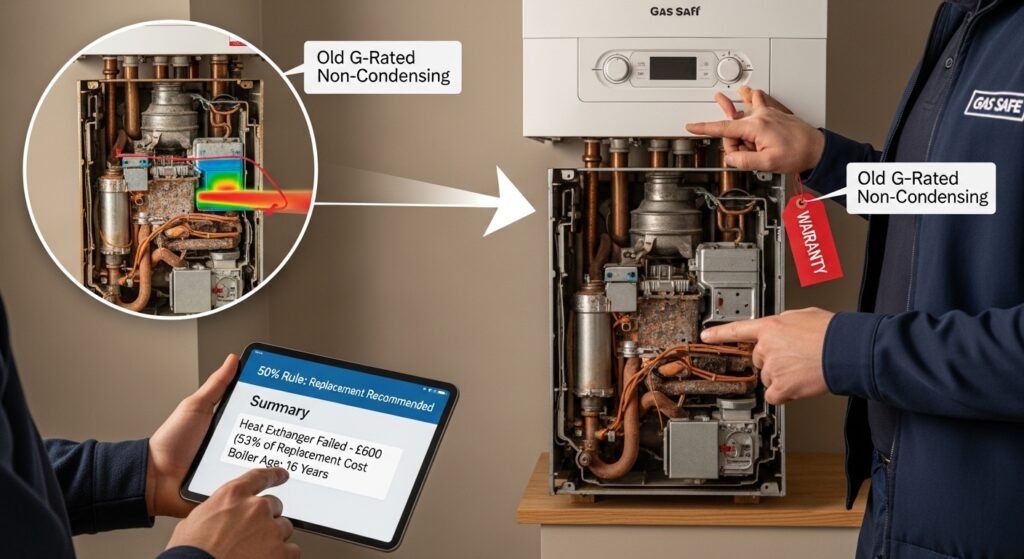
The Boiler Is Over 12 Years Old
Beyond 12 years, the probability of a subsequent fault increases significantly. Components wear out together, not independently. Replacing a diverter valve on a 14-year-old boiler may solve the immediate problem, but the pump, PCB, and heat exchanger are all ageing at the same rate.
Well-maintained boilers can last 15 years, but the economic calculation shifts after year 12. The repair extends the boiler’s life by perhaps one or two winters before the next fault appears. The energy savings alone from a modern A-rated condensing boiler can justify replacement before a major fault even occurs.
You Have Spent More Than £500 on Repairs in the Past Two Years
Cumulative repair costs are the figure most homeowners underestimate. A £180 repair for a diverter valve, a £200 callout for a pressure issue, and a £250 pump replacement over 24 months add up to £630 spent on a boiler that is no more reliable than it was two years ago. That money applied to a new installation reduces the net cost and stops the cycle.
The Boiler Is a Non-Condensing Model
Non-condensing boilers were phased out of new installations by law from 2005. If your boiler predates 2005 and has never been replaced, it is operating at below 80% efficiency compared to 90%+ for any modern condensing model. Upgrading from a G-rated to an A-rated boiler can save £180 to £500 per year in gas bills, depending on property size and usage. Replacing older units can improve the whole of North London’s homes.
For a household spending £1,400 annually on heating, those savings mean a new condensing boiler pays for a significant portion of its own cost over five to seven years, even before accounting for the repair bills the old system would have generated.
The Repair Involves a Heat Exchanger or PCB
These are the two most expensive single-component repairs. A heat exchanger failure at £400 to £800 on a boiler over 10 years old triggers the 50% rule for most standard replacement costs. The heat exchanger is a core structural component, not a peripheral part. Failure often signals broader systemic decline. Major failures often justify a complete system replacement.
A PCB failure at £300 to £550 on an older boiler is similarly significant. The PCB is the control brain of the boiler and its failure on an aged system suggests the system’s electronics are reaching the end of their reliable life.
The Boiler Has a Yellow or Orange Flame
A healthy gas boiler burns with a clear blue flame. A yellow or orange flame indicates incomplete combustion, which produces carbon monoxide. This is a safety emergency, not a cost-benefit calculation. Turn off the boiler immediately, ventilate the property, and call a Gas Safe registered engineer. Carbon monoxide poisoning is fatal. A boiler that presents a yellow flame should not be repaired unless the engineer confirms it is safe to do so after a full assessment. Immediately contact emergency gas safety experts.
You Are Selling the Property
Estate agents and buyers’ surveyors look at the boiler directly. An old boiler without recent service records suppresses buyer confidence and can result in reduced offers or a specific request for a boiler replacement as a condition of sale. A new boiler with a manufacturer’s warranty is a positive feature that adds value. If you are planning to sell within two years, the replacement case strengthens considerably.
Parts Are No Longer Available
Manufacturers typically support boilers for 10 to 15 years after a model is discontinued. Once parts become unavailable or must be sourced at premium prices, even a minor fault becomes uneconomical to fix. An engineer who cannot source a standard part in a reasonable time is telling you something important about the boiler’s position in its lifecycle.
The Long-Term Financial Comparison
The repair-or-replace decision is not just about the cost today. It is about the total cost over the next five to ten years. Here is a realistic comparison.
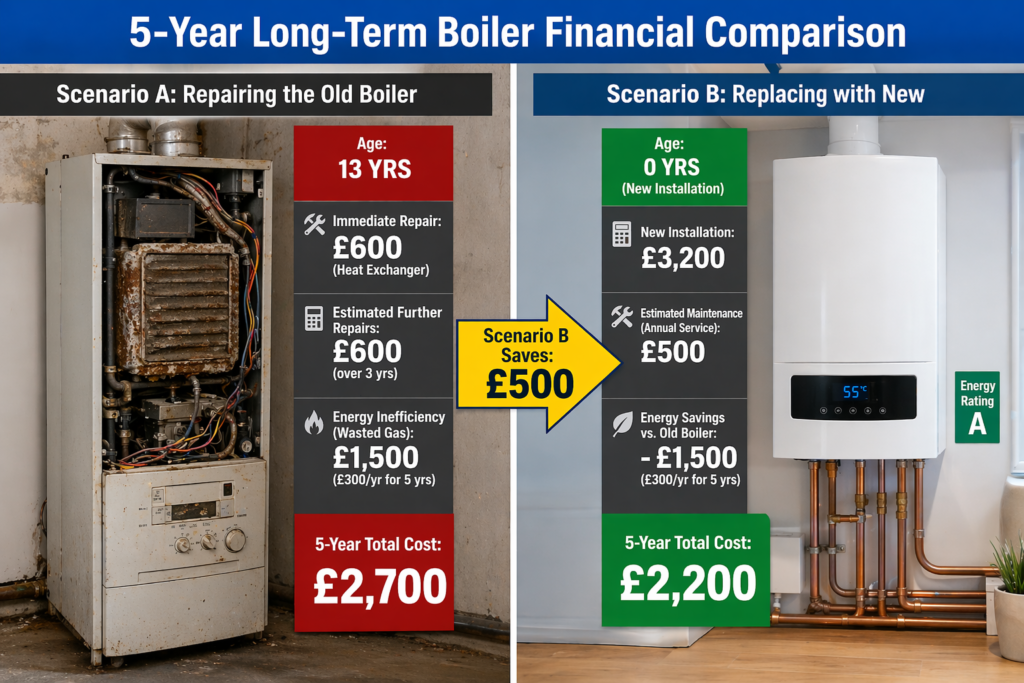
Scenario A: Repair a 13-Year-Old Boiler with a Faulty Heat Exchanger
- Heat exchanger repair: £600
- Estimated further repairs over the next 3 years: £400 to £700
- Energy inefficiency cost vs modern boiler (estimated): £250 to £350 per year
- Total cost over 5 years: £600 + £600 + (£300 x 5) = £2,700
Scenario B: Replace the Same Boiler Now
- New combi boiler installed: £3,200
- Estimated repairs over 5 years (well-maintained new boiler): £100 to £200 (annual service)
- Energy savings vs old boiler: £300 per year
- Total cost over 5 years: £3,200 + £500 – £1,500 (energy savings) = £2,200
Replacement comes out ahead over five years in this scenario, and the gap widens further if the old boiler requires an additional breakdown repair, which is statistically likely on a 13-year-old system.
The numbers change if the boiler is younger. A 7-year-old boiler with a £250 thermostat fault will almost always be cheaper to repair than replace, since the replacement cost is the same but the energy efficiency gap is smaller, and the probability of further faults is lower.
The Role of Boiler Cover
Boiler cover plans (monthly subscription services from providers including British Gas, HomeServe, and Hive) change the financial equation in specific circumstances.
If you already have boiler cover and the repair is covered by your policy, the repair cost to you may be zero or reduced to a small excess. In this case, repair is almost always the right choice for faults that would otherwise qualify under the 50% rule.
However, be aware that most boiler cover policies exclude:
- Boilers over a certain age (commonly 15 years, sometimes 12)
- Boilers that have not been serviced within the past 12 months
- Boilers in poor condition or with pre-existing faults
- Heat exchanger repairs on older boilers (this is often in the small print)
If your boiler is ageing, read your policy carefully before assuming a fault is covered. Some providers use the policy assessment visit as an opportunity to recommend replacement, which may or may not align with your financial interests.
How Boiler Efficiency Affects the Decision
Energy efficiency is a factor that most repair-or-replace guides underweight. An old G-rated boiler running at 70 to 75% efficiency wastes 25 to 30% of every unit of gas. A modern A-rated condensing boiler operates at 90 to 94% efficiency. Many upgrades also pair well with underfloor heating.
For a home spending £1,200 per year on gas heating, the gap between a 75% efficient old boiler and a 92% efficient new one is roughly £210 per year. Over five years, that is £1,050 in additional energy costs from the old boiler alone, before a single repair bill.
Boiler efficiency also affects your property’s Energy Performance Certificate (EPC) rating. Properties with poor EPC ratings are increasingly subject to buyer pressure, lender requirements for mortgages, and potential future regulatory requirements for rental properties. A new boiler improves the EPC score and can push a property from band E or D to band C or above, which has tangible market value. Some owners also add supporting roof insulation.
Practical Steps Before You Decide
When an engineer gives you a repair quote, do not make the decision in the same phone call. Here is the sequence that leads to the best outcome.
Step 1: Get the diagnosis in writing. Use established local professionals for clear quotations. Ask the engineer to confirm the specific fault and the part required before you authorise any repair. Vague diagnoses, such as “the boiler isn’t working properly and needs sorting,” are not acceptable. You should know exactly what is being replaced and why.
Step 2: Apply the 50% rule immediately. What would a new equivalent boiler cost to install at your property? If the repair quote is more than 50% of that figure, and your boiler is over 10 years old, get a replacement quote before committing to the repair.
Step 3: Consider the repair history. How much have you spent on this boiler in the past two years? Add the current repair quote to that figure. If the total approaches £800 or more on a boiler over 10 years old, replacement almost certainly makes more financial sense.
Step 4: Check the warranty. If the boiler is under 10 years old, check whether it is still within the manufacturer’s warranty period. If it is, and the engineer is manufacturer-accredited, the repair may be covered at no cost.
Step 5: Get a replacement quote if the repair triggers the 50% rule. A Gas Safe engineer can quote for replacement at the same visit. This gives you a real number to compare against the repair cost rather than an estimate. Compare offers from trusted London installers.
Common Mistakes to Avoid
Authorising a major repair under time pressure without checking replacement costs. Emergency breakdowns create urgency. Engineers are honest professionals, but the moment you agree to a £600 repair on a 14-year-old boiler without checking what a new one would cost, you may have spent money on the wrong decision. The 15 minutes it takes to get a replacement quote saves significant sums.
Assuming the cheapest option today is the cheapest over time. A £300 repair today on a boiler likely to need another £400 repair in 18 months is more expensive than a new boiler over any five-year horizon.
Ignoring efficiency losses. The energy cost gap between a 70% efficient old boiler and a 90%+ efficient new one is real money every month. This cost is invisible on any single bill but accumulates significantly over years.
Trying to repair a boiler with a yellow flame yourself. This is illegal, dangerous, and can result in carbon monoxide poisoning. Gas work in the UK can only be legally carried out by a Gas Safe registered engineer.
Delaying a replacement decision when the boiler is clearly beyond economic repair. An old, repeatedly failing boiler produces anxiety every cold morning and usually fails at the worst possible time. A planned replacement in spring or autumn, when engineers are less busy and installation is less urgent, costs less and causes less disruption than an emergency replacement mid-winter. Planned upgrades are easier when booked with our team.
FAQ
Q: How much does a boiler repair cost in the UK in 2026?
Most standard boiler repairs cost between £150 and £500 all-in, including parts and labour. The typical repair comes in around £300 for a single component fault on a weekday call-out. Minor faults such as thermostat or sensor replacement sit at £100 to £250. Major faults involving the PCB (£300 to £550) or heat exchanger (£400 to £800) are the repairs that most commonly trigger the replacement decision. Emergency call-outs and out-of-hours repairs add £50 to £150 to these figures.
Q: At what age should I replace my boiler rather than repair it?
As a general guide, boilers under 8 years old with a single minor fault are almost always worth repairing. Boilers over 12 years old with a significant fault are usually better replaced. The 10 to 12 year window is genuinely ambiguous and depends on the specific fault, repair history, and whether the boiler is a condensing model. A non-condensing boiler over 10 years old should almost always be replaced rather than repaired for any fault costing more than £200 to £300.
Q: What is the 50% rule for boiler replacement?
The 50% rule states that if a single repair costs more than 50% of the installed cost of a new equivalent boiler, replacement is usually the better financial decision. For a new boiler costing £3,000 to install, this means any repair over £1,500 should prompt a serious replacement consideration. Many heating engineers apply a stricter 25% threshold for boilers over 10 years old, reflecting the higher probability of further faults on an ageing system.
Q: Can I repair my boiler myself?
No. Gas boiler work in the UK must legally be carried out by a Gas Safe registered engineer. Carrying out gas work without registration is a criminal offence and creates serious safety risks including carbon monoxide poisoning and gas leaks. For oil boilers, all work must be carried out by an OFTEC-registered engineer. The only things a homeowner can safely do is repressurise the system using the filling loop (if shown how by an engineer) and bleed radiators.
Q: Does a new boiler save money on energy bills?
Yes, meaningfully. Upgrading from a pre-2005 non-condensing G-rated boiler to a modern A-rated condensing boiler can reduce gas consumption by 20 to 30% for the same heat output. For a household spending £1,200 per year on gas heating, this represents £240 to £360 in annual savings. For larger homes spending more on heating, the savings are proportionally higher. The Energy Saving Trust estimates that a typical household replacing an old G-rated boiler with an A-rated model saves around £490 per year.
Q: What happens if I ignore a boiler fault?
Minor faults that are ignored typically worsen into major ones. A small pressure loss from a faulty valve, left unattended, can damage the pump. A dirty heat exchanger, not addressed during annual servicing, develops blockages that eventually cause failure. The financial cost of ignoring a minor fault is consistently higher than the cost of fixing it promptly. Safety risks are also real: a boiler with a developing carbon monoxide issue, a gas valve fault, or a heat exchanger crack becomes progressively more dangerous if left unrepaired.
Conclusion
The repair-or-replace decision is not actually complicated once you have the right information. Apply the 50% rule to the specific repair cost versus replacement cost. Check the age and repair history against the thresholds. Factor in the energy efficiency gap that an old boiler is generating every month. And do not make the decision under pressure without getting a replacement quote to compare.
For most faults on boilers under 10 years old, repair is the right call. For most faults on boilers over 12 years old with a repair cost above £400, replacement makes better financial sense over any horizon longer than two years.
The key is making a deliberate decision rather than defaulting to whichever option the engineer in front of you happens to recommend first. Both options have their place. The right one depends entirely on the specific combination of your boiler’s age, its fault, its history, and the numbers.

Tilly Bani is a renovation and roofing specialist with over 15 years of experience in construction and property refurbishment across North London. He specialises in roofing, structural repairs, and full home renovations, helping homeowners improve property value and safety.