
Fitted wardrobes in London usually cost £1,000 to £2,000 per linear metre for well-made painted units from a carpenter or joinery workshop, with premium spray-finished or lacquered work at £2,000 to £3,500 or more per metre. A single alcove wardrobe beside a chimney breast typically costs £1,200 to £2,500, a 2 to 2.4 metre double wardrobe £2,500 to £4,500, and a full wall of wardrobes £4,000 to £8,000. Installed modular systems start lower, at around £600 to £1,000 per metre. Prices include VAT; drawers, internal lighting, painting and making good can add several hundred pounds.
How Fitted Wardrobes Are Priced
Most companies and carpenters price fitted wardrobes by the linear metre: the width of the run along the wall, built floor to ceiling. That figure covers the carcass, doors, basic shelving and hanging rails, and fitting.

Our built-in wardrobes are made to measure for each room, which matters in London period houses where walls are rarely straight, and ceilings are tall. Every quote starts from a measured survey rather than a standard width.
The final price then moves with four things: the material and finish, the door style, what goes inside, and how awkward the space is. Extras such as lighting, drawers and decorating are usually added on top.
Price per Linear Metre by Quality
| Quality level | Typical London price per linear metre | What you usually get |
|---|---|---|
| Installed modular system | £600 to £1,000 | Standard-sized units, fitted with filler panels to the walls |
| Carpenter-built, painted on site | £1,000 to £2,000 | Made to measure, MDF doors, hand-painted finish |
| Workshop-made, spray-finished | £1,800 to £2,800 | Smoother factory finish, more internal options |
| Premium bespoke or luxury brand | £2,500 to £3,500 or more | Veneer or lacquer, complex detailing, full design service |
These ranges are for full-height units in an existing room, including VAT at 20%.
Fitted Wardrobe Costs by Type
The type of wardrobe changes the length of the run, the amount of detailing and the number of doors, so it is the quickest way to estimate a budget.

| Wardrobe type | Typical size | Typical London cost |
|---|---|---|
| Single alcove wardrobe | 0.9 to 1.2 m wide | £1,200 to £2,500 |
| Pair of alcove wardrobes | Both sides of a chimney breast | £2,400 to £4,800 |
| Double hinged wardrobe | 2 to 2.4 m | £2,500 to £4,500 |
| Sliding door wardrobe | 2 to 2.4 m | £2,500 to £5,000 |
| Full wall of wardrobes | 3 to 4 m | £4,000 to £8,000 |
| Eaves storage in a loft | Along the knee wall | £1,500 to £4,000 |
| Walk-in wardrobe or dressing room | Small room or partitioned area | £5,500 to £14,000 or more |
Alcove Wardrobes
Alcove wardrobes are the most common fitted wardrobe in Victorian and Edwardian bedrooms. The chimney breast creates two recesses, usually a little under or over a metre wide, that are perfect for full-height storage.
They cost more per metre than a straight run because each alcove has its own walls to scribe to, its own top and its own detailing. Alcoves are rarely square, and floors in older houses often slope, so the carcass has to be built to fit the space rather than set into it.
Full Wall Wardrobes
A full wall of wardrobes gives the most storage and often costs less per metre than two small alcoves, because the run is simpler. In many London bedrooms, the chimney breast is boxed in or built around, so the wardrobe reads as one continuous wall.
Sliding Door Wardrobes
Sliding doors save space in front of the wardrobe, which helps in small bedrooms. The track and runners cost more than hinges, and large mirrored or glass panels add to the price. On uneven floors and ceilings, sliding doors need careful levelling, which adds fitting time.
Eaves Storage in a Loft Conversion
In a loft conversion, the space behind the low knee walls can hold wardrobes, drawers and cupboards. Our guide to loft conversion cost in London treats eaves joinery as one of the finishes that is easy to underbudget.
Eaves units are cut to the angle of the roof, with shorter doors and pull-out drawers where hanging space is limited.
Walk-in Wardrobes
A walk-in wardrobe or dressing room is fitted out with open hanging, shelving, drawers and sometimes an island. Costs vary widely with size and finish, from around £5,500 for a basic fit-out to £14,000 or more for a premium design with lighting and glass doors.
What Affects the Cost
Materials
The carcass, the box that forms the body of the wardrobe, is usually made from one of these:
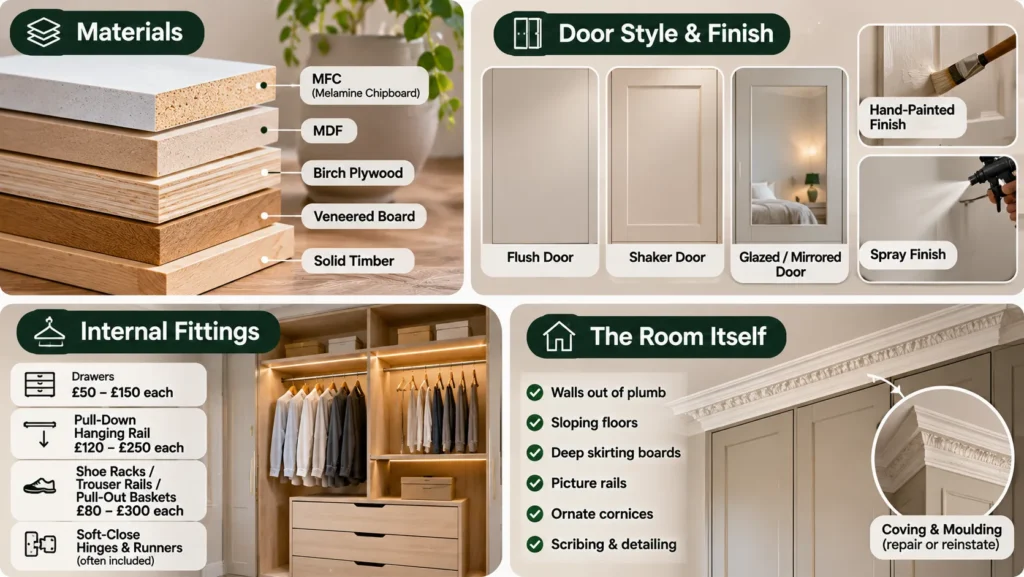
- MFC (melamine-faced chipboard): the most common choice for modular systems and many carcasses. It is cheap and durable, but edges can chip.
- MDF: smooth, stable and easy to paint. It is the usual choice for painted doors and visible panels.
- Birch plywood: stronger and lighter, often used by higher-end joiners and sometimes left with exposed edges.
- Veneered board: a thin layer of real wood on a stable board, giving a timber look without the movement of solid wood.
- Solid timber: used mainly for frames, rails and trims, as large solid panels can move with the seasons.
Door Style and Finish
Doors are the most visible part and a big share of the cost. Flush doors are simplest. Shaker doors, with a frame and recessed panel, cost more but suit period houses. Glazed, mirrored or veneered doors cost more again.
The finish matters as much as the door. Hand-painting on site gives a traditional look and lets the wardrobe be painted in the room colour. Spray-finishing in a workshop gives a smoother, harder-wearing surface but costs more and adds to the lead time.
Internal Fittings
The inside of a wardrobe is where costs quietly add up. Typical extras include:
- Drawers, often £50 to £150 each
- Pull-down hanging rails for tall wardrobes, around £120 to £250 each
- Shoe racks, trouser rails and pull-out baskets, around £80 to £300 each
- Soft-close hinges and runners, sometimes included as standard
Planning the interior around what you actually own, such as long dresses, shoes or folded clothes, avoids paying for fittings you will not use.
The Room Itself
Period rooms add work. Walls out of plumb, sloping floors, deep skirting boards, picture rails and ornate cornices all need scribing and careful detailing so the wardrobe looks built in rather than pushed against the wall.
Many people choose to keep the original cornice running across the top of the wardrobe. Where it has to be cut, our coving and moulding team can repair or reinstate the profile so it still looks continuous.
Extra Costs to Budget For
Several costs sit outside the wardrobe quote itself. UK guides put them at roughly:
| Extra | Typical cost |
|---|---|
| Removing an old built-in cupboard | £150 to £500 |
| Making good walls and plaster | £200 to £600 |
| Skirting and floor adjustments | £100 to £300 |
| Internal lighting, wired by an electrician | £150 to £400 |
| Painting a large wardrobe on site | £400 to £1,200 |
Skirting and Trims
Skirting boards are usually removed where the wardrobe sits and refitted or replaced along the base. Matching existing period profiles is part of our skirting and architraves work.
Lighting
Lights that switch on when a door opens, or LED strips along the top, make a big difference in deep wardrobes. Mains-powered lighting should be installed by an electrician, and our lighting installation team wires it before the wardrobe is closed in.
Decorating
Hand-painted wardrobes are usually painted after fitting, and the wall around them often needs touching up. Booking painting and decorating as part of the same job means the wardrobe and the room are finished together.
Bespoke vs Modular Wardrobes
Modular and Semi-bespoke
Modular wardrobes use standard-sized units, often with filler panels to close gaps against walls and ceilings. They are the cheapest fitted option and quick to install, but they rarely fill period alcoves or tall ceilings neatly, and there is less choice of finish.
Bespoke Carpenter or Joinery Workshop
Bespoke wardrobes are made to the exact size of the space, so every alcove, sloping ceiling and awkward corner is used. A local carpenter often offers good value on painted MDF, while larger workshops may offer spray finishes and a wider range of internal fittings.
Our carpentry and joinery team builds wardrobes alongside other room work, which helps when the job also includes skirting, doors or shelving.
Which Gives Better Value?
In a modern room with straight walls, a good modular system can be perfectly adequate. In a Victorian or Edwardian bedroom with alcoves, high ceilings and uneven walls, bespoke usually gives better value because it uses all the space and looks original to the house.
How Long Fitted Wardrobes Take
Lead Time
After the survey and design are agreed, workshop-made wardrobes usually take four to eight weeks to make. Spray-painted work often takes six to ten weeks, and highly bespoke designs can take longer.
Time on Site
Fitting usually takes two to three days for a basic wardrobe, three to five days for a mid-range run, and five to ten working days for a large bespoke scheme or walk-in wardrobe. Hand-painting on site adds time for coats to dry.
Labour Costs
Carpenters in London and the expensive parts of the South East typically charge around £300 to £450 a day. Parking, congestion and working hour restrictions on some streets can add to the cost of a job.
Fitted Wardrobes in Period Houses
A few points matter more in London period homes than in newer houses.
Cold External Walls
Wardrobes fitted against cold solid external walls can trap damp air behind them and lead to mould. A ventilated back, a small gap behind the carcass, and good room ventilation help. Our guide to internal wall insulation explains why solid walls in Victorian houses stay cold and how lining them can help.
Chimney Breasts
Wardrobes are often built either side of a chimney breast. If the chimney is still in use or has an open flue, keep the area around it clear, and never cut into a chimney breast to make space without structural advice.
Ceiling Heights
Ceilings in Victorian and Edwardian houses are often well above modern heights, especially on the lower floors. Full height wardrobes use that space well, with high level cupboards for luggage and seasonal clothes.
Planning Wardrobes as Part of a Wider Project
Fitted wardrobes are best installed after plastering and electrical work, and before final decoration. On a full refurbishment, they are planned with the electrics and lighting so sockets, switches and wardrobe lights sit in the right places.
If you are renovating a whole period house, our guide to Victorian house renovation shows where joinery fits in the order of works.
How to Get Accurate Quotes
Wardrobe quotes are only comparable if they describe the same thing. When asking for prices, give each company:
- The width and height of each space
- The door style and finish you want
- The internal layout: hanging, shelves and drawers
- Any lighting or extras
- Whether removal of old units, making good and decorating are included
Check whether the quote is per linear metre or a fixed total, whether VAT is included, and whether painting on site is part of the price.
Frequently Asked Questions
How much do fitted wardrobes cost per metre in London?
Most carpenter-built and workshop-made fitted wardrobes in London cost £1,000 to £2,000 per linear metre including VAT. Premium spray-finished or luxury designs cost £2,000 to £3,500 or more per metre.
How much does an alcove wardrobe cost?
A single alcove wardrobe beside a chimney breast usually costs £1,200 to £2,500 in London, depending on size, finish and internal fittings. A matching pair typically costs £2,400 to £4,800.
Are fitted wardrobes cheaper than freestanding ones?
No, fitted wardrobes usually cost more than freestanding furniture, but they use the full height and width of the space, which is why they suit smaller London bedrooms and awkward alcoves.
How long does it take to fit a wardrobe?
Most fitted wardrobes take two to five days on site, after a lead time of four to eight weeks for manufacture. Large bespoke schemes and walk-in wardrobes can take up to two weeks to fit.
Do fitted wardrobes add value to a house?
Good quality fitted storage is attractive to buyers, especially in London where bedrooms are often small. It rarely adds its full cost to the sale price, but it can help a house sell.
Can fitted wardrobes be painted?
Yes. Painted MDF wardrobes can be repainted to match a new colour scheme. Spray-finished and lacquered doors are harder wearing but are harder to repaint neatly on site.
Do I need planning permission for fitted wardrobes?
No, fitted wardrobes are internal furniture. In a listed building, fixing joinery to historic walls or cutting into original features may need listed building consent.
Choosing the Right Wardrobe for the Budget
The cost of fitted wardrobes comes down to the length of the run, the finish, and what goes inside. In most London bedrooms, the best value comes from using every alcove and the full ceiling height with a simple painted finish, then spending on the internal fittings you will use every day.
Start by measuring each space, listing what you need to store, and deciding on a door style. That gives every quote the same starting point, and makes it much easier to see where the money is going.

Tilly Bani is a renovation and roofing specialist with over 15 years of experience in construction and property refurbishment across North London. He specialises in roofing, structural repairs, and full home renovations, helping homeowners improve property value and safety.