
Quick Answer
A consumer unit upgrade in the UK typically costs £450 to £850 for a standard dual RCD board, or £700 to £1,200 for a full RCBO board where every circuit has its own individual protection. The price includes the new unit, labour, testing, an Electrical Installation Certificate, and Part P notification to Building Control. Most straightforward domestic jobs take around a day, though older properties with deteriorated wiring can take longer once faults are uncovered during testing.
What Is a Consumer Unit and Why It Might Need Upgrading
A consumer unit, still commonly called a fuse box, is the central control point for a property’s electrical system. It distributes power to every circuit in the building and provides the protective devices, breakers, and residual current devices that cut power automatically when a fault is detected.
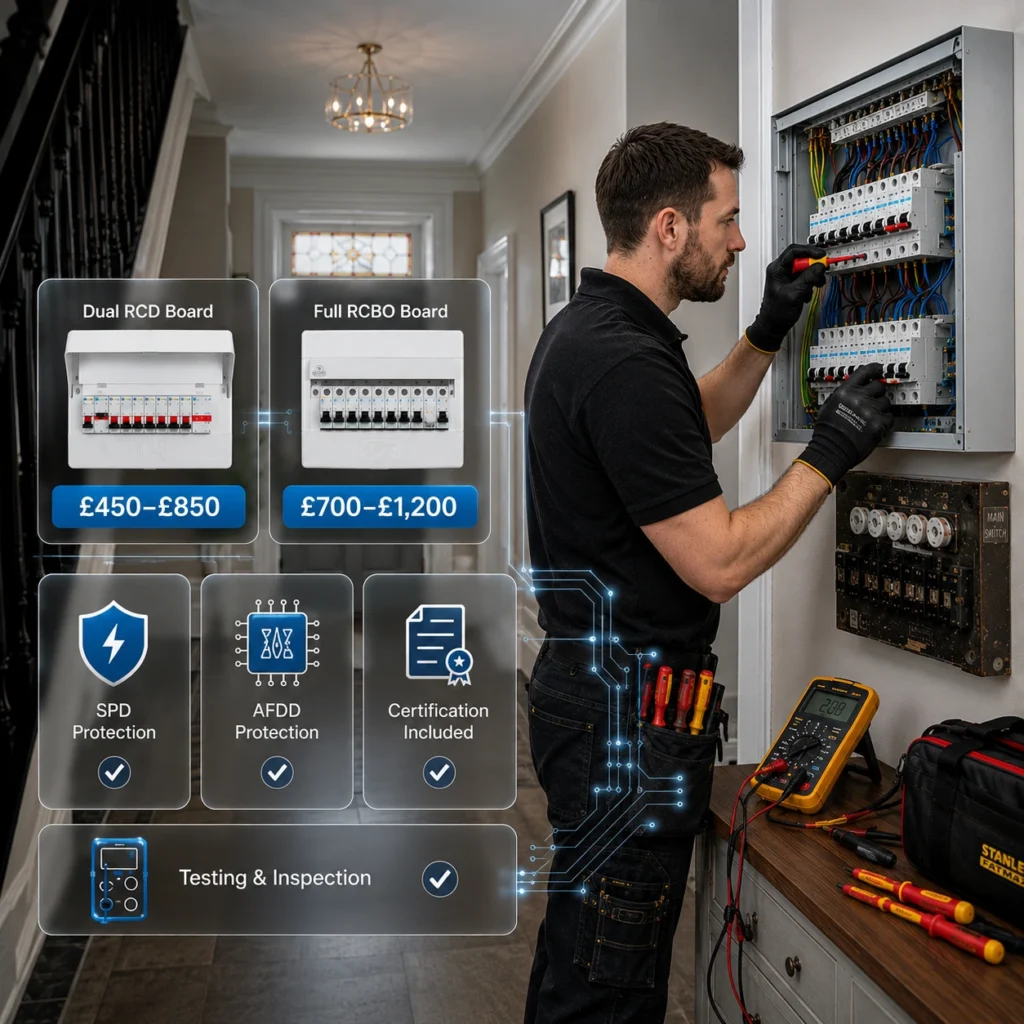
Older properties frequently still run on a fuse box fitted with rewirable fuses or basic circuit breakers, neither of which offers the shock protection a modern residual current device provides. A rewirable fuse only responds to an overload or a short circuit. It does nothing if a person receives an electric shock from a faulty appliance or damaged cable, since that kind of fault does not necessarily draw enough current to blow a fuse. This gap in protection is one reason a loft conversion or similar project is a sensible point to review the whole board, not just the new circuits being added.
Signs You Need a Consumer Unit Upgrade
A handful of practical signs point toward a board that has reached the end of its useful working life.
- The board still uses rewirable fuses with fuse wire, rather than circuit breakers, a design largely unchanged since before the 1980s.
- Circuits trip repeatedly when running normal combinations of appliances, such as a kettle and a tumble dryer together.
- There is no RCD protection on socket circuits, which is now a standard expectation under BS 7671.
- An EICR has come back with a C1 or C2 observation relating to the consumer unit itself.
- The unit is made of plastic rather than a metal enclosure, since plastic consumer units are no longer considered acceptable for new installations following updates to fire safety guidance.
- You are planning a single or double-storey extension or loft conversion that will add new circuits beyond the board’s current capacity.
- A kitchen extension with multiple integrated appliances is planned, since this often pushes an existing board past its safe working load.
Dual RCD vs Full RCBO: Which Board Do You Need
The two standard board types available today differ in how they group circuit protection, and the choice has a direct effect on both cost and everyday convenience.
Dual RCD (Split-Load) Boards
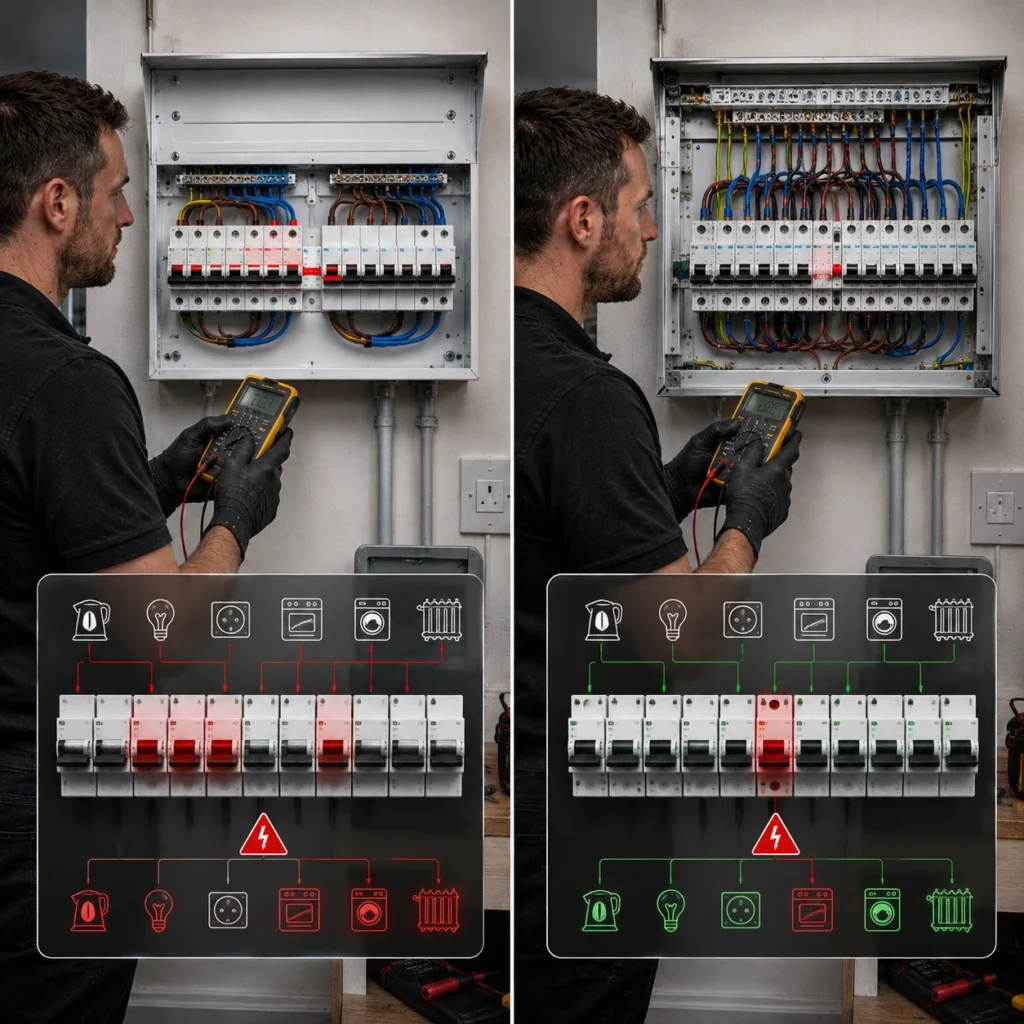
A dual RCD board splits circuits into two groups, each protected by a shared residual current device. If a fault develops on any circuit within one group, the RCD for that entire group trips, taking every circuit on that side of the board offline at once. In practice, a fault on a kitchen socket could cut power to the downstairs lighting circuit if both happen to share the same RCD group. This is the more affordable option and remains fully compliant with BS 7671, but it trades some day-to-day convenience for a lower upfront cost. If you’re comparing overall installation expenses, including electrical upgrades and heating systems, see our guide to new boiler costs in London.
Full RCBO Boards
A full RCBO board gives every individual circuit its own combined breaker and residual current device. A fault on one circuit trips only that circuit, leaving everything else in the property live and unaffected. This is increasingly considered best practice for domestic installations, particularly where a property has circuits serving different priorities, such as a home office running data cabling that cannot afford to lose power alongside an unrelated kitchen fault. The trade-off is a higher unit cost, since RCBOs are priced individually per circuit rather than shared across a group.
Consumer Unit Upgrade Cost
Prices below reflect UK-wide averages for a straightforward domestic upgrade. London labour rates typically sit at the upper end of each range, and where the upgrade is being carried out alongside a wider extension project, it is worth pricing both pieces of work together rather than as separate call-outs.
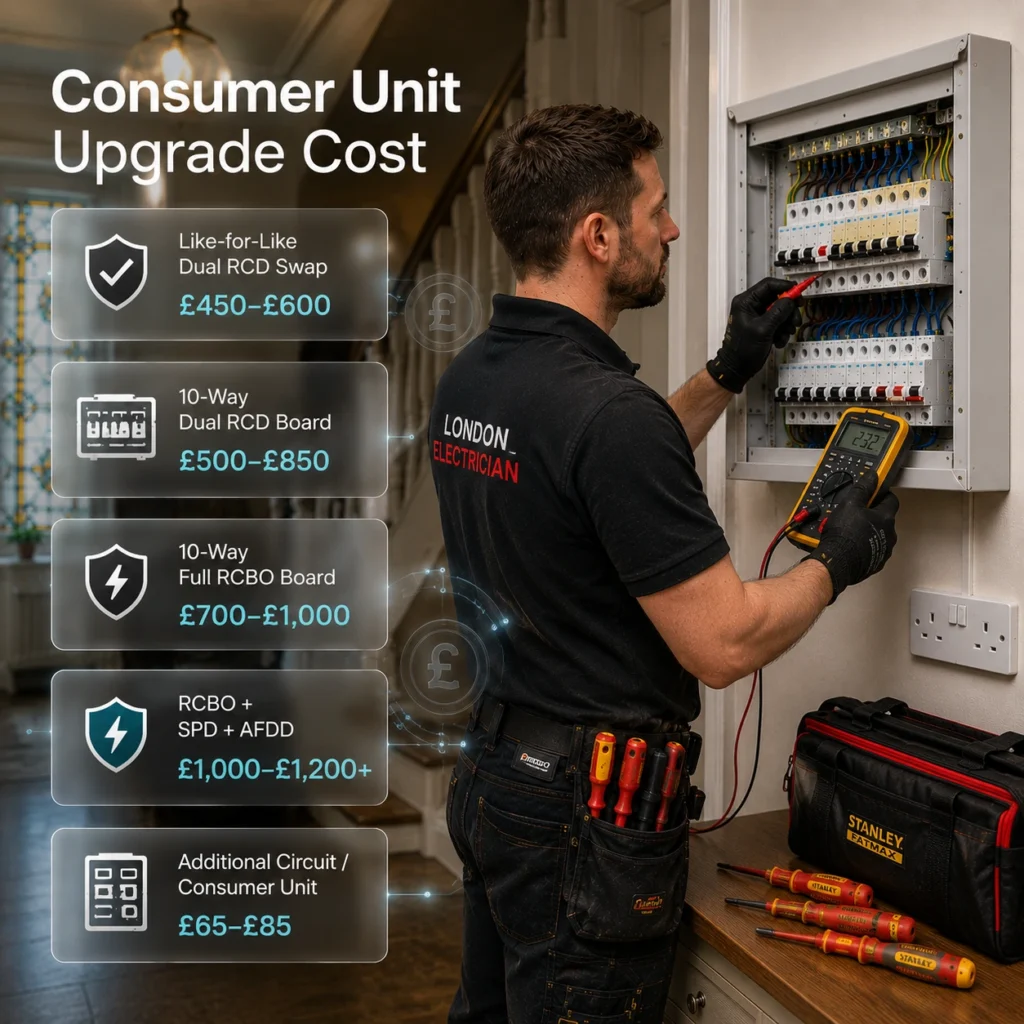
| Board Type | Typical Cost (2026) | Best Suited To |
|---|---|---|
| Like-for-like dual RCD swap | £450 to £600 | Budget replacement, existing wiring in good condition |
| Standard 10-way dual RCD board | £500 to £850 | Most domestic properties |
| Standard 10-way full RCBO board | £700 to £1,000 | Homes prioritising minimal disruption from faults |
| RCBO board with SPD and AFDD | £1,000 to £1,200+ | New installations, higher circuit count, and added protection |
| Additional circuit or consumer unit | £65 to £85 each | Properties needing a second board |
Jobs requiring extra circuits, poor existing earthing, or a difficult installation location, such as a cramped Victorian under-stair cupboard, can push costs beyond these ranges. Always treat the headline figure as a starting point rather than a fixed quote until an electrician has actually seen the installation.
What’s Included in the Price
A properly quoted consumer unit upgrade covers more than just the physical box on the wall. The price should include the unit itself, populated with the correct breakers and RCDs or RCBOs for your circuit count, full labour to fit and wire the new board, and thorough testing of every circuit before it is reconnected. If any damaged or outdated outlets are identified during testing, it is worth considering professional sockets and switches installation to ensure the entire electrical system is safe and compliant.
You should also receive an Electrical Installation Certificate confirming the work meets BS 7671, and Part P notification through the electrician’s competent person scheme, which registers the work with your local Building Control department without you needing to apply separately. If there is no existing isolator switch or the incoming main fuse needs upgrading, the Distribution Network Operator may need to attend, which can add time to the job but is often provided free or at low cost depending on the circumstances.
Additional Protection: SPD and AFDD
Two newer protective devices are increasingly specified alongside a standard consumer unit upgrade, and it is worth understanding what each one actually does before deciding whether to include them.
A Surge Protection Device guards sensitive electronics, televisions, computers, EV chargers, and solar inverters against voltage spikes caused by lightning strikes or switching events on the wider grid. BS 7671 now expects surge protection in many domestic installations unless a specific risk assessment justifies leaving it out, and most electricians fit one as standard on a new board. It typically adds £80 to £150 to the job.
An Arc Fault Detection Device monitors for the specific electrical signature of an arc fault, a dangerous, often invisible condition that can develop in damaged or aging cable insulation and is a known cause of electrical fires that conventional breakers do not always catch in time. AFDDs are not yet a blanket requirement across every domestic circuit, but they are increasingly recommended for higher-risk locations such as loft spaces with combustible materials nearby. If you’re budgeting for wider home improvements, including heating upgrades, see our guide to new boiler costs in London for a complete breakdown of installation costs.
What Happens If Faults Are Found During the Upgrade
Removing an old consumer unit exposes the wiring behind it to proper testing for the first time in years, and it is common for a straightforward like-for-like swap to uncover problems the homeowner had no idea existed.
If the electrician finds insulation resistance failures, incorrect earthing, or genuinely unsafe circuits during testing, they cannot legally connect that wiring to the new consumer unit without addressing the fault first. This is not upselling; it is a legal requirement under BS 7671, and a competent electrician will always explain exactly what was found and why it needs attention before proceeding. Budgeting some flexibility into a consumer unit upgrade, particularly in an older property, is one of the practical lessons covered in our guide to managing a build project.
Consumer Unit Upgrades in Victorian and Edwardian Properties
Victorian and Edwardian terraces raise specific practical issues that a newer property rarely has to deal with during a consumer unit upgrade.
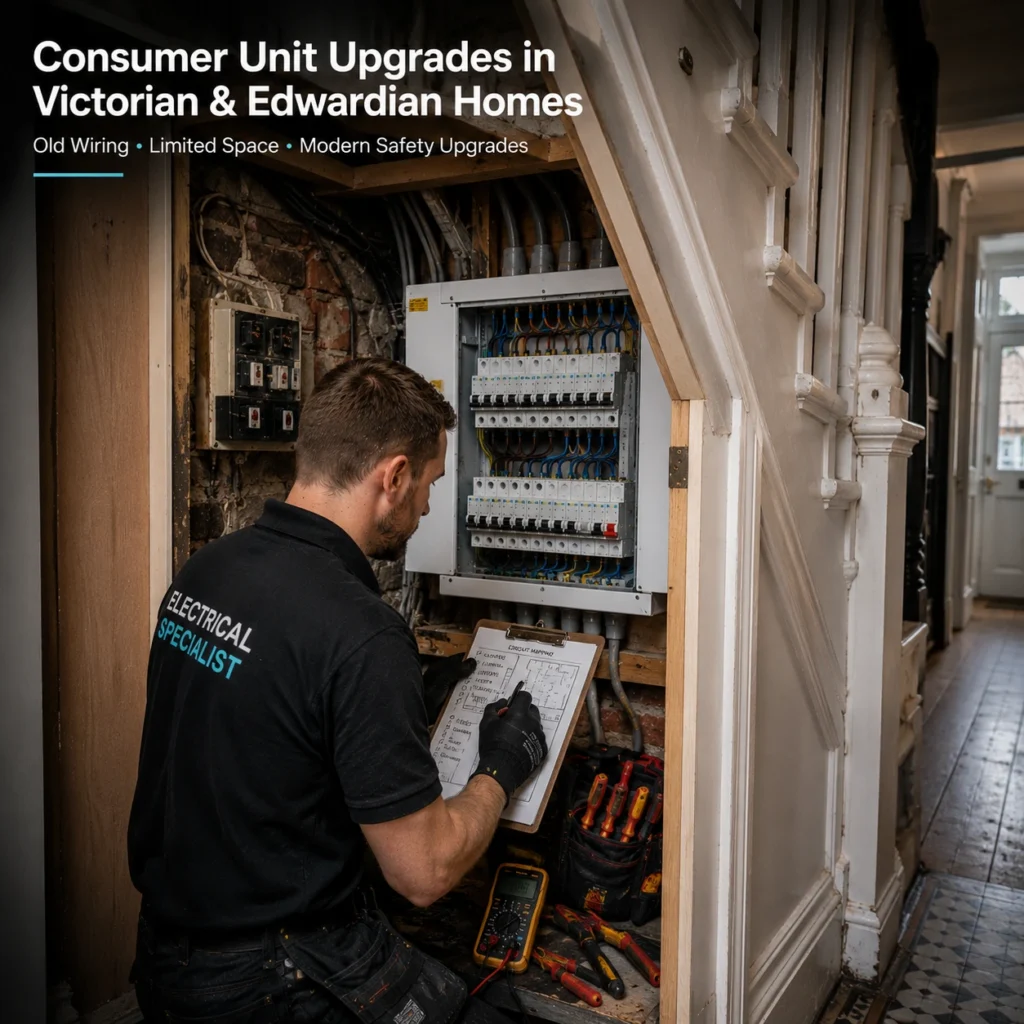
The original board location itself is often a constraint, tucked into a shallow under-stair cupboard or hallway alcove sized for a much smaller Victorian-era fuse box, which can mean a larger modern RCBO board needs careful positioning or a slightly different mounting approach to fit the available space cleanly. Cable entries into the old board were also rarely labelled with any consistency, so an electrician working on a period property typically spends longer during the initial assessment simply identifying which circuit serves which part of the house before any physical work begins, particularly where cracked walls or other structural movement have disturbed cable routes over the years.
Where a property has had partial rewiring over several decades rather than a single coordinated job, mixed cable types and ages are common behind the old board, and a consumer unit upgrade is often the point at which these inconsistencies come to light, sometimes prompting a decision between a full rewire and a more limited repair to bring specific circuits up to standard. A board mounted in a damp-prone location, common in a Victorian hallway or under-stair cupboard, is also worth checking against our guide to damp in Victorian terraces, since moisture reaching the board is a recurring cause of early failure on an otherwise sound installation.
Consumer Units and EV Charger Circuits
Installing an EV charger is one of the most common reasons a consumer unit that has coped fine for years suddenly needs attention, and it is worth understanding why before a charger installer arrives.
An EV charger needs its own dedicated circuit, typically protected by its own RCBO or an equivalent Type A or Type B RCD suited to charging equipment, rather than sharing protection with existing sockets or lighting. Before fitting that circuit, the installer carries out a load calculation to confirm the property’s incoming electricity supply and existing consumer unit have enough spare capacity, since a charger typically draws a continuous 7kW load that older boards were never designed to accommodate alongside everything else already running. Where the condition of the existing installation is uncertain, arranging an EICR certificate in London can help identify any issues before the EV charger is installed.
Where a board is already near capacity, adding an EV charger circuit is frequently the trigger that brings forward a full consumer unit upgrade rather than a simple additional circuit, since there may be no safe way to add the new load without addressing the board as a whole. This is a common pairing job alongside broader full refurbishment work, where electrical capacity is reviewed as part of the wider project rather than in isolation.
Choosing a Qualified Electrician for the Job
Consumer unit replacement is safety-critical, notifiable work, and the standard of the person doing it matters more here than on almost any other domestic electrical job.
Confirm registration with a recognised competent person scheme, NICEIC, NAPIT, or ELECSA, before booking, since only a registered installer can self-certify the work and notify Part P automatically. Ask for a fixed-price quote covering the unit, labour, testing, and certification as a single figure, rather than a day rate that leaves the final cost open-ended once the cover comes off and testing begins.
A quote that seems significantly below the ranges in this guide is worth treating with caution rather than excitement. A board fitted without full circuit testing, or without the correct RCBO or RCD specification for each circuit, can look identical to a properly installed one from the outside while leaving genuine safety gaps behind the cover. This is also where combining the work with a related job, such as lighting installation or a boiler electrical connection, can be more cost-effective than booking separate call-outs for closely related electrical work.
Part P and Building Control
Consumer unit replacement is classed as notifiable work under Part P of the Building Regulations in England and Wales, meaning it must either be carried out by an electrician registered with a competent person scheme such as NICEIC, NAPIT or ELECSA, who self-certifies the work and notifies Building Control automatically, or be separately submitted to and inspected by local authority Building Control if the installer is not registered with such a scheme.
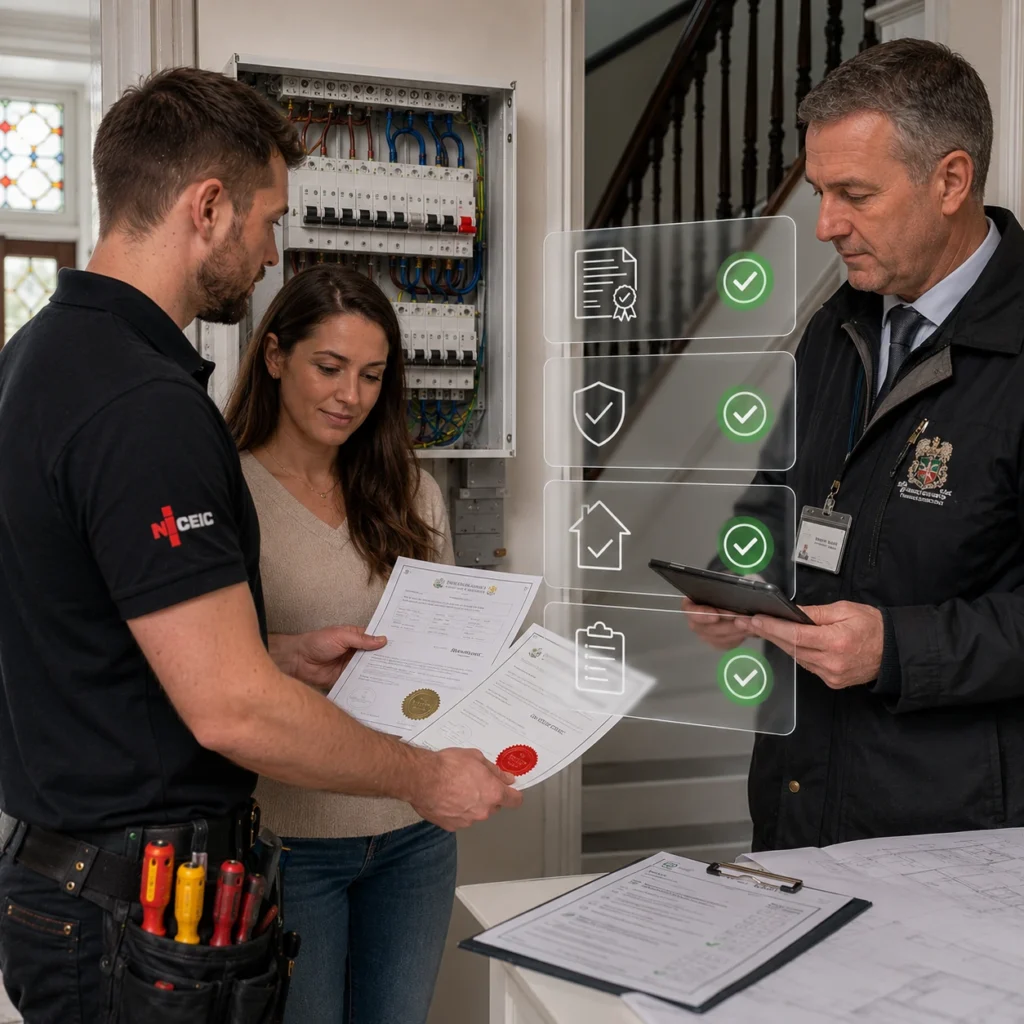
Skipping this notification entirely, or using an unregistered installer who does not follow either route, leaves the work technically non-compliant even if it was carried out competently. This becomes a genuine problem later at the point of sale, since a conveyancing solicitor will typically ask for the Part P certificate covering any consumer unit work visible on the property, much like they would check for a valid gas safety certificate on a rental property, and its absence can delay or complicate a transaction.
Frequently Asked Questions
Q: How long does a consumer unit upgrade take?
A straightforward domestic upgrade typically takes around one day, including testing and certification. Properties with a larger circuit count, difficult access, or faults uncovered during testing can take longer, sometimes extending into a second day if remedial work is needed before the new board can be fully energised.
Q: Will I be without power during the upgrade?
Yes, power is switched off for the duration of the physical installation, typically several hours within the working day, since the consumer unit is the single point to which every circuit in the property connects. A competent electrician will confirm the expected downtime in advance so you can plan around it.
Q: Do I need a consumer unit upgrade if I pass my EICR?
Not necessarily. An EICR inspection assesses the condition of your existing installation as it stands, and an older board can still receive a satisfactory result if it is functioning safely, even without RCD protection on every circuit. A C1 or C2 observation specifically relating to the consumer unit is the clearest signal that an upgrade is required rather than optional.
Q: Is a full RCBO board worth the extra cost over a dual RCD board?
For most households, a dual RCD board is a fully compliant, cost-effective choice. A full RCBO board makes more sense where minimising disruption matters, such as a home office, a property with sensitive equipment, or simply a preference for a fault on one circuit not affecting unrelated parts of the house.
Q: Can I replace my own consumer unit as a DIY project?
No. Consumer unit replacement is notifiable work under Part P and must be carried out by a competent, registered electrician. Beyond the legal requirement, working on a live distribution board without the correct training and testing equipment carries a genuine risk of serious injury or fire.
Q: Does upgrading my consumer unit affect my home insurance?
Most insurers do not require a specific consumer unit specification, but they increasingly expect evidence of general electrical safety compliance, and a documented upgrade with a valid Electrical Installation Certificate strengthens your position if you ever need to make a claim connected to an electrical fault.
Q: What is the difference between an RCD and an RCBO?
An RCD, Residual Current Device, detects current leaking to earth and cuts power to protect against electric shock, but on a dual RCD board, it typically covers a group of circuits together. An RCBO combines that same shock protection with overload and short circuit protection in a single device dedicated to one circuit, so only the affected circuit trips rather than the whole group.
Q: Will my consumer unit upgrade come with a warranty?
Reputable electricians typically offer a workmanship guarantee separate from the manufacturer’s warranty on the consumer unit itself, which commonly runs for several years depending on the brand. Always ask for both in writing, since a manufacturer defect and an installation fault are covered under different terms.
Q: How do I know if my current consumer unit is a fire risk?
A plastic-cased consumer unit installed before the current fire safety guidance was tightened is generally considered a higher risk than a metal-encased unit, since plastic can contribute to fire spread in a fault scenario. If you are unsure what your board is made of or how old it is, an EICR will identify this and note it as an observation if it falls below current standards.
Conclusion
A consumer unit upgrade is one of the more straightforward electrical jobs to budget for accurately, since the price is driven mainly by board specification and circuit count rather than the unpredictable variables that affect a full rewire. If your EICR certificate has flagged the consumer unit specifically, or your board still uses rewirable fuses, treat the upgrade as a near-term priority rather than something to defer.
EBT Build carries out consumer unit upgrades alongside house rewiring across North London’s Victorian and Edwardian properties, identifying board location, circuit mapping, and any wiring inconsistencies before a fixed quote is confirmed.

Tilly Bani is a renovation and roofing specialist with over 15 years of experience in construction and property refurbishment across North London. He specialises in roofing, structural repairs, and full home renovations, helping homeowners improve property value and safety.