
| Quick Answer A new boiler in London costs between £2,000 and £5,500 for most homeowners, depending on the boiler type, property size, and complexity of the installation. A standard like-for-like combi boiler swap typically comes in at £2,800 to £4,000 all-in. London prices run 10 to 25% above the UK national average due to higher labour rates, parking and logistics costs, and the additional complexity of working in period properties and flats. All gas boiler installations must be carried out by a Gas Safe-registered engineer. |
Introduction
Few things concentrate the mind like a boiler failing in the middle of a London winter. Whether yours has stopped working or you can see the breakdown coming, the first question is always the same: how much is this going to cost? Many homeowners start by comparing trusted London builders and heating specialists.
In London, that question is harder to answer than elsewhere. The capital’s premium labour rates, dense housing stock of Victorian terraces and converted flats, conservation area logistics, and range of property sizes all push boiler installation costs above what most online guides quote. A figure that applies in Leeds or Nottingham simply does not apply in Hackney or Islington.
This guide gives you current 2026 prices for every type of boiler installation in London, explains what drives the cost up or down, covers the extras that always end up on your final bill, and tells you how to avoid the most common mistakes when getting quotes. Older homes often combine heating upgrades with a full home refurbishment.
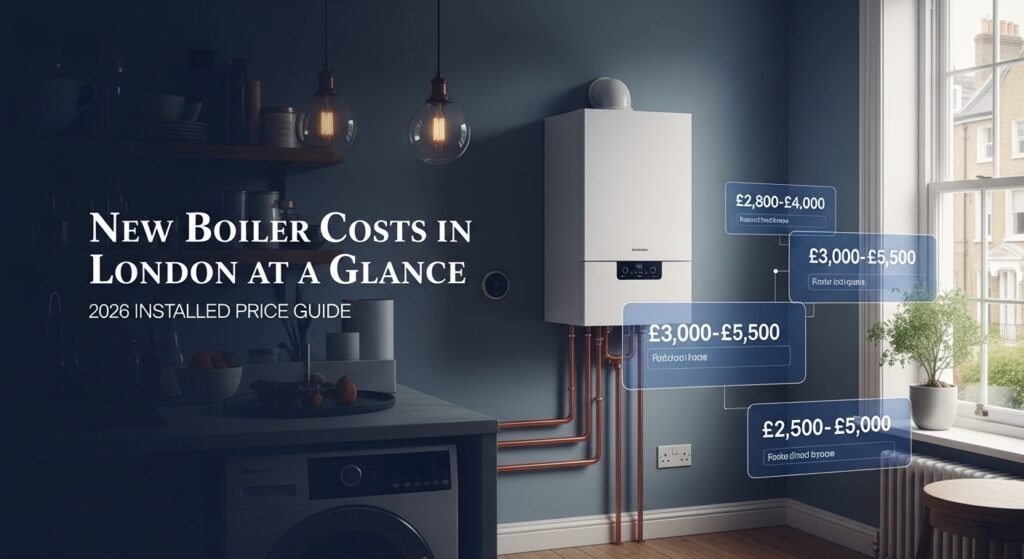
New Boiler Costs in London at a Glance
London homeowners should use these ranges as starting points before getting quotes. All figures include the boiler unit and labour, and assume a straightforward installation in an average-sized property.
| Installation Type | London Cost Range (inc. VAT) |
|---|---|
| Like-for-like combi boiler swap | £2,800 – £4,000 |
| New combi boiler (full installation) | £2,800 – £4,500 |
| System boiler replacement | £3,000 – £5,000 |
| Conventional/regular boiler replacement | £3,200 – £5,500 |
| Combi to system boiler conversion | £3,500 – £5,500 |
| System to combi boiler conversion | £3,000 – £4,800 |
| Electric boiler installation | £2,500 – £5,000 |
| Oil boiler installation (where applicable) | £3,500 – £6,000 |
These figures are based on 2026 market data and reflect the London premium over national averages. A standard combi replacement at the national average costs around £2,400 to £2,700. In London, the same job typically runs £2,800 to £4,000 once higher labour rates, parking, and access factors are included.
What Does a London Boiler Installation Include?
A properly quoted boiler installation should cover these core elements:
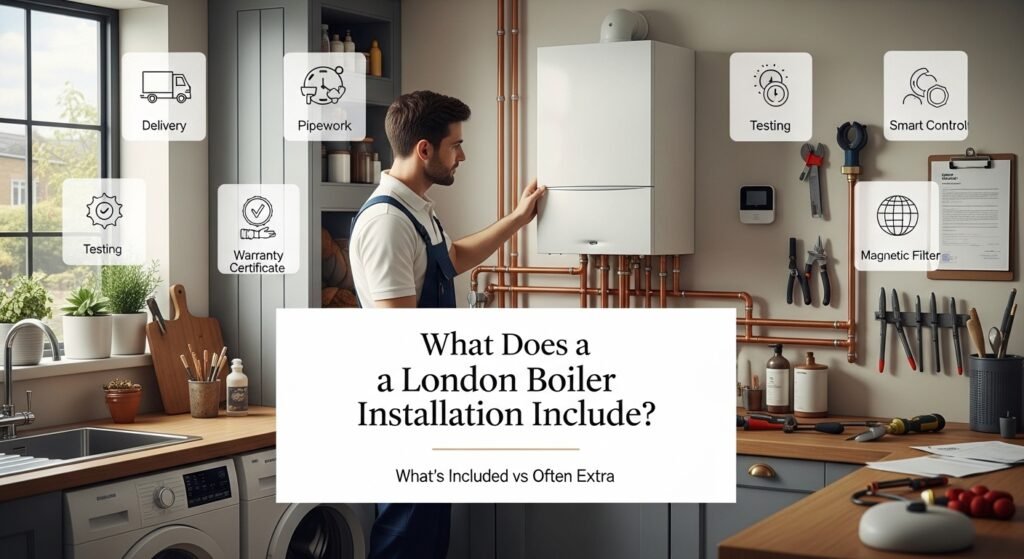
- Supply and delivery of the new boiler unit
- Removal and disposal of the old boiler
- Installation of the new boiler by a Gas Safe-registered engineer. Always use certified Gas Safe engineers for compliance.
- Connection to existing pipework, flue, and controls. Older systems may also require pipework replacement.
- Testing and commissioning of the new system. Some landlords request updated safety certification alongside heating works.
- Gas safety certificate (Building Regulations compliance document)
- Registration of the boiler installation with Building Control
- Manufacturer warranty registration
What is frequently excluded from initial quotes, and what you should always ask about:
- Powerflush or system chemical flush (usually necessary to protect the warranty)
- Magnetic filter installation
- Smart thermostat or upgraded heating controls
- Thermostatic radiator valves (TRVs)
- Flue extension or relocation
- New gas pipework if the existing pipe is undersized
- Boiler relocation to a different position
Not knowing what is excluded is the single most common cause of surprise when the final bill arrives. Ask every installer to confirm what their quote does and does not cover before you accept it.
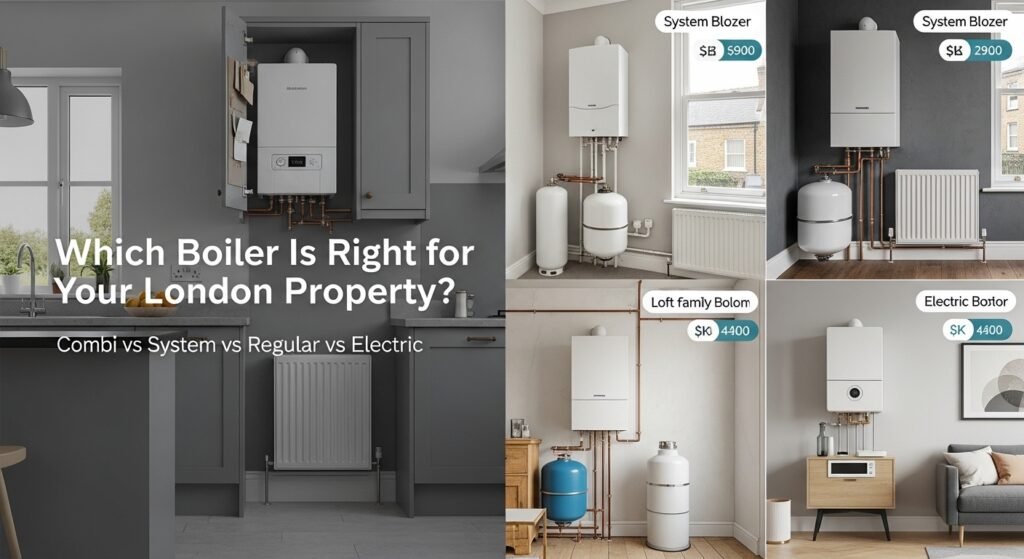
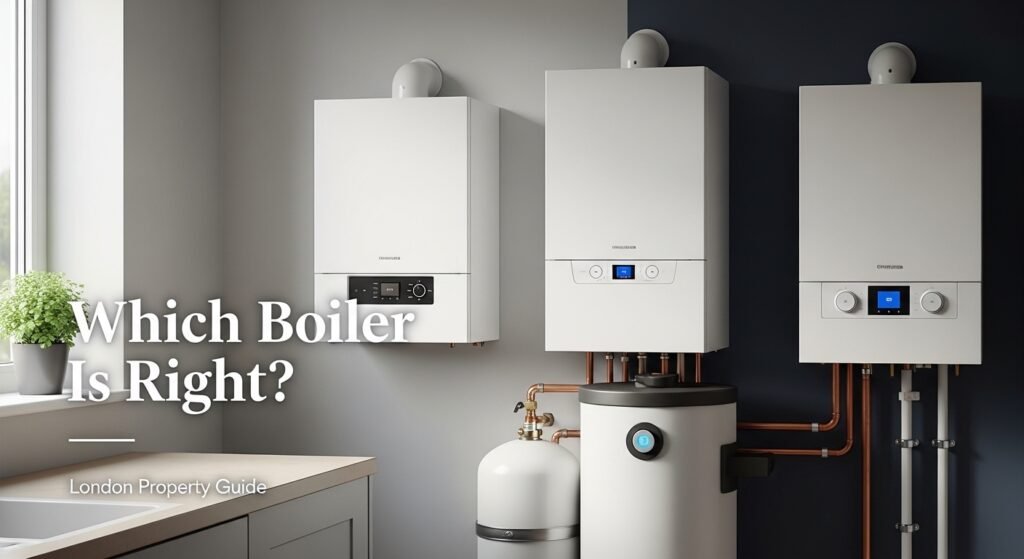
Boiler Types Explained: Which One Is Right for Your London Property?
Choosing the wrong boiler type for your property is expensive to fix later. London’s housing stock, from small one-bedroom flats in Brixton to four-bedroom Victorian terraces in Stoke Newington, has very different requirements.
Combi Boilers
Combi (combination) boilers account for around 70 to 80% of new boiler installations in the UK. Ideal for flats needing compact heating systems. They provide both central heating and hot water on demand from a single compact unit, with no need for a separate hot water cylinder or cold water tank. This makes them ideal for London flats and smaller terraced houses where space is at a premium.
Best for: One and two-bedroom flats, small to medium houses with one bathroom. Not suitable for larger properties with multiple bathrooms running simultaneously, as the flow rate can struggle.
Supply cost (unit only): £600 to £2,300 depending on brand and output.
London installed cost: £2,800 to £4,500.
Popular brands: Worcester Bosch, Viessmann, Vaillant, Baxi, Ideal, Alpha.
Worcester Bosch and Viessmann sit at the premium end, consistently winning Which? Best Buy awards for reliability, and are the brands that most Gas Safe engineers recommend for long-term performance. Alpha and Baxi offer mid-range options at lower unit costs with shorter warranty periods.
System Boilers
System boilers heat water directly from the mains and store it in a separate hot water cylinder. Many families pair them with modern radiator installation. They can supply multiple bathrooms simultaneously without pressure loss, making them better suited to larger London properties with higher hot water demand.
Best for: Three and four-bedroom houses with two or more bathrooms. Properties with high simultaneous hot water demand.
London installed cost: £3,000 to £5,000.
The hot water cylinder occupies space, which matters in a London terrace. A cylinder typically requires a dedicated cupboard of around 0.5 to 1 cubic metres. Some homeowners in London’s larger Victorian properties are converting from conventional to system boilers to reduce the number of components while still meeting high hot water demand.
Conventional (Regular) Boilers
Conventional boilers, also called heat-only or regular boilers, work with both a separate hot water cylinder and a cold water storage tank, usually in the loft. They are common in older London properties, particularly pre-1980s houses that were originally installed with this configuration.
Best for: Larger homes with older heating systems, properties with multiple bathrooms where peak demand is very high, and homes with solar thermal panels that feed into the hot water cylinder.
London installed cost: £3,200 to £5,500.
Converting from a conventional to a combi system in a large London Victorian terrace involves removing the hot water cylinder and cold water tank, replumbing the system, and installing a new flue. This conversion typically adds £500 to £1,500 to the installation cost but frees up significant space.
Electric Boilers
Electric boilers are increasingly common in London flats where there is no mains gas connection, or in properties where a gas supply would be expensive to install. They can suit homes already using consumer unit upgrade systems. They are compact, quiet, and do not require a flue.
Best for: Small flats without mains gas, properties where flue installation is problematic, supplementary heating in extensions or annexes.
London installed cost: £2,500 to £5,000.
The key drawback is the running cost. Electricity in the UK costs roughly 4 to 5 times more per unit of energy than gas. An electric boiler in a large property can carry significantly higher annual heating bills than a gas alternative. For a small flat with moderate heating demand, the difference is more manageable.
Why Boiler Installation Costs More in London
London homeowners pay 10 to 25% more than the national average for an identical boiler installation. Several specific factors explain this:
Labour rates. Heating engineers in London charge more than anywhere else in the UK. The premium reflects both higher personal costs of living and sustained demand driven by the density of London’s housing. Expect to pay £800 to £2,000 for labour on a standard installation, compared to £600 to £1,400 in the Midlands or North.
Parking and logistics. An engineer installing a boiler in a Hackney terrace or Islington flat cannot park outside the property for free. Parking permits, Congestion Charge, and ULEZ charges add to their overhead and appear in their rates. This is especially common on jobs in busy North London areas.
Access difficulties. London has a high proportion of converted Victorian and Edwardian properties with narrow hallways, restricted loft access, multiple floors, and awkward boiler cupboard positions. Removing and replacing a boiler in a fourth-floor flat of a converted townhouse takes significantly longer than replacing one in a ground-floor semi-detached.
Period property complications. Many London properties have old or narrow gas pipes that cannot supply a modern high-output combi boiler. Older homes may need new gas line installation. Upgrading an undersized gas pipe adds £200 to £500 to the job. Old flue positions may not meet current building regulations and require rerouting, adding another £200 to £600.
Flat-specific costs. In a purpose-built block of flats or a converted Victorian house, the flue often needs to run through shared spaces, up through several floors, or along a route that requires more time and materials. Some London flat installations require planning approval or freeholder consent before work can start. These administrative requirements do not exist in a standard house installation.
The Extras That Always End Up on the Bill
Even a straightforward London boiler installation involves costs beyond the headline quoted price. These are the most common additions.
Powerflush: £350 to £900
A powerflush cleans sludge, rust, and debris from your heating system’s pipes and radiators before the new boiler is connected. A blocked system may also need heating diagnostics. Magnetite sludge, the black iron oxide that builds up in heating systems over the years, causes around 60% of UK boiler breakdowns and can block heat exchangers. Most boiler manufacturers require evidence that the system was properly flushed before the installation to validate the warranty. Skipping a power flush to save money can invalidate your new boiler’s guarantee.
The powerflush cost varies by system size: a small flat with six to eight radiators typically costs £350 to £500. A four-bedroom house with twelve to fifteen radiators typically costs £600 to £900.
A chemical flush (adding cleansing agents to the system without the high-pressure equipment) costs £100 to £200 and is suitable for systems in good condition. A powerflush is recommended for systems with evident sludge, cold radiators, or systems that have not been flushed in the past five to six years.
Magnetic Filter: £100 to £250
A magnetic filter fits into the heating circuit and captures the metallic particles that continuously form as your pipes and radiators corrode. Without one, this debris eventually damages the new boiler’s heat exchanger and pump. Most Gas Safe engineers fit one as standard practice, and most manufacturers require one to maintain the warranty. If a quote does not include a magnetic filter, ask why.
Smart Thermostat: £150 to £350
A smart thermostat, such as a Nest, Hive, or Worcester Bosch Wave, replaces your existing programmer and room thermostat with a connected device you can control from your phone. Smart thermostats learn your heating patterns and can reduce gas consumption by up to 10%, paying back their cost within two to three years in most London homes. The installation adds a few hours of labour to the job, making it most cost-effective to add at the same time as a new boiler. Many owners combine this with smart home controls.
Thermostatic Radiator Valves (TRVs): £70 to £140 per radiator
TRVs allow you to set each radiator to a different temperature, turning down rooms you do not use and saving energy. If your property does not have TRVs, or if they are more than ten years old and stiff or inaccurate, adding new ones during a boiler installation is significantly cheaper than doing it as a separate job. A typical three-bedroom London terrace with eight radiators would cost £560 to £1,120 to fit with TRVs. TRVs work best with balanced radiator systems.
Flue Extension or Relocation: £150 to £600
Modern boilers must be flued in accordance with current building regulations, which specify minimum distances from windows, doors, and boundaries. If your existing flue does not meet these standards, or if the new boiler needs to be positioned differently, the flue must be extended or rerouted. In London flats, routing a flue through a shared external wall or roof often requires additional work and materials.
Gas Pipe Upgrade: £200 to £500
High-efficiency combi boilers have higher gas flow requirements than older boilers. If your property’s gas pipe (the internal pipe between the meter and the boiler) is too narrow to supply the required flow rate, it must be replaced. This is particularly common in pre-1970s London properties and those with long pipe runs. Your engineer should assess this during the survey before quoting.
Boiler Brand Comparison: What to Buy in London
The boiler brand you choose affects the unit cost, warranty length, and long-term reliability. These are the brands most commonly installed in London in 2026.
| Brand | Typical Unit Cost | Warranty | Reliability |
|---|---|---|---|
| Worcester Bosch | £900 – £1,800 | Up to 12 years | Excellent |
| Viessmann | £1,000 – £2,000 | Up to 10 years | Excellent |
| Vaillant | £800 – £1,600 | Up to 10 years | Very good |
| Baxi | £600 – £1,200 | Up to 7 years | Good |
| Ideal | £550 – £1,100 | Up to 7 years | Good |
| Alpha | £500 – £1,000 | Up to 7 years | Good |
Worcester Bosch and Viessmann are consistently recommended for London’s period housing stock. Their efficiency ratings, warranty terms, and manufacturer support are strongest, making them the right choice if you plan to stay in the property for more than five years. The higher upfront cost is typically recovered through lower repair frequency and lower gas bills.
Budget brands like Alpha and Ideal are a reasonable choice if upfront cost is the primary concern, but shorter warranty periods mean you take on more risk if a fault develops after year three or four.
One practical tip: always check whether the installer is accredited by the boiler manufacturer, as manufacturer-accredited installers typically offer longer warranties. Worcester Bosch Approved Installers, for example, can extend the standard warranty from two years to up to twelve years.
9 Signs Your London Boiler Needs Replacing
Knowing when to replace rather than repair saves money in the long run. The repair-or-replace decision rule of thumb is straightforward: if a repair costs more than 25% of the cost of a new boiler, replace it. If the boiler is over 10 years old, lean toward replacement rather than major repairs.
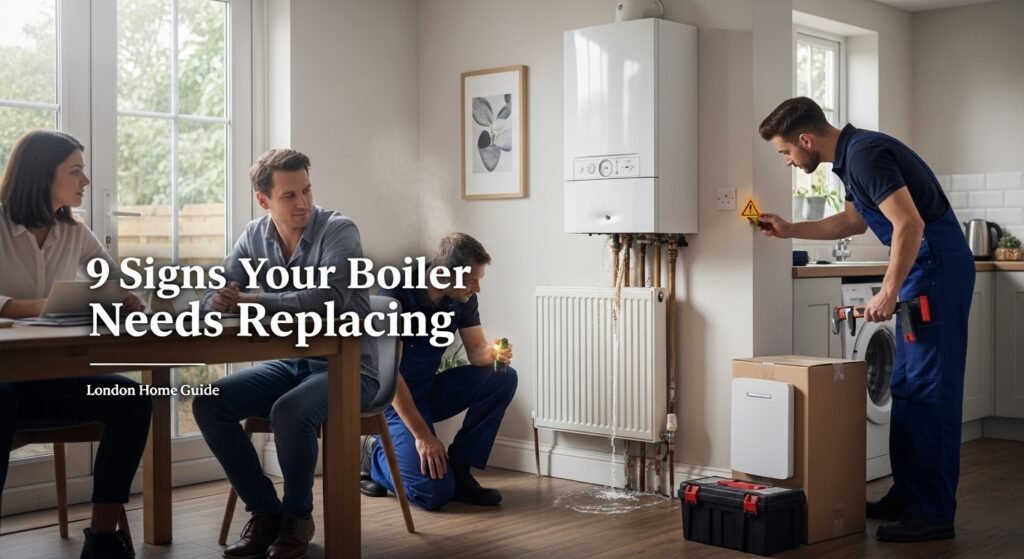
These are the most reliable signs that a replacement is due:
The boiler is over 12 years old. Well-maintained boilers can last 15 years, but reliability drops sharply beyond 12. Parts become harder to source and more expensive, and repairs become more frequent.
Energy bills are rising without explanation. An ageing boiler losing efficiency wastes more gas to produce the same heat. Upgrading from a G-rated boiler to a modern A-rated condensing model can save up to £500 per year in energy costs.
The pilot flame is yellow or orange. A healthy gas boiler burns with a sharp blue flame. A yellow or orange flame indicates incomplete combustion, which can produce carbon monoxide. This is a safety emergency. Turn off the boiler and call a Gas Safe engineer immediately.
There is water leaking from or under the boiler. Leaks should be checked quickly through leak detection. Leaks usually indicate a failed seal, valve, or heat exchanger. Minor seal replacements are cheap. Heat exchanger failure on an older boiler is expensive and often not worth repairing.
The boiler makes kettling, banging, or rumbling sounds. Persistent faults may need urgent boiler repairs. Kettling, a sound like water boiling in a kettle, is caused by limescale or sludge buildup in the heat exchanger. It strains the boiler and reduces efficiency. On an older boiler, it is often cheaper to replace it than to attempt a fix.
The boiler needs resetting more than once a week. Frequent lockouts indicate the control board, sensors, or internal components are failing. Once a boiler enters this pattern on an older system, it typically does not improve.
Radiators are slow to heat or have persistent cold spots. This can indicate a circulation problem or sludge buildup. A powerflush may resolve it in a younger system, but in a boiler over 10 years old, it often points to a pump or heat exchanger failing.
Replacement parts are no longer available. Manufacturers typically support boilers for 10 to 15 years after the model is discontinued. Once parts become unavailable, even a minor fault becomes unfixable.
The boiler has a G efficiency rating. G-rated boilers predate the condensing technology introduced from around 2005. They operate at below 80% efficiency, wasting 20% or more of every unit of gas. A modern A-rated condensing boiler operates above 90% efficiency, meaning significantly lower annual running costs.
Repair vs Replace: A Practical Decision Framework
If your boiler has broken down and an engineer has given you a repair quote, use this framework to decide whether to repair or replace:

Repair if: The boiler is under 8 years old, the repair cost is under £300, the fault is a minor component (a fan, sensor, or valve), and the boiler has been regularly serviced.
Replace if: The boiler is over 10 years old, the repair involves a major component (heat exchanger or PCB), the repair cost exceeds £500, or the boiler has required repairs more than twice in the past two years.
A useful rule: if the repair cost exceeds 25% of the cost of a new installed boiler, replacement is almost always the better financial decision.
Government Grants and Financial Support for London Homeowners
Boiler Upgrade Scheme (BUS)
The Boiler Upgrade Scheme provides grants to replace gas or oil boilers with low-carbon heating systems. In 2026, the grant provides:
- £7,500 toward an air source heat pump, Some upgrades are combined with efficient underfloor heating.
- £7,500 toward a ground source heat pump
- £5,000 toward a biomass boiler (in limited circumstances)
The BUS does not provide grants toward gas boiler replacements, only toward the switch to low-carbon alternatives. If you are considering the longer-term implications of the 2035 phase-out of gas boilers in new-build properties and want to future-proof your heating system, the BUS grant makes heat pump installation significantly more affordable.
ECO4 Scheme
The Energy Company Obligation (ECO4) scheme covers heating upgrades, including boiler replacement, for low-income households in properties with poor energy efficiency ratings. To qualify, your property typically needs an EPC rating of D, E, F, or G, and you or a household member must be receiving a qualifying benefit such as Universal Credit, Pension Credit, or Housing Benefit.
The ECO4 scheme has been running through to March 2026. Under this scheme, eligible London households may receive a full or partial contribution toward a new boiler at no cost. Check eligibility through an approved installer rather than applying directly, as the installer carries out the assessment.
0% VAT on Energy-Saving Products
Certain energy-efficient heating components qualify for 0% VAT rather than the standard 20% rate. This applies to the installation of heat pumps, solar panels, and some insulation products. A standard gas boiler replacement does not qualify for 0% VAT, but if you are installing a heat pump alongside a new heating system, this represents a meaningful saving.
How Long Does a Boiler Installation Take in London?
Timeline varies by the complexity of the job and the type of installation.
- Like-for-like combi replacement: 6 to 8 hours. This is typically a single-day job for one or two engineers.
- System boiler replacement or combi to system conversion: 1 to 2 days.
- Conventional to combi conversion (removing cylinder and tank): 2 to 3 days.
- Boiler relocation: Add half a day to a full day, depending on the complexity of the new pipework.
- Installation in a difficult-access London flat: Add 2 to 4 hours for access, flue routing, and making good after completion.
Plan for your heating and hot water to be off throughout the working day during installation. If you have an electric shower, you will have hot water for showering. If your home relies entirely on the boiler for hot water, plan accordingly.
How to Get a Fair Quote in London
The London boiler installation market has significant price variation. The same boiler from different installers can be quoted at prices varying by £800 to £1,500 or more. Here is how to navigate this.

Get at least three quotes. Prices for identical boilers vary 30 to 50% between installers in London. A single quote gives you no market reference point. Always compare trusted local specialists before booking.
Use Gas Safe-registered engineers only. Check the Gas Safe Register at gassaferegister.co.uk before accepting any work. All gas boiler work in the UK must be carried out by a registered engineer. An unregistered installer creates safety risks, invalidates the manufacturer’s warranty, and creates problems when you come to sell the property.
Ask for an itemised quote. A quote that gives you a single total figure with no breakdown is hiding something. Ask for separate line items for: the boiler unit, labour, powerflush, magnetic filter, controls, and any additional pipework or flue work. This is the only way to compare quotes on a like-for-like basis.
Check whether the installer is manufacturer-accredited. Worcester Bosch Approved Installers, Vaillant Advance engineers, and Viessmann-trained installers can extend standard warranties beyond the base period. The extended warranty is typically worth more than the small premium some accredited installers charge.
Be sceptical of very low quotes. A quote that is £500 to £800 below the others is almost certainly excluding something: the powerflush, the magnetic filter, proper flue compliance checks, or the correct boiler output for your property size. When the work starts, and these items emerge as necessary, you pay more than you would have with the honest quote.
Consider the timing. London heating engineers are busiest in November, December, and January. Booking a replacement in spring or early autumn means better availability, less pressure on the engineer to rush, and sometimes lower prices from businesses looking to fill their diary.
FAQ
Q: How much does a new boiler cost in London in 2026?
Most London homeowners pay between £2,800 and £4,500 for a new combi boiler fully installed. A system boiler installation costs £3,000 to £5,000. These figures include the boiler unit, labour, and standard installation. They exclude extras like a powerflush (£350 to £900), magnetic filter (£100 to £250), and smart thermostat (£150 to £350). London costs run 10 to 25% above the national average of around £2,400 due to higher labour rates and the complexity of the capital’s housing stock.
Q: How long does a new boiler last in London?
A well-maintained boiler should last 10 to 15 years. Annual servicing by a Gas Safe engineer is the single most important factor in achieving the longer end of this lifespan. London’s hard water supply (classified as very hard in most central and inner London areas) accelerates scale buildup in heat exchangers, making a magnetic filter and periodic powerflush particularly important for boiler longevity in the capital.
Q: What is the cheapest type of boiler to install in London?
A like-for-like combi boiler replacement, fitting the same type of boiler in the same position with no system changes, is the cheapest installation type. It minimises labour time, avoids pipework changes, and requires no new flue routing. For a small or medium London property already on mains gas with a working combi, this is typically the most cost-effective route.
Q: Is a heat pump cheaper than a boiler in London?
The Boiler Upgrade Scheme provides a £7,500 grant toward an air source heat pump, reducing the installed cost from £9,000 to £16,000 to around £3,000 to £8,000. Running costs depend heavily on the property’s insulation. A heat pump in a well-insulated London home can achieve lower running costs than a gas boiler because of its high efficiency (producing around 3 units of heat per unit of electricity). In a poorly insulated Victorian terrace, the running cost advantage is smaller or absent. The government plans to phase out gas boilers in new-build properties by 2035, making heat pumps an increasingly relevant option for London homeowners planning long-term.
Q: Can I get a free boiler in London?
Under the ECO4 scheme, low-income London households in properties with poor EPC ratings may qualify for a fully funded boiler replacement. Eligibility requires receiving a qualifying benefit and having a property rated D, E, F, or G on the Energy Performance Certificate. ECO4 runs to March 2026. Camden Council’s Warm Homes Local Grant scheme and similar borough-level initiatives may offer additional support for qualifying households. Check eligibility through an approved ECO4 installer rather than directly.
Q: Do I need to tell my landlord before replacing the boiler?
If you are a tenant, your landlord is responsible for the boiler and central heating system. They must keep it in safe working order under the Landlord and Tenant Act 1985. You should report a faulty or failing boiler to your landlord in writing (email is acceptable). Landlords have a legal obligation to arrange repairs within a reasonable time. If you are a leaseholder rather than a tenant, your lease will specify whether the boiler is your responsibility or the freeholder’s. Check your lease before arranging any work.
Conclusion
A new boiler in London costs more than the national guides suggest. The 10 to 25% London premium is real, driven by labour rates, access difficulties, period property complexity, and logistics that simply do not apply in the same way in other UK cities.
The most common mistake London homeowners make is accepting the cheapest quote without checking what it includes. A quote that omits the powerflush, magnetic filter, or proper flue compliance is not cheaper. It is the starting point for a higher final bill.
Get at least three itemised quotes from Gas Safe-registered engineers, confirm what is and is not included in each, check whether the installer is manufacturer-accredited, and factor in the extras before comparing prices. For most London properties, a mid-range brand installed by an accredited engineer with a full system flush and magnetic filter is the combination that delivers the best balance of upfront cost, warranty protection, and long-term reliability. For tailored pricing and installation advice, you can contact our team.

Tilly Bani is a renovation and roofing specialist with over 15 years of experience in construction and property refurbishment across North London. He specialises in roofing, structural repairs, and full home renovations, helping homeowners improve property value and safety.