
| Quick Answer A kitchen extension in Hackney costs between £50,000 and £120,000 for most single-storey projects, depending on size, extension type, and finish. Labour in this part of East London runs higher than the national average, and Hackney’s 35 conservation areas add planning complexity that can affect both cost and timeline. Budget at least £2,500 to £3,500 per square metre for the structural build alone, before kitchen fit-out costs. |
Introduction
Hackney is one of London’s most popular boroughs for home extensions. Its Victorian terraces in Stoke Newington, Clapton, and De Beauvoir Town are full of potential: deep rear gardens, side passages, and floor plans that adapt well to open-plan kitchen-dining layouts.
But extending a kitchen in Hackney comes with costs and complications that a generic London cost guide won’t tell you about. Many homeowners first speak with kitchen fitters Hackney before budgeting properly. Between the conservation area restrictions, the Party Wall Act obligations shared with terraced neighbours, and the premium contractor rates in East London, the numbers add up faster than most homeowners expect.
This guide gives you a full cost breakdown for kitchen extensions in Hackney in 2026, covering every extension type, what drives the price, what the planning rules actually say, and how to build a realistic budget before you get your first quote.
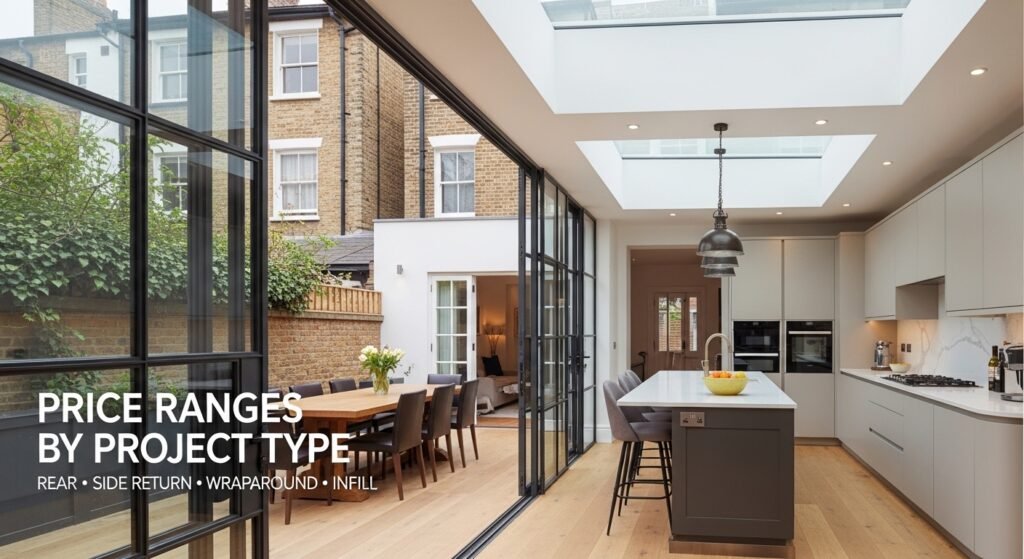
Kitchen Extension Costs in Hackney: Price Ranges by Project Type
The type of extension you build is the biggest single driver of cost. Here’s what each option typically costs in Hackney.
Rear Extension
The most common choice for terraces. A rear extension creates room for an open-plan kitchen and dining area and is often completed by a full refurbishment company.
| Size | Typical Cost (ex. VAT) |
| Small (15 – 20m²) | £50,000 – £75,000 |
| Medium (20 – 30m²) | £75,000 – £105,000 |
| Large (30m²+) | £105,000 – £150,000+ |
A single-storey rear extension within the standard depth limits (3 metres for terraced and semi-detached houses) qualifies as permitted development in most of Hackney, meaning no full planning application is needed. Larger rear extensions up to 6 metres can still be approved under the Prior Approval Neighbour Consultation Scheme.
Side Return Extension
Side return extensions use the narrow alleyway beside a Victorian terrace, typically 1 to 2 metres wide, to widen the kitchen footprint. They often pair well with stud wall construction changes internally. They don’t add much floor area on their own, but combined with a rear extension, they transform a dark, narrow galley kitchen into a wide, light-filled space.
- Side return only: £35,000 – £60,000
- Side return combined with rear extension (wraparound): £80,000 – £130,000
Side extensions are not permitted development in Hackney’s conservation areas. If your property sits within one of the borough’s 35 designated zones, you’ll need a planning application for any side extension, regardless of size.
Wraparound Extension
A wraparound combines rear and side return space into one large open-plan layout. Many owners combine this with a kitchen installation service. It’s the most transformative option for a Victorian terrace and the most expensive.
- Typical cost: £90,000 – £160,000+
Wraparound projects nearly always require planning permission, involve structural steelwork to span the new open-plan space, and need careful design to ensure the new roof integrates properly with the original building. In Hackney’s conservation areas, the design will be scrutinised for how well it matches the existing character of the street.
Infill Extension
Some Hackney properties have a rear outrigger or return that creates an awkward L-shaped ground floor. An infill extension fills in this corner, squaring off the footprint and gaining usable kitchen space without extending into the garden.
- Typical cost: £25,000 – £55,000
Infill extensions are often smaller in scope than full rear extensions and can be done under permitted development in most cases. They’re worth considering if your garden space is limited.
Cost Per Square Metre in Hackney
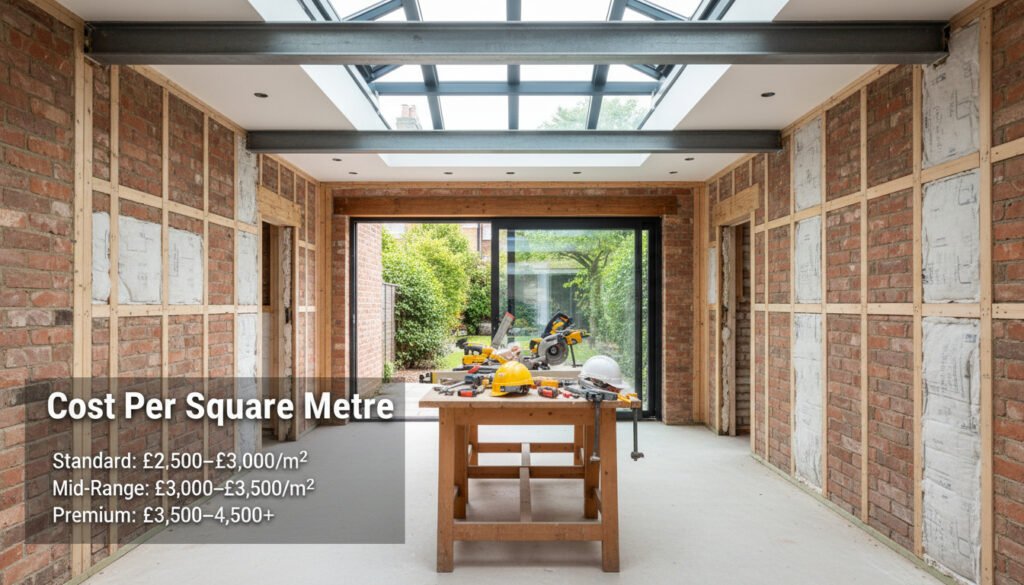
Most reputable contractors price kitchen extensions per square metre of floor area added. Premium builds usually include bespoke finishes, upgraded flooring installation, and modern services. In Hackney, expect these ranges in 2026:
| Spec Level | Cost Per m² (structural build only, ex. VAT) |
| Standard | £2,500 – £3,000 |
| Mid-range | £3,000 – £3,500 |
| Premium | £3,500 – £4,500+ |
These figures cover the structural shell: foundations, walls, steelwork, roof, windows, insulation, and first-fix plumbing and electrics. They do not include the kitchen fit-out, which is a separate and significant cost discussed below.
The FMB (Federation of Master Builders) puts the London average at around £1,700 per m² as a base rate, but this reflects outer London and simpler builds. Inner East London boroughs like Hackney sit at the higher end due to labour premiums, access difficulties, and the complexity common in period properties.
What’s Included in the Build Cost
Understanding what a builder’s quote covers helps you compare quotes accurately and avoid surprises. Many projects also need plumbing and heating work for sinks, dishwashers, and radiators.
Structural work:
- Foundations and groundworks (depth depends on soil conditions)
- Demolition of the existing rear wall
- Structural steelwork (typically one or two RSJ beams to carry the load above the new opening)
- External walls (brick, block, or timber frame)
- Roof structure and weatherproofing (flat roof, pitched roof, or glazed)
- Windows and bi-fold or sliding doors
First fix:
- Plumbing rough-in (new pipe runs to kitchen sink, dishwasher, boiler connections)
- Electrical rough-in (consumer unit upgrade if needed, lighting circuits, sockets)
- Underfloor heating pipework (if specified)
Second fix and finishing:
- Plastering and rendering
- Flooring screed or subfloor
- Insulation to building regulations standards
- Decoration (primer coat)
What it typically does NOT include:
- The kitchen itself (units, worktops, appliances)
- Flooring finish (tiles, wood, LVT)
- Final decoration and painting
- Architect or structural engineer fees
- Planning application fees
- Building regulations fees
Kitchen Fit-Out Costs: A Separate Budget
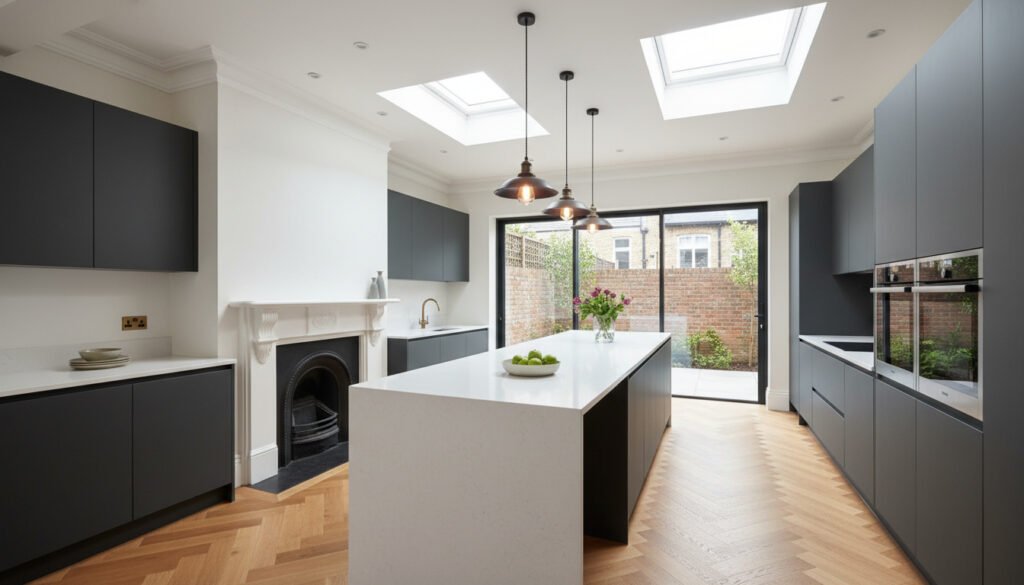
The structural build gets you the shell. The kitchen fit-out fills it. This is where costs vary the most, and where homeowners most frequently underestimate.
Budget kitchen fit-out (£10,000 – £20,000)
Off-the-shelf units from Howdens, IKEA, or Wren, with laminate worktops, a standard ceramic sink, and mid-range integrated appliances. Fine for a rental property or a project where you’re primarily adding space rather than upgrading the kitchen quality. Budget kitchens often use standard cabinets and laminate tops, while premium projects include custom kitchen units fitted.
Mid-range kitchen fit-out (£20,000 – £40,000)
Rigid-built cabinets from suppliers like John Lewis of Hungerford, Magnet’s higher-end ranges, or bespoke joinery from a local maker. Quartz or engineered stone worktops. Stone surfaces and islands often need specialist worktop installation services. A larger island or breakfast bar. Integrated Bosch or Siemens appliances. This is where most Hackney homeowners land when extending to create a proper family kitchen.
High-end kitchen fit-out (£40,000 – £80,000+)
Fully bespoke cabinetry, hand-painted finishes, natural stone worktops (marble, granite, or quartzite), statement lighting, and premium appliances from brands like Gaggenau, Miele, or Wolf. This spec is typically found in Hackney’s higher-value streets, such as Albion Drive or Navarino Road, where the property values justify the investment.
A simple kitchen fit-out, including appliances and installation, can start around £15,000 for a small kitchen from a standard supplier. A high-end bespoke kitchen can exceed £60,000 before appliances. Be clear with your builder which budget you’re working to so they can plan services and island positions accordingly.
Professional Fees
Your build cost is not your total project cost. Professional fees add 10 to 20% on top, depending on how much design and project management support you need. Older properties may also need updated electrics, such as consumer unit upgrades.
- Architect: £3,000 – £12,000+, depending on the scope of service. A full service (measured survey, concept design, planning drawings, building regulations drawings, contract administration) typically costs 8 to 15% of the build cost for smaller projects.
- Structural engineer: £800 – £2,500. Required for any extension involving steelwork or significant structural changes. Your architect usually coordinates this.
- Planning application fee: £528 in England (2025 rate) for a householder application. Not all extensions need a full application (see planning section below).
- Lawful Development Certificate: £129 from Hackney Council. Strongly recommended for permitted development projects as it gives you documentary proof that the build was lawful, which solicitors will ask for when you sell.
- Building regulations application: £200 – £900 depending on project size and whether you use a full plans application or building notice.
- Party Wall Surveyor: £700 – £1,500 per surveyor. If you share a party wall with a neighbour (standard for terraced houses), you must serve a Party Wall Notice under the Party Wall Act 1996. If your neighbour consents in writing, there’s no cost. If they dispute it, each party appoints a surveyor, and you pay both.
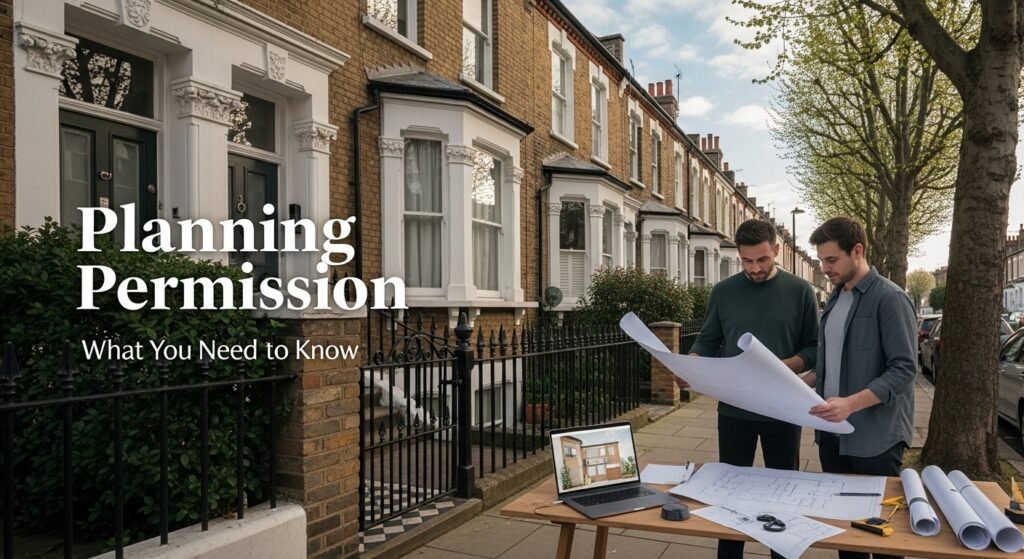
Planning Permission in Hackney: What You Need to Know
Hackney has more planning restrictions than most London boroughs. Getting this wrong delays your project by months and can force you to redesign or demolish completed work. Before building, many owners confirm their status with an experienced Hackney builders team.
Permitted Development
If your property is a house (not a flat or maisonette) and is not in a conservation area or covered by an Article 4 direction, national permitted development rules apply. You can build a single-storey rear extension up to 3 metres deep (for a terrace or semi-detached house) without planning permission. Under the Prior Approval Neighbour Consultation Scheme, you can extend up to 6 metres, subject to neighbour consultation and the Hackney Council issuing prior approval within 42 days.
Conservation Areas
Hackney has 35 conservation areas, covering a large portion of the borough’s most desirable streets. These include Albion Square, Broadway Market, Brownswood, Clapton Common, Clapton Square, De Beauvoir Town, Dalston Lane, Graham Road and Mapledene, Hackney Road, Hoxton Street, Lordship Park, Mare Street, Stoke Newington, and Victoria Park, among others.
If your property sits within one of these areas, side extensions are not permitted development and will need a planning application. Single-storey rear extensions within the standard depth limits are still permitted development in conservation areas, but check with Hackney’s planning department before starting any work.
Article 4 Directions
Hackney has several Article 4 directions that remove permitted development rights in specific areas. The Brownswood, Beck Road, and Well Street conservation areas have Article 4 directions that remove PD rights under Part 1 (extensions and alterations), Part 2 (minor operations), and Part 14 (renewable energy). In these areas, you need planning permission for work that would be PD elsewhere in Hackney.
A Lawful Development Certificate from Hackney Council costs £129 and is issued within 8 weeks. It is not the same as planning permission but is proof that your build is legal. Always get one for permitted development projects.
Flats and Maisonettes
Permitted development rights do not apply to flats. If you live in a converted flat, any extension requires planning permission. Many Hackney properties are converted Victorian terraces. If you’re a leaseholder, you will also need written consent from your freeholder before starting any structural work.
The Hackney Property Factor: What Affects Cost Locally
Hackney’s housing stock is predominantly Victorian and Edwardian terraces, many of which have been converted into flats. The specific characteristics of these properties directly affect what your extension will cost.
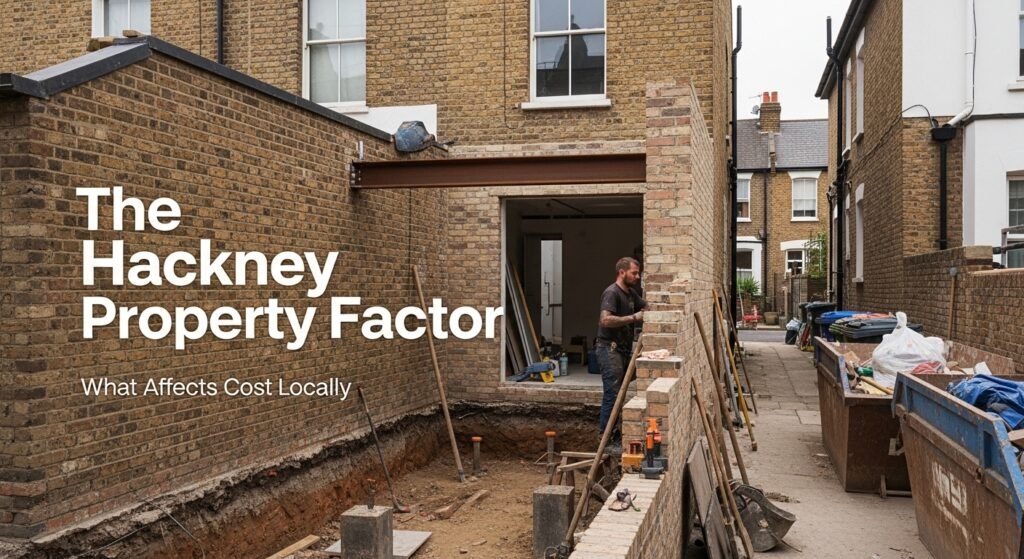
Victorian foundations. Most Victorian terraces in Hackney were built with shallow strip foundations. Modern building regulations require extensions to be built on deeper, more robust foundations. In some areas close to the River Lea in Hackney Wick or Lower Clapton, you may encounter clay soil that requires specially engineered foundations. Groundwork costs can rise by £3,000 to £8,000 in difficult ground conditions.
Structural steelwork. Creating an open-plan kitchen by removing the rear wall requires at least one RSJ (Rolled Steel Joist) beam to carry the load above. Creating an open-plan kitchen usually needs steel beams and internal door opening work adjustments. In a typical Hackney terrace, this costs £2,000 to £5,000, including installation and structural engineer sign-off. Wider openings or more complex spans cost more.
Matching existing brickwork. Hackney Council’s conservation area guidelines and general planning policy require extensions to respect the character of the existing building. Matching Victorian stock bricks for the external walls can cost 30 to 50% more than using modern bricks. Some projects use contrasting materials (zinc, timber cladding, or render) as an intentional design choice, which avoids the matching problem entirely.
Party walls. Nearly all Hackney terraces share party walls with neighbours. The Party Wall Act 1996 requires you to serve formal notice on affected neighbours at least two months before starting work. If a neighbour dissents, the process adds time and cost. Walls and ceilings may need plastering and decorating work after structural changes. Budget for party wall surveyors’ fees from the start rather than discovering this obligation mid-project.
Access and logistics. Hackney’s residential streets are dense and often restricted for parking and deliveries. Local contractors frequently highlight congestion in Hackney near thoroughfares like the A10 or Mare Street, so booking skip deliveries away from rush hours is prudent. This is a real operational cost that experienced local contractors factor into their quotes.
How Long Does a Kitchen Extension Take in Hackney?
Timeline varies significantly based on planning requirements and project complexity.
If permitted development applies (no planning application needed):
- Architect drawings and structural engineering: 4 to 8 weeks
- Lawful Development Certificate from Hackney: up to 8 weeks
- Party Wall notices: minimum 2 months before work starts
- Build time (single-storey rear extension): 10 to 16 weeks
- Kitchen fit-out: 2 to 4 weeks
Total realistic timeline: 6 to 9 months from start to finished kitchen.
If planning permission is required:
- Hackney Council targets an 8-week decision on householder applications, but this is a target, not a guarantee. Complex applications or those requiring design revisions can take 3 to 5 months.
Add the planning period to the above timeline, and you’re looking at 9 to 14 months for projects that need a full planning application.
A Realistic Budget Breakdown for a Hackney Kitchen Extension
Here’s what a typical mid-range 20m² rear extension with a quality kitchen fit-out costs in Hackney. The property is a Victorian terrace in Stoke Newington, with no conservation area complications.
| Item | Estimated Cost |
| Architect (measured survey, planning drawings, building regs) | £6,000 |
| Structural engineer | £1,500 |
| Lawful Development Certificate | £129 |
| Party Wall surveyor (if neighbour consents) | £800 |
| Building regulations fee | £600 |
| Structural build (20m² at £3,200/m²) | £64,000 |
| Mid-range kitchen fit-out | £28,000 |
| Flooring (polished concrete or engineered oak, 20m²) | £4,000 |
| Decoration | £1,500 |
| Contingency (10%) | £10,000 |
| Total (ex. VAT) | £116,529 |
| Total (inc. VAT at 20%) | ~£140,000 |
This is a realistic all-in number for a well-specified mid-range project. It is not a budget figure, and it is not a high-end figure. It’s what a competent project with a quality contractor and a good kitchen actually costs in Hackney in 2025.
How to Reduce Cost Without Compromising the Project
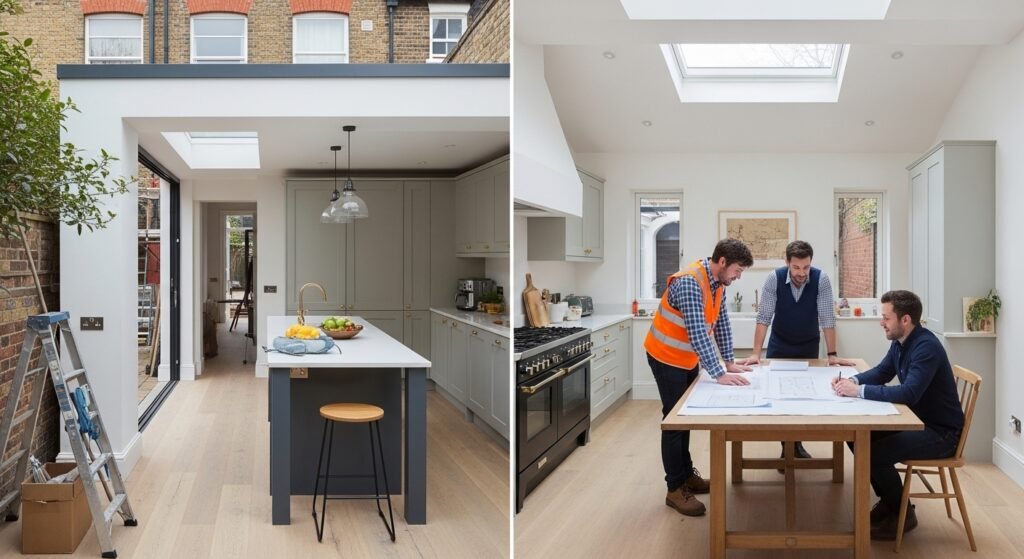
Keep the rear extension within permitted development limits. Building to a depth of 3 metres avoids a planning application, saving £528 in fees and, more importantly, 8 to 16 weeks of waiting. The Prior Approval scheme lets you go to 6 metres if you need the space, but it still involves a formal process.
Choose a flat roof rather than a pitched or glazed roof. A flat roof with a rooflight is cheaper to build than a fully glazed roof lantern or vaulted glazed ceiling. A single rooflight costs £800 to £2,000. A large roof lantern starts at £3,000 and can reach £10,000. Both let in excellent light.
Use a design-and-build contractor for simpler projects. For a straightforward rear extension with no planning complications, a reputable design-and-build firm handles both the drawings and construction. This is cheaper than hiring an architect and a separate contractor. For complex projects or conservation area applications, an architect adds value that outweighs the fee.
Fix the layout before any work starts. Changes made during build are expensive. Moving a window position or relocating the island after the steel is in can add £2,000 to £5,000. Spend more time on design upfront and lock the layout before your contractor mobilises.
Phase the work if the budget is tight. Some homeowners build the structural shell first, then do a basic kitchen fit-out, and upgrade the kitchen in a few years. This works, but flag it to your contractor upfront so they can design the services and drainage to accommodate future changes.
Does a Kitchen Extension Add Value in Hackney?
The FMB reports that a well-executed kitchen extension can add up to 15% to a property’s value. In Hackney, where average house prices have consistently outperformed the London average over the past decade, this return is typically well above the cost of the works themselves for mid-to-large terraced houses. Projects completed with quality cabinet fitting experts tend to perform better visually and practically.
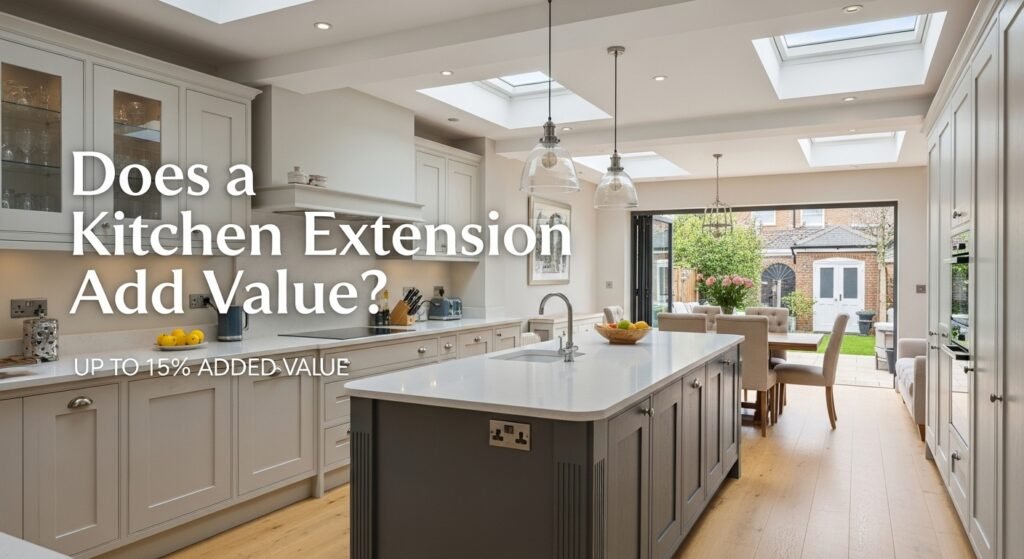
The return is strongest when:
- The extension brings the kitchen to a standard consistent with the rest of the property
- The new layout creates an open-plan kitchen-dining-living space that buyers want
- The quality of finish matches the local market (over-specifying a £60,000 kitchen in a street where houses sell for £600,000 rarely pays back)
The return is weakest when:
- The extension is built to a budget spec that already looks dated
- The planning or party wall process was handled incorrectly, leaving legal uncertainties
- The kitchen fit-out spec is significantly higher than comparable properties on the street
FAQ
Q: Do I need planning permission for a kitchen extension in Hackney?
It depends on your property type and location. If you own a house that is not in a conservation area, a single-storey rear extension up to 3 metres deep is permitted development and does not require planning permission. If your property is in one of Hackney’s 35 conservation areas, side extensions require planning permission. Flats and maisonettes always require planning permission for extensions. Always get a Lawful Development Certificate from Hackney Council before starting work; it costs £129 and provides legal protection when you come to sell.
Q: How much does a 4-metre rear kitchen extension cost in Hackney?
A 4-metre deep rear extension on a typical Hackney terrace would cover approximately 16 to 20m² (depending on the width of your property). At Hackney’s mid-range rate of £3,000 to £3,500 per m², the structural build alone costs £48,000 to £70,000 before VAT. Add professional fees, kitchen fit-out, flooring, and a contingency, and the all-in cost is typically £90,000 to £130,000, depending on kitchen specification.
Q: What is the Party Wall Act, and does it apply to my Hackney extension?
The Party Wall Act 1996 requires you to formally notify neighbours before carrying out work that affects a shared party wall, which applies to virtually all terraced and semi-detached extensions in Hackney. You must serve notice at least two months before starting structural work. If your neighbour agrees in writing, the process costs nothing. If they dissent, both parties appoint surveyors to agree a Party Wall Award. Budget £700 to £1,500 per surveyor for a dispute. Ignoring the Party Wall Act can result in injunctions stopping your build mid-construction.
Q: How long will a kitchen extension project take in Hackney?
From first appointing an architect to sitting in your finished kitchen, expect 6 to 9 months for a straightforward permitted development project. Projects requiring planning permission add 2 to 4 months for the planning process alone. The structural build typically takes 10 to 16 weeks for a single-storey rear extension, with the kitchen fit-out taking a further 2 to 4 weeks.
Q: Can I live in my house during a kitchen extension?
Yes, most homeowners stay in their homes during construction. The main disruption comes during the demolition of the rear wall, when your kitchen becomes unusable for several weeks. Most contractors manage this in stages to minimise the period without a functioning kitchen. Dust and noise are constant throughout the build. If you have young children or work from home, discuss this with your contractor before signing the contract.
Q: How do I find a reliable builder for a kitchen extension in Hackney?
Use the Federation of Master Builders (FMB) directory, TrustMark, or Checkatrade to find vetted contractors with verified project histories. Prioritise builders who have completed projects specifically in Hackney or similar inner East London boroughs, as familiarity with local planning officers, conservation area requirements, and Victorian property quirks is genuinely valuable. Always get three written quotes with detailed cost breakdowns, and never accept a quote that does not specify exactly what is and isn’t included.
Conclusion
A kitchen extension in Hackney is one of the most effective ways to add space, light, and value to a Victorian terrace, but it is not a cheap project. A realistic budget for a single-storey rear extension with a quality kitchen fit-out sits between £90,000 and £140,000 all-in, including VAT and professional fees.
The key variables are extension size, whether you need planning permission, the quality of the kitchen fit-out, and whether your property throws up the structural surprises common in Hackney’s Victorian housing stock. Budget a 10 to 15% contingency on top of your quoted build cost, and you’ll be far better placed to finish the project without financial stress.
Get your architect and structural engineer involved before approaching builders, confirm your planning position with Hackney Council before committing to a design, and serve Party Wall notices early. These steps take time but prevent the delays and costs that catch most homeowners off guard. The biggest cost drivers are size, planning status, structural work, and finish level. Working with trusted local building experts helps avoid delays and budget overruns.

Tilly Bani is a renovation and roofing specialist with over 15 years of experience in construction and property refurbishment across North London. He specialises in roofing, structural repairs, and full home renovations, helping homeowners improve property value and safety.