
| Quick Answer For most Islington homeowners, a loft conversion delivers better value per pound spent. It costs £55,000 to £120,000, typically avoids the need for full planning permission in non-conservation areas, preserves garden space, and can add 15 to 25% to a property’s value. A house extension costs more, takes longer, almost always requires planning permission in Islington, and frequently loses garden space, but it delivers a type of space a loft cannot: a ground-floor open-plan kitchen-dining room directly connected to the garden. The right answer depends on what your household actually needs and what your property can structurally deliver. |
Introduction
Islington homeowners asking “Should I convert my loft or extend the house?” are really asking two separate questions. The first is about money: which project costs less and adds more value? The second is about space: which project gives us the room we actually need?
The answer to both questions depends on your property, your household, and Islington’s specific planning landscape. This borough has 42 conservation areas, Article 4 directions covering 40 of them, around 4,500 listed buildings, and a dense Victorian housing stock that imposes its own structural constraints on both options.
This guide cuts through the general advice and gives you a clear, Islington-specific comparison: costs, planning rules, timelines, disruption, and which project makes sense for which type of homeowner. Many homeowners first speak with experienced Islington builders before choosing either route.
The Core Difference: What Each Project Actually Does
Before comparing costs and planning rules, it helps to be clear on what each project delivers.
A loft conversion turns unused roof space into a habitable room. Roof access projects often require specialist local roofers for structural changes. In Islington’s Victorian terraces, this almost always means a new bedroom, ensuite bathroom, or home office on the top floor of the house. It does not add any ground-floor space, does not bring the kitchen closer to the garden, and does not create the kind of wide, open living area that families typically seek. What it does brilliantly is add a bedroom at relatively low cost without touching the garden.
A house extension pushes the footprint of the house outwards, typically into the rear garden, to the side, or both. In Islington’s Victorian terraces, the most common extension is a single-storey rear or side return extension that transforms a narrow galley kitchen into a wide, open-plan kitchen-dining space connected to the garden through bifold or sliding doors. Many families complete the space with a full kitchen renovation. Extensions can also be two-storey, adding bedrooms above a ground-floor addition.
The fundamental choice is therefore: do you need more bedroom space upstairs, or do you need more living and kitchen space downstairs? In most cases, the answer to that question decides which project is right.
Cost Comparison: Loft Conversion vs Extension in Islington
Islington sits 10 to 15% above the London average for both project types, due to conservation area design requirements, logistical constraints in dense residential streets, and premium labour rates driven by sustained demand in this part of North London.
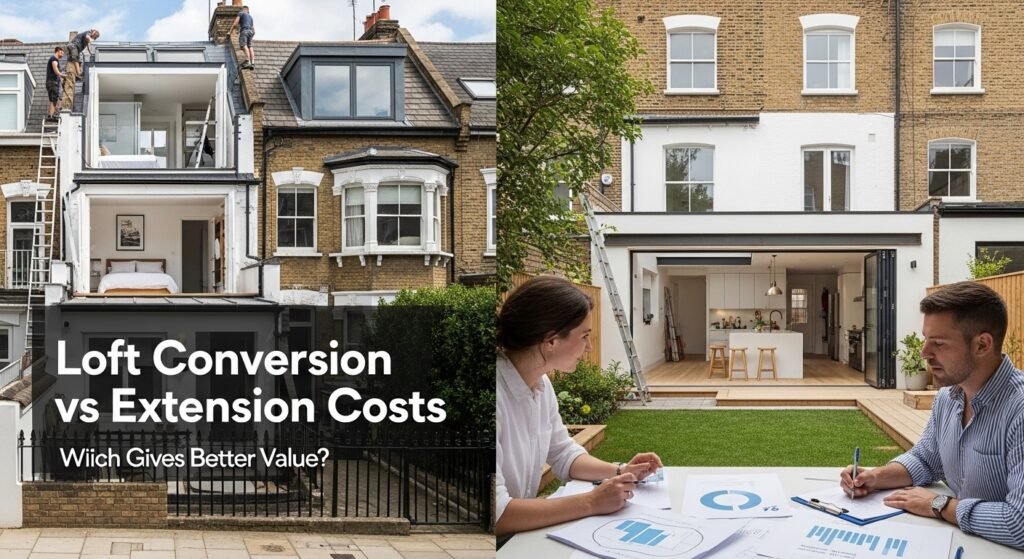
Loft Conversion Costs in Islington (2026)
| Conversion Type | Cost Range (inc. VAT) |
|---|---|
| Velux / rooflight (no structural roof change) | £20,000 – £38,000 |
| Rear dormer (most common in Victorian terraces) | £58,000 – £90,000 |
| Hip-to-gable (semi-detached properties) | £65,000 – £100,000 |
| Mansard (significantly alters roofline) | £90,000 – £130,000+ |
These figures include professional fees, structural engineering, and a standard bedroom and ensuite fit-out. Ensuite layouts are usually completed by skilled bathroom fitters. They do not include the planning application fee of £548 if required, or party wall surveyor fees of £700 to £1,500 per neighbour.
Per square metre, loft conversions in Islington and similar inner London boroughs cost £2,600 to £4,200, reflecting the specialist structural work and logistical complexity of operating in dense Victorian residential streets.
House Extension Costs in Islington (2026)
| Extension Type | Cost Range (inc. VAT) |
|---|---|
| Single-storey rear extension (15–20m²) | £55,000 – £85,000 |
| Single-storey rear extension (20–30m²) | £85,000 – £120,000 |
| Side return extension | £55,000 – £95,000 |
| Wraparound (rear plus side return) | £95,000 – £155,000 |
| Double-storey rear extension | £115,000 – £200,000+ |
These figures cover the structural build only and exclude kitchen fit-out, which adds £15,000 to £40,000 depending on specification. Most homeowners also hire local kitchen fitters after completion. Add professional fees at 10 to 15% of build cost, the £548 planning application fee, building regulations, party wall surveyors, and a 10% contingency, and the all-in cost for a 20m² rear extension with a mid-range kitchen is typically £95,000 to £135,000.
Extensions run £3,000 to £4,800 per square metre in Islington for the structural build, a premium that reflects the borough’s conservation area requirements, the cost of matching Victorian stock brick, and the logistical complexity of working on a dense residential street.
The Cost Verdict
For a comparable amount of new floor space, a loft conversion is generally cheaper than an extension. A well-specified rear dormer conversion adding a bedroom and ensuite at around 25 to 30 square metres costs less than a rear extension of the same footprint once kitchen fit-out is included. The structural efficiency of working within an existing roof space, without foundations, groundworks, or major external wall construction, is the main driver of this cost advantage.
However, the comparison only holds if you are adding the same type of space. A loft bedroom is not a substitute for a ground-floor kitchen-dining room. If you need a larger kitchen, a loft conversion does not help you, regardless of its cost.
Planning Permission in Islington: The Critical Difference
This is where Islington’s planning environment fundamentally shapes the comparison. The borough’s conservation areas and Article 4 directions change what is possible under permitted development for both project types, but they affect loft conversions and extensions differently.
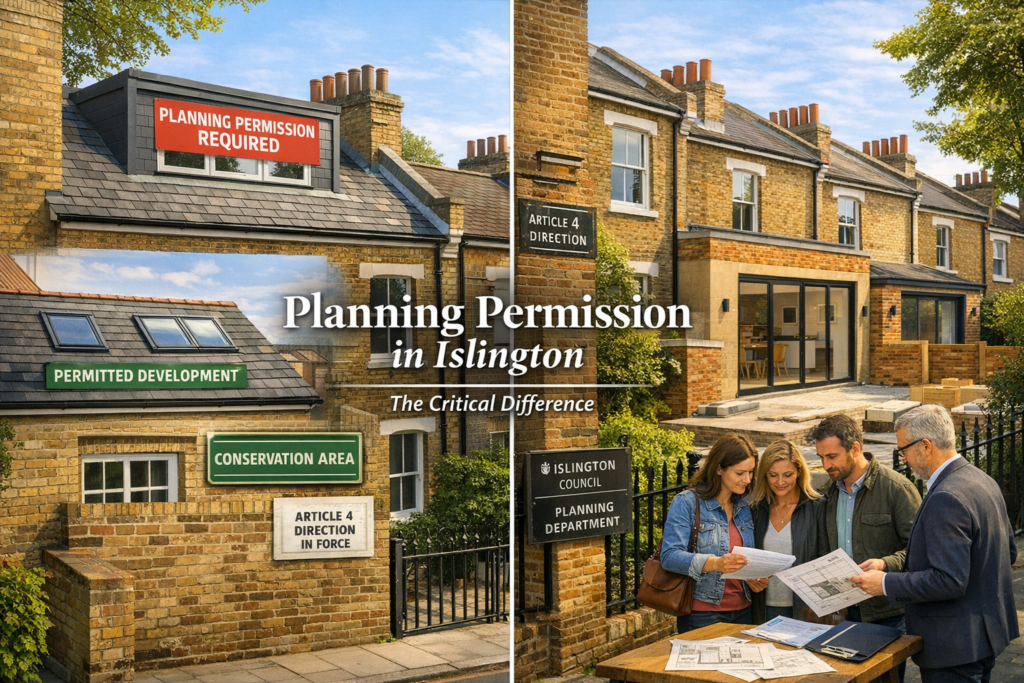
Loft Conversions: When You Need Planning Permission in Islington
For a house (not a flat) outside a conservation area, a rear dormer loft conversion can proceed as permitted development if it stays within the 40 cubic metre volume limit for terraced houses, does not extend beyond the existing roof slope on the front elevation, and uses materials that match the existing house. Some homeowners combine approvals with a full roof replacement.
However, Islington has 42 conservation areas, and within these zones, the rules change significantly. Islington Council is explicit: within a conservation area, you will need to apply for planning permission for roof alterations or erecting dormer windows. Since Article 4 directions cover 40 of Islington’s 42 conservation areas, the majority of the borough’s Victorian residential streets require a planning application for any dormer loft conversion that makes an external change to the roof.
The only type of loft conversion that routinely avoids planning permission, even in conservation areas, is a Velux or rooflight conversion, which installs windows into the existing roof slope without changing its shape. This often includes a rear-facing rooflight fitting. These do not alter the street’s appearance and are typically permitted development even in conservation areas, provided the rooflights are on the rear elevation and do not front a highway.
If you live in a flat in Islington, the rules are absolute: any loft conversion requires full planning permission, regardless of whether you are in a conservation area or not.
House Extensions: Planning Permission in Islington
The planning picture for extensions in Islington is similarly constrained. A single-storey rear extension of up to 3 metres depth can be permitted development for a terraced house outside a conservation area. However, side extensions, wraparound extensions, and rear extensions beyond 3 metres deep all require a planning application in most of Islington.
More importantly, Islington’s Article 4 directions in its conservation areas restrict many works that would be permitted development nationally. For extensions in conservation areas, materials must match the existing building; side extensions require planning permission, and the design must satisfy Islington’s Conservation Area Design Guidelines, which require any extension to be visually subordinate to the original host building.
In practice, most extensions in Islington require a householder planning application costing £548, with an 8-week decision target. Add pre-application advice (recommended for conservation area projects), heritage design statements, and additional architect time for detailed drawings, and the planning process for an extension in Islington adds £3,000 to £7,000 to professional fees and 3 to 5 months to the overall project timeline.
The Planning Verdict
For houses outside Islington’s conservation areas, a Velux loft conversion avoids planning entirely. A rear dormer on a non-conservation-area house may also be permitted development if it meets the volume and design conditions. For extensions in the same non-conservation-area locations, a single-storey rear extension of up to 3 metres can also avoid a planning application, but anything larger or on the side requires one.
For the majority of Islington properties, which sit within conservation areas or Article 4 direction zones, both project types will need planning permission. In this context, the planning process is not a differentiator between the two projects. Both require an application, both face Islington’s heritage-focused scrutiny, and both take similar amounts of time to progress through the planning system.
The advantage of a rooflight conversion in conservation areas remains: it is the one option that consistently avoids planning permission regardless of conservation status.
Disruption During Construction: Loft vs Extension
Loft conversions and house extensions have very different impacts on daily life during construction.
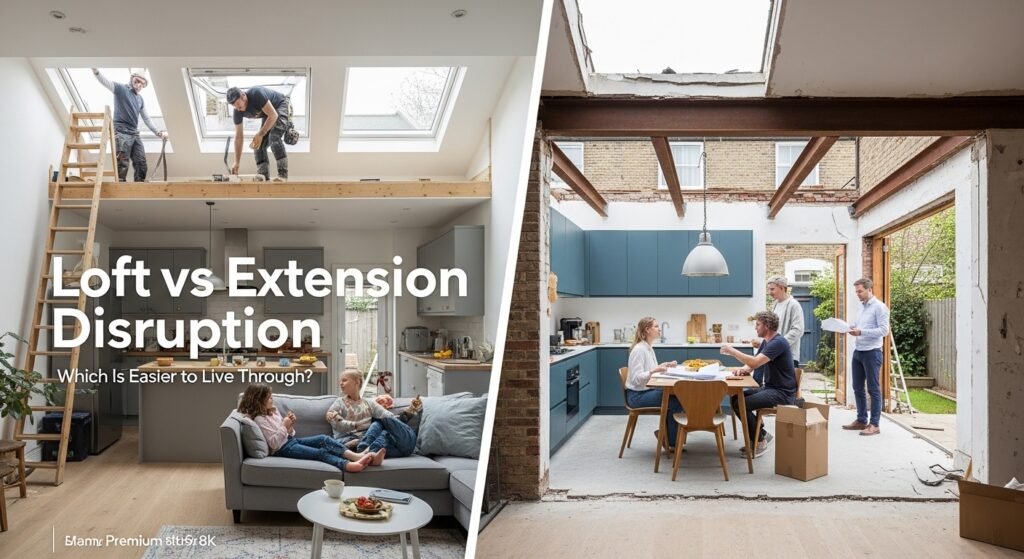
Loft Conversion Disruption
Most loft conversion work happens at roof level, above the existing living space. The ground floor and first floor remain largely usable throughout the build. Access is through the roof rather than through internal rooms. The main disruptions are: noise during the structural phase, dust when cutting into the party wall or floor structure, and a period of a few days when the roof is open to the weather before the new structure is waterproofed.
Most households can continue living in the property throughout a loft conversion. Internal upgrades may still require light plastering services afterwards. A well-managed project leaves the kitchen, bathrooms, and living rooms functional throughout.
Timeline: a Velux conversion takes 4 to 6 weeks. A rear dormer on a Victorian terrace takes 8 to 12 weeks. A mansard conversion takes 12 to 16 weeks.
House Extension Disruption
An extension project is more disruptive. Many owners schedule full home refurbishment works at the same time. The rear wall of the house is demolished during construction, leaving the kitchen, rear reception room, or wherever the extension joins the existing footprint open to the elements for several weeks. The kitchen typically becomes unusable for 4 to 8 weeks during the structural phase.
Some families choose to stay in the property during an extension by relocating the kitchen temporarily to another room and accepting the disruption. Others rent temporary accommodation, adding £2,000 to £4,000 per month to the project cost. The decision depends on family size, the duration of the disruption, and individual tolerance for living on a building site.
Timeline: a single-storey rear extension takes 10 to 16 weeks for the structural build, plus 2 to 4 weeks for kitchen fit-out. A wraparound takes 14 to 20 weeks. A double-storey extension takes 16 to 24 weeks.
The Disruption Verdict
Loft conversions are significantly less disruptive to daily life. For families with young children or homeowners who work from home, this is a material consideration. Extensions involve a period of living without a functioning kitchen, which loft conversions simply do not create.
Garden Space: The Silent Consideration
In Islington’s dense Victorian terraces, rear gardens are typically narrow and modest. For many households, the garden is a precious outdoor space that they are unwilling to give up.
A rear extension directly consumes garden space. A 20m² rear extension extending 4 metres into the garden removes a significant section of what may already be a compact garden. For families with children, or for anyone who values outdoor space as part of their lifestyle, this is a real trade-off that pure cost comparisons ignore.
A loft conversion takes no garden space. It adds a room above the existing structure without reducing the outdoor footprint at all.
If garden space matters to you, a loft conversion has an obvious advantage that no financial comparison captures.
Value Added: Which Project Has the Better Return?
Both projects add value to Islington properties, but they do so in different ways and by different amounts.
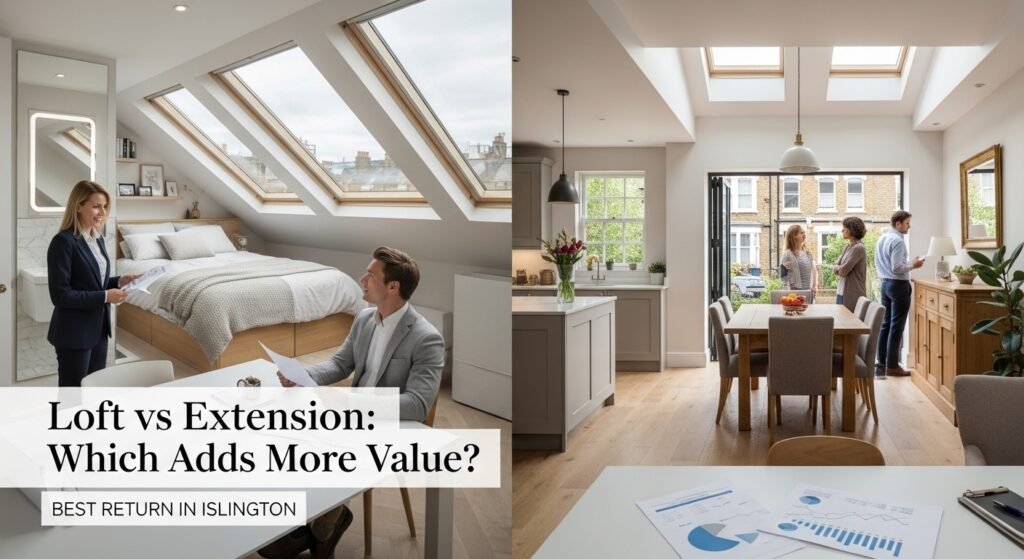
Loft Conversion Value Added
A well-executed loft conversion adding a bedroom and ensuite bathroom can increase an Islington property’s value by 15 to 25%. Extra bathrooms are often finished through a quality bathroom renovation. In high-demand Islington streets where property values are strong, adding a usable top-floor bedroom and bathroom can add significantly more in absolute terms: on a property valued at £700,000, a 20% uplift is £140,000.
The reason loft conversions generate strong returns is that they add one of the most valued features in the London market: an additional bedroom. Converting a two-bedroom house to three bedrooms, or a three-bedroom house to four, crosses a buyer threshold that materially widens demand and supports a higher sale price.
A Nationwide House Price Index analysis of loft conversions found they can add up to 24% to a London property’s value when they include both a bedroom and a bathroom.
Extension Value Added
A single-storey rear extension typically adds 5 to 10% to a property’s value, while a double-storey extension adding both kitchen-dining space and a bedroom above can add 10 to 20%.
Extensions consistently add functional value that buyers recognise. An open-plan kitchen-dining space with bifold doors to the garden is one of the most sought-after features in the Islington family buyer market. New layouts usually include premium flooring installation throughout. Properties that have this configuration consistently attract more viewings and stronger offers than comparable properties that have not been extended.
However, extensions cost more than loft conversions, and their value uplift is not always proportionally higher. A £120,000 all-in rear extension that adds £80,000 of value delivers a 67% return on the build cost. A £75,000 rear dormer loft conversion that adds £120,000 of value delivers a 160% return. On a pound-for-pound basis, loft conversions typically outperform extensions on return on investment in Islington’s market.
The exception is when an extension converts a property from having no open-plan ground-floor living space to having a modern kitchen-dining room. This transformation is so desirable to buyers in Islington that it can generate returns that match or exceed a loft conversion.
The Value Verdict
Loft conversions generally deliver better return on investment. Extensions generally deliver a bigger transformation to daily life. The correct question is not “which adds more value” but “which adds the right value for my specific property and the buyers who will eventually purchase it.”
If your Islington property already has an open-plan ground floor but only two bedrooms, a loft conversion is clearly the higher-value project. If it has three bedrooms but a dark, compartmentalised ground floor with no connection to the garden, an extension delivers the transformation buyers in this market will pay for.
Which Is Right for Your Islington Property?
Here is a practical decision framework based on the most common situations Islington homeowners face.
Choose a Loft Conversion If:
- You need an additional bedroom, particularly to convert a two-bedroom property to three or a three-bedroom to four
- You want to add a home office or ensuite without sacrificing garden space
- Your budget is £55,000 to £90,000, and you need a meaningful new space
- Your property is outside a conservation area, and you want to avoid or minimise planning involvement
- Your household needs to keep daily disruptions to a minimum during construction
- You are in a flat-to-house comparison and need to verify whether your property qualifies (flats always need full planning permission)
- Your roof already has adequate head height (typically 2.2 metres at the ridge as a minimum)
- Older homes may also need compliant electrical upgrades during conversion works.
Choose a House Extension If:
- Your ground-floor layout is cramped, dark, or has no connection between the kitchen and the garden
- You want to create an open-plan kitchen-dining-living space, which a loft conversion cannot deliver
- You are planning for multi-generational living or need a ground-floor room accessible to someone with mobility needs
- Your loft does not have sufficient head height for conversion without major structural changes
- Your household is willing to accept significant disruption during construction (or has a plan for temporary accommodation)
- You are willing to invest £95,000 to £155,000 all-in for a full transformation of the ground floor
- Heating layouts are often improved with modern plumbing services.
Consider Doing Both
Tackling both projects simultaneously delivers the most dramatic transformation and carries real efficiency savings. Combined builds often include full-house rewiring for efficiency. The architect’s fees are shared, the builder’s mobilisation is not duplicated, and the disruption happens once. A combined rear dormer loft conversion and rear extension on a Hackney or Islington Victorian terrace, creating a new open-plan ground floor and a top-floor bedroom suite, typically costs £150,000 to £200,000 all-in, compared to £200,000 to £250,000 if done sequentially.
For families planning to stay in their Islington property long-term and wanting both types of space, the combined project is usually the most financially efficient and practically sensible route.
Islington-Specific Factors That Change the Calculation
Several factors specific to Islington affect the comparison in ways that a generic loft-vs-extension guide will not capture.
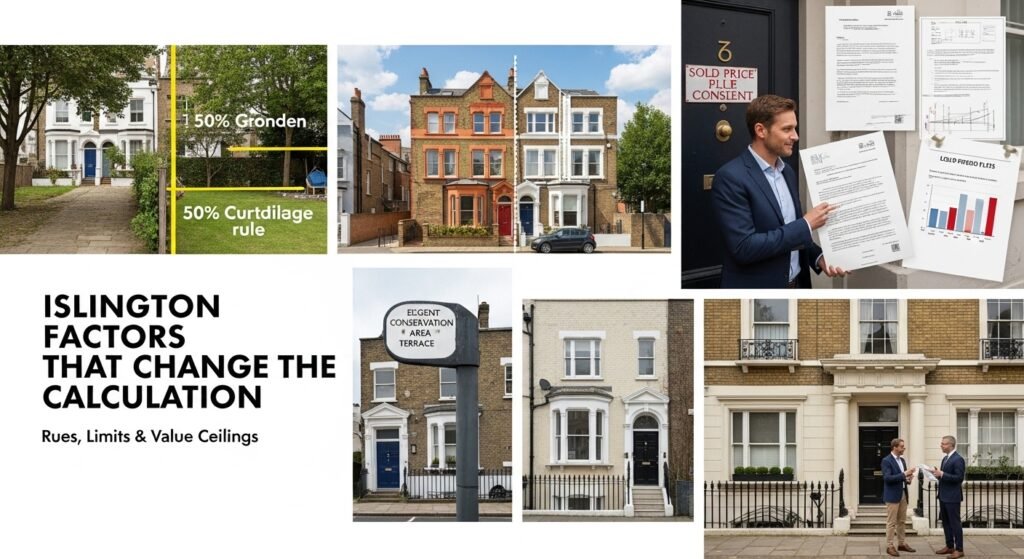
The 50% curtilage rule for extensions. Islington enforces a rule requiring that the combined footprint of all extensions and outbuildings does not exceed 50% of the original garden area. This is measured against the property’s historic plot size, not its current garden. In Islington’s Victorian terraces with compact rear gardens, this can be a binding constraint that limits extension depth to less than what you need or expect. A loft conversion has no curtilage limitation.
Conservation area design requirements for extensions. Extensions in Islington conservation areas must be visually subordinate to the host building. This restricts extension height, limits how close to the first-floor windows a flat roof extension can rise, and requires materials that respect the character of the area. These constraints can reduce the usable floor area of an extension below what you hoped for. Loft conversions face the same design scrutiny, but have the advantage that Velux conversions are the one option that avoids external change entirely.
Flats and maisonettes. Islington is full of converted Victorian terraces containing two or three flats. If your property is a flat, planning permission is required for both a loft conversion and an extension, with no permitted development rights. Extending a flat in Islington is also frequently complicated by leasehold restrictions that require freeholder consent before any structural work begins. In many converted Victorian terraces in Islington, a loft conversion affects the top-floor flat’s airspace and raises questions of ownership and consent that require careful legal advice before any project proceeds.
Listed buildings. Islington has approximately 4,500 nationally listed buildings. Any works to a listed building require Listed Building Consent in addition to planning permission. Both loft conversions and extensions in listed buildings are assessed against a stricter heritage standard, and some works that would be approved in unlisted properties in the same conservation area may be refused in a listed building. Always confirm listing status before planning either project.
The ceiling price problem. In some Islington streets, particularly those where the existing property values are already at the top of the local market, the additional value a loft conversion or extension creates may be limited by the ceiling price of similar properties on the same street. If your house is valued at £800,000 after a loft conversion but the highest-sold comparable on the street is £750,000, you will not realise the full theoretical uplift. Before committing to either project, check recent sold prices on comparable properties in your street and factor this ceiling into your investment decision.
A Side-by-Side Summary
| Factor | Loft Conversion | House Extension |
|---|---|---|
| Typical all-in cost (Islington) | £58,000 – £130,000 | £95,000 – £200,000+ |
| Cost per m² | £2,600 – £4,200 | £3,000 – £4,800 |
| Likely planning requirement in Islington CA | Yes (dormer/mansard) | Yes (most cases) |
| Avoids planning permission | Velux only | 3m rear only (outside CA) |
| Garden space affected | No | Yes |
| Type of space added | Bedroom / office upstairs | Kitchen-dining downstairs |
| Build time | 6 – 16 weeks | 10 – 24 weeks |
| Daily disruption | Low | High |
| Value added to property | 15 – 25% | 5 – 20% |
| ROI vs cost | Typically higher | Typically lower |
| Suitable for flats | Requires full PP | Value added to the property |
FAQ
Q: Does a loft conversion or house extension need planning permission in Islington?
Both often do. Islington has 42 conservation areas, and Article 4 directions covering 40 of them remove permitted development rights for many types of external work. In conservation areas, any dormer loft conversion requires planning permission. Extensions beyond 3 metres deep, all side extensions, and wraparound extensions also need a planning application. The exception is a Velux rooflight conversion, which typically avoids planning permission even in conservation areas by not altering the external roofline. A householder planning application costs £548 and takes 8 weeks to decide. Always check Islington Council’s conservation area map and your property’s listing status before assuming permitted development applies.
Q: Which project adds more value to an Islington property?
On a return-on-investment basis, loft conversions typically outperform extensions in Islington. Adding an extra bedroom by converting the loft can increase property value by 15 to 25%, while a single-storey rear extension typically adds 5 to 10%. However, an extension that transforms a cramped, compartmentalised ground floor into an open-plan kitchen-dining space connected to the garden delivers a transformation that buyers in Islington’s family market pay a premium for, which can narrow the gap significantly. The best return comes from the project that addresses the most obvious limitation of your specific property relative to comparable homes on the same street.
Q: Can I do both a loft conversion and a house extension in Islington?
Yes, and doing both together is significantly more cost-efficient than tackling them separately. A combined project shares professional fees, builder mobilisation costs, and disruption. In Islington’s market, a Victorian terrace with a new open-plan ground floor and a top-floor bedroom suite commands a strong premium. The all-in cost for a combined rear dormer and rear extension is typically £150,000 to £200,000, compared to £200,000 to £250,000 or more if the projects are phased. This route makes strong financial sense for homeowners planning to stay in the property for at least five years.
Q: Does my property’s loft have to meet any specific requirements for conversion?
Yes. The key structural requirement is sufficient head height, typically at least 2.2 metres from the existing floor joists to the ridge beam. If the existing loft has less than this, the floor structure on the floor below may need to be lowered, which adds high cost. The roof structure also matters: traditional cut-roof construction (common in Islington Victorian terraces) is generally suitable for conversion. Trussed roofing (more common in post-1960s properties) is more complex to convert because the structural members take up much of the available space. An architect or structural engineer can assess whether your specific loft structure is suitable during an initial site visit.
Q: Which project is less disruptive to live through in Islington?
A loft conversion is significantly less disruptive. Work takes place at roof level, above the existing living space, and the ground floor and first floor remain usable throughout. A rear extension demolishes the rear wall of the house during construction, typically making the kitchen and ground-floor rear rooms unusable for 4 to 8 weeks. Many families opt for temporary accommodation during an extension’s structural phase, which adds £2,000 to £4,000 per month to the total project cost. For households with young children or where working from home is important, loft conversions are consistently the lower-disruption option.
Conclusion
The loft conversion versus house extension question in Islington does not have a universal answer. Both projects add value, both face similar planning complexity in this conservation-area-dense borough, and both can transform a property’s appeal and liveability.
Loft conversions cost less, cause less disruption, preserve garden space, and typically deliver a stronger return on investment per pound spent. They are the right choice for Islington homeowners who need more bedroom space, a home office, or an ensuite suite without sacrificing their outdoor space or budget.
House extensions cost more, take longer, and involve significantly more disruption, but they deliver something a loft cannot: a ground-floor transformation that connects the kitchen to the garden and creates the open-plan family space that defines what buyers in this market are looking for. For properties with dark, compartmentalised ground floors and adequate bedroom space, a rear or wraparound extension is the higher-impact investment. For tailored advice on lofts or extensions, you can contact our team.
The most complete and cost-efficient solution for an Islington Victorian terrace is often both, tackled together. But if you can only do one, start with whichever project addresses the most significant limitation of your property relative to the comparable homes on your street. That is where your money will work hardest.

Tilly Bani is a renovation and roofing specialist with over 15 years of experience in construction and property refurbishment across North London. He specialises in roofing, structural repairs, and full home renovations, helping homeowners improve property value and safety.