
Quick Answer
An EICR, Electrical Installation Condition Report, is a formal inspection of a property’s fixed wiring, consumer unit, and circuits, and it typically costs £120 to £300 in London for a domestic property, rising to £400 or more for larger or more complex installations. Landlords in England have a legal duty to hold a valid EICR before a new tenancy starts and at least every five years after that, under the Electrical Safety Standards in the Private Rented Sector Regulations 2020. Homeowners are not legally required to have one, but an inspection every ten years is widely recommended, particularly in a Victorian or Edwardian terrace with older wiring.
What Is an EICR and Who Actually Needs One
An Electrical Installation Condition Report is produced after a qualified electrician inspects and tests the fixed electrical installation in a property, meaning the wiring, sockets, light fittings, consumer unit, and circuits built into the structure. It does not cover portable appliances such as kettles or lamps, which fall under a separate PAT test instead.

Landlords: A Legal Requirement
Since 1 April 2021, every landlord letting a property in England must hold a valid EICR, covering all tenancy types, including assured shorthold tenancies, HMOs, and student lets. This requirement comes from the Electrical Safety Standards in the Private Rented Sector (England) Regulations 2020, and it sits alongside separate obligations such as an annual gas safety certificate for properties with gas appliances.
A landlord must arrange a new EICR before a new tenancy begins, or at least every five years during an ongoing tenancy, whichever comes sooner. A copy must be provided to existing tenants within 28 days of the inspection, and to a prospective tenant before they move in. Local authorities can also request a copy within seven days, and failure to comply can result in a civil penalty of up to £30,000.
Homeowners: Recommended, Not Required
There is no legal requirement for an owner-occupied property to have an EICR, but most electricians recommend one roughly every ten years, or sooner in a period property where the wiring’s age and history are uncertain. An EICR is also worth commissioning before buying a property, since a seller’s electrical safety history rarely comes with reliable documentation, and after any significant extension or renovation that adds new circuits.
EICR Cost in London
London prices sit above the national average, reflecting higher labour rates, though the difference is smaller than for many other trades since EICR pricing is largely driven by circuit count rather than travel time. Properties with a recent kitchen extension or significant new appliance load often sit at the upper end of a size band, since additional circuits add to the inspection time regardless of the property’s overall floor area.
| Property Type | Typical London Cost |
|---|---|
| Studio or 1-bedroom flat | £120 to £180 |
| 2-bedroom flat or house | £150 to £230 |
| 3 to 4 bedroom house | £200 to £330 |
| 5+ bedroom house or licensed HMO | £350 and up, custom quoted |
| Additional consumer unit or fuse board | £65 to £85 each |
| Commercial premises | £280 and up, after site survey |
These figures cover the inspection and report only. Any remedial work needed to fix faults identified during the inspection is quoted and charged separately, and is not included in the EICR price itself.
What Happens During an EICR Inspection
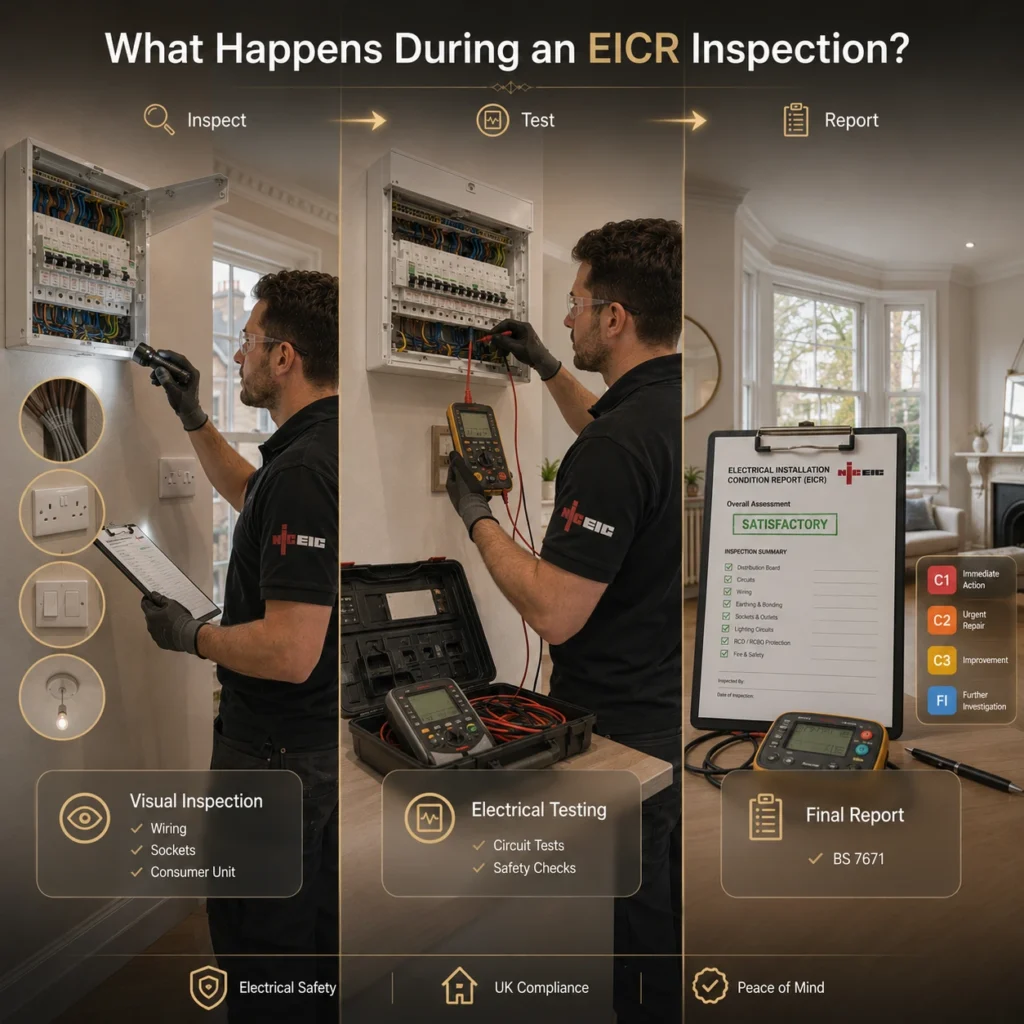
Visual Inspection
The electrician first carries out a visual check of accessible wiring, the consumer unit, sockets, switches and light fittings, looking for signs of damage, incorrect installation, overheating, or wear consistent with the property’s age.
Testing
Beyond the visual check, the electrician runs a series of tests on the fixed installation, including insulation resistance testing to check that wiring is not leaking current where it should not, and earth fault loop impedance testing to confirm the earthing system will trip a circuit fast enough in a fault. Circuit continuity and polarity are also checked on each circuit tested.
The Report and Classification Codes
Every observation on the report is assigned a standard code under BS 7671, the UK wiring regulations, so the severity of any issue is clear regardless of which electrician carried out the inspection.
| Code | Meaning | Action Required |
|---|---|---|
| C1 | Danger present, risk of injury | Immediate remedial action |
| C2 | Potentially dangerous | Urgent remedial action |
| C3 | Improvement recommended | Not mandatory, advisory only |
| FI | Further investigation required | Additional inspection needed to confirm severity |
An EICR is only marked satisfactory if the report contains no C1 or C2 observations. A report with only C3 or FI codes can still be classed satisfactory, since these do not indicate an immediate or urgent safety risk.
How Long Does an EICR Take
Most domestic inspections take between two and four hours, though a small studio or one-bedroom flat can be completed in as little as ninety minutes to two hours if access to every area is straightforward. Larger properties, more circuits, or restricted access to a loft, meter cupboard or locked room all extend the inspection time. Someone should generally be available throughout, since the electrician often needs access to different parts of the property at different points during testing.
How Long Is an EICR Valid
For landlords, an EICR is valid for five years from the inspection date, matching the maximum interval set out in the Private Rented Sector Regulations. This is a ceiling rather than a target: if the inspecting electrician identifies deterioration that warrants an earlier recheck, that shorter interval on the report becomes the binding date, not the standard five years.
Owner-occupied homes have no statutory expiry, but a ten-year recheck interval is the general industry recommendation, shortened for older installations or properties where the wiring history is unknown. Commercial premises typically follow a three to five-year cycle under the Electricity at Work Regulations 1989, based on a risk assessment specific to the business and how the premises are used.
What Happens If Your EICR Fails
An unsatisfactory EICR, meaning one or more C1 or C2 observations, is not the end of the process; it is the start of the remedial work stage. The electrician provides a breakdown of every issue found alongside a quote for the fix, and once the remedial work is complete and verified, either a new EICR or a Minor Electrical Installation Works Certificate confirms the property is now compliant, depending on the scope of the repair.
Common causes of a failed EICR in older properties include an outdated consumer unit without RCD protection, deteriorated cable insulation, incorrect earthing or bonding, and overloaded circuits from appliances added long after the original wiring was designed.
Structural movement of the kind covered in our guide to cracked walls can also disturb cabling routed through affected walls, which is one of several reasons a visual check alone is never sufficient. This is one of the most frequent remedial items and typically exceeds £450 on its own, so it is worth budgeting for as a realistic possibility rather than an unlikely surprise, particularly on a pre-war or Victorian installation.
EICR vs Other Electrical Certificates
Confusing an EICR with other electrical paperwork is common, and using the wrong certificate to satisfy a landlord obligation can leave you technically non-compliant even with a valid-looking document in hand.
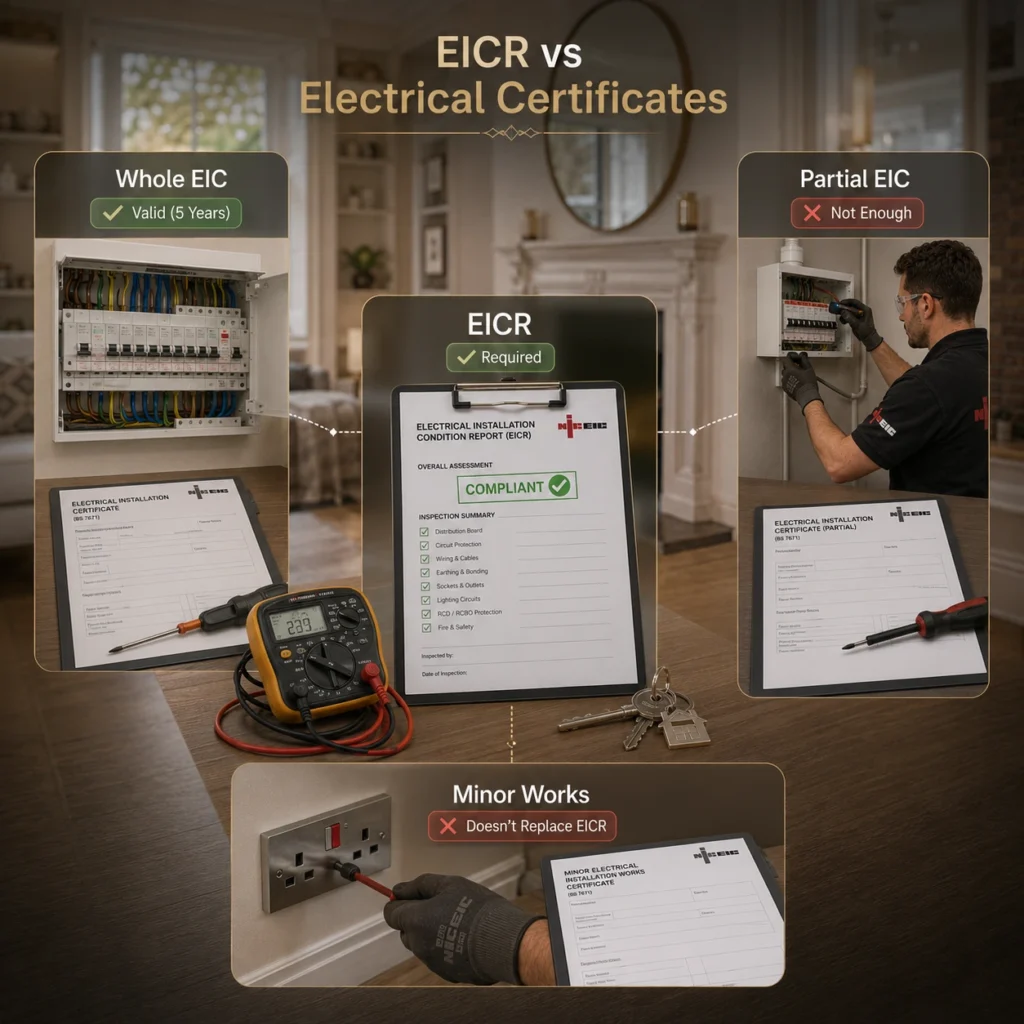
| Certificate | Issued When | Satisfies Landlord EICR Duty? |
|---|---|---|
| EICR | Periodic inspection of the existing installation | Yes, this is the required certificate |
| Whole-installation EIC | Full rewire or new build, less than 5 years old | Yes, for 5 years from the issue |
| Partial EIC | New consumer unit or single circuit added | No, the remaining installation still needs an EICR |
| Minor Works Certificate | Small alterations, such as adding a socket | No, does not replace an EICR |
If you have a whole-installation Electrical Installation Certificate from a full rewire carried out less than five years ago, that document satisfies the landlord requirement in place of an EICR for the remainder of its five-year validity. A partial EIC covering only one upgraded circuit does not extend that coverage to the rest of the property.
Electrical Safety in Victorian and Edwardian Terraces
North London’s period housing stock raises specific electrical safety questions that a modern new-build simply does not face. Original wiring from the early twentieth century, and in some cases even later rewires from the 1960s and 1970s, frequently lack RCD protection and were never designed for the number of appliances a modern household actually runs. Where an EICR reveals widespread deterioration rather than isolated faults, a full house rewiring is often more cost-effective than a series of smaller repairs.

Damp is a particular risk factor worth flagging, since moisture reaching cabling or a consumer unit is a common cause of insulation resistance failures during testing. The two issues, damp in Victorian terraces and deteriorating electrics, are often found together in older properties where neither has been addressed for decades.
Renovation projects are also a common trigger point, since a loft conversion typically adds new lighting circuits, sockets and sometimes a new consumer unit, which is a natural point to commission a full EICR on the rest of the property rather than certifying only the new work in isolation.
Choosing a Qualified Electrician
Only an electrician registered with a government-approved competent person scheme, such as NICEIC, NAPIT or ELECSA, can issue a valid EICR. Ask to see the registration number before booking, and be cautious of a quote significantly below the typical London range, since a rushed inspection that skips circuits or under-codes observations is not a genuine cost saving; it is a compliance risk that surfaces later, often at the worst possible time, such as a tenancy dispute or an insurance claim.
A fixed-price quote covering the full inspection, every circuit tested, and a written report within a stated turnaround is a reasonable standard to expect. Day-rate pricing, where the electrician is effectively paid for time rather than outcome, is more prone to circuits being sampled rather than fully tested when a job overruns. Building EICR timing into the wider programme is one of the fundamentals covered in our guide to managing a build project.
HMOs and Selective Licensing: Extra Requirements
Houses in multiple occupation and properties in a selective licensing area face additional electrical compliance requirements beyond the standard EICR, and several North London boroughs fall into this category.
An HMO requires per-letting-room circuit testing rather than a single whole-property assessment, since each let room is treated as an individual unit for safety purposes. Licensed HMOs also typically need a separate emergency lighting certificate, covering escape route lighting in shared hallways and stairwells, and a fire alarm certificate confirming the detection system functions correctly. These are usually quoted as a bundled compliance pack alongside the EICR itself, since booking them together as a single visit is generally cheaper than three separate call-outs.
Selective licensing extends similar scrutiny to some non-HMO rented properties. Several North London boroughs, including Haringey, Hackney, Enfield, Barnet, and Waltham Forest, operate selective licensing schemes covering some or all of their rental stock, and a council operating one of these schemes can request a copy of your EICR within seven days as part of a licence application or a compliance check. Landlords letting in a selective licensing area should treat the EICR less as a background compliance item and more as a document a council may specifically ask to see.
What Happens If You Don’t Get an EICR
Beyond the £30,000 civil penalty already covered under landlord obligations, an EICR failure has consequences that extend beyond the immediate fine.
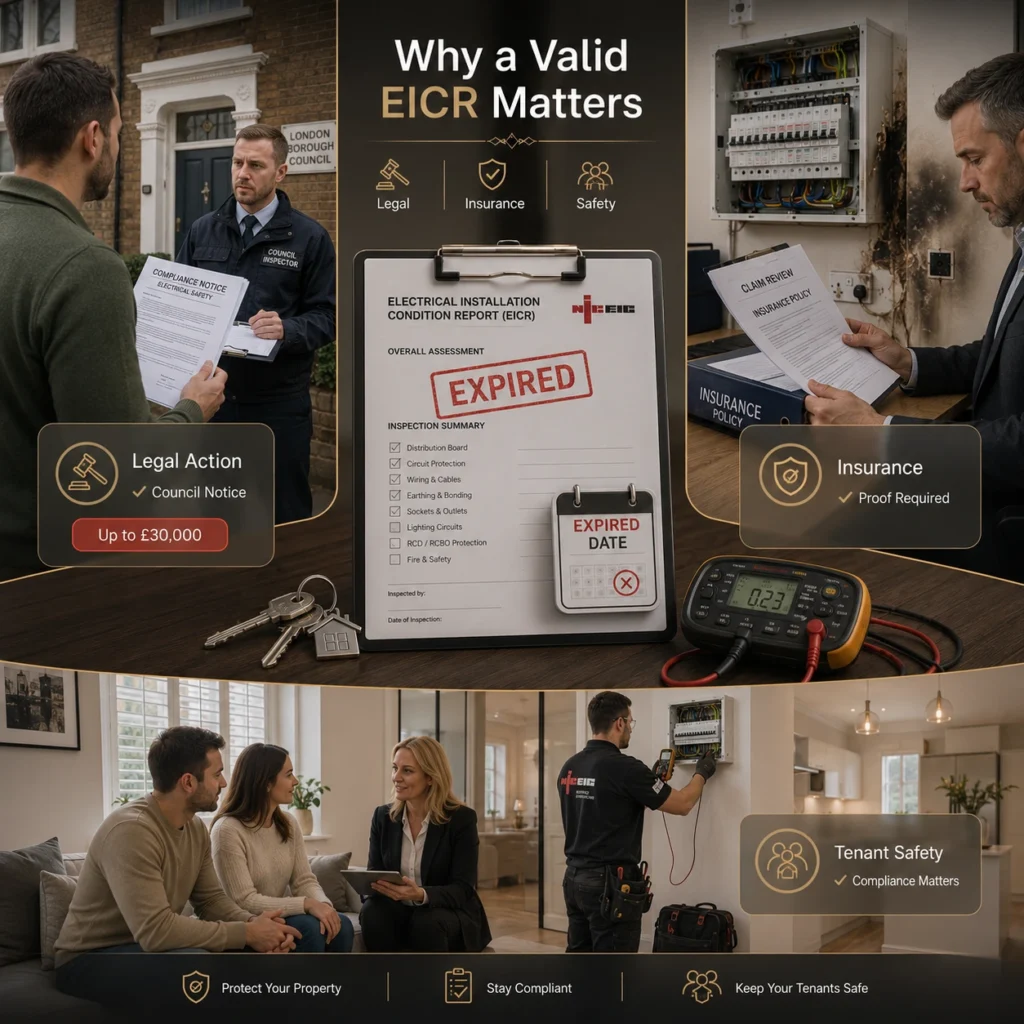
A council that identifies a missing or expired EICR during a licensing check or a tenant complaint can issue a remedial notice, requiring the landlord to arrange an inspection within a set timeframe, and can escalate to further enforcement if the deadline is missed. Persistent non-compliance can also expose a landlord to a Rent Repayment Order, where a tenant or the council can apply to have rent repaid for a period during which the property was let without meeting its legal safety obligations.
Insurance is a second, often overlooked, exposure. Most landlord insurance policies require evidence of electrical safety compliance as a condition of cover, and insurers increasingly request a current EICR before settling a claim connected to fire or electrical damage. Electrical faults are linked to a significant share of accidental house fires in the UK each year, which is the underlying reason insurers treat this documentation as a real underwriting factor rather than a formality.
Frequently Asked Questions
Q: Is an EICR a legal requirement for homeowners?
No. EICRs are a legal requirement only for landlords letting a property in England. Homeowners are not obligated to have one, though it is widely recommended every ten years, and sooner for older properties or before a house purchase where the electrical history is unknown.
Q: What is the difference between an EICR and a gas safety certificate?
They cover entirely different systems, and both are separate legal requirements for landlords. An EICR covers the fixed electrical installation and is renewed at least every five years. A gas safety certificate, sometimes called a CP12, covers gas appliances and pipework and must be renewed annually. Neither certificate substitutes for the other.
Q: How much does it cost to fix a failed EICR?
Remedial cost depends entirely on what is found. A single faulty socket or missing RCD protection might cost under £100 to fix, while a full consumer unit replacement typically exceeds £450, and rewiring sections of a property with deteriorated cabling can run into several thousand pounds. Always ask for an itemised remedial quote rather than a single lump sum, so you understand which fixes are mandatory C1 or C2 items and which are advisory C3 recommendations.
Q: Can I sell my house without an EICR?
Yes, there is no legal requirement for a homeowner to have an EICR to sell a property. However, buyers and their solicitors increasingly ask about electrical safety during conveyancing, and a recent satisfactory EICR can support a smoother sale, particularly for a period property where wiring age is a natural buyer concern.
Q: Does a new consumer unit mean I don’t need an EICR?
Not on its own. A consumer unit upgrade typically comes with a Minor Works Certificate or a partial EIC covering that specific work, but it does not certify the rest of the property’s wiring. A landlord still needs a full EICR covering every circuit, not just the new consumer unit, to meet the legal requirement.
Q: What’s the difference between an EICR and an Electrical Installation Certificate?
An EICR is a periodic inspection of an existing installation, checking its current condition. An EIC is issued after new electrical work, such as a full rewire or a new build, confirming that the work complies with current regulations at the point it was completed. A whole-installation EIC less than five years old can substitute for an EICR, but a partial EIC covering only part of the property cannot.
Q: How often should a homeowner in a Victorian terrace get an EICR?
Every ten years is the general recommendation, but a Victorian or Edwardian property with wiring of uncertain age, visible signs of deterioration, or a history of damp is a reasonable case for testing sooner. If the property has never had an EICR and the wiring history is unknown, treat the first inspection as overdue rather than optional.
Q: Do I need to be present during the inspection?
Not necessarily, as long as access to every area, including lofts, meter cupboards and any locked rooms, has been arranged in advance. Many landlords use a managing agent or key-holder to provide access, though being present for the initial walkthrough is useful if you have specific concerns to flag.
Q: What happens to the EICR if I buy a property that already has one?
An existing EICR does not automatically transfer legal responsibility to a new landlord owner in the way its remaining validity period might suggest. It is good evidence of the property’s condition at the time it was carried out, but if you intend to let the property, arrange your own inspection before the first new tenancy rather than relying solely on a report commissioned by the previous owner.
Conclusion
An EICR is one of the more overlooked compliance items in North London’s rental and renovation market, largely because the legal requirement applies only to landlords and the cost is modest compared with the rest of a typical building project. For anyone extending or renovating an older property, whether it is a single or double-storey extension, adding new circuits or a full loft conversion, an EICR on the existing installation is a sensible companion to the new work rather than an afterthought once the build is finished.
EBT Build coordinates EICR inspections alongside broader lighting installation and electrical work across North London’s period properties, so any issues found during inspection can be scoped and fixed without a second visit from a different contractor.

Tilly Bani is a renovation and roofing specialist with over 15 years of experience in construction and property refurbishment across North London. He specialises in roofing, structural repairs, and full home renovations, helping homeowners improve property value and safety.