
| Quick Answer A full Victorian house renovation in North London costs between £70,000 and £250,000 for most projects, depending on property size, condition, and scope. Per square metre, expect to pay £1,800 to £3,000 for a mid-range renovation, rising above £3,000 for premium finishes or significant structural work. Conservation area rules in boroughs like Islington, Camden, and Haringey add planning constraints that affect both budget and timeline. |
Victorian terraces define the streets of North London. From Barnsbury and Tufnell Park to Muswell Hill and Crouch End, these properties are built to last, but they are rarely ready to live in without significant work from full refurbishment experts.
The challenge with a Victorian house renovation in North London is not just the cost. It is knowing which problems to expect, which planning rules apply to your borough, and in what order to tackle the work. Get the sequence wrong, and you spend money twice. Get the planning wrong, and you face enforcement action or delays that stall the whole project.
This guide covers costs, common structural problems, planning rules across North London’s key boroughs, how to sequence the work, and what a realistic budget looks like from start to finish.
What Does a Victorian House Renovation Cost in North London?
The cost depends on three things: the size of the property, how much work it actually needs, and the level of finish you are aiming for.
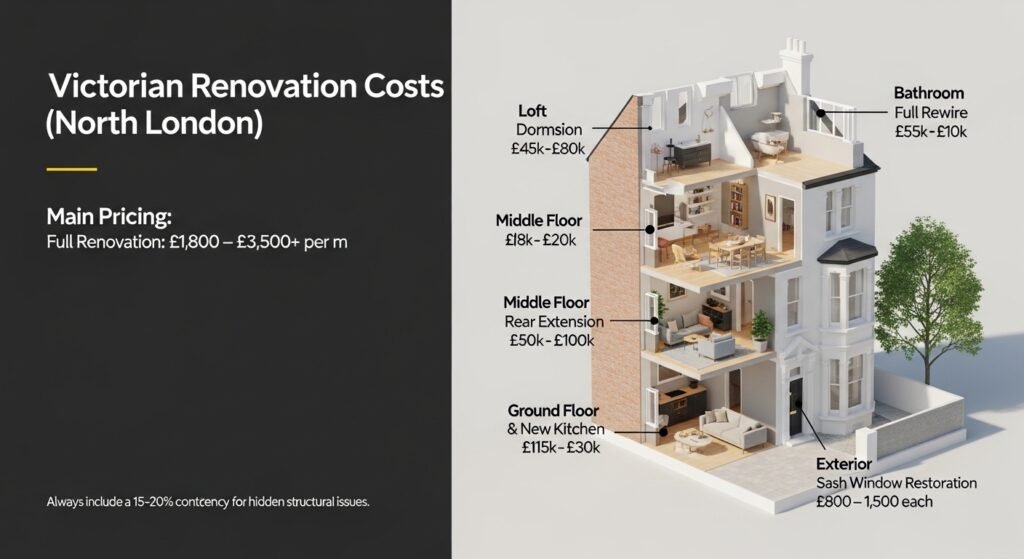
Cost Per Square Metre
| Renovation Level | Cost Per m² (ex. VAT) | What It Covers |
| Light (cosmetic updates, minor repairs) | £1,200 – £1,800 | Decoration, flooring, minor plumbing and electrical fixes |
| Mid-range (full rewire, replumb, new kitchen and bathrooms) | £1,800 – £2,500 | Structural repairs, full services upgrade, new rooms |
| Full renovation (structural changes, extensions, premium finish) | £2,500 – £3,500+ | Steel beams, extensions, bespoke joinery, high-spec fit-out |
For a standard three-bedroom Victorian terrace of around 100 to 120 square metres in North London, total project costs typically fall between £150,000 and £300,000 for a full renovation. Light cosmetic work on the same property starts around £70,000 to £90,000.
Cost by Project Type
Full North London house renovations in 2025 generally start from £70,000 and can exceed £200,000, depending on size, condition, and scope. Victorian and Edwardian homes common in this area often require structural updates and specialist finishes that push costs above standard London averages.
Here is a breakdown of typical individual project costs in North London:
- full house rewire (three-bedroom house): £5,000 – £10,000
- Full replumb: £4,000 – £8,000
- New central heating system with boiler: £4,000 – £8,000
- Kitchen renovation (mid-range): £15,000 – £30,000
- Bathroom renovation (per room): £8,000 – £20,000
- Loft conversion (dormer): £45,000 – £80,000
- Single-storey rear extension: £50,000 – £100,000
- Structural wall removal with steel beam: £2,000 – £8,000
- Damp treatment and replastering (ground floor): £3,000 – £8,000
- Sash window restoration (per window): £800 – £1,500
- Underfloor heating (per m²): £50 – £100
Always add a contingency of 15 to 20% on top of your quoted costs. Victorian properties routinely produce surprises once work starts: rotten joists, hidden asbestos, lead pipes, or structural movement that was invisible before walls came down.
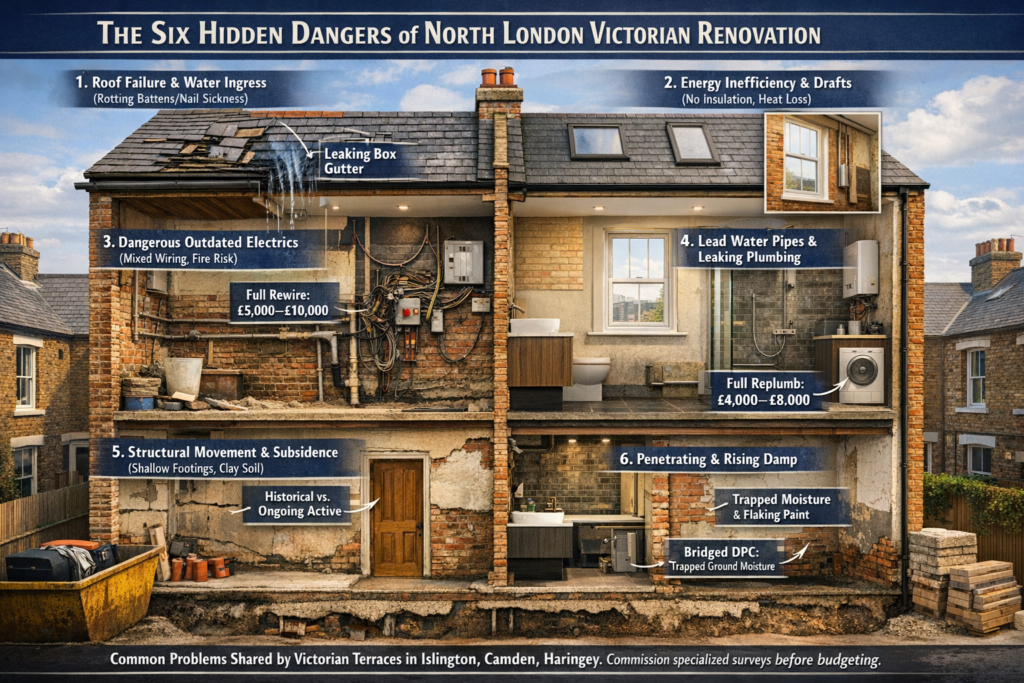
The Six Problems Every North London Victorian House Has
Before any renovation work begins, you need to know what you are actually dealing with. Most Victorian terraces in North London share the same set of underlying problems, regardless of how good they look on the surface.
1. Damp
Damp is the single most common issue in Victorian properties, and it is frequently misdiagnosed. Victorian houses were built using lime mortar and lime plaster, both of which are breathable and allow moisture to move through the walls and evaporate. When modern renovations introduce gypsum plaster, cement pointing, or impermeable external renders, moisture gets trapped and causes the visible staining, peeling paint, and crumbling plaster that homeowners mistake for “damp problems.”
The actual cause is often one of three things: penetrating damp from a failed roof, blocked gutters, or cracked brickwork; rising damp from a bridged or absent damp-proof course; or condensation caused by poor ventilation.
Treating the symptom without identifying the cause is the most expensive mistake in Victorian renovation. A damp-proof injection costs £300 to £1,000, but if the real problem is a blocked gutter or failed roof repair, the damp returns within two years. Commission a specialist damp and timber survey before any remedial work starts.
2. Outdated Electrics
Victorian houses were built before electricity existed. Most properties in North London have had electrical systems added, upgraded, and patched over multiple decades. What you commonly find is a mix of old wiring standards, undersized consumer units, and cabling that cannot safely support modern loads.
If the electrics have not been updated since the 1970s, a full rewire is almost certain. Older rubber-insulated cabling is a fire risk and will fail building regulations when you come to sell. A full rewire costs £5,000 to £10,000 for a three-bedroom terrace and is best done early in the renovation, before any plastering or decorating takes place.
3. Lead Pipes and Outdated Plumbing
Original lead pipe replacements are still found in many North London Victorian properties. Lead in drinking water is a health risk, and water suppliers, including Thames Water, actively encourage replacement. Corroded iron waste pipes and undersized supply lines are also common.
A full replumb costs £4,000 to £8,000 and should be done alongside the rewire, while walls and floors are already open. Doing them separately doubles the disruption and the plastering bill.
4. Roof Problems
Victorian roofs use original Welsh slate on timber battens. The timber battens and the nails fixing the slates corrode over time, a condition called nail sickness, causing slates to slip and water to enter. Box gutters, chimney flashings, and valley junctions are the other common failure points.
A full roof replacement on a standard North London terrace costs £8,000 to £18,000. In many cases, selective reslating combined with new leadwork to the flashings and gutters costs £3,000 to £7,000 and extends the roof’s life by 20 to 30 years. Commission a roofing specialist before deciding between repair and replacement.
5. Structural Issues
Victorian foundations are shallow by modern standards. In North London’s clay-heavy ground, particularly in areas of Islington, Camden, and Haringey, movement and minor subsidence are common. Symptoms include cracks above door frames, sticking doors, and sloping floors.
Not all movement is active or serious, but distinguishing stable historical movement from ongoing subsidence requires a structural engineer. A structural survey costs £500 to £1,500 and is money well spent before committing to a renovation budget.
Chimney breast removal is another common structural task in Victorian renovations. A chimney breast is a load-bearing element. Removing it without correctly installing a steel support is a serious structural risk. This work costs £2,000 to £5,000 and triggers a Party Wall Agreement with neighbours if the chimney is shared.
6. Energy Inefficiency
Victorian terraces were built with solid brick walls, single-glazed sash windows, and no insulation anywhere. Heat loss through an uninsulated Victorian terrace is significant. Under current Building Regulations Part L (Conservation of Fuel and Power), renovation works must include reasonable improvements to thermal performance where practicable.
Internal wall insulation work costs £40 to £60 per square metre installed. External wall insulation is more expensive and often not permitted in conservation areas. Secondary glazing on original sash windows costs £300 to £600 per window and is the standard solution where replacing windows is restricted by planning rules.
Planning Rules for Victorian Renovations in North London
This is where most homeowners underestimate the complexity. North London’s boroughs, particularly Islington, Camden, Haringey, and Barnet, have dense networks of conservation areas and Article 4 directions that restrict work that would normally be permitted development elsewhere.
What Permitted Development Covers
For a standard house that is not in a conservation area and not listed, permitted development rights allow you to:
- Build a rear extension build up to 3 metres deep (4 metres for a detached house) without planning permission
- Build a rear dormer loft conversion within the relevant volume limits (40 cubic metres for a terrace, 50 for a semi)
- Replace windows like-for-like without planning permission
- Carry out internal alterations, including removing non-load-bearing walls
Internal renovations, including new kitchens, bathrooms, and rewiring, do not need planning permission regardless of where you are.
Conservation Areas and Article 4 Directions
North London has an exceptionally high concentration of conservation areas. Islington has 42 conservation areas and has issued Article 4 directions removing permitted development rights in 40 of them. In these areas, you may need planning permission for changes that would be permitted elsewhere, including replacing external doors and windows, painting brickwork, or altering front boundary walls.
Camden’s conservation areas cover Primrose Hill, Hampstead, Belsize Park, and much of the borough’s Victorian residential stock. Haringey requires planning permission for single-storey rear extensions beyond 3 metres in its conservation areas. Highgate falls across the boundaries of Camden, Haringey, and Islington simultaneously, each with its own policies.
The practical impact on your renovation:
- Replacing sash windows: In a conservation area, replacement windows must match the original design. Double-glazed timber sash windows cost £1,200 to £2,000 each, compared to £800 to £1,200 for standard uPVC replacements elsewhere.
- External alterations: Changing the front door, adding a bay roof, or altering the front elevation in a conservation area typically requires a planning application. The current fee in England is £528 for a householder application.
- Extensions: Side extensions and loft extensions with dormers visible from the street require planning permission in most North London conservation areas.
Check your property against the relevant council’s conservation area map before drawing up any plans. Pre-application advice from the local planning authority costs £50 to £300, depending on the borough and saves significant time if your project is at all complex.
Listed Buildings
A listed building requires Listed Building Consent for any works that affect its special interest, both internally and externally. This includes structural work, removing original features such as fireplaces or cornicing, and changing windows or doors. North London has significant concentrations of listed properties in Barnsbury, Canonbury, Primrose Hill, and Highgate Village. Working on a listed building without consent is a criminal offence.
The Right Order to Renovate a Victorian House
Sequence matters in a Victorian renovation more than in almost any other project type. Do the work in the wrong order, and you spend money undoing earlier stages.
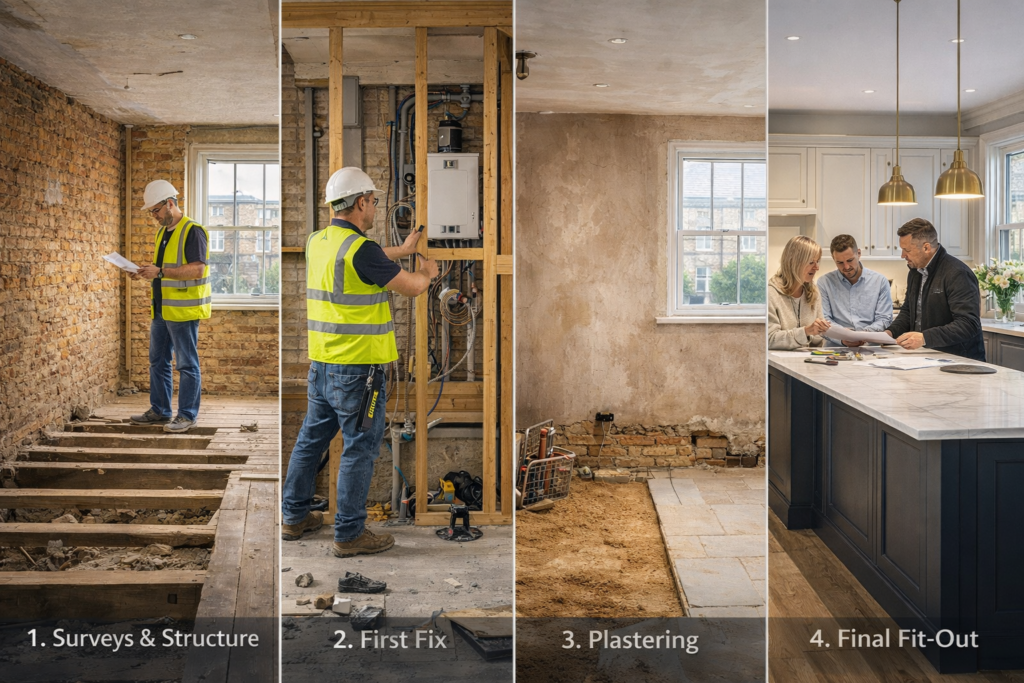
Stage 1: Surveys (Before You Commit to a Budget)
Commission a full structural survey, a damp and timber report, and a roofing survey before finalising your renovation budget. These three surveys cost £1,500 to £4,000 combined and tell you what you are actually dealing with. A drainage survey (CCTV camera through the drains) is worth adding for £300 to £500, as collapsed or cracked Victorian clay pipes are expensive to fix and worse to discover mid-project.
Stage 2: Planning and Design
Appoint an architect once you have the survey reports. The surveys define the scope; the architect translates that into a design and a schedule of works. For projects requiring planning permission, allow 8 to 12 weeks for a decision on a householder application, and longer for conservation area or listed building consent.
Architect fees for a full renovation typically run 8 to 15% of the construction cost, or £5,000 to £15,000 for a standard North London terrace project. A structural engineer is needed for any project involving steelwork, foundation work, or chimney breast removal, adding £1,000 to £3,000.
Stage 3: Structural and Roof Work
Fix the structure before everything else. Roof repairs, foundation stabilisation, damp treatment, and structural steelwork all come first. You cannot plaster walls next to an unresolved damp source. You cannot lay floors beneath a roof that still leaks.
Stage 4: First Fix Services
With the structure sound and the roof weathertight, bring in the electrician and plumber for first fix: running new cables and pipes through walls and floors before they are closed up. This is the time to install underfloor heating pipework, add new drainage for an ensuite or relocated bathroom, and upgrade the consumer unit.
Stage 5: Plastering
Victorian houses should be replastered using breathable materials wherever possible. Lime plaster on the original solid walls allows moisture to move and evaporate rather than trapping it behind an impermeable surface. Many plasterers in North London now specialise in lime replastering. Expect to pay a 15 to 25% premium over standard gypsum plastering.
Stage 6: Second Fix and Fit-Out
Second fix covers installing sockets, switches, light Installation, bathroom suites, kitchen units fitted, and all the finishes. This is the visible stage of the renovation where design choices materialise. It is also where projects most commonly overspend if the specification was not locked down early.
Stage 7: Decoration and Snagging
Final decoration, snagging (fixing minor defects), and commissioning of the heating system and appliances. A thorough snagging process at this stage, before you release the final payment to your contractor, catches problems while there is still leverage to get them fixed.
Preserving Period Features: What to Keep and What to Replace
Victorian houses in North London have original features worth preserving, both for their aesthetic value and their contribution to the property’s sale price. These are not decorative extras. Buyers in boroughs like Islington and Camden specifically seek out properties with intact original features.
Original cornicing and ceiling roses: Plaster cornicing and ceiling roses can be restored using traditional lime-based materials. Specialist plasterers charge £50 to £150 per linear metre for cornice restoration. Reproduction cornicing from suppliers like Stevensons of Norwich or English Heritage starts at £8 per linear metre for simpler profiles. Matching the original profile is worth the extra cost.
Timber sash windows: Original sash windows can be draught-proofed, repaired, and fitted with secondary glazing for a fraction of the cost of replacement. A well-maintained original sash window with secondary glazing performs close to a modern double-glazed unit thermally, while preserving the character of the property and avoiding a planning application in conservation areas.
Fireplaces: Victorian cast-iron fireplaces and timber surrounds are increasingly valuable. Where they are still in place, restoration rather than removal is almost always the right decision. A restored original fireplace adds more to a North London property’s perceived value than a modern alternative costs to install.
Original timber floorboards: Floorboards in Victorian terraces are typically 4 to 6 inches wide and made from Baltic pine. Sanding and finishing costs £15 to £25 per square metre and produces a result that no laminate or engineered alternative can match. Check for gaps and springiness before assuming they need replacing. Loose boards can be re-secured; gaps can be filled with slivers of matching timber or draught-excluding strips.
Features worth replacing: Not everything original is worth keeping. Victorian bathrooms were retrofitted into rooms not designed for them. Victorian kitchens were built as separate service rooms with no connection to living spaces. Victorian wiring, lead pipes, and iron waste pipes have reached the end of their useful life. The skill is in identifying what is genuinely characterful and what is simply old.
A Realistic Budget for a Full North London Victorian Renovation
Here is what a full renovation of a 110m² three-bedroom Victorian terrace in North London looks like when all costs are properly accounted for. The property is in a Haringey conservation area and requires a rear extension as part of the project.
| Item | Estimated Cost |
| Structural survey, damp and timber report, drainage survey | £3,000 |
| Architect (full service: design, planning, building regs, contract admin) | £12,000 |
| Structural engineer | £2,500 |
| Planning application fee (rear extension) | £528 |
| Building regulations fee | £900 |
| Roof: reslating and new lead flashings | £9,000 |
| Damp treatment and lime replastering (ground floor) | £6,000 |
| Full rewire including new consumer unit | £8,000 |
| Full replumb including new central heating system | £9,500 |
| Structural wall removal and RSJ beam | £4,500 |
| Rear extension (25m² at £3,000/m²) | £75,000 |
| Kitchen renovation (mid-range) | £22,000 |
| Two bathrooms | £18,000 |
| Sash window restoration and secondary glazing (8 windows) | £10,000 |
| Cornice restoration and ceiling repairs | £5,000 |
| Original floorboard sanding and finishing | £3,000 |
| Decoration throughout | £8,000 |
| Contingency (15%) | £30,000 |
| Total (ex. VAT) | £226,928 |
| Total (inc. VAT at 20%) | ~£272,000 |
This is a realistic all-in figure for a well-specified full renovation with a rear extension in North London in 2025. A project without the extension would reduce the total by £75,000 to £85,000. A project with lighter finishes and no structural changes could come in around £120,000 to £150,000 all-in.
How to Choose the Right Contractor
The contractor choice on a Victorian renovation in North London is more consequential than on a standard new build or modern refurbishment. Period properties require tradespeople who understand lime, original timber, lead flashings, and sash windows. Not all general contractors do.
- Use the Federation of Master Builders (FMB) directory to find vetted contractors with a track record on period properties. Members are inspected and monitored, and their work carries an insurance-backed warranty.
- Ask specifically about Victorian work. Request examples of similar projects in North London and ask to speak to former clients. A contractor who has renovated three terraces on your street understands the problems that come with them.
- Get three detailed written quotes. Ensure each quote specifies exactly what it includes and excludes. Quotes that omit damp treatment, structural engineer costs, or waste disposal are not comparable to quotes that include them.
- Do not appoint on price alone. The cheapest quote on a Victorian renovation is often the most expensive outcome. Underbidding followed by variation orders mid-project is one of the most common causes of budget overruns.
- Agree a payment schedule tied to milestones. Never pay more than 25 to 30% upfront. Release payments on completion of defined stages: structural work done, first fix complete, plastering done, second fix complete, snagging signed off.
FAQ
Q: Do I need planning permission to renovate a Victorian house in North London?
Internal renovations never need planning permission. External changes depend on your location. If your property is in a conservation area, which covers a large proportion of North London’s Victorian stock, you may need planning permission for changes as minor as replacing windows or painting external brickwork. Islington has issued Article 4 directions in 40 of its 42 conservation areas that remove standard permitted development rights. Check with the relevant borough council before starting any external work, and consider getting a Lawful Development Certificate for works that do not require planning permission to protect your position when you sell.
Q: How long does a full Victorian house renovation take in North London?
A full renovation without an extension typically takes 4 to 8 months of construction time. Add an extension and the timeline extends to 8 to 14 months. If planning permission is required, add 2 to 4 months for the planning process before work can start. Commission surveys and appoint your architect before approaching builders, as the design and planning stage takes 3 to 6 months even before construction begins. From first survey to moving in, a realistic total timeline is 12 to 18 months for a full renovation with extension.
Q: What is the biggest hidden cost in a Victorian house renovation?
Damp and structural remediation discovered once walls and floors come up. Victorian terraces routinely produce rotten joists, bridged damp-proof courses, failed lead flashings, and corroded iron pipes that were invisible at survey stage. Set aside a contingency of 15 to 20% of your quoted costs specifically to cover these discoveries. On a £200,000 renovation, that is £30,000 to £40,000 held in reserve. If you do not need it, you keep it.
Q: Should I live in the property during a Victorian house renovation in North London?
For a light renovation covering one or two rooms, living in the property is manageable. For a full renovation that involves the roof, rewiring, replumbing, or structural work, it is almost always better to find temporary accommodation. Dust, noise, lack of a functioning kitchen or bathroom, and the safety risks from active construction make an occupied property significantly harder to work in, which often increases the build time and therefore the cost. Temporary accommodation in North London adds £2,000 to £5,000 per month to the project.
Q: How much does a Victorian house renovation add to property value in North London?
A well-executed full renovation in North London typically adds 15 to 25% to a property’s market value, depending on the borough and the quality of the finish. Extensions add the most value per pound spent, particularly rear extensions that create open-plan kitchen-dining spaces with garden access. Preserved period features, including original cornicing, fireplaces, and sash windows, actively add to buyer appeal in Islington, Camden, and Haringey, where purchasers pay a premium for character. Over-specified renovations in streets where comparable properties sell at lower prices rarely return full cost.
Q: How much does a Victorian house renovation add to property value in North London?
A well-executed full renovation in North London typically adds 15 to 25% to a property’s market value, depending on the borough and the quality of the finish. Extensions add the most value per pound spent, particularly rear extensions that create open-plan kitchen-dining spaces with garden access. Preserved period features, including original cornicing, fireplaces, and sash windows, actively add to buyer appeal in Islington, Camden, and Haringey, where purchasers pay a premium for character. Over-specified renovations in streets where comparable properties sell at lower prices rarely return full cost.
Q: Do I need a specialist architect for a Victorian renovation in North London?
For conservation area projects, extensions, or listed building works, a specialist architect is worth the fee. An architect familiar with Islington, Camden, or Haringey’s planning officers and local policies will produce a scheme that gets consent more reliably and with fewer revisions. For internal-only renovations with no planning involvement, an experienced contractor with a good track record on period properties can manage without an architect, though you will need a structural engineer if any walls are coming down. For larger or complex projects, the architect’s fee is typically recovered through better contractor management and fewer costly redesigns mid-build.
Conclusion
A Victorian house renovation in North London is one of the most complex and rewarding projects a homeowner can undertake. The properties are built to a quality that modern construction rarely matches. The problem is that 100 to 150 years of use, and often decades of misguided modernisation, have created layers of problems that need resolving before the character of the house can be properly realised.
The sequence matters: surveys, then design, then structure, then services, then finishes. The planning rules matter: North London’s conservation areas are dense and the Article 4 directions in Islington and Camden specifically restrict works that would be permitted development elsewhere. And the contingency matters: 15 to 20% is not optional on a Victorian renovation; it is a structural part of the budget.
Get all three of those right, choose the right contractor, and a Victorian terrace in Islington, Tufnell Park, Muswell Hill, or Crouch End can be transformed into a home that performs to modern standards while keeping the character that made you want to buy it in the first place.

Tilly Bani is a renovation and roofing specialist with over 15 years of experience in construction and property refurbishment across North London. He specialises in roofing, structural repairs, and full home renovations, helping homeowners improve property value and safety.