
| Quick Answer CORGI ceased to be the UK’s official gas registration scheme on 1 April 2009, when it was replaced by the Gas Safe Register. CORGI is no longer a valid qualification or registration. Any engineer claiming to be CORGI registered in 2026 is not legally qualified to work on your gas appliances. The Gas Safe Register is the only official body that legally authorises gas engineers in the UK, covering Great Britain, Northern Ireland, the Isle of Man, and the Channel Islands. Always verify an engineer’s Gas Safe registration before allowing any gas work to begin. Homeowners should only hire certified gas work specialists. |
Introduction
If you have asked a heating engineer whether they are CORGI registered in the last few years, you may have been met with a puzzled look or an explanation you barely had time to absorb before they got on with the job. The confusion between CORGI and Gas Safe is understandable. Research by Aspect found that as late as 2019, 58% of UK adults still believed CORGI was an official register, and over-35s were significantly more likely to use it as a benchmark for trusting an engineer.
The distinction matters because getting it wrong has real consequences. Using an unregistered gas engineer is illegal under UK law, can invalidate your home insurance, and in the worst cases, has contributed to carbon monoxide poisoning and death. For landlords, the legal stakes are even higher. Many residents choose trusted North London engineers for peace of mind.
This guide explains the full history of CORGI and Gas Safe, how the Gas Safe Register actually works, how to verify an engineer’s qualifications before they touch your boiler, what the law requires, and why anyone who claims to be CORGI registered today should be concerned rather than reassured.
What CORGI Was: A Brief History
CORGI stood for the Council for Registered Gas Installers. It was established in 1991 as the UK’s official gas registration body, operating under an agreement with the Health and Safety Executive (HSE) to maintain a register of competent gas engineers and protect the public from unsafe gas work.
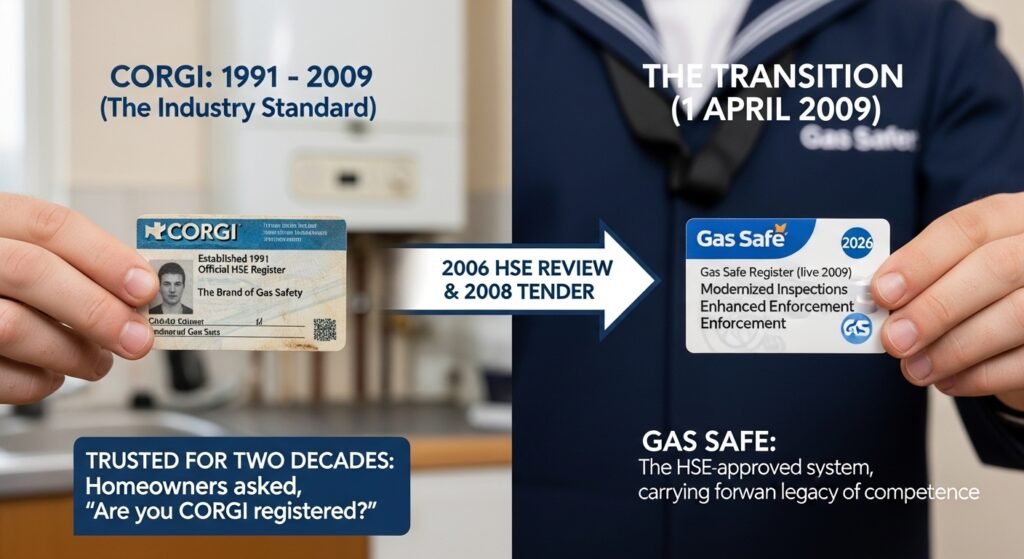
For nearly two decades, CORGI registration was the standard marker of a qualified gas engineer. Homeowners and landlords learned to ask “Are you CORGI registered?” before letting anyone near a boiler. The brand became synonymous with gas safety. During those years, the number of domestic gas-related fatalities fell significantly, which CORGI’s proponents credited in part to the registration system driving unqualified workers out of the market.
By 2009, over 55,000 businesses were registered with CORGI. Engineers had to prove competence in their specific area of gas work, carried official ID cards, and were subject to checks. The system worked well enough that its successor has retained its basic structure.
However, a 2006 review by the HSE involving industry stakeholders, gas engineers, their representatives, and consumer groups concluded that while the CORGI scheme had succeeded, there was no room for complacency and a strong case for change. The review identified opportunities to strengthen enforcement, improve inspection targeting, and raise consumer awareness through a modernised approach.
The result was a competitive tender for a new scheme. In September 2008, the HSE awarded a ten-year contract to Capita Gas Registration and Ancillary Services to create and operate the Gas Safe Register. On 1 April 2009, CORGI ceased to function as the official gas registration body. The Gas Safe Register went live on the same day.
What Happened to CORGI After 2009?
When Gas Safe replaced CORGI, the CORGI name did not disappear entirely. It was rebranded as a voluntary membership organisation rather than an official regulatory body. CORGI Services offered commercial services unrelated to gas safety regulation, but this was entirely separate from any regulatory function and had no legal standing.
By 2019, the original CORGI website (trustcorgi.com) was no longer online and had been archived. The rebranded Corgi Services website also appeared to be offline by that point.
The practical position today is clear: CORGI no longer has any regulatory role. It is not a valid qualification, not an official register, and not a body that confers legal authority to work on gas appliances. An engineer who tells you they are CORGI registered in 2026 is either describing a voluntary membership with no regulatory weight, making an error, or attempting to mislead you.
The only registration that matters legally is Gas Safe.
What Is the Gas Safe Register?
The Gas Safe Register is the UK’s official gas registration body, established on 1 April 2009 and operating under an agreement with the Health and Safety Executive. It covers Great Britain, Northern Ireland, the Isle of Man, Guernsey, and Jersey.
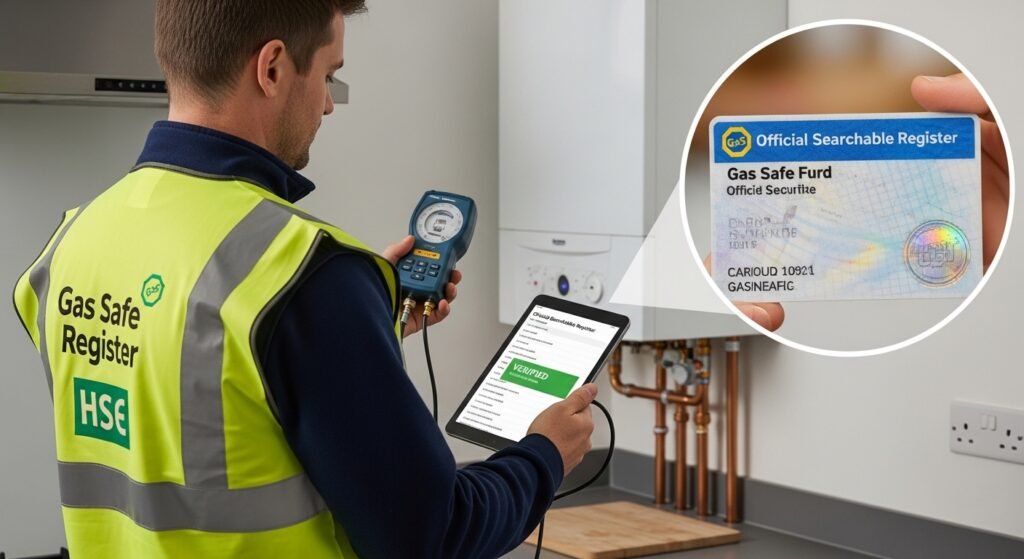
Under the Gas Safety (Installation and Use) Regulations 1998, it is a legal requirement for anyone working on gas appliances, installations, or pipework to be Gas Safe registered. This applies to boilers, gas hobs and ovens, gas fires, gas cookers, water heaters, gas pipework, and related systems. Domestic upgrades often include professional cooker hob installation.
The Gas Safe Register is administered by Capita on behalf of the HSE. Its functions include:
- Maintaining an accurate, searchable register of qualified gas engineers
- Issuing Gas Safe ID cards to registered engineers
- Conducting inspections of gas work carried out by registered engineers
- Investigating reports of illegal gas work
- Running public awareness campaigns, including the annual Gas Safety Week
- Taking enforcement action against engineers and businesses who breach regulations
The register is not a simple self-certification scheme. Engineers must hold recognised qualifications, pass competency assessments, and submit to periodic inspection of their work. Qualified teams also handle safe boiler installation work. The Gas Safe Register has a team of inspectors who conduct both scheduled and unannounced inspections of registered businesses.
How Gas Safe Registration Works
To become Gas Safe registered, an engineer must follow a specific process that cannot be shortcut.

Step 1: Gain the Required Qualifications
Engineers must hold one of the following recognised qualifications before they can apply for registration:
- ACS (Accredited Certification Scheme): The most common route. Engineers sit practical and theoretical assessments covering core gas safety competencies. The core ACS qualification covers essential gas safety knowledge, after which engineers can take additional assessments for specific appliance types.
- NVQ (National Vocational Qualification) Level 3 in gas engineering or plumbing and heating with gas modules
- SVQ (Scottish Vocational Qualification) equivalent
- QCF (Qualifications and Credit Framework) qualification in Scotland
The ACS route is the most direct for engineers already working in the industry. New entrants more commonly complete an NVQ through an apprenticeship, which combines college-based study with supervised on-site experience, typically over one to two years.
Step 2: Apply to the Gas Safe Register
Once qualified, the engineer applies through their employing business (or as a sole trader business) to join the register. The application includes:
- Evidence of qualifications
- Business details
- Payment of registration fees
As of April 2025, new registration costs approximately £368, including VAT, covering one engineer and initial registration for one year. An additional fee of £18.42 applies if a physical card is requested, as the register has moved to digital licence cards.
Step 3: Annual Renewal and Five-Year Reassessment
Gas Safe registration is not permanent. Every registered business renews annually. Engineers must update their qualifications every five years through ACS reassessment. This ongoing requirement means that Gas Safe registration reflects current competence, not just a historical qualification.
Engineers who do not renew or fail their reassessment lose their registration and with it their legal authority to work on gas appliances.
Understanding the Gas Safe ID Card
The Gas Safe ID card is the physical (or now increasingly digital) evidence that an engineer is registered. When an engineer arrives at your property to work on a gas appliance, you have the right to see this card, and you should exercise that right. This is especially important before booking boiler repairs.

What the Front of the Card Shows
The front of the Gas Safe card includes:
- The engineer’s photograph (compare this to the person in front of you)
- The engineer’s name
- The Gas Safe registration number (a unique identifier)
- The licence number (embossed across the card for security)
- The expiry date (licences are renewed annually, so check that the date has not passed)
- The business name (confirming the engineer represents the company you contacted)
- A Gas Safe security hologram (a fraud prevention measure)
- A QR code (scan this with a smartphone to verify registration instantly on the Gas Safe Register website)
If the expiry date has passed, the engineer is no longer legally registered for gas work. Do not allow work to proceed, and contact the Gas Safe Register for guidance.
What the Back of the Card Shows
The back of the Gas Safe card is equally important and is often overlooked. It lists the specific categories of gas work the engineer is qualified to undertake. These are divided into domestic and non-domestic categories and include the name of the work type, the appliance type, and the expiry date for each qualification.
Why this matters: Not all Gas Safe-registered engineers are qualified for all types of gas work. Some jobs also require certified gas line installation experience. An engineer registered for commercial catering equipment is not necessarily qualified to work on domestic boilers. An engineer qualified for natural gas appliances may not be qualified for LPG. Checking the back of the card confirms that the engineer is specifically qualified for the work you are asking them to do.
For most domestic boiler work, look for qualifications that include:
- Domestic Natural Gas appliances (boilers, central heating), Routine checks should include annual boiler servicing.
- CENWAT (Central heating, Warm air, and hot water systems)
- CPA (Combination Boilers) if relevant
- CCN1 (the core domestic gas safety qualification)
Digital Cards
Gas Safe Register has introduced digital licence cards, which engineers can present on their mobile phones. The QR code on a digital card links directly to the official Gas Safe Register website for instant verification. This is a legitimate and increasingly common form of ID. If an engineer presents a digital card, scan the QR code to verify it is genuine.
How to Check a Gas Safe Engineer
Before any gas engineer starts work at your property, you can and should verify their registration through more than one method. This matters before arranging any heating services.
Online Check
Visit gassaferegister.co.uk and use the “Check an Engineer” tool. Enter the engineer’s licence number or business details to confirm their registration status and the categories they are qualified for. This takes less than two minutes and is the most reliable check available.
Phone Check
Call the Gas Safe Register on 0800 408 5500. This is a free number, and the team can verify registration details over the phone.
Find an Engineer
The Gas Safe Register’s “Find an Engineer” tool at gassaferegister.co.uk allows you to search for registered engineers by postcode and appliance type. This is useful before you have contacted anyone, as it generates a list of registered engineers in your area who are specifically qualified for your type of work.
What to Do if an Engineer Cannot Show a Valid Card
If an engineer arrives at your property and either cannot produce a Gas Safe card or produces one that is out of date, do not allow them to begin work. Instead, contact approved Islington contractors if local help is needed. Politely explain that you cannot permit work to proceed without a valid Gas Safe card, and contact the Gas Safe Register to report the situation. The register takes reports of illegal gas work seriously and will investigate.
The Law: What Gas Safe Registration Means Legally
The legal framework for gas safety in the UK is the Gas Safety (Installation and Use) Regulations 1998. These regulations make it a criminal offence for a person to work on gas appliances or installations unless they are Gas Safe registered. Landlords often pair this with annual gas safety checks.
Regulation 3(3) of these regulations is the specific provision that has been used to prosecute unregistered gas workers. In October 2025, the HSE prosecuted Scott Anthony Williams, an unregistered gas installer in Cheshire. In December 2025, a father and son were prosecuted in the same court, with the son having carried out new boiler installations without Gas Safe registration and the father, a registered engineer, having signed off the work without attending the property to check safety. The son received a 12-month community order and 200 hours of unpaid work, with £2,500 in costs.
These are not isolated cases. The HSE and the Gas Safe Register pursue illegal gas work actively, and prosecutions are a matter of public record.
As a consumer, if you knowingly hire an unregistered gas engineer, you may also face legal consequences, particularly as a landlord. The legal and safety risks of using unregistered workers include:
- Criminal liability under the Gas Safety (Installation and Use) Regulations 1998
- Invalidated home insurance: Most home insurance policies require that gas work be carried out by registered engineers. Work by an unregistered engineer typically voids the policy for related claims
- Invalidated boiler warranty: Manufacturer warranties universally require installation and servicing by a Gas Safe-registered engineer. Incorrect fitting can lead to costly boiler breakdown repairs.
- Unsafe work: Unregistered engineers lack the competency checks that registration requires. Illegal gas work has directly caused gas leaks, explosions, fires, and carbon monoxide poisoning
Landlord Obligations: A Stricter Legal Standard
For landlords, the Gas Safe requirements go beyond simply using a qualified engineer for repairs. The Gas Safety (Installation and Use) Regulations 1998 impose specific annual duties.
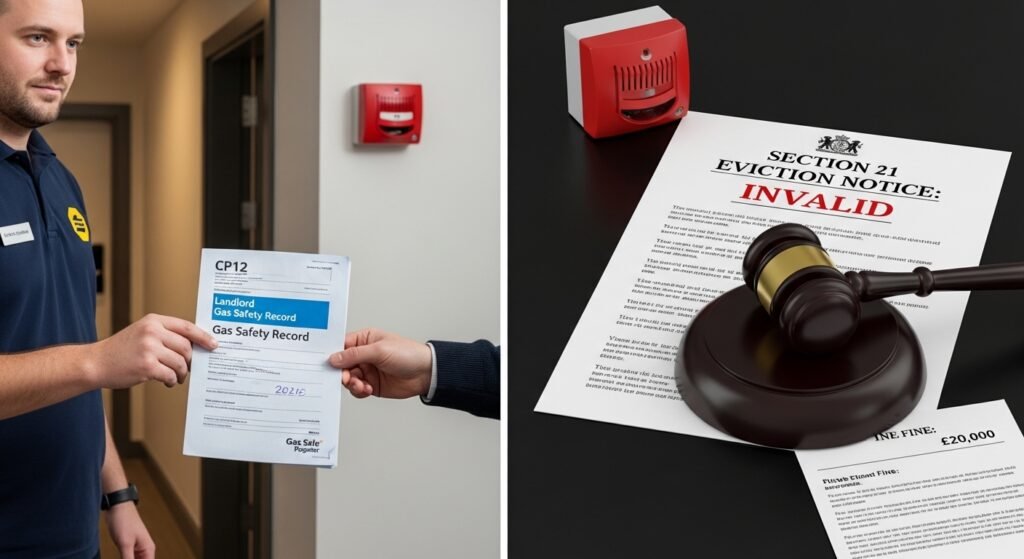
Landlords must, by law:
- Arrange an annual gas safety inspection of all gas appliances, flues, and installation pipework they provide in rented properties. Many owners also inspect nearby heating pipework.
- Use only a Gas Safe-registered engineer to conduct this inspection
- Receive a Gas Safety Record (the document formally called a CP12, a term carried over from the CORGI era) after each inspection
- Provide a copy of the Gas Safety Record to existing tenants within 28 days of the inspection
- Provide a copy to new tenants before they move in
- Keep copies of Gas Safety Records for at least two years
The Gas Safety Record (CP12) is the inspection document that proves compliance. Note that the term CP12 originates from the old CORGI scheme and remains in common use in the industry, even though the correct modern term is Landlord Gas Safety Record or Gas Safety Record.
Consequences of Non-Compliance for Landlords
The consequences of failing to meet gas safety obligations as a landlord are severe and have been tightening:
- Unlimited fines for failure to comply
- Imprisonment of up to six months for serious breaches
- Invalidated landlord insurance, leaving personal liability for any fire, explosion, CO incident, or property damage
- Blocked Section 21 evictions: To serve a valid Section 21 no-fault eviction notice, landlords must have provided the Gas Safety Record at the tenancy start. Without it, the notice is invalid
- Criminal prosecution in cases where negligence leads to injury or death
Real enforcement cases document what these figures look like: landlords have received fines of £6,000 to £20,000 for individual compliance failures. Where carbon monoxide incidents or fatalities have occurred, prosecutions have included custodial sentences.
Other Relevant Qualifications and Accreditations
Gas Safe registration is the mandatory legal baseline. Beyond it, several additional accreditations indicate higher levels of training or manufacturer endorsement.
Manufacturer Accreditation
Major boiler manufacturers, including Worcester Bosch, Vaillant, and Viessmann, run accreditation programmes for Gas Safe-registered engineers. Engineers who complete manufacturer-specific training:
- Demonstrate detailed knowledge of that brand’s products
- Can offer extended manufacturer warranties (up to 10 to 12 years on Worcester Bosch installations by approved engineers, compared to the standard two years)
- Have been assessed on the specific installation and commissioning requirements of those boilers
If your boiler manufacturer’s warranty matters to you, check whether the engineer carries manufacturer accreditation for your boiler brand.
NVQ and SVQ Qualifications
NVQ Level 3 in plumbing and heating or gas engineering indicates formal vocational training validated through an apprenticeship or recognised training programme. This is a broad professional credential that underpins Gas Safe registration rather than replacing it.
OFTEC Registration for Oil Boilers
For oil boilers, Gas Safe does not apply. Homes changing systems may consider modern hot water cylinder upgrades. Oil boiler work requires an engineer registered with OFTEC (Oil Firing Technical Association). Hiring a Gas Safe engineer to work on an oil boiler is not the correct qualification match: you need OFTEC registration specifically.
TrustMark and FMB Membership
These are voluntary quality accreditations rather than legal requirements. TrustMark is the UK government’s endorsed quality scheme for domestic trades. FMB (Federation of Master Builders) membership involves independent vetting and inspection. Neither replaces Gas Safe registration for gas work, but both indicate additional professional commitment and accountability that goes beyond the legal minimum.
Common Questions and Misconceptions
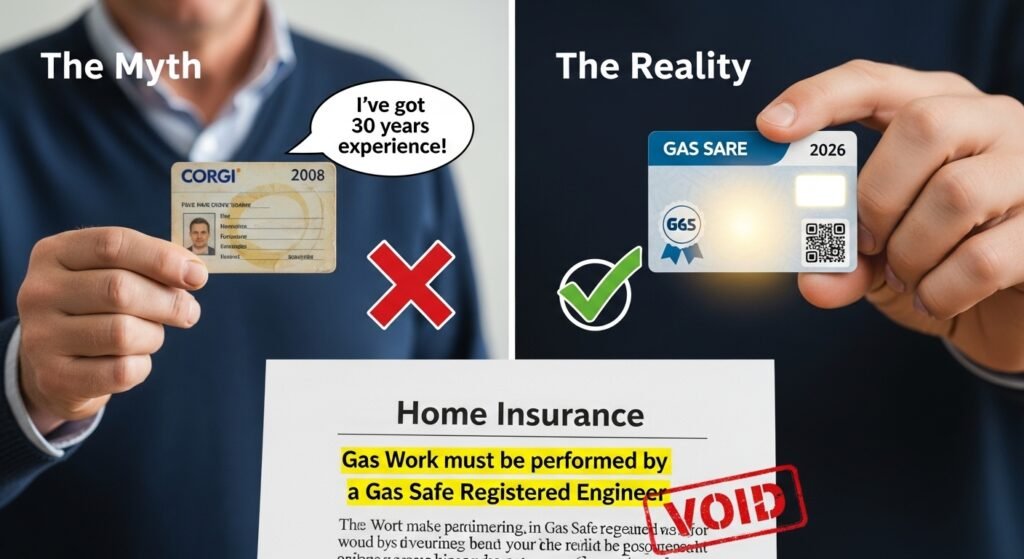
“The engineer said they used to be CORGI registered. Is that OK?”
No. CORGI ceased to be the official registration scheme in 2009. A reference to past CORGI registration describes historical status with no current legal weight. The only relevant question is whether the engineer is currently Gas Safe registered.
“The engineer says they have years of experience. Is that enough?”
Experience is not a substitute for Gas Safe registration. Under the Gas Safety (Installation and Use) Regulations 1998, there is no exemption based on experience. An engineer with 30 years in the industry who is not Gas Safe registered is not legally permitted to work on gas appliances.
“The work is small. Does Gas Safe registration still apply?”
Yes. Gas Safe registration applies to all gas work regardless of scope. Replacing a thermostat, reconnecting a gas hob, servicing a boiler, and installing a new gas fire all require a registered engineer. There is no threshold below which the requirement disappears. Yes, even minor jobs like gas appliance fitting need registration.
“I can save money by hiring someone without registration.”
The apparent saving is rarely real. Unregistered gas work voids your home insurance, voids the boiler manufacturer’s warranty, may require expensive correction by a registered engineer, and in the worst cases, creates physical danger. The cost of a legitimate Gas Safe-registered engineer is minor compared to any of these outcomes. Gas Safe Register data estimates that bogus unregistered gas fitters carry out over 250,000 jobs per year in the UK, costing approximately £100 million annually to correct.
“Someone told me they are registered, but they cannot show a card.”
Do not proceed. The Gas Safe card is evidence of registration. An engineer without a valid card is either unregistered or presenting a situation that needs immediate verification through the Gas Safe Register’s online check or phone line (0800 408 5500) before any work begins.
How Gas Safety Week Raises Awareness
Since 2011, the Gas Safe Register has run an annual Gas Safety Week, coordinating with energy providers, retailers, charities, and registered engineers to raise awareness of gas safety risks. The campaign has grown significantly and is now a major UK consumer safety initiative.
The themes of Gas Safety Week campaigns have focused on carbon monoxide awareness, the importance of annual servicing, how to spot a fake engineer, and how to check Gas Safe registration. Homes should also maintain working smoke heat alarms. The 2025 campaign theme was “Looking after your home, friends and family,” incorporating guidance on CO alarms and the signs of CO exposure.
Annual Gas Safety Week takes place each September. Between Gas Safety Week campaigns, the Gas Safe Register maintains year-round consumer resources at gassaferegister.co.uk, including the engineer checker, the Find an Engineer directory, and educational content on gas safety in the home.
FAQ
Q: Is CORGI still a valid gas qualification in the UK?
No. CORGI ceased to be the UK’s official gas registration body on 1 April 2009, when it was replaced by the Gas Safe Register. Since that date, only Gas Safe registration confers legal authority to work on gas appliances in the UK. CORGI no longer has any regulatory function. Any engineer who claims CORGI registration as a current credential is describing something with no legal standing.
Q: How do I check if an engineer is Gas Safe registered?
Use the “Check an Engineer” tool at gassaferegister.co.uk, entering the engineer’s licence number or business name. Alternatively, call 0800 408 5500. When an engineer arrives at your property, ask to see their Gas Safe ID card or digital licence, verify the photograph matches, check the expiry date has not passed, and scan the QR code to confirm registration on the Gas Safe Register website.
Q: What happens if an unregistered engineer works on my gas appliances?
The gas work is illegal under the Gas Safety (Installation and Use) Regulations 1998. Your home insurance will likely be invalidated for any claim related to that work. Any boiler manufacturer’s warranty will be voided. If the work is unsafe and causes a gas leak, fire, explosion, or carbon monoxide incident, the legal and financial consequences can be severe. The work will need to be inspected and corrected by a registered engineer at your cost. Both the unregistered engineer and potentially you as the customer, can face legal action.
Q: Are all Gas Safe engineers qualified to work on all gas appliances?
No. Gas Safe registration covers specific categories of gas work, listed on the back of the engineer’s ID card. An engineer qualified for domestic gas boilers may not be qualified for commercial appliances, LPG, gas fires, or unvented cylinders. Before authorising any gas work, check the back of the card to confirm the engineer holds the specific qualification for the work you need.
Q: What is a CP12 and how does it relate to Gas Safe?
CP12 is the informal term for a Landlord Gas Safety Record, the document issued by a Gas Safe registered engineer after completing the annual inspection of gas appliances in a rented property. The term CP12 originated from the old CORGI registration scheme (CORGI Proforma 12) and has carried over into common use despite CORGI no longer existing. The correct modern term is Landlord Gas Safety Record or Gas Safety Record. The document itself is unchanged: it records the inspection findings, appliances checked, and confirms the engineer’s Gas Safe registration number.
Q: Does Gas Safe registration apply to oil boilers?
No. Gas Safe Register covers gas work: natural gas and LPG appliances. For oil boilers, the relevant registration is OFTEC (Oil Firing Technical Association). A Gas Safe registered engineer is not automatically qualified or registered for oil boiler work. If you have an oil boiler, use an OFTEC-registered engineer for servicing, repairs, and installation.
Conclusion
The shift from CORGI to Gas Safe in 2009 was not simply a name change. It was a deliberate overhaul of the UK’s gas safety framework, strengthening enforcement, improving inspection targeting, and creating a more transparent system for consumers to verify engineer qualifications.
More than 15 years on, the confusion between CORGI and Gas Safe persists in public awareness, but the legal and practical position is clear. CORGI is no longer valid. Gas Safe registration is the only legal basis for gas work in the UK. Verifying it before any engineer touches a gas appliance in your home takes two minutes, costs nothing, and in the worst cases can save lives.
The steps are straightforward: check gassaferegister.co.uk or call 0800 408 5500; ask to see the engineer’s Gas Safe card when they arrive; check the expiry date and the specific qualifications listed on the back; and never allow gas work to proceed if an engineer cannot produce a valid, in-date card.
For landlords, the obligations are even more specific: annual inspections by registered engineers, Gas Safety Records provided to tenants on schedule, and records kept for two years. The consequences of falling short, unlimited fines, invalidated insurance, criminal prosecution, and blocked eviction proceedings, make compliance not just a legal duty but a financial necessity.

Tilly Bani is a renovation and roofing specialist with over 15 years of experience in construction and property refurbishment across North London. He specialises in roofing, structural repairs, and full home renovations, helping homeowners improve property value and safety.