
| Quick Answer Whether you need planning permission for a house extension in Islington depends on your property type, its location, and the size and type of extension you are proposing. Houses in Islington that are not in a conservation area and not listed may qualify for permitted development, which allows certain home extensions without a formal application. However, Islington has issued Article 4 directions removing permitted development rights in 40 of its 42 conservation areas, which cover the majority of the borough’s Victorian and Georgian residential streets. If you are planning structural works, it is wise to speak with experienced Islington builders. Flats always require full planning permission for any external extension, regardless of where they are. |
Introduction
Islington is one of the most planning-restricted boroughs in London. Its dense network of conservation areas, around 4,500 nationally listed buildings, and actively enforced Article 4 directions mean that the rules many homeowners assume apply to them simply do not apply in this borough.
Getting this wrong is expensive. Islington Council can and does take enforcement action against extensions built without the required permission, requiring you to demolish the work at your own cost. Many homeowners planning major upgrades first consult home renovation experts to align design and compliance from the start. When you come to sell, solicitors will identify the missing consent, and buyers will either walk away or demand a price reduction.
This guide explains exactly what planning permission rules apply to house extensions in Islington in 2025: what permitted development allows, how conservation areas change the picture, what the application process involves, and what Islington’s planning officers look for when assessing your proposal.
The First Question: House or Flat?
Before anything else, you need to establish what type of property you own. This is the single most important distinction in Islington’s planning system.
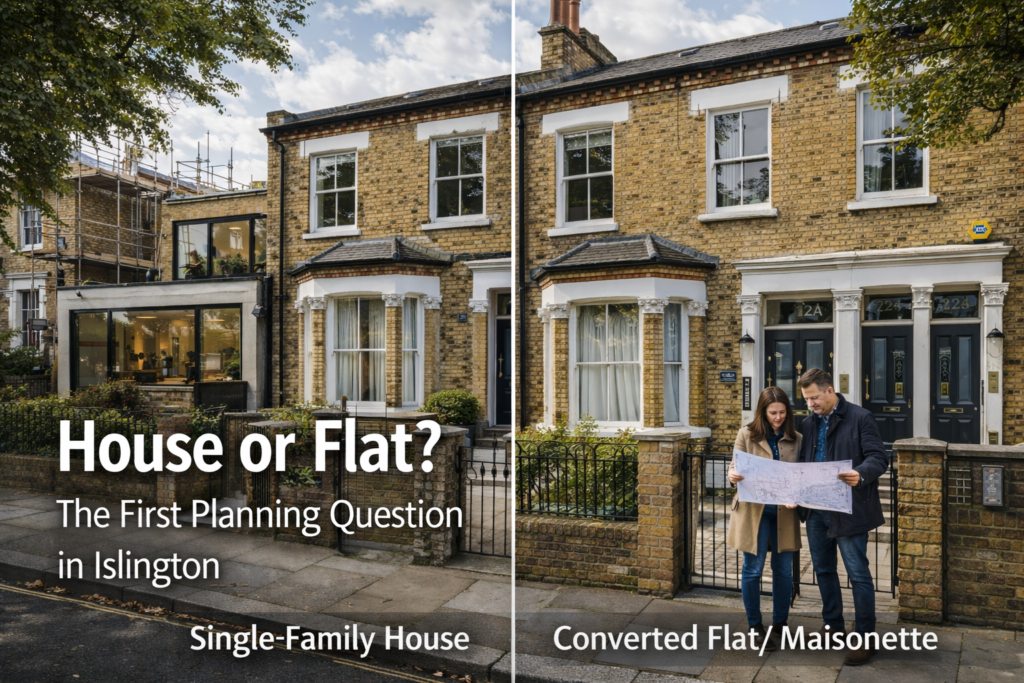
If you own a house (meaning you occupy all of it as a single-family dwelling), you may have permitted development rights for certain extensions, subject to the conservation area and Article 4 rules described below.
If you own a flat or maisonette, even in a converted Victorian terrace that looks like a house from the street, permitted development rights do not apply. Islington Council is explicit on this point: planning permission is always required for any external alteration or extension to a flat. You must submit a full planning application regardless of the size or type of work.
This catches a large number of Islington homeowners. Many converted homes later need full upgrades handled as one project through full-house refurbishment specialists. The borough is full of converted Victorian terraces split into two or three flats. If your property is leasehold or if the building contains more than one dwelling, you are almost certainly in flat territory and need full planning permission for any extension.
Permitted Development in Islington: What It Covers and What It Does Not
Permitted development (PD) is planning permission granted by Parliament rather than your local council. It allows certain types of building work to proceed without a formal application, provided they stay within defined limits and conditions. Where roof alterations form part of the build, professional roofing services can help complete the project efficiently.
What Permitted Development Allows for Houses
For a house in Islington that is not in a conservation area and not covered by an Article 4 direction, the national permitted development rules set these limits for extensions:
Single-storey rear extensions:
- Maximum depth of 3 metres for a terraced or semi-detached house
- Maximum depth of 4 metres for a detached house
- Maximum height of 4 metres with a dual-pitched roof, or 3 metres any other roof type
- Must not extend beyond the side wall of the original house
Flat roof rear extensions are common on London terraces, often completed by flat roof experts where suitable.
Larger rear extensions (Prior Approval Neighbour Consultation Scheme):
- Up to 6 metres deep for a terraced or semi-detached house
- Up to 8 metres deep for a detached house
- Requires prior approval from Islington Council, which involves notifying neighbours and a 42-day consultation period
- Council can refuse if neighbours object and the impact is deemed unacceptable
Double-storey rear extensions:
- Maximum 3 metres depth beyond the rear wall of the original house
- Must be at least 7 metres from the rear boundary
- Roof pitch must match the original house as closely as possible
- Upper-floor side-elevation windows must be obscure-glazed and non-opening below 1.7 metres
Where major alterations involve changing the roofline, many homeowners coordinate work with roof extension work to streamline construction.
Loft conversions (dormer extensions):
- Volume limit of 40 cubic metres for terraced houses, 50 cubic metres for detached and semi-detached houses
- Must not extend beyond the roof slope fronting a highway
- Materials must appear similar in visual character to the existing house
- Any side-elevation windows must be obscure-glazed
If you are adding rooflights as part of the loft design, professional skylight installation can improve natural light and ventilation.
Side extensions:
- Width must not exceed half the width of the original house
- Maximum height of 4 metres with a dual-pitched roof, or 3 metres with any other type
- Cannot be forward of the principal elevation
The Critical Islington Exception: Article 4 Directions
Here is where the standard national rules stop applying. Islington has issued Article 4 directions removing permitted development rights in 40 of its 42 conservation areas. In these areas, works that would normally be permitted development nationally require a planning application from Islington Council.
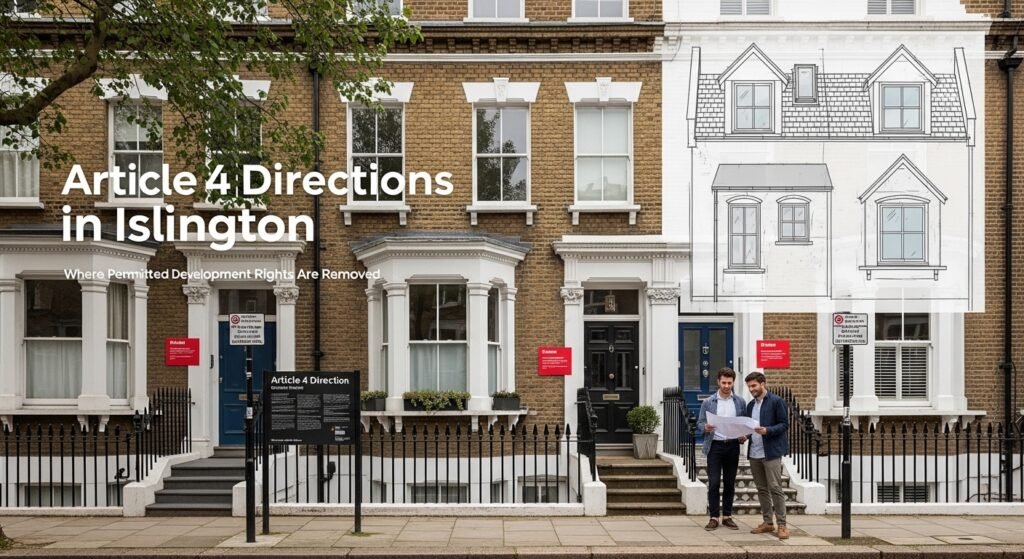
The practical impact is significant. In most of Islington’s residential streets, including Barnsbury, Canonbury, Highbury Fields, Highbury, Thornhill, Tufnell Park, Gillespie, Tollington, Hillmarton, Mildmay, Newington Green, St Peter’s, and the Angel and Upper Street area, your permitted development rights as a householder have been reduced or removed entirely.
Works that trigger a planning application in these Article 4 areas include:
- Replacing external doors or windows, even like-for-like, for conservation properties, specialist window repairs are often preferred over replacement.
- Painting unpainted external brickwork
- Roof extensions and dormers that would otherwise be permitted development
- Side extensions that meet the national PD limits but not Islington’s local requirements
- Installing satellite dishes visible from the street
Where roofing changes need approval, some homeowners choose a full roof replacement at the same time to avoid future disruption.
If you are uncertain whether your property falls within one of these areas, use Islington Council’s interactive conservation area map at islington.gov.uk before assuming any work is permitted development.
When You Definitely Need Planning Permission in Islington
The following situations always require a planning application in Islington, regardless of the type of work:
You live in a flat or maisonette. No exceptions. Any external extension requires full planning permission. This includes garden structures, conservatories, and any alterations to a roof that forms part of your flat.
Your property is a listed building. Islington has approximately 4,500 nationally listed buildings. Any works to a listed building that affect its special architectural or historic interest require Listed Building Consent, which is a separate application from planning permission and is assessed against stricter criteria. This includes internal alterations: changing a staircase, removing original plasterwork, or altering a fireplace in a listed building, all of which require consent.
Your property is in a conservation area with an Article 4 direction, and the work involves an external alteration. Side extensions, roof extensions visible from the street, dormer windows, and replacement windows on front or street-facing elevations all require a householder planning application.
You want to extend beyond the permitted development limits. Any single-storey rear extension deeper than 3 metres on a terrace (or 4 metres on a detached house), or any side extension exceeding half the width of the original house, requires a planning application.
Your extension would extend beyond 50% of the original curtilage. Islington enforces what is commonly called the 50% rule. The combined footprint of all extensions and outbuildings must not consume more than 50% of the original land area of the property. Islington measures this against the original historic plot, not including any previous extensions.
Many owners also improve layouts internally after consent is secured, using local kitchen fitters and bathroom fitters.
Islington’s Design Principles: What Planning Officers Look For
Islington’s planning officers apply a clear set of design principles when assessing extension applications in the borough. Understanding these principles is not optional. Applications that ignore them are refused.
The Host Building Must Remain Dominant
Islington’s Conservation Area Design Guidelines make clear that the original Victorian or Georgian host building must remain the visually dominant structure. Any extension must read as secondary and subordinate to the original building. An extension that is taller than the original rear ground floor windows, or that matches the mass and scale of the original building, will be refused.
In practical terms, this means rear extensions in Islington are typically lower than the first-floor rear windows of the original house. Extensions that sit flush with or above these windows are consistently challenged by planning officers.
Extensions Must Be Legible as Modern Additions
Unlike some conservation authorities that insist on matching original materials exactly, Islington generally accepts modern design that is clearly distinguishable from the original building. A flat-roofed rear extension clad in zinc or glass is acceptable in principle, provided it is clearly secondary in scale and does not dominate the rear elevation. What is not acceptable is fake period detailing: trying to replicate Victorian brickwork and sash windows in a modern extension tends to produce a pastiche that Islington officers reject.
Materials Must Respect the Character of the Area
For front and side elevations in conservation areas, materials must match or be sympathetic to the existing building and the character of the surrounding streetscape. Replacing London stock brick with render, or introducing contrasting cladding on a street-facing elevation, is almost always refused. For rear extensions not visible from the street, there is more flexibility. Street-facing elevations should use sympathetic materials. Internal finishing after approval is where upgrades like plastering services can modernise interiors without harming heritage character.
Daylight and Privacy for Neighbours
Islington applies the BRE (Building Research Establishment) daylight and sunlight assessment methodology. Extensions that would reduce a neighbour’s daylight below BRE guidance thresholds, or that would create a significant loss of outlook or privacy, will face refusal or require redesign. In Islington’s tightly packed Victorian terraces, where rear gardens are often narrow, and overlooking is common, this is a genuine constraint that limits extension depth and height. After structural works, many homes also benefit from new flooring installation throughout the upgraded space.
The Three Types of Applications You Might Need in Islington
Knowing which type of application to submit matters. Islington reports that 70% of the planning applications they receive are invalid because they have been completed incorrectly.
Householder Planning Application
This is the standard application for extensions and alterations to a single house. It costs £548 (from April 2026 in England). Islington Council targets an 8-week decision on householder applications from the date the application is validated, though complex applications involving conservation areas or heritage considerations can take longer.
You will need to submit:
- A completed application form via the Planning Portal
- A site location plan at 1:1250 scale with the site outlined in red
- A block plan at 1:200 or 1:500 scale
- Existing and proposed floor plans and elevations, typically at 1:50 or 1:100
- A design and access statement is not required for most householder applications, but Islington recommends including one for conservation area proposals
Certificate of Lawfulness (Proposed)
If you believe your extension qualifies as permitted development and want formal written confirmation from Islington Council, you apply for a Certificate of Lawfulness (Proposed). This costs £264 (half the householder application fee). It is not the same as planning permission, but it is documentary proof that your works are lawful. Solicitors will ask for this when you sell the property, and it protects you if planning rules change in the future.
A Certificate of Lawfulness is strongly recommended for any extension in Islington that you believe falls within permitted development. Given the extent of the Article 4 directions across the borough, there is a meaningful risk in proceeding without one.
Listed Building Consent
If your property is listed, any works that would affect its special interest require Listed Building Consent, submitted alongside or separately from a planning application. Working on a listed building without consent is a criminal offence. The fee for a listed building consent application is currently set at £0 in England (no charge), though professional fees for preparing the application apply.
During the approval period, many owners also plan utilities such as electrical upgrades and plumbing services, ready for construction.
Pre-Application Advice: Why It Matters More in Islington Than Most Boroughs
Islington’s planning team offers a formal pre-application advice service, and using it before submitting any application in a conservation area is strongly recommended.
The service works as follows:
- For householder applications, the council undertakes a desk-based study and provides written advice within 30 working days of receiving payment
- A site visit can be arranged as part of the service and typically lasts up to 30 minutes
- The case officer will advise on the acceptability of your proposal and confirm which supporting documents you need to submit
Pre-application advice fees in Islington increased on 2 January 2025. The exact fees are published on islington.gov.uk. While the service is not free, the cost of a refusal, a redesign, and resubmission almost always exceeds the pre-application advice fee.
Islington also operates a free Duty Planner service, available Monday to Friday from 9 am to 1 pm, for informal general enquiries about whether planning permission is required for a specific proposal. This is a useful starting point before committing to a formal pre-application submission.
Common Reasons Applications Are Refused in Islington
Understanding why applications fail saves you from the same mistakes. The most consistent grounds for refusal in Islington for householder extension applications are:
The extension is too tall. Single-storey rear extensions that rise above the first-floor rear windowsill line of the original house are routinely refused on grounds of over-dominance.
Materials are inappropriate. Using render, uPVC, or modern brick on a street-facing elevation in a conservation area without demonstrating compatibility with the existing building almost always draws a refusal.
Loss of daylight to neighbours. Extensions that fail the BRE daylight test for adjacent properties will be refused or required to reduce in depth or height.
Insufficient documentation. As noted, 70% of Islington’s planning applications are submitted with errors or missing information and are invalidated before assessment. This delays the process by weeks and, in conservation areas, can cause you to miss pre-agreed timelines with contractors.
The extension exceeds the 50% curtilage rule. Previous extensions or outbuildings that have already used up much of the original plot can prevent further extension even when neighbours are not objecting.
Building Regulations: The Separate Approval You Cannot Skip
Planning permission and Building Regulations approval are two entirely separate processes. Confusing them is a common and costly error.
Planning permission covers the site, the surrounding area, and the visual impact of your development. It says nothing about whether your extension is structurally safe, properly insulated, or correctly connected to drainage.
Building Regulations approval addresses exactly those construction standards. Where boards are outdated, a consumer unit upgrade is commonly recommended. Virtually all extensions in Islington require Building Regulations approval, regardless of whether planning permission was needed. This includes:
- Check the structure (foundations, walls, roof) and ensure full house rewiring is essential in older homes.
- Insulation and thermal performance to Part L standards
- Electrical safety under Part P
- Qualified plumbing services usually complete drainage compliance under Part H and pipework changes.
- Fire safety under Part B
Luxury rear extensions frequently include underfloor heating for improved comfort. Building Regulations applications are submitted separately, either through Islington Council’s Building Control team or through an approved private inspector. A full plans application (which is reviewed before work starts) is preferable to a building notice (which is inspected as work proceeds) because it identifies problems before they are built. Budget £400 to £1,000 for the Building Regulations fee, depending on the scale of the project. Many households also install efficient boiler installation systems during major works.
Party Wall Act Obligations
If your extension involves work on or near a shared party wall with a neighbour, the Party Wall etc. Act 1996 applies. This is not a planning requirement but a legal obligation that runs alongside the planning process.
In Islington’s Victorian terraces, party wall notices are required for virtually all rear and side extensions. You must serve formal written notice on affected neighbours at least two months before starting structural work. If a neighbour consents in writing, the process costs nothing. If they dissent, both parties appoint surveyors to agree a Party Wall Award, and you pay both surveyors’ fees.
Party wall surveyor fees in Islington typically run from £700 to £1,500 per surveyor. Ignoring the Party Wall Act does not invalidate your planning permission, but it can result in an injunction that halts your build mid-construction and exposes you to a damages claim from the neighbour.
Serve party wall notices early, before finalising your construction contract, so any disputes can be resolved before your build is scheduled to start.
A Step-by-Step Planning Process for Islington Extensions
This is the correct sequence for a homeowner seeking to extend a house in Islington.
- Establish your property type. House or flat? Single dwelling or converted building? This determines whether PD rights apply at all.
- Check the conservation area map. Use Islington Council’s interactive map to confirm whether your property is within a conservation area and whether an Article 4 direction applies.
- Check your property’s listing status. Search the National Heritage List for England at historicengland.org.uk to confirm whether your property is listed.
- Use the Duty Planner service for a free initial conversation with an Islington planning officer about whether your proposal requires a formal application.
- Appoint an architect. For any application in a conservation area or involving a listed building, an architect experienced in Islington planning is not an optional extra. The council’s design guidance is specific, and applications designed without local knowledge are refused at a significantly higher rate.
- Apply for formal pre-application advice from Islington’s planning team before submitting. This costs money but reduces refusal risk substantially.
- Serve Party Wall notices on affected neighbours at least two months before your planned construction start date.
- Submit your planning application via the Planning Portal with all required documents. Pay the £548 householder application fee.
- Apply for Building Regulations approval from Islington Building Control or a private approved inspector. Do this in parallel with the planning process, not after. Once building work is complete, homeowners often choose a full kitchen renovation to match the new layout.
- Obtain a Certificate of Lawfulness if your works were permitted development, as confirmation to protect you when you sell.
FAQ
Q: Can I build a rear extension in Islington without planning permission?
Possibly, but the answer depends on whether you own a house or a flat, and whether your property is in one of Islington’s conservation areas with an Article 4 direction. If you own a house outside a conservation area, a single-storey rear extension up to 3 metres deep may qualify as permitted development. If you are in a conservation area, which covers the majority of Islington’s residential streets, you need a planning application even for modest rear extensions. If you own a flat, you always need full planning permission. Use Islington Council’s interactive conservation area map and the free Duty Planner service to confirm your position before proceeding.
Q: How long does planning permission take in Islington?
Islington Council targets 8 weeks for householder planning applications from the date the application is validated. However, if your application is submitted with errors or missing documents (which Islington notes affects 70% of applications), it will be invalidated and the clock resets. Applications for extensions in conservation areas or listed buildings can take longer if heritage officers need to review the proposal. Add the pre-application advice period (up to 30 working days), and the total process from initial advice to decision is realistically 4 to 6 months.
Q: What happens if I build an extension in Islington without planning permission?
Islington Council takes enforcement action. If you build an extension that requires planning permission and do not obtain it, the council can issue an enforcement notice requiring you to remove the works and restore the property to its original condition, at your expense. This is particularly likely in conservation areas where the council monitors changes to the streetscape actively. When you come to sell, solicitors will identify the missing consent and the absence of a Certificate of Lawfulness. This can cause buyers to pull out, reduce the price they offer, or require you to obtain retrospective permission before completion.
Q: Do I need planning permission to replace my windows in Islington?
In most of Islington, it depends on your property type and location. For a house outside a conservation area, replacing windows like-for-like is generally permitted development. However, Islington has issued Article 4 directions in 40 of its 42 conservation areas that remove this permitted development right. In these areas, replacing windows that change the material, style, or appearance, including replacing timber sash windows with uPVC, requires a planning application. For a flat, any change to windows that changes their material, size, or appearance requires full planning permission regardless of conservation area status.
Q: What is a Certificate of Lawfulness, and do I need one?
A Certificate of Lawfulness (Proposed) is a formal document from Islington Council confirming that your proposed works do not require planning permission because they qualify as permitted development. It costs £264 in England and is issued within 8 weeks. It is not legally required if you are confident your works are permitted development, but it is strongly recommended. It provides documentary proof that your build was lawful, which mortgage lenders and solicitors will request when you sell. Without it, a buyer’s conveyancer may raise a legal query that delays or derails the sale. Given Islington’s complexity, the £264 cost is a small price for that certainty.
Q: Can I get pre-application advice from Islington Council before submitting?
Yes, and Islington strongly recommends it. The council offers a formal pre-application advice service where a planning officer reviews your proposal and provides written advice within 30 working days. A site visit can also be arranged as part of this service. Fees for this service increased on 2 January 2025; current rates are on Islington’s website at islington.gov.uk. For general enquiries about whether planning permission is needed, the free Duty Planner service is available Monday to Friday between 9 am and 1 pm and does not require a formal submission.
Conclusion
Planning permission for house extensions in Islington is more complex than in most London boroughs. The combination of 42 conservation areas, Article 4 directions covering 40 of them, approximately 4,500 listed buildings, and a clear distinction between houses and flats means that assumptions based on national permitted development rules are frequently wrong in this borough.
The consequences of getting it wrong range from enforcement action and demolition to blocked property sales. The process to get it right involves checking your property type, checking your conservation area status, using Islington’s pre-application advice service, and submitting a properly documented application with appropriate professional support.
An experienced architect familiar with Islington’s planning policies, its Conservation Area Design Guidelines, and the specific expectations of its planning officers is not a luxury on these projects. In a borough where design principles around dominance, legibility, and materials are applied consistently and rigorously, professional guidance substantially increases the chance of approval first time. The best route is to verify your property status, secure the right approvals, and use experienced professionals for design and construction. If you are planning a project in the borough, speak with trusted Islington builders or contact our team for guidance.

Tilly Bani is a renovation and roofing specialist with over 15 years of experience in construction and property refurbishment across North London. He specialises in roofing, structural repairs, and full home renovations, helping homeowners improve property value and safety.