
| Quick Answer You need an emergency roof repair in North London when water is actively entering the property, when water is anywhere near electrical fittings, when the roof shows visible structural sagging or movement, when large areas of slates or tiles are missing after a storm, or when internal ceiling damage is spreading rapidly. Storm damage often needs urgent tile roof repairs. In all five cases, waiting even 24 hours typically multiplies the repair cost and the risk to your property and safety. |
Introduction
Most North London homeowners do not think about their roof until something goes wrong. In a Victorian terrace in Islington or an Edwardian semi in Muswell Hill, the roof can run for years without visible problems, then fail suddenly after a single storm or a winter of slow flashing deterioration. The difference between a £300 repair and a £3,000 restoration often comes down to how quickly a problem was identified and addressed. Fast inspections can prevent full roof replacement costs.
Not every roof problem is an emergency. A single cracked slate on an otherwise sound roof is not. Moss that has built up over two summers is not. But five specific situations demand immediate professional attention, regardless of the time of day, the day of the week, or how inconvenient the timing feels.
This guide explains each sign in detail, explains why it escalates so quickly in North London’s housing stock, and tells you exactly what to do when you encounter it.
Sign 1: Active Water Ingress Inside the Property
Water entering your home through the roof is the clearest possible signal that the repair cannot wait. Persistent leaks usually need urgent roof leak repair. It is also, unfortunately, the sign that homeowners most often underestimate.
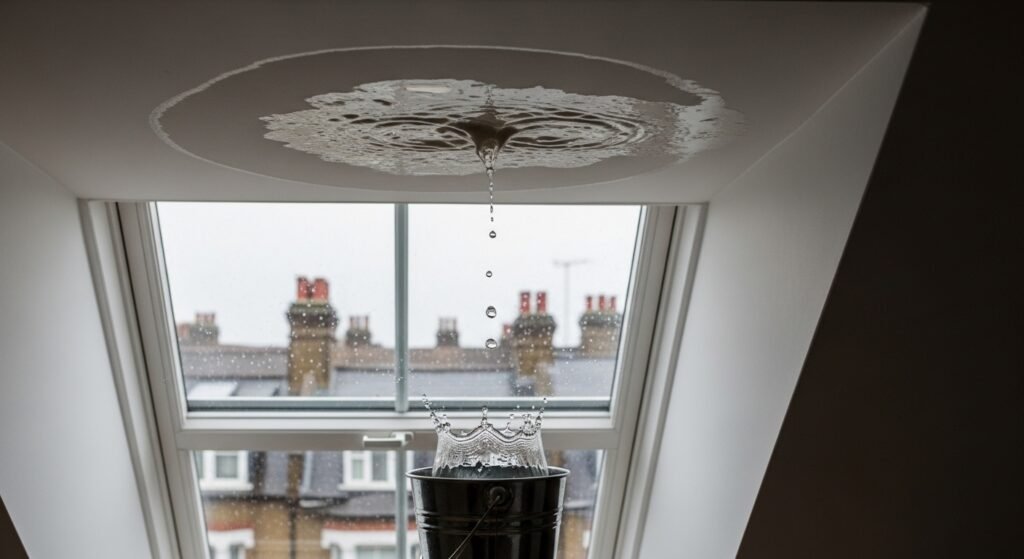
When you see a drip on the ceiling or a damp patch that was not there yesterday, the common instinct is to put a bucket under it and monitor the situation. This instinct is understandable but consistently expensive. By the time water is visible inside the property, it has already travelled some distance. On a typical Victorian terrace in Archway or Stoke Newington, a roof leak tracks water along roof timbers, through insulation, across joists, and down through ceiling boarding before it becomes visible as a stain or drip. The visible drip represents the end of a water journey, not its beginning.
The actual entry point in the roof covering is almost always some distance from where the drip appears inside. Professional roof inspections help trace hidden entry points. Water follows the path of least resistance through the roof structure, which means the ceiling stain in the back bedroom may trace to a failed flashing around the chimney on the front elevation.
Why This Escalates Faster on Victorian Terraces
North London’s Victorian terraces were built with original pine roof timbers that have been in service for 100 to 140 years. These timbers have survived this long partly because the roof has kept them dry. When water enters persistently, even in small quantities, Victorian timber rots faster than modern treated timber. Older homes often require wider property refurbishment after water damage. A rafter that absorbs water for two or three weeks can develop wet rot that requires section replacement. A rafter that absorbs water for three months may need full replacement along with adjacent boarding. The structural repair cost of untreated water ingress routinely runs five to ten times the cost of the original roofing repair that would have stopped the water.
What to Do Right Now
- Place buckets or towels beneath the drip to limit floor and furniture damage.
- Move any electronics, valuables, and documents away from the damp area.
- If the ceiling is visibly bulging or bubbling, the void above is holding collected water. Carefully pierce the lowest point with a screwdriver to release the water in a controlled way rather than waiting for the ceiling to fail and release it all at once. Do this only if you are certain the ceiling contains no electrical fittings directly above the bulge.
- Call an emergency roofer. Do not wait until the leak worsens, until the rain stops, or until Monday morning.
Sign 2: Water Near Electrical Fittings
This sign elevates a roofing problem from a property emergency to a safety emergency. Water and electricity in proximity create three distinct risks: electrocution, fire from short circuits, and long-term corrosion of wiring that causes hidden faults long after the leak is repaired. After leaks, many homes need certified electrical repairs.
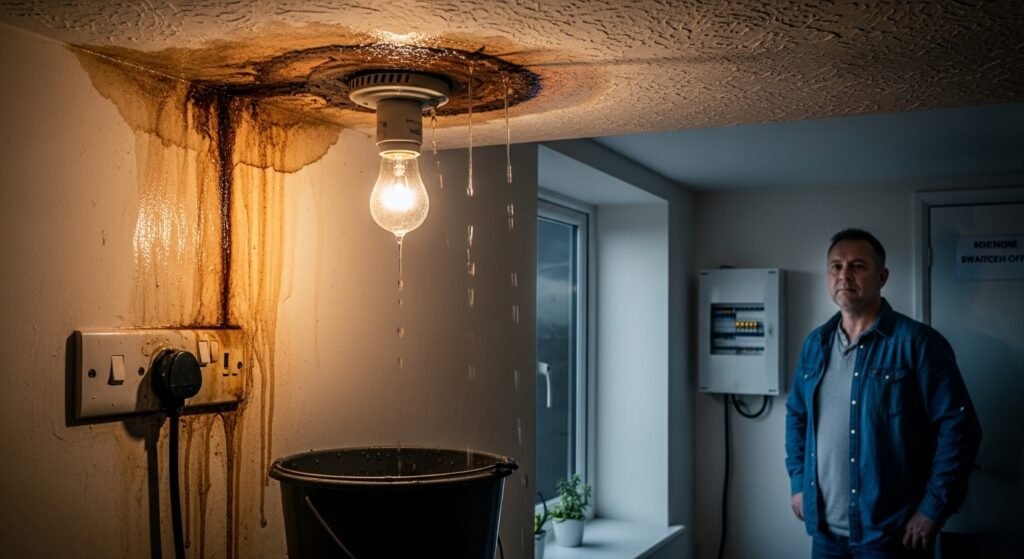
The specific scenario that demands immediate action is water dripping from, around, or near a ceiling light fitting, or damp appearing on a wall near a socket or light switch. Water is an excellent conductor of electricity. Rainwater in particular, which carries dissolved minerals and particulates, conducts more effectively than distilled water. A fitting that appears to be working normally with water present is not safe. The wiring inside may already be carrying current through pathways it was never designed for.
Common indicators that water has reached electrical elements:
- A ceiling light that has begun to flicker during or after rain
- A ceiling light that has stopped working in a room that has recently had a damp patch
- A brown or dark water stain appearing in a ring around a ceiling rose or fitting
- Any dripping water from a fitting, however small
- Unexpected tripping of the circuit breaker coinciding with rainfall
The Electrocution and Fire Risk
When water bridges the positive and negative conductors inside a light fitting, it creates an arc. An arc generates heat. In a roof void full of old mineral wool insulation and dry timber, heat and sparks are a fire risk. Electrical fires in roof spaces are particularly dangerous because they develop unseen and are well-established before smoke detectors in living areas trigger.
The second risk is electrocution. Do not use the light switch to turn off a fitting that you suspect has water in it. The switch itself may be live. Turn off the entire circuit at the consumer unit (fuse box) and do not restore power to that circuit until both the roofing repair is complete and an electrician has confirmed the fitting and wiring are safe and dry. Faulty boards may need consumer unit upgrades.
What to Do Right Now
- Turn off the power to the affected circuit at the consumer unit. Do not use the light switch.
- Do not touch the fitting, the switch plate, or any wet surface near an electrical fixture while the power is on.
- Place a bucket or container to catch water, but do not stand in water or on a wet surface while doing this.
- Call an emergency roofer. The roofing repair is the source of the problem and must happen first.
- After the roofing repair is complete, call a qualified electrician to assess and certify the affected fittings before restoring power to that circuit.
Sign 3: Structural Sagging, Movement, or Visible Collapse
A sagging roofline, a ceiling that visibly bows or dips, a ridge that is no longer straight when viewed from the street, or any section of the roof that has visibly moved from its original position represents a structural emergency. Severe movement may require complete pitched roof rebuilding. This is categorically different from a cosmetic roofing problem and requires immediate professional assessment.
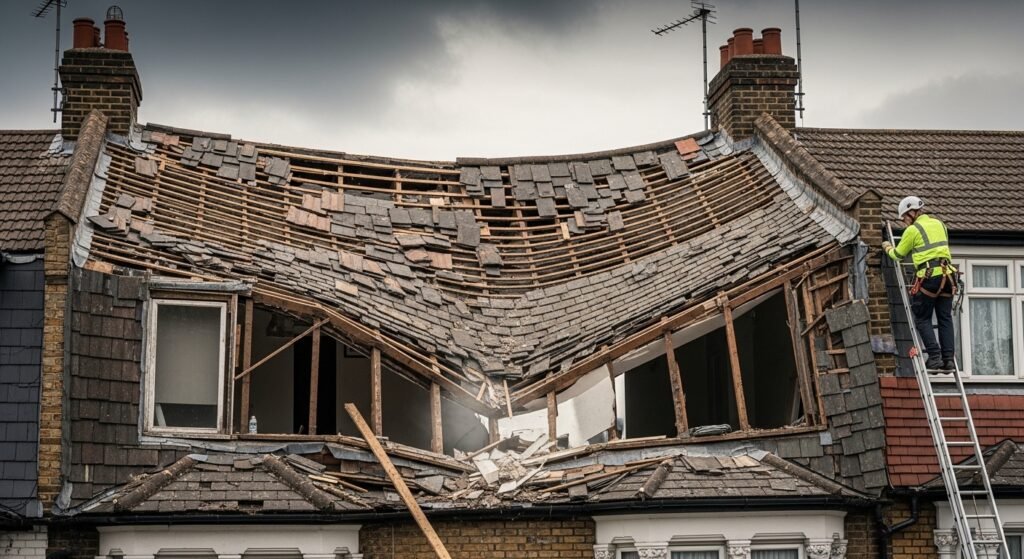
Structural movement in a North London roof can have several causes, the most common being:
Long-term undetected water ingress. Timber that has been wet for an extended period loses structural integrity. A rafter that has been carrying a load while gradually rotting can fail suddenly, particularly in cold weather when the timber is under additional thermal stress, or during a storm when wind adds lateral loading.
Failure of roof fixings at the ridge. Victorian terraces in North London commonly have mortar-bedded ridge tiles. Loose ridges are often replaced with dry ridge systems. As the mortar degrades over decades, the ridge tile can shift. In the most serious cases, this represents not just a waterproofing failure but a structural instability at the apex of the roof.
Impact damage from falling trees or heavy debris. North London’s tree-lined residential streets, particularly in Highgate, Crouch End, Muswell Hill, and Hampstead, create a specific storm risk from branches and entire trees falling onto roof structures. An impact that dislodges tiles may also have damaged the structural members beneath.
Trussed roof deterioration. Post-war properties across Barnet and Enfield were often built with engineered trussed roofs. While these are structurally efficient when intact, damaged truss members can cause rapid deflection because the truss relies on the interconnection of all its components.
What to Do Right Now
- Do not enter the loft or roof space if there is visible structural distortion. A compromised structure can fail under the additional load of a person.
- If there is internal ceiling distortion, vacate the room below and keep others away from it.
- Call an emergency roofer immediately. Do not wait to see whether it gets worse. Structural problems do not stabilise without intervention.
- If you can see daylight through the roof structure from inside the loft, or if there is a visible hole or gap in the external roof covering, the property is open to the elements and to pest ingress. This requires the same-day temporary covering at a minimum.
Sign 4: Large-Scale Missing Slates or Tiles After a Storm
Losing a slate or tile in a storm is not automatically an emergency. A single missing slate that exposes a small area of felt can wait 24 to 48 hours for a non-emergency repair call in mild weather. Three or more missing slates from the same area, or a section of the roof where the felt or batten layer beneath is visibly exposed over a large area, is a different matter. Grouped failures often need expert slate roof repairs.
North London experiences a specific combination of risk factors after significant storms. The area’s Victorian housing stock sits on streets where the housing is densely packed, creating wind channelling effects between terraces that can dramatically increase local wind speeds at roof level. Chimney stacks on Victorian terraces, often the tallest part of the structure, are particularly vulnerable to loosening and partial collapse in high winds. Storm impact frequently causes chimney repairs. When a chimney pot or section of stack falls, it can damage adjacent slates and tiles across a significant area.
The Waterproofing Cascade
Modern roofs are built with redundancy: the primary waterproofing is the slates or tiles, and beneath them is a breathable membrane or felt that provides a secondary layer. Victorian terraces were often built with just the slate and no secondary membrane. When slates are missing on one of these older properties, the exposed roof structure is the timber battens and rafters with no membrane protection.
Even where a membrane does exist, its function is as a secondary barrier for incidental water penetration, not as a primary waterproof layer. Prolonged exposure of felt to direct rainfall will eventually cause failure, typically at nail holes and laps. North London’s winters combine persistent rainfall with freeze-thaw cycles. A membrane exposed after storm damage and left unrepaired through a series of freeze-thaw nights typically develops cracks and tears that exceed its design tolerance within days to weeks.
The consequence is a roof that appeared to have isolated tile damage but progressed to widespread membrane failure and subsequent water ingress across a much larger area than the original storm damage.
What to Do Right Now
- Do not attempt to access the roof yourself to assess the damage. Post-storm roofs have weakened fixings, wet surfaces, and unknown structural integrity in the affected area.
- Photograph the damage from ground level or from an upstairs window if possible. This provides useful documentation for your roofer and for any insurance claim.
- Check internally for any evidence of water entry. Go into the loft with a torch if it is safe to do so and look for light through the roof structure, damp insulation, or any sign of water pooling.
- Call an emergency roofer for a temporary covering if the exposed area is significant and rain is forecast.
- Contact your home insurance provider as soon as possible, as storm damage is typically covered by buildings insurance.
Sign 5: Spreading Internal Ceiling Damage
A slow-spreading ceiling stain, a ceiling that has developed widespread discolouration, or an area of ceiling that has become soft or crumbling to the touch is a sign that water has been accumulating within the roof or ceiling structure for some time. This is not necessarily a new leak. It may reflect a slow deterioration that has crossed a threshold into visible damage, or it may indicate that what appeared to be a resolved problem is continuing unseen.
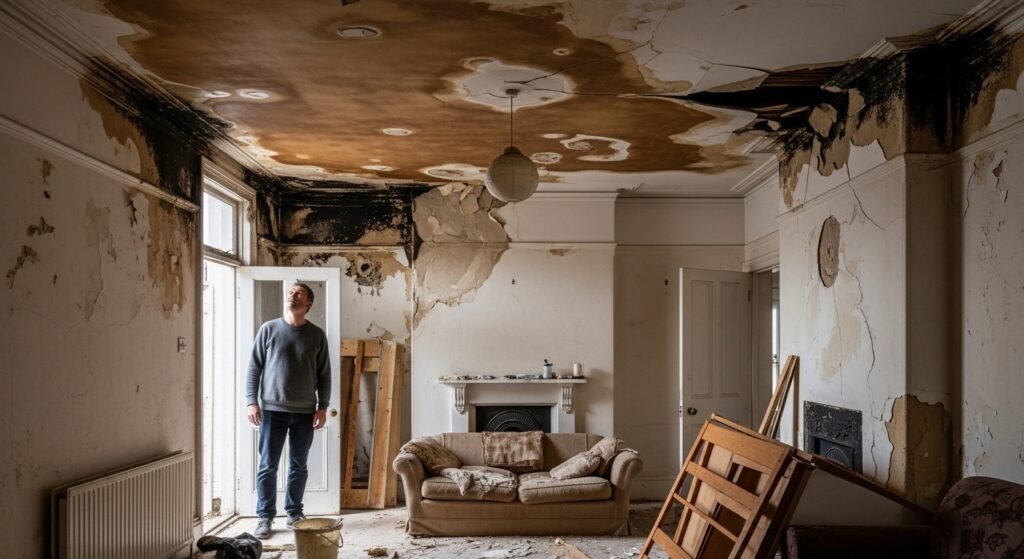
The specific risk with spreading internal damage is that the water has typically compromised the insulation, saturated the ceiling boarding, and potentially begun to affect the structural elements above. Wet mineral wool insulation loses its thermal performance almost entirely. Wet ceiling plasterboard becomes structurally weak, and a weakened wet ceiling represents a collapse risk, particularly if the water is pooling in a void rather than dripping.
On North London’s Victorian terraces, ceilings are often lath and plaster rather than modern plasterboard. Lath and plaster are heavy, rigid materials when dry. When saturated, the plaster key holding it to the lath can fail, causing sections of the ceiling to drop suddenly. A lath and plaster ceiling collapse on the top floor of a Victorian terrace is both a safety hazard and a significant internal repair project.
Mould and Health Consequences
Water that has been present in a ceiling or wall cavity for more than 24 to 48 hours begins to develop mould. The visible brown or black patches that appear in the weeks after a roof leak are the external evidence of mould colonies that are already established inside the wall or ceiling structure. Mould in roof voids and ceiling cavities produces spores that enter the living space and can trigger or worsen respiratory conditions. Children and elderly residents are particularly vulnerable.
This consequence is not solvable by roof repair alone. Once mould has established in insulation or cavity walls, professional remediation is required to prevent its spread and to ensure the air quality in the property is safe. Rapid roof repair that stops the water source significantly reduces the extent and cost of any subsequent mould remediation.
What to Do Right Now
- Move furniture, electronics, and valuables away from the affected ceiling area immediately. Do not assume the ceiling is stable.
- Identify whether there is active water present or whether the damage appears to have dried. Dried damage in a roof that has not been repaired means the leak is intermittent, not resolved.
- Call a roofer for an urgent inspection, even if no active drip is visible. Spreading internal staining without an obvious current leak often indicates that water is tracking along a structural member from an entry point that has not yet been identified.
- Consider a specialist inspection if the affected area is large. Drone inspection and thermal imaging technology is available to North London roofers and can identify the source and extent of moisture in the roof structure without requiring the ceiling to be opened.
How North London’s Housing Stock Creates Specific Risks
Understanding why these signs are more serious in North London than in other parts of the UK helps homeowners make the right call about urgency.
Age of housing stock. The majority of residential properties in Islington, Camden, Hackney, Haringey, and parts of Barnet date from the Victorian and Edwardian periods. Roofs on these properties have 100 to 140 years of weathering behind them. The slate fixings may be original iron nails that are progressively failing. The lead flashings may have been in service for 60 or more years. The timber structure beneath may have had multiple repair cycles of varying quality. Any of these factors means that a visible symptom at the surface may represent a much more extensive underlying problem than it would in a newer building.
Density of development. Victorian terraces are mid-terrace properties on streets where every house is directly joined to its neighbours. A roof that fails on a mid-terrace does not just threaten that property. Water tracking down a party wall can affect adjacent properties, and shared chimneys mean that flashing failures at one property’s chimney can cause water ingress in the neighbouring property’s roof structure.
Conservation area restrictions. Approximately 40 of Islington’s 42 conservation areas operate under Article 4 Directions that restrict permitted development. Similar restrictions apply across large parts of Camden, Hackney, and Haringey. For like-for-like emergency repairs using matching materials, these restrictions do not typically block urgent work. But if a temporary repair uses non-matching materials, or if an emergency patch materially changes the appearance of the roof from the street, it may technically require retrospective consent. A roofer experienced in North London conservation areas will know how to make emergency repairs in a way that is both effective and compliant.
Hard water and lead flashing. Thames Water’s supply to North London is very hard. This accelerates the degradation of lead flashings, which are the most common source of roof leaks on Victorian terraces, through calcite scale formation within the lead joint. An emergency roofing call in North London, where the source is identified as failed chimney flashing, is extremely common for this reason.
What to Expect from an Emergency Roofer in North London
When you call a roofer for an emergency in North London, the immediate goal is to make the property weathertight as quickly as possible, not necessarily to complete the full permanent repair in a single visit. Temporary coverings are common during Hackney roofing callouts.
An emergency response typically involves arriving within one to four hours, depending on current demand and time of day. The roofer will assess the visible damage and, if safe to do so, access the roof to identify the source of the problem. Emergency temporary measures usually include applying a heavy-duty waterproof membrane over exposed areas, tarpaulin covering for larger damaged sections, and emergency lead sealing at chimney flashings.
These temporary measures should stop active water ingress, but should be followed by a permanent repair appointment within a week to two weeks. Permanent follow-up may include full flat roof replacement. A temporary repair on a North London slate roof in winter is not a substitute for the permanent repair; it buys the time needed to procure matching materials and schedule the full job correctly.
Always ask an emergency roofer for written confirmation of the work done and a follow-up appointment for the permanent repair before they leave the site.
FAQ
Q: What counts as a roofing emergency vs a repair that can wait?
A roofing emergency is any situation where the damage threatens safety, is actively worsening in real time, or involves electrical risk. Active water ingress, structural movement, missing slates in a rainstorm, or any water near electrical fittings are all emergencies. A single cracked tile with no associated leak, moss growth, or surface gutter blockage can wait for a scheduled repair appointment.
Q: How do I find a reliable emergency roofer in North London at short notice?
The NFRC (National Federation of Roofing Contractors) and TrustMark both have searchable directories of vetted roofers by postcode. For an emergency call-out, confirm that the roofer carries public liability insurance before they start work, ask for a written quote or at least a verbal quote confirmed by text message, and do not pay the full amount in cash before the job is done. Legitimate emergency roofers will accept card payment and provide a receipt.
Q: Will my home insurance cover emergency roof repair in North London?
Buildings insurance typically covers sudden and unexpected damage, including storm damage, fallen trees, and accidental impact. Gradual deterioration and general wear and tear are usually excluded. If the emergency has a sudden cause, such as a storm or a fallen branch, document it with photographs and report it to your insurer promptly. Your insurer may require you to have emergency repairs carried out to prevent further damage before a full assessment can be made.
Q: Can I do anything myself before the roofer arrives?
The only safe actions are internal: placing buckets to catch water, moving valuables, turning off relevant circuits at the consumer unit if water is near electrical fittings, and documenting the damage with photographs. Do not attempt to access the roof yourself. Working at height on a wet, potentially structurally compromised roof without the correct equipment and training is the cause of a significant number of serious injuries in the UK each year. A temporary repair done incorrectly can also worsen the problem by trapping moisture or directing water to a new entry point.
Conclusion
The five signs that demand an emergency roof repair in North London are: active water entering the property, water near electrical fittings, visible structural sagging or movement, large-scale storm damage with missing slates or tiles, and spreading internal ceiling damage. Each of these escalates with time. Each becomes significantly more expensive if treated as something to monitor rather than something to address immediately.
North London’s Victorian housing stock, its conservation area restrictions, its hard water, and the specific vulnerability of ageing lead flashings and nail-fixed slats make the borough’s roofing emergencies both more common and potentially more serious than in newer housing. Knowing the five signs and understanding what they mean for your specific property type is the first step to acting quickly enough to keep a manageable problem from becoming a serious one. Choosing reliable Camden roofers helps limit damage.

Tilly Bani is a renovation and roofing specialist with over 15 years of experience in construction and property refurbishment across North London. He specialises in roofing, structural repairs, and full home renovations, helping homeowners improve property value and safety.