
| Quick Answer Velux is the market leader and most reliable choice for pitched roof windows, with the widest range of accessories, installer familiarity, and proven 20 to 30-year lifespans. Many homeowners trust premium skylight installation for loft upgrades. Fakro offers comparable quality at 10 to 20% lower cost with strong thermal performance and higher opening angles. Fixed roof windows, either framed or frameless, suit flat roofs and spaces needing light without ventilation, at a lower cost. Most skylight installations do not need planning permission, provided the unit does not project more than 150mm above the roof plane. |
Introduction
A skylight Installation can do more for a dark room than almost any other improvement. Many homes gain brightness through expert roof window fitting. According to Velux’s own daylight studies, a well-placed roof window delivers two to three times more natural light than an equivalent vertical facade window, which explains why loft conversions, kitchen extensions, and dark Victorian terraces across the UK are increasingly fitted with them. They are especially popular during full home refurbishment projects.
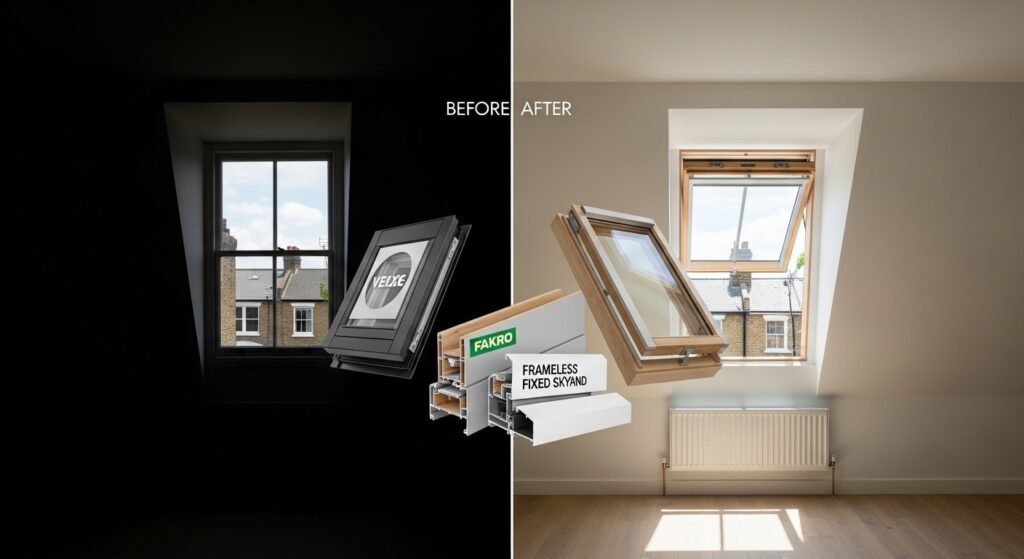
The decision that stops most homeowners is the brand and product type. Velux dominates the market so thoroughly that “Velux” has become shorthand for any roof window, but Fakro produces genuinely competitive products at lower prices, and fixed skylights for flat roofs operate entirely differently from opening roof windows. Getting the type right for your roof and room matters more than brand loyalty.
This guide gives you a direct comparison of all three approaches, the product and cost ranges, planning and building control requirements, and what to expect from a professional installation.
Understanding Skylight Types
Before comparing brands, the choice of skylight type is determined by your roof. Using the wrong type is a structural and waterproofing mistake that cannot be corrected cheaply.
Roof Windows for Pitched Roofs
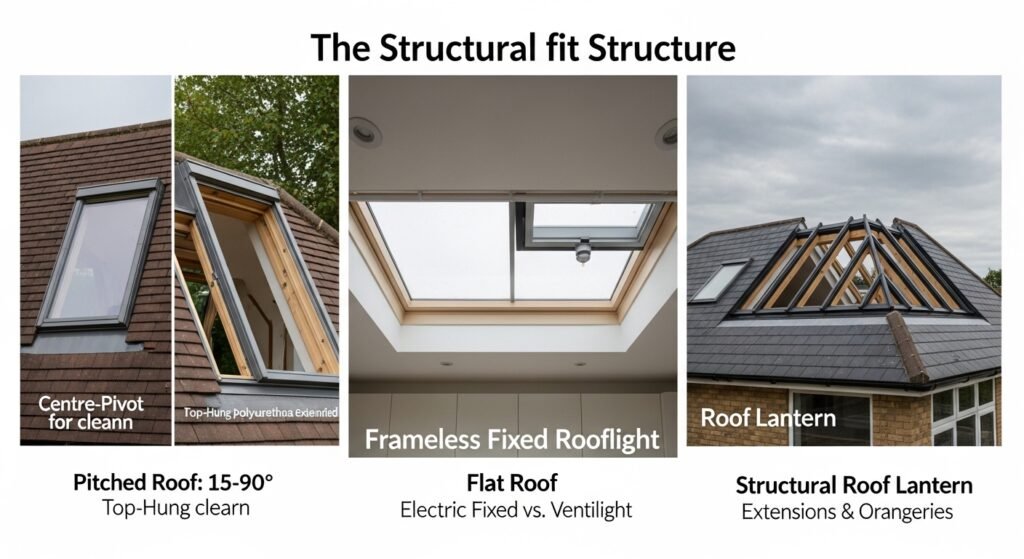
Roof windows sit within the pitch of a sloped roof, typically between 15 and 90 degrees. They are the standard solution for loft conversions, attic rooms, and top-floor bedrooms. Many loft spaces also need durable pitched roof work. Velux and Fakro dominate this category.
Roof windows come in two primary opening mechanisms:
Centre-pivot: The frame rotates 180 degrees around a central axis, allowing the lower half of the glass to swing inward and the upper half outward. This is the most common type, suitable for bedrooms and living rooms where reaching the top half of the window for cleaning is practical. Most Velux and Fakro standard models are centre-pivot.
Top-hung: The frame is hinged at the top, swinging the window outward from the bottom. This gives a clear, unobstructed view downward without the frame crossing the middle of the opening. It provides better headroom in lofts where a centre-pivot would hit a low ceiling or obstruction on the way round. Fakro’s top-hung models are particularly popular in loft conversions for this reason.
Fixed Rooflights for Flat Roofs
Fixed flat roof skylights do not open. They are designed for flat or very low-pitch roofs and admit light without ventilation. They are common on single-storey kitchen extensions, utility areas, hallways, and anywhere where light rather than airflow is the primary need. Rear additions often combine this with kitchen renovation plans.
Modern frameless flat rooflights use aluminium upstands and thermally broken frames with triple glazing. They achieve U-values of 0.9 to 1.2 W/m²K, which comfortably exceeds current Building Regulations requirements of 1.6 W/m²K for replacement windows in existing buildings.
Opening Flat Roof Skylights
Some flat roof installations require ventilation, particularly bathrooms, kitchens, and rooms with no other windows. Wet rooms benefit from quality bathroom upgrades alongside ventilation. Opening flat roof skylights come in manual, electric, and solar-powered variants. Electric and solar-powered opening models can include rain sensors that close the window automatically.
Roof Lanterns
Roof lanterns are structural glass assemblies that rise above the roof plane rather than sitting flush with it. Many extensions choose stylish roof lantern designs. They are typically installed on the flat roofs of extensions and orangeries, creating a sense of height and admitting light from multiple angles. They are more expensive than flat roof skylights and often require planning permission because they project more than 150mm above the roof plane.
Velux Roof Windows: The Market Leader
Velux was founded in Denmark in 1941 and entered the UK market in 1954. It is the most recognised roof window brand globally, with its name now used generically in the way that Hoover was once used for vacuum cleaners.
What Velux Does Well
Installer familiarity. Experienced North London roofers often fit these systems faster. The overwhelming majority of UK roofers have Velux experience. The fitting process, flashing systems, and product range are familiar to most professionals. This familiarity translates into faster, more reliable installations and fewer errors.
Product range. Velux offers more variants than any competitor: manual centre-pivot and top-hung windows, electric and solar-powered opening models, the Cabrio balcony (which converts into an opening balcony), sun tunnels for bringing light into spaces without direct roof access, and a comprehensive range of blinds, shutters, and accessories that are designed specifically for each window size.
Accessories and aftermarket support. Velux blinds, including blackout, pleated, and venetian variants, are available for every window size and are designed to integrate with the frame. Replacement parts, seals, and mechanism components are readily available for windows 20 or more years old.
Thermal performance. Velux’s ThermoTechnology glazing delivers double-glazed U-values of 1.0 to 1.3 W/m²K and triple-glazed options at 0.9 to 1.1 W/m²K. The frames use FSC-certified pine with aluminium external capping.
Warranties. Current Velux products come with a 10-year product warranty, with the glazed unit carrying a 20-year sealed unit guarantee.
Velux Limitations
Price. Velux is the most expensive mainstream roof window brand. Some owners compare costs with Hackney roofers first. A standard GGL centre-pivot window in a 78x98cm size costs approximately £450 to £600 ex-VAT at merchant prices before flashing kit or installation. Premium models, including electric and solar-powered variants, run £700 to £1,800.
Less competitive U-values than Fakro in some configurations. For equivalent price points, Fakro’s thermal performance on some models is marginally better.
Velux Key Product Ranges
- GGL (Centre-Pivot, Pine): The standard residential centre-pivot. Manual opening, pine interior, aluminium exterior. Most commonly installed UK roof window.
- GPL (Top-Hung, Pine): Top-hung opening for better headroom and unobstructed views.
- GGU (Centre-Pivot, Polyurethane): Moisture-resistant polyurethane frame for bathrooms and kitchens.
- INTEGRA (Electric and Solar): Solar-powered and mains-electric opening models with rain sensors and remote control.
- CABRIO: Converts from a roof window into a balcony in a single step, with a two-panel folding mechanism.
Fakro Roof Windows: Strong Alternative at Lower Cost
Fakro was founded in Poland in 1991 and has grown to become the second largest roof window manufacturer globally, with products sold in over 80 countries. In the UK, Fakro is less well-known than Velux but is gaining market share among installers and homeowners who have discovered the quality-to-price ratio.
What Fakro Does Well
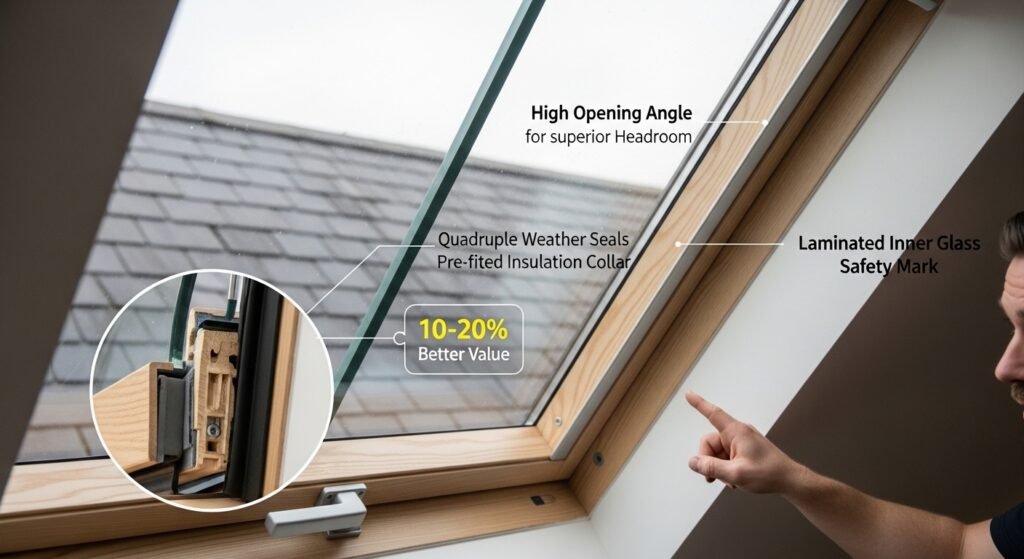
Price. Fakro windows typically cost 10 to 20% less than equivalent Velux models at the unit level. A comparable centre-pivot in the same size costs £380 to £500 ex-VAT at merchant prices.
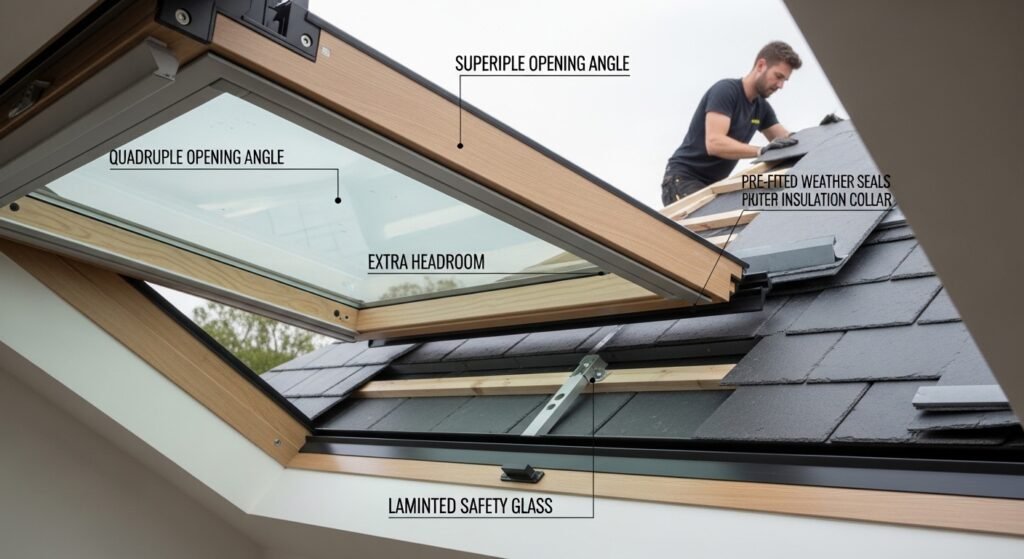
Thermal performance. Fakro is known for strong insulation values. Its standard range achieves U-values of 1.1 to 1.3 W/m²K, and its premium triple-glazed windows achieve 0.9 to 1.0 W/m²K. The pre-fitted insulation collar on Fakro’s pitched roof windows reduces heat loss at the installation joint, which is one of the main thermal weak points of any roof window installation. Energy savings improve further with proper roof insulation.
Opening angle. Fakro top-hung windows open to a greater angle than most equivalent Velux models, which is useful in tight loft spaces and for ventilation. The centre-pivot models also open slightly higher than direct Velux equivalents.
Glazing quality. Fakro’s standard double glazing uses laminated inner glass, which provides additional safety and impact resistance compared to standard glass.
Quadruple weather seals. Fakro’s standard models include four independent rubber seals around the frame perimeter, compared to fewer on some Velux equivalents. This reduces the risk of wind-driven rain penetrating the window-to-frame joint.
Fakro Limitations
Installer familiarity. Most UK roofers default to Velux. Fewer have Fakro-specific installation experience, which can occasionally mean a longer fit time or reluctance from some contractors to use Fakro. This is changing as more installers use both brands.
Accessories range. Fakro offers a solid but less extensive accessories range than Velux. The blind range is good, but less choice than Velux’s comprehensive lineup, and availability at trade counters and merchants is less consistent.
Resale perception. Velux carries stronger brand recognition in UK property surveys and estate agent valuations. In a loft conversion that will be sold within 5 to 10 years, some homeowners and buyers associate Velux specifically with quality, regardless of whether Fakro windows are equivalent or superior in specification.
Fakro Key Product Ranges
- FTP-V (Centre-Pivot, Pine): The standard Fakro centre-pivot equivalent to Velux GGL. Competitive pricing and strong thermal performance.
- FHV (Top-Hung, Pine): Top-hung opening with a high opening angle.
- FTP-V U4 and U6 (Triple Glazing): Enhanced thermal performance models achieving 0.9 to 1.0 W/m²K.
- FTP-V SSL (Electric and Solar): Solar-powered and mains-electric models with rain sensors, broadly equivalent in function to Velux INTEGRA.
Fixed Roof Windows and Flat Roof Skylights
For flat roofs and low-pitch applications, the Velux vs Fakro comparison is largely irrelevant. Both brands produce flat roof products, but the dominant products in the fixed flat roof market are architectural rooflights from brands including Korniche, Roof Maker, and frameless systems from specialist manufacturers.
Fixed Framed Flat Rooflights
Framed flat rooflights use a thermally broken aluminium frame mounted on an upstand (a raised kerb around the opening). They are the standard type for most residential extension flat roof applications. Many extensions use reliable EPDM roofing around openings.
Specification features to look for in 2026:
- U-value of 1.2 W/m²K or better (triple glazing achieves 0.9 to 1.1 W/m²K)
- Thermally broken frame to prevent cold bridging at the aluminium
- Self-cleaning glass coating (a hydrophilic coating that uses UV light and rain to break down organic matter, reducing cleaning frequency)
- Toughened and laminated inner glass for safety
- Minimum roof pitch of 1 to 2 degrees to prevent water ponding on the glass
Frameless Flat Rooflights
Frameless rooflights use structural glass bonded into the upstand with no visible frame on the interior or exterior. They offer a cleaner aesthetic and maximise the glazed area for a given opening size. Modern finishes pair well with interior plastering upgrades. They cost more than framed equivalents, typically £700 to £2,500 for the unit, depending on size.
Roof Lanterns
Roof lanterns sit above the roof plane and are glazed on all four sides plus the top, creating a lantern effect that admits light from multiple angles. Popular brands include Korniche, Roof Maker, and Atlas.
A 1,000×2,000mm Korniche roof lantern costs approximately £1,500 to £2,500 supply-only. Installation adds £600 to £1,500, depending on the structural preparation needed.
Costs: Supply and Installation
These are realistic 2026 UK costs for the most common skylight installation scenarios, reflecting national averages. London and the South East add approximately 20 to 25%.
Pitched Roof Windows (Supply + Installation + Flashing)
| Product | Size | Supply | Flashing | Installation | Total |
|---|---|---|---|---|---|
| Velux GGL (manual centre-pivot) | 55×78cm | £300–£450 | £80–£150 | £300–£500 | £680–£1,100 |
| Velux GGL (manual centre-pivot) | 78×98cm | £450–£600 | £100–£180 | £300–£500 | £850–£1,280 |
| Velux INTEGRA (electric) | 78×98cm | £700–£1,000 | £100–£180 | £400–£600 | £1,200–£1,780 |
| Fakro FTP-V (manual centre-pivot) | 55×78cm | £260–£380 | £80–£140 | £300–£500 | £640–£1,020 |
| Fakro FTP-V (manual centre-pivot) | 78×98cm | £380–£500 | £100–£160 | £300–£500 | £780–£1,160 |
| Keylite (manual centre-pivot) | 78×98cm | £250–£380 | £80–£130 | £300–£500 | £630–£1,010 |
Flat Roof Skylights (Supply + Upstand + Installation)
| Type | Size | Total Installed |
|---|---|---|
| Fixed framed rooflight (standard) | 600×900mm | £800–£1,400 |
| Fixed framed rooflight (standard) | 1,000×1,200mm | £1,200–£2,200 |
| Frameless triple-glazed rooflight | 1,000×1,200mm | £1,500–£2,800 |
| Opening flat roof skylight (manual) | 600×900mm | £1,000–£1,800 |
| Opening flat roof skylight (electric) | 1,000×1,200mm | £1,800–£3,500 |
| Roof lantern | 1,000×2,000mm | £2,500–£5,000 |
Additional Costs to Budget For
Scaffolding: Required for most installations on properties above single-storey. Budget £500 to £1,200, depending on height and footprint.
Structural modifications: If rafters need to be cut to create the opening, temporary support must be installed and a trimmer (doubled rafter) added around the opening. This adds £300 to £800 in labour and materials and is typically needed when the opening is larger than a single rafter bay.
Internal finishing: Plasterboard, skimming, and painting around the reveal after installation. Budget £200 to £500, depending on the depth of the reveal and condition of existing work. Access equipment is common for larger roof access jobs.
Blinds and accessories: Velux blackout blinds for a standard 78×98cm window cost £80 to £200, depending on type. Budget for accessories when comparing total installation costs across brands.
Planning Permission and Building Regulations
Planning Permission
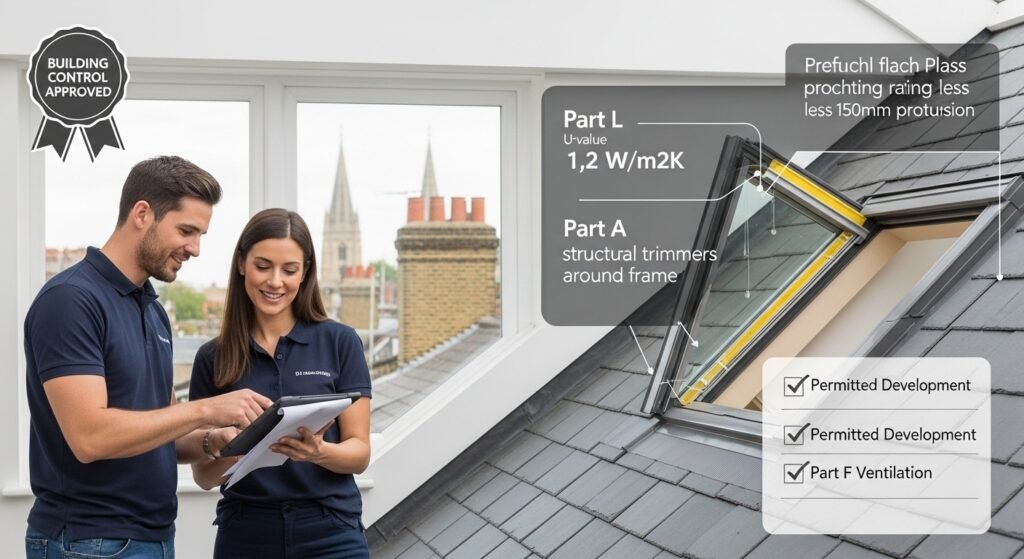
Most skylight installations in the UK are permitted development and do not require planning permission, provided:
- The skylight does not protrude more than 150mm above the existing roof plane
- The installation does not increase the volume of the roof space beyond permitted development limits
- The property is not in a conservation area, a World Heritage Site, an Area of Outstanding Natural Beauty, or a National Park
In conservation areas, any alteration to the roof requires planning permission, including skylight installation. Owners often consult local Islington builders before changes. Many conservation area design guides also specify that skylights on the front (street-facing) slope of a roof are not acceptable, while rear-slope skylights may be permitted. In Islington alone, 40 of 42 conservation areas operate under Article 4 Directions that restrict permitted development. Always check with the local planning authority before installation in a conservation area.
Roof lanterns that project more than 150mm above the roof plane require planning permission regardless of conservation area status.
Building Regulations
All skylight installations are building work that must comply with Building Regulations, specifically:
- Part L (Energy Efficiency): The installed window must achieve a U-value of 1.6 W/m²K or better for a replacement in an existing building, or 1.4 W/m²K for an extension. Modern double-glazed roof windows from Velux, Fakro, and others achieve 1.0 to 1.3 W/m²K, comfortably meeting this requirement.
- Part A (Structure): Where structural members are cut or modified, the work must be structurally adequate. A Structural Engineer’s approval may be required for larger openings.
- Part F (Ventilation): Opening skylights in habitable rooms must provide adequate ventilation. The minimum opening area is 1/20th of the floor area in bedrooms, bathrooms, and kitchens.
For a straightforward like-for-like replacement of an existing skylight with a new unit of similar size, Building Regulations approval is technically required but can often be self-certified through a competent person scheme. Your installer should confirm this.
For new openings or loft conversions, Building Regulations approval must be obtained from your local authority Building Control department before work begins.
Choosing the Right Skylight for Your Project
Loft Conversion Bedroom or Study
Best choice: Velux GGL or Fakro FTP-V centre-pivot, or GPL/FHV top-hung if headroom is limited.
For a main living space in a loft conversion, quality matters over a 20 to 30-year horizon. Both Velux and Fakro deliver. Choose Velux if the installer is more experienced with it, resale value is a priority, or you want the widest accessories range. Choose Fakro if your budget is tighter, you want better opening angles, or you want to specify triple glazing at a lower cost.
Bathroom or Kitchen Roof Window
Best choice: Velux GGU (polyurethane frame) or Fakro FTP-V in a moisture-resistant finish.
Standard pine frames can swell and warp in high-moisture environments. Both Velux’s polyurethane GGU range and Fakro’s moisture-resistant models are specifically designed for wet areas. Ventilation is essential in bathrooms: ensure the opening area meets Part F requirements.
Flat Roof Extension (Kitchen or Living Room)
Best choice: Fixed framed rooflight with triple glazing for energy efficiency, or an opening electric model if ventilation is needed.
For a new kitchen extension that is already well-ventilated, a fixed triple-glazed rooflight delivers maximum light with no maintenance requirements and excellent thermal performance. If the room has limited other ventilation, an electric opening model with a rain sensor offers automatic ventilation management.
Conservation Area Victorian Terrace
Best choice: Rear-slope only, like-for-like replacement matching existing profile, with Velux Conservation series or equivalent.
Front-facing slopes in conservation areas almost always require planning permission and are usually refused. Rear-facing skylights are more likely to be approved. Velux’s Conservation roof window range uses low-profile, flush-fitting designs specifically intended for sensitive planning contexts. Check with the local planning authority before specifying any product.
Budget-Constrained Projects (Garages, Outbuildings, Secondary Rooms)
Best choice: Keylite or budget fixed skylight.
For spaces where longevity and accessories range matter less, Keylite provides a functional centre-pivot roof window at the lowest mainstream price point. Fixed budget rooflights are appropriate for detached garages and outbuildings. The quality difference versus Velux is real but less consequential in low-use spaces.
Installation: What to Expect
A standard single-pitched roof window installation by a professional roofer takes four to six hours from start to finish. Qualified teams offering roof repair services often handle installs too. including:
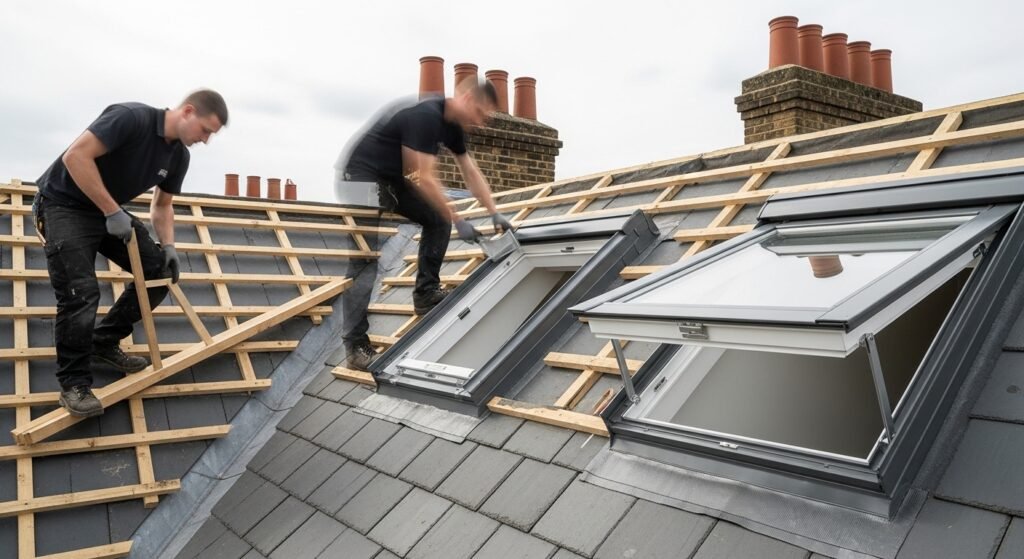
- Marking and cutting the opening between rafters
- Fitting the lining frame to the structural opening
- Bedding and fixing the window frame
- Installing the flashing kit with weathering to the surrounding tiles or slates
- Fitting and sealing the internal reveal
- Testing the opening mechanism
Where a structural opening must be created by cutting a rafter, additional time and materials add two to four hours for fitting a trimmer and temporary support.
Flat roof skylight installations typically take similar or slightly longer, depending on the waterproofing complexity at the upstand junction.
Ask your installer to confirm:
- The specific flashing kit being used and whether it matches the roof material and pitch
- Whether the installation includes testing the sealed unit and confirming no condensation between panes
- What is the building control or self-certification process for the installation
- Whether the scaffold is included in the quote
FAQ
Q: Is Velux worth the premium over Fakro?
For a main residential application, such as a loft bedroom or kitchen extension, the Velux premium is justifiable if installer familiarity is strong, if you want the widest accessories range, or if resale recognition matters. If you are primarily focused on thermal performance, value, or a higher opening angle, Fakro delivers genuinely competitive quality. The quality gap between Velux and Fakro is smaller than the price gap in most configurations.
Q: Do I need planning permission for a skylight in the UK?
Most skylight installations are permitted development and do not require planning permission, as long as the unit does not protrude more than 150mm above the roof plane, does not front a highway, and the property is not in a conservation area, National Park, or Area of Outstanding Natural Beauty. Conservation areas almost always require planning permission for any external roof alteration. Always confirm with your local planning authority before installing in a sensitive location.
Q: What is the difference between a skylight and a roof window?
They are often used interchangeably. Technically, a roof window is designed specifically for pitched roofs and can be opened for ventilation. A skylight or rooflight is often a fixed unit and can be used on both pitched and flat roofs. In practice, Velux uses “roof window” for pitched applications and “skylight” for flat roof products. Fixed rooflights are sometimes called flat roof skylights regardless of whether they open.
Q: How long does a skylight installation take?
A single-pitched roof window installation takes four to six hours for a straightforward replacement or new installation between existing rafters. Creating a new structural opening that requires cutting a rafter adds two to four hours. A flat roof rooflight installation takes a similar time but may be longer if the upstand preparation or waterproofing is complex. Multiple windows in a loft conversion are typically completed over one to two days.
Q: What U-value should I specify for a skylight in 2026?
Building Regulations Part L requires a maximum U-value of 1.6 W/m²K for replacement windows and 1.4 W/m²K for new windows in extensions. For thermal performance that goes beyond the minimum and reduces heat loss meaningfully, specify a double-glazed window at 1.0 to 1.3 W/m²K or a triple-glazed window at 0.9 to 1.1 W/m²K. The difference in annual heat loss between a 1.3 and 0.9 U-value window is material on a north-facing roof where the window receives limited solar gain.
Conclusion
For pitched roof windows, the Velux vs Fakro decision is genuinely close. Velux wins on installer familiarity, accessories range, and brand recognition. Fakro wins on unit cost, some thermal specifications, and opening angles. Both are significantly better than the budget options sold by lesser-known brands, and both will last 20 to 30 years with normal maintenance.
For flat roofs, fixed rooflights from quality manufacturers with triple glazing, thermally broken frames, and self-cleaning glass are the correct specification in 2026, regardless of brand. The opening vs fixed decision is driven by whether ventilation is needed, not by cost alone.
In all cases, the installer matters as much as the product. The best Fakro window fitted by an experienced installer outperforms a Velux fitted by someone unfamiliar with its flashing requirements. Get three written quotes, confirm flashing specification and Building Regulations compliance, and choose the contractor as carefully as the product. Choose trusted local Camden roofers for the best results.

Tilly Bani is a renovation and roofing specialist with over 15 years of experience in construction and property refurbishment across North London. He specialises in roofing, structural repairs, and full home renovations, helping homeowners improve property value and safety.