
| Quick Answer For a house extension in Hackney, you need both a structural engineer and a builder, but they serve entirely different functions. The structural engineer produces the calculations and drawings that prove the extension is structurally safe. The builder uses those drawings to physically construct it. Neither replaces the other. In a Hackney Victorian terrace, where most extensions involve removing load-bearing walls, installing steel beams, and connecting new foundations to 130-year-old footings, skipping the structural engineer is not a cost saving. It is a liability. |
Introduction
When Hackney homeowners start planning a rear extension, side return, or loft conversion, the question of the professional team comes up quickly. You need an architect, possibly a planning consultant, a builder, and, most people discover eventually, a structural engineer. Larger projects are often managed through one contractor offering complete building services. The confusion is understandable. Builders are experienced, confident people who build extensions every week. Why do you need a separate professional to tell them how?
The answer lies in what each person is actually qualified and insured to do. A structural engineer and a builder have distinct, non-overlapping roles in an extension project. Understanding where one ends and the other begins prevents the most expensive mistakes in Hackney extension projects: undersized steel beams, failed Building Control inspections, and structural problems that emerge years after the build is complete.
This guide explains what each professional does, when you need each one, what they cost in Hackney and the surrounding boroughs, and how they work together through a typical extension project. Many owners planning bigger upgrades also compare full refurbishment options at the same time.
What a Structural Engineer Actually Does
A structural engineer is a chartered professional who specialises in calculating how loads move through a building. Their job is not designed in the architectural sense. They do not decide where your kitchen island goes or what the bi-fold doors look like. Those layout choices usually sit within the wider kitchen installation design process. They determine whether the building will remain standing safely once the work is complete.
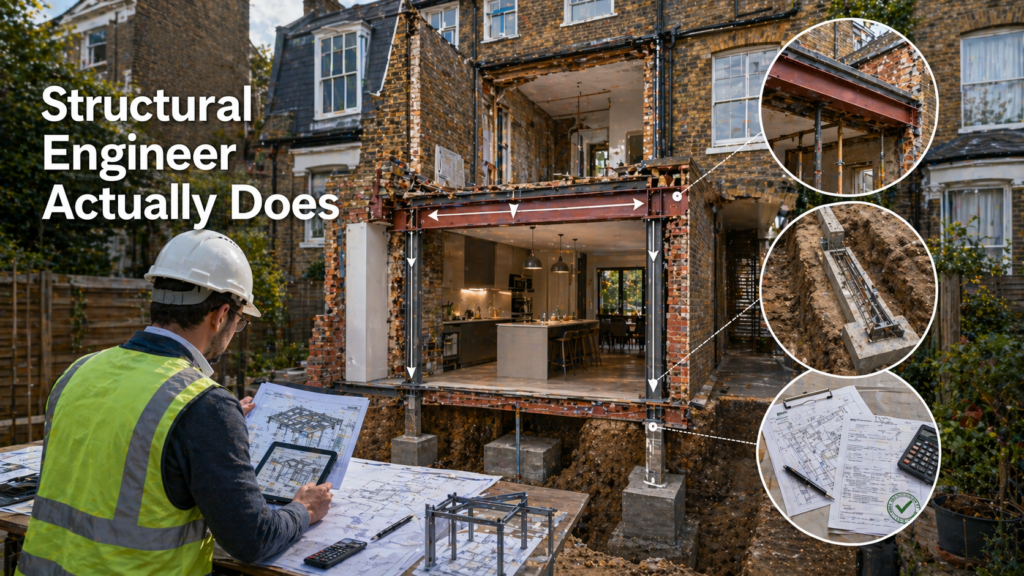
For a house extension in Hackney, the structural engineer’s work typically covers three main areas.
Steel beam design. When the existing wall between your kitchen and the new extension is removed to create an open-plan space, something must carry the load above that opening. In a Victorian mid-terrace, the wall being removed is almost always load-bearing. The structural engineer calculates the exact RSJ (rolled steel joist) beam size needed to span the opening safely, accounting for the weight of the floor or roof above and the point loads at each end of the beam.
Foundation design. The new extension needs its own foundations. Groundworks can also uncover issues needing drainage repairs before concrete is poured. For a Hackney Victorian terrace, the structural engineer assesses the soil conditions, the proximity to existing tree root systems (significant in De Beauvoir Town and London Fields where mature street trees are common), the depth and condition of the existing house footings, and the load the new structure will impose. They then specify the foundation type, whether strip, raft, pad, or mini-piled, and the dimensions needed.
Structural calculations for Building Control. Building Control will not issue a completion certificate without structural calculations demonstrating that the extension meets the requirements of Approved Document A (Structure) of the Building Regulations. These calculations must be produced by a qualified engineer. A builder cannot produce them, and an architect, unless they are also a structural engineer, cannot produce them either.
What a Builder Actually Does
A builder plans and executes the physical construction. This often includes coordinating roofing services, trades, and deliveries. On a Hackney extension project, the builder’s responsibilities cover excavation and foundation construction, masonry and blockwork, structural steelwork installation (fitting beams to the engineer’s specification), roofing, glazing installation, plastering and first-fix services, flooring, and finishing trades. Final stages may also include painting decorating and snagging works.
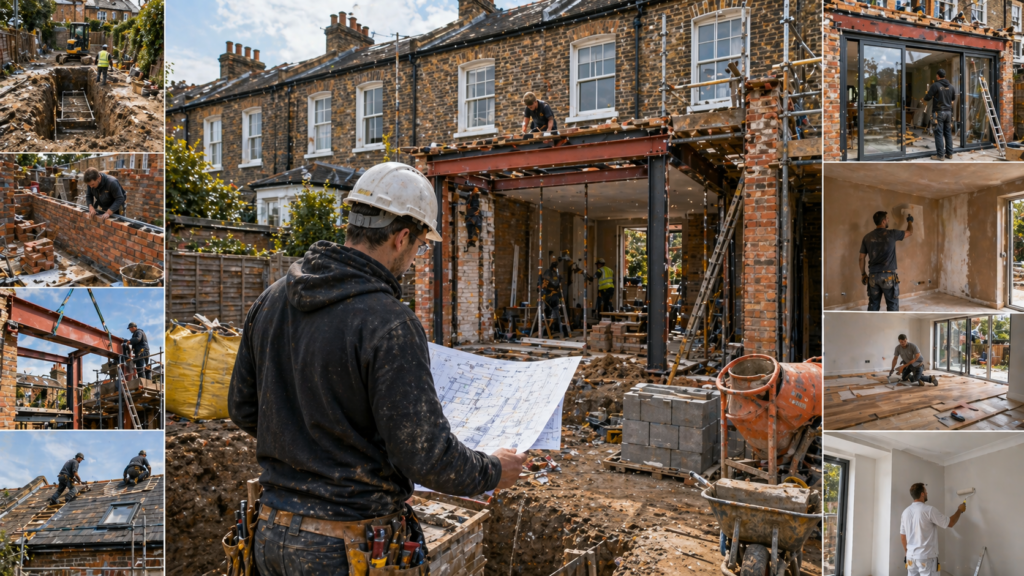
A good builder in Hackney coordinates the other trades, manages the site program, orders materials, and ensures the work follows the structural engineer’s drawings. They do not generate those drawings. They follow them.
This is the key distinction. A reputable builder takes the structural engineer’s specification and builds to it. They ask the engineer when site conditions differ from what was assumed (a common occurrence in Hackney Victorian terraces where the existing foundation depths often turn out to be shallower than expected). They document deviations and request sign-off.
A builder who claims they do not need a structural engineer because they “know what beam to use” from experience is telling you they are willing to work without calculations that Building Control will require. This either means the project will fail its Building Control inspection, or that the completion certificate will be obtained by someone submitting calculations after the fact. Neither is a position you want to be in.
Why Victorian Terraces in Hackney Make a Structural Engineer Essential
Standard UK guidance already makes a structural engineer effectively mandatory for any extension involving wall removal or new foundations. In Hackney Victorian terraces specifically, the case is even stronger.
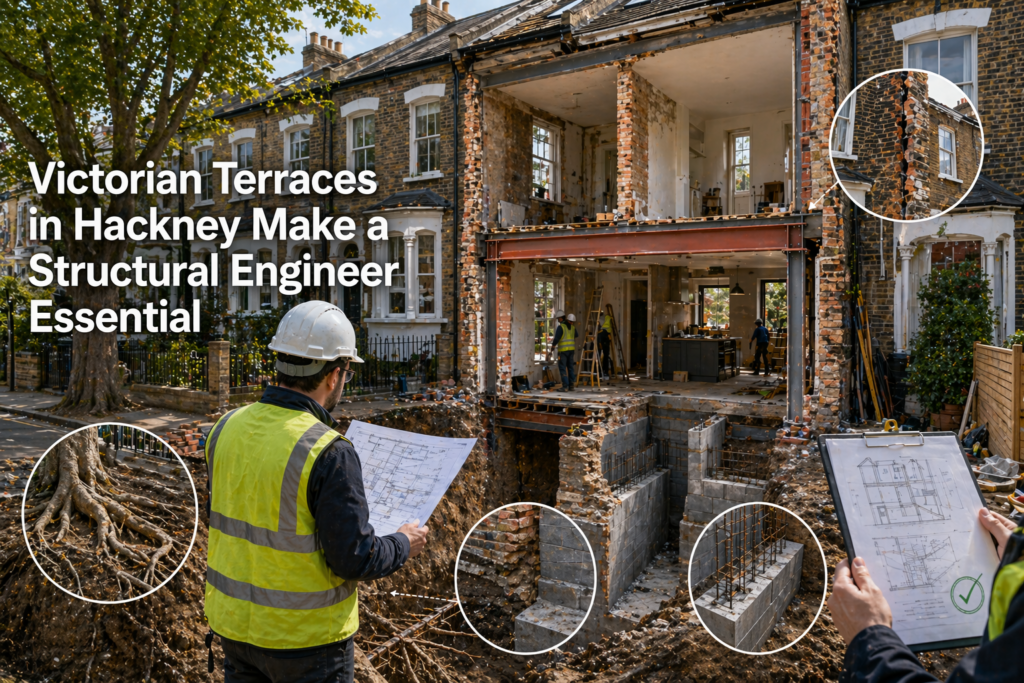
Load-bearing walls are not always obvious. Victorian terraces have solid brick construction throughout. Most of the internal ground-floor walls are load-bearing. The rear kitchen wall adjacent to where the extension connects is typically load-bearing. Even experienced builders misidentify load-bearing walls in Victorian properties.
Existing foundations are shallow and variable. Older services may also require pipework replacement during excavation. Victorian terraces were built on strip foundations that are often 450mm deep or less. Modern extensions are typically specified to 900mm or deeper. Where the new foundations connect to the existing, the structural engineer must design the junction to manage differential settlement and load transfer safely.
Tree root proximity. This can affect drainage lines and later leak detection work if roots have caused movement. Hackney’s residential streets, particularly in De Beauvoir Town, Clapton, London Fields, and around Victoria Park, have significant mature tree populations. Tree root systems extend 1.5 to 2 times the height of the tree and can affect foundation design significantly. Where extensions are proposed within root protection zones, the structural engineer may specify modified foundations such as mini-piles or reinforced rafts to avoid root damage and ensure stability.
Party wall complications. Extensions on Hackney mid-terraces frequently involve excavation adjacent to or along a shared party wall foundation. The structural engineer assesses the risk to the neighbour’s existing foundations and, where necessary, specifies temporary or permanent protection works. This assessment sits entirely within the structural engineer’s domain, not the builder’s.
Building Control scrutiny. Hackney’s Building Control department applies standard national requirements. Calculations must be submitted, and site inspections are conducted at key stages. The inspector will check that steelwork matches the engineer’s specification, that foundations reach the specified depth, and that the structural junction between old and new is correctly executed. Without approved calculations, the site is stopped.
The Professional Team for a Hackney Extension: Who Does What
Most Hackney extension projects involve at least three distinct professionals alongside the builder. Understanding their roles prevents duplication of fees and gaps in coverage.
Architect or architectural technician. Designs the extension layout, produces the planning drawings, and submits the planning application. Many modern layouts include open-plan kitchen renovation as part of the scheme. In many cases, the architect also produces the building regulations drawings showing the non-structural elements such as insulation, ventilation, drainage, and fire safety. The architect does not produce structural calculations unless they are also a qualified structural engineer, which is rare.
Structural engineer. Produces the structural calculations, beam specifications, foundation design, and structural drawings. These are submitted to Building Control alongside or separately from the architect’s drawings. The structural engineer may attend the site to inspect foundations before concrete is poured and steel before it is fixed, depending on the complexity of the project.
Builder. Constructs the extension following the architect’s design drawings and the structural engineer’s structural drawings. Coordinates all trades on site. Manages the Building Control inspection process in conjunction with the structural engineer.
Party wall surveyor. Required if the extension involves excavation near or works on a shared boundary or party wall. Separate from both the structural engineer and the builder.
The sequence matters. The architect produces the design. The structural engineer then analyses the design and produces structural specifications. The builder then prices and builds to both sets of drawings. Commissioning the structural engineer before the design is finalised leads to abortive costs if the design changes.
When a Builder Can Proceed Without a Separate Structural Engineer
There are genuine, limited situations where a separate structural engineer appointment is not needed.
A builder who holds structural engineering qualifications. Some small building firms operating in Hackney have qualified engineers within their team. If a person who is a member of the Institution of Structural Engineers (IStructE) or the Institution of Civil Engineers (ICE) is producing the calculations for your project, it does not matter that they are employed by the builder. The qualification, not the job title, is what matters.
An architect who provides structural engineering as part of their service. Some architectural practices include a structural engineering service, often by working with an in-house engineer. If the architect’s fee proposal explicitly includes structural calculations and the person producing them is a qualified engineer, a separate appointment is not needed. Confirm this before assuming.
A conservatory or glazed lean-to with no wall removal. Where roof glazing is added, owners often use skylight installation specialists. The narrowest exception. A small glazed structure attached to the rear of the house, where no load-bearing wall is removed and the existing structure is not altered, may not require formal structural calculations. Building Control would confirm this on a case-by-case basis. This exception does not apply to any extension involving wall removal or structural openings, which covers most Hackney extension projects.
What a Structural Engineer Costs in Hackney: 2026 Figures
Structural engineering fees in Hackney and the surrounding inner London boroughs reflect the London premium on professional services.
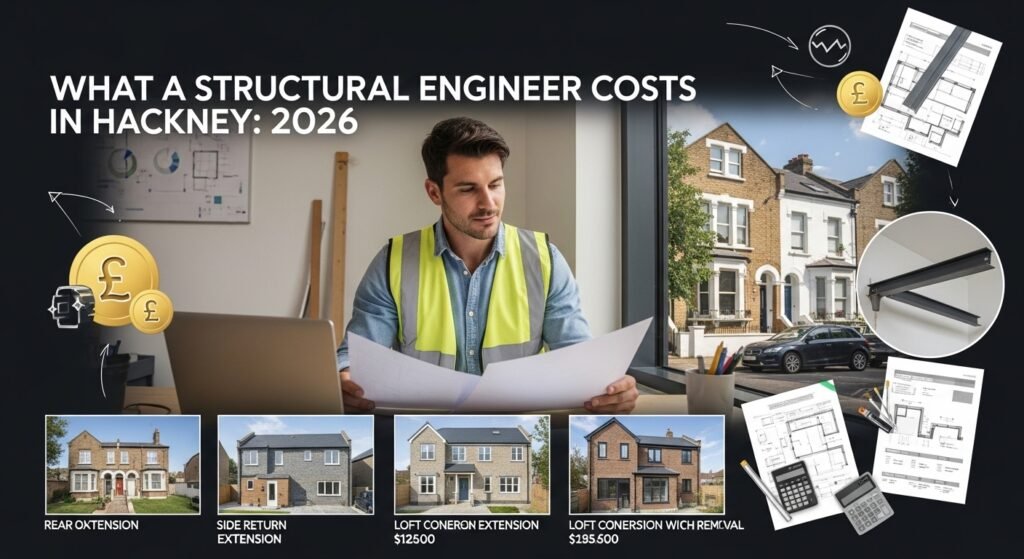
| Project Type | Typical Fee |
|---|---|
| Single-storey rear extension (calculations and drawings), Many projects later include fitted kitchen fitters within the overall budget. | £1,200 to £2,500 |
| Side return extension | £1,500 to £2,800 |
| Wraparound or L-shaped extension | £2,000 to £4,000 |
| Double-storey rear extension | £2,500 to £5,000 |
| Loft conversion with dormer | £1,200 to £2,500 |
| Wall removal only (no extension) | £600 to £1,200 |
Fees are typically charged as a fixed project fee once the engineer has seen the architect’s drawings. Some engineers charge hourly rates of £100 to £200 per hour, which can work out higher than a fixed fee for complex projects. Always confirm whether the fee includes site inspection visits, which building control may require at foundation and steelwork stages.
Structural engineering fees in London are 15 to 25% higher than national UK averages, reflecting higher labour costs, travel time, and the complexity of working on Victorian terrace stock where existing conditions are unpredictable.
How to Find a Structural Engineer for a Hackney Extension
The Institution of Structural Engineers (IStructE) maintains a searchable register of chartered members at istructe.org. The Institution of Civil Engineers (ICE) has a similar register at ice.org.uk. Both organisations require members to demonstrate competence, hold professional indemnity insurance, and comply with professional conduct standards.
Professional indemnity insurance is the critical requirement. It is just as important as using qualified teams for certified electrical work. If a structural engineer’s calculations are wrong and your extension suffers structural failure, their professional indemnity policy covers the cost of remediation. An engineer without PI insurance provides calculations without financial accountability for errors. Always confirm PI insurance is in place before appointing.
Many Hackney homeowners find their structural engineer through their architect, who will have established working relationships with engineers experienced in Hackney Victorian terrace construction. This is usually the most efficient route, because the architect and engineer communicate directly during the design stage rather than through the homeowner as an intermediary.
FAQs
Q: Can my builder produce the structural calculations for Building Control?
Builders cannot produce structural calculations unless they hold a structural engineering qualification. Building Control requires calculations to be produced by a suitably qualified person, which in practice means a member of IStructE or ICE. A builder who claims to produce their own calculations is either unqualified to do so, or is using standard tables rather than project-specific calculations, which may not satisfy Building Control for a complex Hackney Victorian terrace extension.
Q: Do I need a structural engineer even if my extension is under permitted development?
Yes. Permitted development determines whether planning permission is required. It has no bearing on whether Building Regulations approval is needed. All extensions require Building Regulations approval regardless of their planning status. Building Regulations in turn require structural calculations for any extension involving wall removal or new foundations. So a permitted development extension still needs a structural engineer.
Q: How does the structural engineer know what beam size to specify?
The engineer calculates the span of the opening, the load above (typically the floor joists or roof structure), the tributary area of load flowing to the beam, and the bearing conditions at each end. For a typical Hackney Victorian terrace, a rear kitchen opening of 3 to 4 metres will commonly require a 152 x 89 UB (Universal Beam) or 203 x 133 UB section, though the actual specification is project-specific. The engineer then specifies padstones or bearing plates at each end to distribute the point load safely into the masonry below.
Q: What happens if I skip the structural engineer and use my builder’s judgment?
Building Control will not issue a completion certificate without structural calculations. Without a completion certificate, your extension is technically unauthorised. When you sell the property, the buyer’s solicitor will identify the absence of a completion certificate and may require either retrospective calculations and inspection, which requires the structure to be partially exposed, or indemnity insurance, which does not fix the structural risk. Additionally, if the structure fails, you have no professional indemnity coverage to draw on.
Q: How long does it take to get structural calculations in Hackney?
Most structural engineers working on Hackney residential extension projects turn around calculations within 3 to 10 working days of receiving the architect’s drawings and any site measurement information they need. More complex projects or those requiring site visits first can take two to three weeks. Factor this into the project program: the structural calculations must be complete before the building control application is submitted, and building control must approve the calculations before construction reaches the relevant stages.
Q: Should I appoint the structural engineer before or after getting planning permission?
In most cases, after planning permission is granted. If the planning design may change following application and negotiation with the planning officer, commissioning structural calculations before the design is finalised risks abortive fees if the design changes. The architect may need outline structural input during the planning stage to confirm the design is structurally feasible, but the full calculation package is typically produced once planning is confirmed and the design is locked.
Conclusion
For a house extension in Hackney, the structural engineer and the builder are both essential and non-interchangeable. The engineer produces the technical proof that the extension is safe. The builder constructs it. Attempting to use one to replace the other is the most common professional mistake in Hackney extension projects, and it creates liability that follows the property for as long as you own it.
In Hackney’s Victorian terrace stock, where load-bearing walls are everywhere, foundations are old and shallow, tree root systems affect ground conditions, and Building Control scrutiny is consistent, the structural engineer’s fee of £1,200 to £2,500 is one of the most cost-effective parts of the entire project. It is the fee that ensures the other £80,000 to £120,000 you are spending on the build is not wasted on a structure that fails an inspection, damages a party wall, or develops cracks within five years. Appoint both. Use each for what they are qualified to do. The strongest results usually come from experienced London builders working alongside the right consultants.

Tilly Bani is a renovation and roofing specialist with over 15 years of experience in construction and property refurbishment across North London. He specialises in roofing, structural repairs, and full home renovations, helping homeowners improve property value and safety.