
Electric underfloor heating costs about £50 to £100 per m² to install in London, so a small bathroom usually comes to £600 to £1,100 including the thermostat and electrician’s certificate. Wet underfloor heating costs more to fit, roughly £90 to £180 per m² plus £600 to £1,200 for the manifold and mixing unit, so a 25 m² kitchen extension is typically £3,000 to £5,000.
Electric is cheaper to install but costs about three times as much to run as a wet system on a gas boiler. That makes electric the better choice for bathrooms and small rooms, and wet the better choice for kitchen extensions, open-plan ground floors and whole-house heating.
How Much Does Underfloor Heating Cost to Install?
The cost depends on three things: whether the system is wet or electric, the size of the room, and what the existing floor is like. The table below shows typical supply-and-fit prices in London for the rooms we are asked about most, including insulation boards, controls and VAT, but excluding the final floor finish.

| Room | Typical size | Electric system | Wet system |
|---|---|---|---|
| Small bathroom or en-suite | 3 to 5 m² | £600 to £1,100 | £1,200 to £2,200 |
| Family bathroom | 5 to 8 m² | £800 to £1,400 | £1,500 to £2,600 |
| Kitchen or kitchen-diner | 15 to 20 m² | £1,200 to £2,400 | £2,200 to £3,800 |
| Kitchen extension | 25 to 30 m² | £1,600 to £3,400 | £3,000 to £5,000 |
| Whole ground floor | 40 to 60 m² | Rarely the right choice | £5,000 to £9,000 |
Wet systems carry a fixed cost for the manifold, pump and mixing valve, whatever the room size, which is why they look expensive in a small bathroom and good value across a large floor. Our underfloor heating installations are usually planned as part of a wider kitchen, bathroom or extension project for that reason.
What Changes the Price
The floor underneath matters more than most people expect. A new extension with a fresh concrete slab is the easiest case, because the pipes go straight into the screed. An existing room means lifting the old floor or laying a low-profile system on top, which adds labour and raises the floor level.
Other factors that move the price are the number of separately controlled zones, the type of thermostat, whether the boiler needs upgrading to supply the extra load, and how much levelling the subfloor needs before anything is laid.
Electric Underfloor Heating Cost
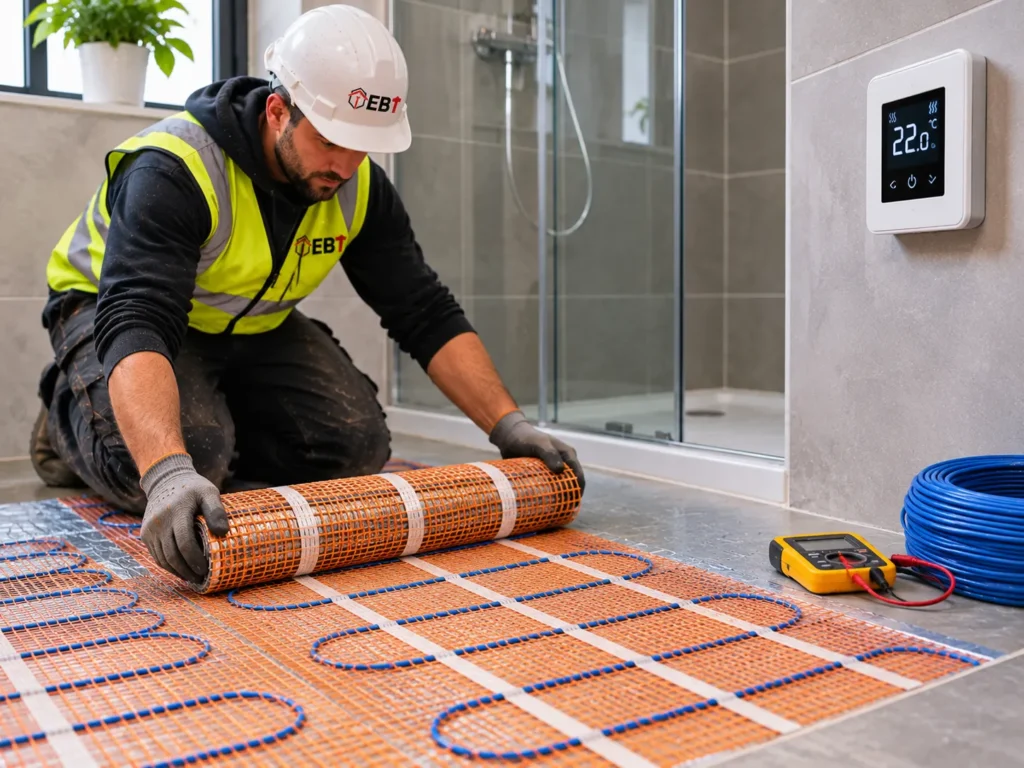
Electric underfloor heating uses thin heating cables or mats laid under the floor finish and wired to a thermostat. There is no plumbing involved, which keeps the cost and disruption down.
Types of Electric Systems
There are a few types of electric systems, and the right one depends on the floor finish going on top:
- Heating mats: cables pre-fixed to a mesh, rolled out under tile adhesive. The usual choice for bathrooms.
- Loose cable: a single cable fixed to the floor by hand, used in awkward rooms with lots of corners.
- Foil heaters: a thin foil element laid under floating wood, laminate or LVT, with no adhesive or screed.
Across these types, supply and fitting usually costs £50 to £100 per m² in London once insulation boards are included. Add around £300 to £500 for the thermostat, the electrical connection and testing.
Electrical Rules
Electric underfloor heating must run on a circuit protected by a 30 mA RCD. In a bathroom, or where a new circuit is added, the work is notifiable under Part P of the Building Regulations, which a registered electrician handles through their competent person scheme and certifies at the end. Our underfloor heating wiring covers the circuit, thermostat and certificate.
Older homes sometimes need a consumer unit upgrade before a new heating circuit can be added, especially where the existing fuse board has no spare ways or no RCD protection.
Wet Underfloor Heating Cost
Wet underfloor heating, also called water underfloor heating, circulates warm water through plastic pipes laid under the floor. The pipes connect to a manifold, which controls the flow to each zone, and the manifold is fed from your boiler or heat pump.

Laid in Screed
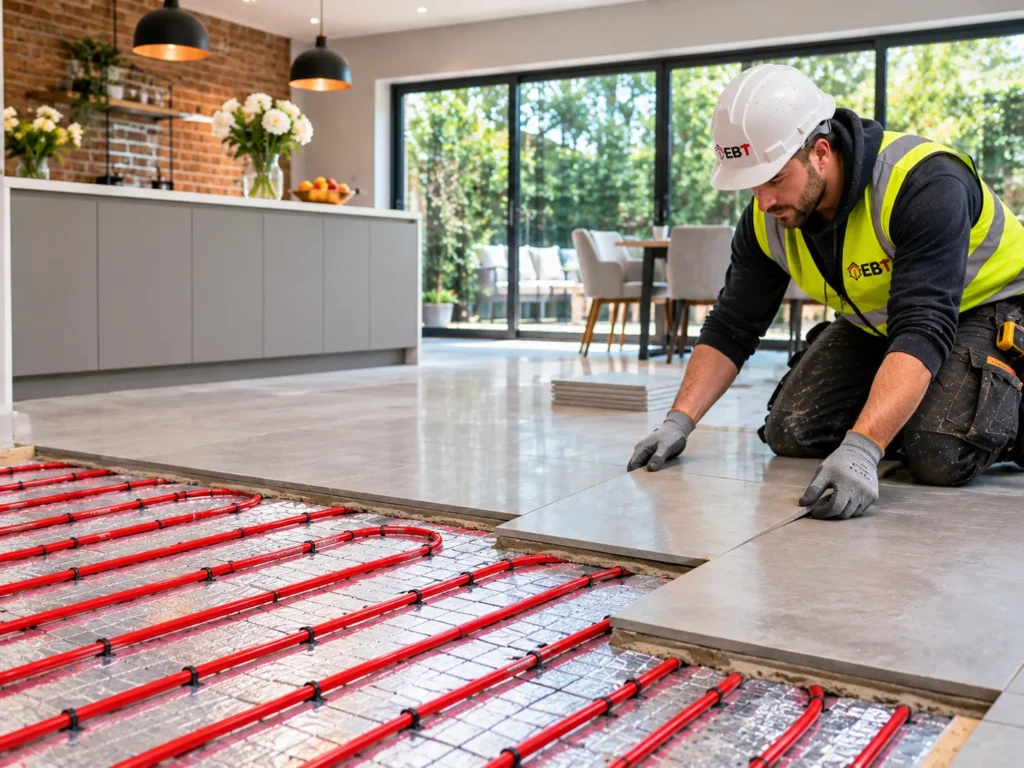
In a new extension or where a floor is being dug out, the pipes are clipped to insulation boards and covered with screed. This gives the most even heat and is usually the cheapest wet option per square metre, at roughly £90 to £130 per m² for the pipework, insulation and screed in London.
Screed takes time to dry. Traditional sand and cement screed can take several weeks before flooring goes down, while liquid screed dries faster and goes down thinner. The system must also be warmed up gradually when first commissioned, so build this into the programme for any rear extension.
Overlay Systems for Existing Floors
Where you cannot dig up the floor, low-profile overlay boards with routed channels for the pipes are laid directly on top of the existing floor. They add around 15 to 25 mm to the floor height and cost more per square metre, typically £120 to £180 per m² fitted. Doors, skirting and thresholds may need adjusting.
Suspended Timber Floors in Victorian Houses
Most Victorian terraces in Islington, Hackney and Haringey have suspended timber floors on the ground floor. Pipes can be laid between the joists in aluminium spreader plates, with insulation underneath, either from above by lifting the boards or from below if there is cellar access.
The insulation is not optional here. Without it, much of the heat goes into the void under the floor rather than into the room. Draughts through old floorboards also need sealing, or the system will struggle on cold days.
Manifold, Pump and Controls
Every wet system needs a manifold with a pump and mixing valve, which brings the flow temperature down to the 35 to 55°C that underfloor pipes need. This usually costs £600 to £1,200 fitted for a single room or extension, depending on the number of zones and the type of thermostats.
Underfloor Heating Running Costs
Running costs are where wet and electric systems really separate. The figures below use typical UK energy prices under the Ofgem price cap, around 26p per kWh for electricity and 8p per kWh for gas, and assume a room needs 10 kWh of heat on a typical winter day. If your tariff is different, the pattern stays the same.
| Heating method | Energy bought per day | Approximate cost per day | Approximate cost per month |
|---|---|---|---|
| Electric underfloor heating | 10 kWh of electricity | £2.60 | £78 |
| Wet system on a gas boiler (90% efficient) | 11.1 kWh of gas | £0.89 | £27 |
| Wet system on an air source heat pump (efficiency of about 3.5) | 2.9 kWh of electricity | £0.74 | £22 |
These are illustrations, not quotes. Real costs depend on insulation, how long the heating runs and the temperature you set. They do show the pattern clearly: electric heating converts each unit of electricity into one unit of heat, while gas costs far less per unit and a heat pump produces several units of heat for each one it uses.
Small Rooms Are Different
In a small bathroom, the difference is modest. A 4 m² electric mat rated at 150 W per m² draws 0.6 kW, so running it for three hours a day costs around 47p, or about £14 a month. For a bathroom that only needs warming in the morning and evening, that is a reasonable price for warm tiles.
Is Underfloor Heating Worth It?
For the right room, yes. Underfloor heating spreads heat evenly across the floor rather than concentrating it near a radiator, frees up wall space for units and glazing, and works at lower water temperatures than radiators, which suits condensing boilers and heat pumps.
When It Makes Sense
Underfloor heating is most worthwhile in these situations:
- A new kitchen extension, where the slab is going in anyway and the extra cost of pipes is small
- An open-plan kitchen and living space with large areas of glazing and little wall space for radiators
- A bathroom renovation, where the floor is coming up and warm tiles make a real difference
- A home switching to a heat pump, which runs more efficiently at the low flow temperatures underfloor heating uses
When It May Not Be Worth It
It is harder to justify in a single bedroom with carpet, in a poorly insulated room where heat losses are high, or in a rented property where the cost will not be recovered. Underfloor heating is also slow to respond: a screeded wet system can take a couple of hours to warm a room, so it suits rooms used for long periods rather than a spare room heated occasionally.
On older London houses, underfloor heating on its own may not keep up in very cold weather if the room has single-glazed sash windows and solid walls. In those rooms, it often works best alongside a radiator rather than replacing it.
Underfloor Heating and Your Boiler
A wet system needs a heat source that can supply it. Most modern combi and system boilers can run underfloor heating through a mixing unit, but adding a large area to an existing radiator system can push an older or undersized boiler to its limit.
If you are planning a kitchen extension, ask for a heat loss calculation that covers the whole house, not just the new room. The guide to combi or system boilers explains which type suits larger heating loads.
If the existing boiler is near the end of its life, a boiler installation may be worth combining with the underfloor heating work.
Choosing Flooring Over Underfloor Heating
The floor finish decides how much heat reaches the room. Stone and porcelain tiles conduct heat best and are the usual choice in kitchens and bathrooms; our tile flooring is regularly laid over both wet and electric systems.
Engineered wood works well because its layered construction is stable when warmed. Solid wood can be used but is more likely to move, and most wood and LVT manufacturers limit the floor surface temperature to 27°C. Carpet and underlay together should have a combined tog rating of no more than 2.5, or the heat will struggle to get through. With a heat pump, which runs at lower temperatures, aim for 1.5 tog or less.
If you want a wood floor with character, the guide to herringbone parquet flooring covers how parquet is laid over underfloor heating.
Installing Underfloor Heating in a Bathroom
Bathrooms are the most common place for underfloor heating in London homes, and usually the simplest. Electric mats go down under the tile adhesive, add only a few millimetres to the floor height, and can be fitted in a day before tiling.
A thermostat with a floor probe keeps the tiles at a comfortable temperature without overheating the room. In a small bathroom, underfloor heating can also replace a bulky radiator, leaving room for a heated towel rail on its own. Our bathroom installation projects often include it for that reason.
For layouts that work in tight spaces, the guide to small bathroom renovation ideas shows how heating fits around showers and storage.
Underfloor Heating in an Extension
Most kitchen extensions in North London now include wet underfloor heating, because the slab and screed are being laid anyway. The extra cost over radiators is usually small compared with the overall build, and the room gains wall space for units and full-width glazing.
Plan the pipe layout early, so the manifold has a sensible home and the zones match how the room is used. The guide to house extension cost shows where heating sits within an overall extension budget.
Frequently Asked Questions
How much does underfloor heating cost per m²?
In London, electric underfloor heating costs about £50 to £100 per m² supplied and fitted. Wet underfloor heating costs about £90 to £130 per m² in screed and £120 to £180 per m² as an overlay system, plus £600 to £1,200 for the manifold and controls.
How much does electric underfloor heating cost to install?
A small bathroom usually costs £600 to £1,100, including insulation boards, the thermostat and the electrical connection. A 15 to 20 m² kitchen typically costs £1,200 to £2,400.
How much does wet underfloor heating cost?
A 25 m² kitchen extension usually costs £3,000 to £5,000 for wet underfloor heating, including the manifold and controls. A whole ground floor of 40 to 60 m² is typically £5,000 to £9,000.
Is underfloor heating expensive to run?
Electric underfloor heating is expensive to run over large areas, at roughly three times the cost of a wet system on a gas boiler. A wet system is usually cheaper to run than radiators because it works at a lower water temperature.
Is underfloor heating cheaper than radiators?
Wet underfloor heating is more expensive to install than radiators but can be cheaper to run, especially with a heat pump. Electric underfloor heating is usually more expensive to run than radiators on a gas boiler.
Can you fit underfloor heating in an old house?
Yes. In Victorian houses with suspended timber floors, pipes can sit between the joists with insulation below, or a low-profile overlay system can be laid on top. Good insulation and draught-proofing under the floor are essential.
How long does underfloor heating last?
The pipes in a wet system can last 50 years or more, and electric cables are often guaranteed for 25 years or longer. Pumps, valves and thermostats need occasional replacement, just as they do on any heating system.
Can you put underfloor heating under carpet?
Yes, if the carpet and underlay together have a tog rating of 2.5 or less, or 1.5 or less with a heat pump. Thick carpets and dense underlays block too much heat for the system to work well.
Choosing the Right System for Your Home
The cost of underfloor heating comes down to the system, the size of the room and the floor you are starting with. Electric suits bathrooms and small rooms where installation cost matters most. Wet suits extensions and larger spaces, where lower running costs repay the higher installation price over time.
Before choosing, check the floor construction, the boiler’s capacity, and the flooring you plan to lay on top. Those three things decide whether underfloor heating will work well in your home and what it will really cost.

Tilly Bani is a renovation and roofing specialist with over 15 years of experience in construction and property refurbishment across North London. He specialises in roofing, structural repairs, and full home renovations, helping homeowners improve property value and safety.