
| Quick Answer Damp in Islington Victorian terraces falls into three categories: rising damp, penetrating damp, and condensation. Each has a different cause and a different fix. Rising damp treatment costs £2,500 to £5,000 for a typical Islington terrace, including replastering. Penetrating damp treatment costs £500 to £3,000, depending on the source. Condensation treatment costs £300 to £1,500. Misdiagnosis is the most expensive mistake. Getting an independent damp survey from a Property Care Association (PCA) qualified surveyor before any treatment begins costs £250 to £400 and consistently saves more than it costs. |
Introduction
Damp is the most common building defect in Islington’s Victorian terrace housing stock. Many owners combine repairs with wider Victorian house renovation projects. These properties were built between 1860 and 1910 with solid brick walls, lime mortar, and original slate damp-proof courses that are now 115 to 165 years old. They were designed to absorb moisture and release it through breathable materials. When those materials are replaced with impermeable modern alternatives, damp becomes trapped, and the problems begin. Damaged interiors often need follow-up wall crack repairs once moisture is resolved.
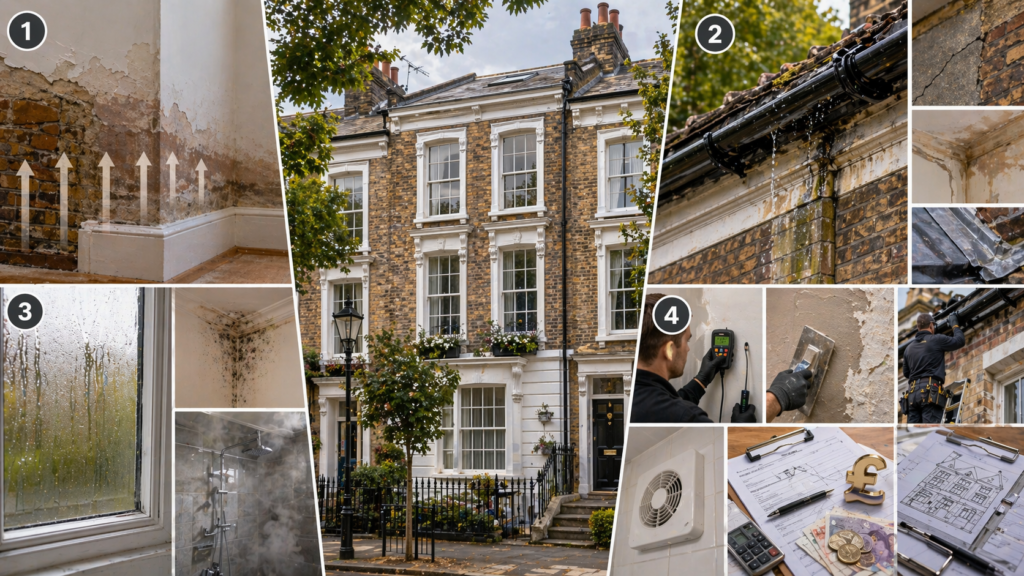
Islington homeowners dealing with damp face a specific set of challenges. The dense terrace streets, shared party walls, hard London water, and the age of the infrastructure all create damp conditions that differ from newer or more rural properties. Understanding the three types of damp, what causes each, and what treatment genuinely fixes each one is the starting point for any damp repair that will last.
Why are Islington Victorian Terraces particularly prone to Damp?
Before addressing the types and treatments, it helps to understand why damp is so prevalent in Islington specifically.
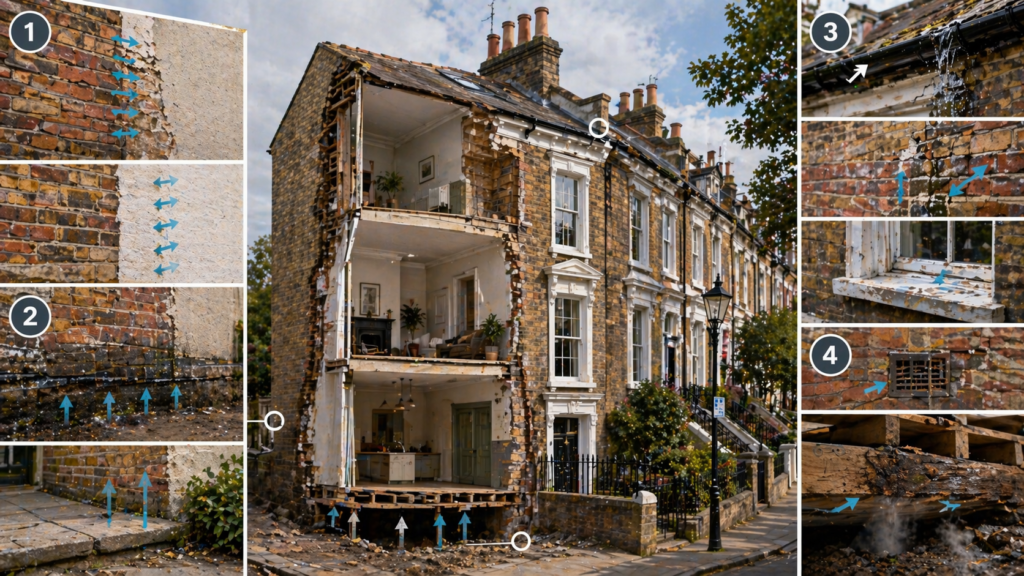
Solid brick wall construction. Victorian terraces in Islington were built with solid brick walls 225mm or more thick. Unlike modern cavity wall construction, which keeps the inner and outer leaf separate with an air gap, solid walls absorb moisture from rain and release it again through vapour diffusion. This works as designed when breathable lime plaster and lime mortar are used. It fails when cement renders, vinyl paints, or impermeable coatings are applied, because moisture becomes trapped inside the brick rather than evaporating. Many homes later need breathable finishes during terrace repair works.
Failed or bridged original DPCs. Building regulations in London required a damp-proof course in new construction from 1875. Many Islington Victorian terraces have an original physical DPC made from slate or bituminous felt set into the brickwork at around 150mm above ground level. After 130 years, these materials deteriorate. The DPC may have cracked, corroded, or been bridged by raised ground levels, garden soil, paving, or added render that connects the ground to the wall above the DPC level. This issue is commonly identified during wider property improvement plans, especially during renovation or external works.
Deferred external maintenance. Issues such as leaking gutters often need prompt gutter installation or repair. Failing gutters, cracked pointing, deteriorated lead flashings, and defective window frames and sills allow water to enter solid walls from outside. In terraced streets where access to rear elevations is limited, external defects often go unnoticed for years. The water that enters from these defects accumulates inside the wall and eventually shows as damp patches internally. Many cases are effectively resolved through guttering replacement London, along with necessary external masonry repairs.
Restricted ventilation. Victorian terraces were built with suspended timber floors over void spaces ventilated through airbricks in the front and rear walls. When these airbricks are blocked by accumulated debris, raised paving, or well-meaning draught exclusion, the under-floor void becomes humid. Timber joists and floorboards in an unventilated void develop wet rot. This is a common and destructive consequence of damp in Islington terrace ground floors.
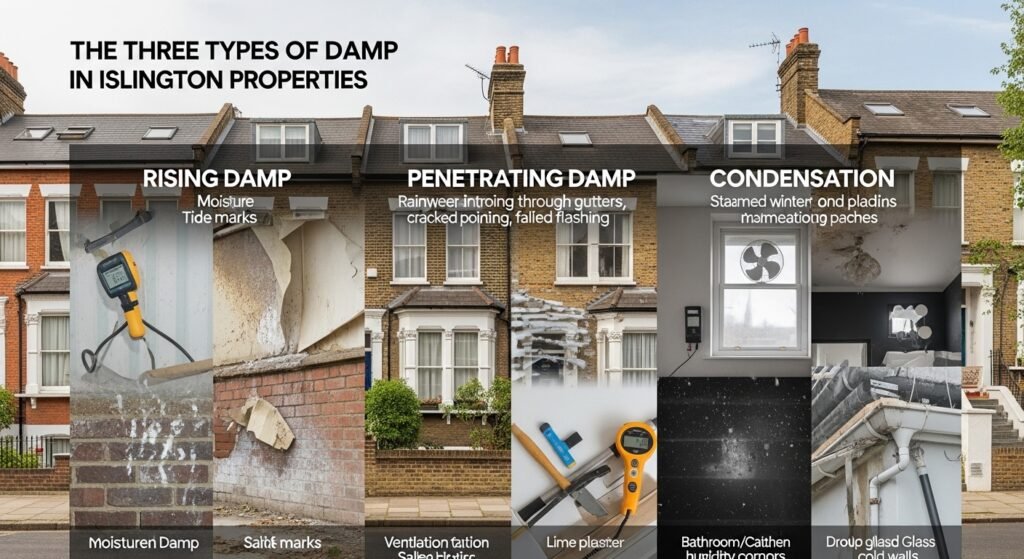
The Three Types of Damp in Islington Properties
Rising Damp
Rising damp occurs when groundwater travels upward through the masonry of an external wall by capillary action. It is the type of damp most frequently diagnosed and, according to many independent surveyors, also the type most frequently misdiagnosed.
Genuine rising damp has a distinctive signature. The tide mark of salt deposits on the lower wall, typically up to 1 metre high and rarely above 1.2 metres, is the defining characteristic. The salts are hygroscopic, meaning they attract moisture from the air even after the damp source is treated, which is why replastering with new plaster is an essential part of any rising damp treatment. Leaving salt-contaminated plaster in place causes the damp patch to reappear even after a correctly installed DPC injection. Many homeowners include this work within broader home repair costs, particularly when addressing multiple property issues together.
Signs of rising damp:
- Horizontal tide mark on lower walls, typically 0.5 to 1.2 metres above floor level
- White salt deposits (efflorescence) on plaster or brickwork
- Plaster that is soft, crumbling, or hollow-sounding when tapped
- Skirting boards that are damp, rotting, or lifting away from the wall, Joinery damage is often repaired during wider building services works.
- Wallpaper peeling from the base of the external walls
Rising damp does not appear at high levels on walls, above window sills, or on upper floor walls. If damp patches are appearing above 1.2 metres, the cause is penetrating damp, not rising damp.
Penetrating Damp
Penetrating damp is water entering through external defects and moving horizontally through the wall. It is the more common cause of damp patches in Islington Victorian terraces and is more frequently misdiagnosed as rising damp by contractors who sell DPC injections.
Penetrating damp can appear at any height on any wall. It is directly associated with an external defect: a cracked or open mortar joint, a failed lead flashing at a chimney or abutment, a blocked or overflowing gutter, a cracked or eroded window sill, or a defective downpipe discharging against the wall. The damp patch on the internal wall typically appears in a pattern that corresponds to the external defect, either directly behind it or slightly below it where water has tracked downward through the wall.
Common sources of penetrating damp in Islington terraces:
- Blocked or overflowing gutters running behind the parapet or valley gutter on London-type flat roofs, This commonly requires specialist Roofing services to stop repeat water ingress.
- Failed lead flashings at chimney bases, bay window roofs, and rear outrigger abutments, Many older roofs need related chimney repairs at the same time.
- Eroded pointing on rear elevation brickwork where maintenance access is poor
- Cement rendering applied over brickwork that has subsequently cracked, trapping water behind it
- Raised garden levels above the DPC line on rear elevations, which also cause bridging of the DPC
Roof leaks are a frequent cause, making regular roof repair Islington checks essential to prevent ongoing water ingress. The treatment for penetrating damp is always to fix the external source first. A DPC injection does nothing for penetrating damp. Internal tanking or sealants are temporary measures at best. If the water is still entering from outside, it will find another route regardless of what treatment is applied internally.
Condensation
Condensation is the most common cause of damp and mould in Islington properties, and the cheapest to address correctly. It occurs when warm, humid air from cooking, bathing, and breathing meets a cold surface and deposits moisture.
In Islington Victorian terraces, the cold surfaces are external walls (particularly uninsulated solid brick walls facing north or east), single-glazed or poorly-sealed window reveals, and cold spots above thermal bridges such as steel lintels and concrete floor slabs.
Condensation damp is characterised by:
- Black mould growth on walls, particularly in corners and on north-facing surfaces
- Mould on the window reveals and frames
- Condensation water on windows in the mornings
- A musty smell in rooms with poor ventilation
- Mould appearing at ceiling level and on furniture pushed against external walls
Condensation is not a structural defect in the building fabric. It is a consequence of insufficient ventilation relative to the moisture load produced by the occupants. Upgrades often include certified electrical work for extractor fans. The treatment is improving ventilation and, where practical, improving the thermal performance of cold surfaces. A DPC injection or tanking system does not treat condensation and will have no effect on it. Poor-performing windows can worsen condensation issues, so many homes benefit from window draught proofing to improve insulation and reduce moisture build-up.
Damp Proofing Solutions: What Each Type Requires
Rising Damp Treatment
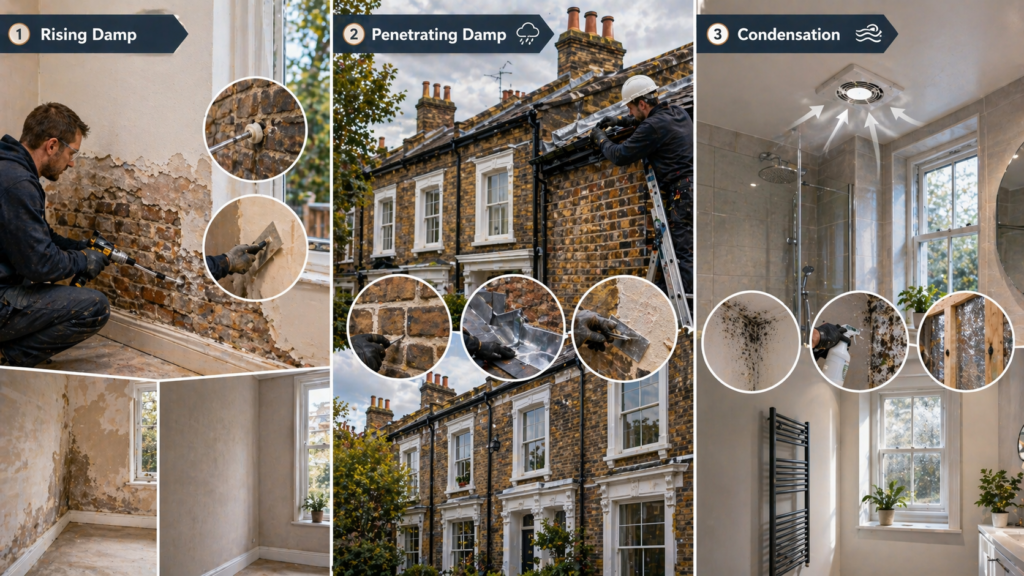
The standard treatment for rising damp in a Victorian brick terrace is a chemical DPC injection combined with replastering using renovating plaster.
Chemical DPC injection. A series of holes is drilled into the mortar course at DPC level, typically at 120mm centres, and a silicone-based damp proofing cream or fluid is injected into the holes under pressure. The chemical spreads through the mortar and brick, forming a hydrophobic barrier that blocks capillary moisture movement. The holes are repointed after injection. This treatment should be carried out on both the internal and external face of the wall, or at a depth sufficient to create a full-thickness barrier.
Replastering. The existing plaster on the affected walls must be hacked off to expose the bare brickwork. Salt-contaminated plaster cannot be left in place. Once the DPC is installed and has cured (typically 24 to 48 hours), the walls are replastered using a renovating plaster system or a sand and cement render coat, followed by a breathable internal finish. Standard gypsum plaster is not appropriate for replastering after rising damp treatment because it absorbs moisture and will show tide marks again as hygroscopic salts draw moisture from the air.
In Islington Victorian terraces, lime plaster is the preferred replastering material because it matches the original building fabric and allows the wall to breathe. A renovation plaster containing hydraulic lime, or a proprietary salt-resistant renovating plaster, is the correct specification.
Penetrating Damp Treatment
Penetrating damp treatment is not a standard package. It depends entirely on what is allowing water in.
Repointing. Open mortar joints on external elevations are the most common cause of penetrating damp in Islington rear elevations. Repointing must use lime mortar (NHL 3.5 hydraulic lime) on Victorian brickwork, not cement. Cement mortar is stronger than the brick and causes moisture entrapment and accelerated brick spalling.
Lead flashing replacement. Failed lead flashings at chimney bases, bay roofs, and roof-to-wall abutments must be replaced with new Code 4 or Code 5 lead. The correct method uses lead wedged into mortar joints, not surface-applied cement pointing, which fails within a few years.
Gutter repair or replacement. A blocked, overflowing, or leaking gutter that discharges water against the wall is a common cause of penetrating damp in Islington terraces. Clearing the blockage or replacing the failed section is the correct fix, not internal tanking.
External render repair. Where cement render has been applied to the brickwork and has subsequently cracked, water enters the crack and becomes trapped between the render and the brickwork behind. The correct repair is to remove the failed cement render entirely and replace it with lime render, not to fill the cracks with sealant.
Internal treatment only after external repairs are complete. Once the external source is fixed, any remaining internal damp patches should dry out over three to six months. If internal replastering is needed, use breathable lime plaster, not standard gypsum. Because penetrating damp often involves multiple external repairs, many homeowners choose a reliable builder London to coordinate the work effectively.
Condensation Treatment
Condensation treatment addresses the cause (excessive moisture in the air meeting cold surfaces) rather than the surface symptom (mould).
Mechanical ventilation. Continuous mechanical ventilation (CMV) in bathrooms and kitchens, running at a low background rate and boosting automatically when humidity rises, is the most effective intervention for properties with persistent condensation. Bathrooms with poor airflow often require upgrades during bathroom renovation works. Positive Input Ventilation (PIV) units, mounted in the loft and pushing a gentle stream of filtered, slightly warmed air into the property, are an effective whole-house solution for severe condensation in Islington Victorian terraces.
Extractor fans. A bathroom extractor fan that actually extracts to outside air (not into the roof void) at 15 litres per second minimum, with a 15-minute overrun, is a Building Regulations requirement and an effective condensation control measure.
Mould treatment. Black mould on walls should be treated with a fungicidal wash before replastering or redecorating. Painting over mould without treatment results in regrowth within weeks. Anti-mould paints reduce the surface temperature differential that allows condensation to form, and are appropriate on north-facing or cold walls.
Improving thermal performance. Internal wall insulation on cold external walls raises the surface temperature of the wall and reduces the frequency and severity of condensation. In Islington conservation areas, internal wall insulation is generally acceptable planning-wise, as it is an internal change. Using wood fibre or breathable insulation boards rather than impermeable foam boards maintains the breathability of the solid brick wall.
Damp Proofing Costs in Islington: 2026 Figures
Islington costs reflect inner London labour rates, which run 15 to 25% above national averages. All figures include VAT.
Damp Survey Costs
| Survey Type | Cost |
|---|---|
| Independent damp survey (PCA qualified surveyor) | £250 to £400 |
| Specialist report for rising damp with moisture readings | £300 to £500 |
Do not accept a free survey from a contractor who also sells the treatment. The incentive to oversell the treatment is structural. An independent PCA-qualified surveyor who does not carry out the remediation work provides an objective diagnosis.
Rising Damp Treatment Costs
| Element | Cost |
|---|---|
| Chemical DPC injection (per linear metre) | £70 to £120 |
| Hack off and dispose of existing plaster (per m²) | £20 to £40 |
| Renovating plaster, two coats (per m²) | £45 to £80 |
| Skirting board replacement (per room) | £150 to £400 |
| Full rising damp treatment, one wall, including replastering | £800 to £2,000 |
| Full rising damp treatment, ground floor (two to three walls) | £2,500 to £5,000 |
Penetrating Damp Treatment Costs
| Source and Fix | Cost |
|---|---|
| Gutter clearance or repair | £100 to £400 |
| Lead flashing replacement at chimney | £400 to £900 |
| Lime repointing (per m²) | £30 to £50 |
| External lime render removal and replacement (per m²) | £60 to £120 |
| Internal replastering after penetrating damp resolved (per m²) | £45 to £80 |
| Full penetrating damp treatment (source fix plus internal reinstatement) | £500 to £3,000 |
Condensation Treatment Costs
| Intervention | Cost |
|---|---|
| Positive Input Ventilation (PIV) unit, supply and install | £300 to £600 |
| Bathroom extractor fan with overrun, supply and install | £150 to £300 |
| Anti-mould treatment and redecoration (per room) | £200 to £500 |
| Internal wall insulation, breathable boards (per m²) | £60 to £120 |
Additional Costs to Budget For
| Item | Cost |
|---|---|
| Skip hire in Islington (highway permit required) | £200 to £350 |
| Airbrick clearing or replacement | £80 to £200 |
| Timber joist assessment and treatment (if rot found) | £300 to £2,500 |
| Structural engineer report (if structural damage found) | £500 to £1,500 |
The Most Common Damp Proofing Mistakes in Islington
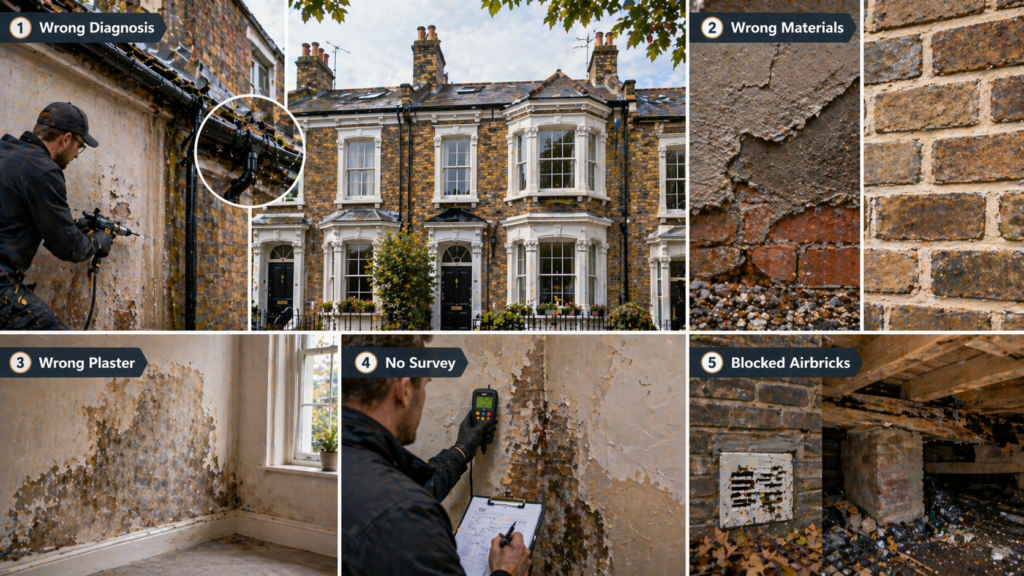
Treating penetrating damp as rising damp. A contractor who arrives, quotes a DPC injection without inspecting the external wall, and leaves having injected the wall is not treating penetrating damp. Penetrating damp cannot be fixed from inside. The external source must be fixed first, always.
Using cement mortar or cement render on Victorian brickwork. Breathable finishes and skilled London builders help avoid repeat moisture problems. Cement is stronger and less permeable than the original brick. It traps moisture inside the wall and accelerates brick spalling through frost action. All repointing and rendering on Islington Victorian terraces should use lime mortar. Lime repointing costs more per metre than cement but does not cause the secondary damage that cement does.
Replastering with standard gypsum plaster after rising damp treatment. Gypsum plaster is highly sensitive to moisture and hygroscopic salts. Replastering over a newly treated DPC with standard gypsum will show damp patches again within months, not because the treatment failed, but because the wrong plaster was used. Renovating plaster or lime plaster is required.
Accepting a contractor’s diagnosis without an independent survey. The damp proofing industry in London has a well-documented problem with overselling. Condensation is diagnosed as rising damp because chemical DPC injection is more expensive than improving ventilation. An independent survey from a PCA-qualified surveyor who does not sell the treatment eliminates this conflict of interest. The £250 to £400 survey fee consistently saves multiples of its cost.
Blocking airbricks or under-floor ventilation. Airbricks in the front and rear walls of Islington Victorian terraces ventilate the under-floor void. When these are blocked by debris, raised paving, or draught exclusion materials, the suspended timber floor loses its airflow and joists begin to develop wet rot within a few years. Keep airbricks clear.
What a Guarantee Covers and for How Long
A properly installed chemical DPC backed by a Property Care Association (PCA) member guarantee typically runs for 20 to 30 years. These guarantees are insurance-backed and transferable to the next owner on sale of the property. Buyers’ solicitors increasingly require a guarantee document as evidence of professional treatment.
The guarantee covers the DPC treatment itself, not the replastering or the consequences of any later bridging of the DPC by new ground levels, new paving, or new render. If a neighbour raises their garden level after your DPC is installed and this bridges the new DPC, the guarantee does not cover the consequent damp.
FAQ
Q: How do I know if I have rising damp or penetrating damp in my Islington terrace?
The height and pattern of the damp patch is the primary diagnostic. Rising damp creates a horizontal tide mark on lower walls up to 1.2 metres high, with salt deposits at the base. It never appears above door sill level. Penetrating damp can appear at any height, often directly behind or below an external defect such as a leaking gutter, failed flashing, or cracked pointing. Check the external wall directly outside the damp patch before accepting any diagnosis. If the contractor has not inspected the external wall, their diagnosis is incomplete.
Q: Do I need a specialist damp proofing company or can a general builder treat damp in Islington?
For chemical DPC injection, use a company with Property Care Association (PCA) membership and a surveyor holding the Certificate in Remedial Treatment (CSRT) qualification. PCA membership requires training standards, insurance, and the ability to issue insurance-backed guarantees. A general builder can fix the external sources of penetrating damp, including repointing, lead flashing, guttering, and other external roof repairs, but a PCA-registered specialist is needed for DPC injection and the associated guarantee.
Q: Does damp proofing treatment affect saleability in Islington?
Positively. A property with a professional damp survey report, a completed DPC treatment, and an insurance-backed PCA guarantee is more straightforward to sell than a property with untreated damp. Buyers’ solicitors request evidence of professional treatment, and the guarantee is transferable to the new owner. Untreated damp in an Islington terrace is typically picked up in a buyer’s survey and either results in a price reduction or requires completion of the treatment before exchange.
Q: Is rising damp covered by buildings insurance in Islington?
In most cases, no. Standard building insurance policies exclude rising damp and penetrating damp on the basis that these are gradual defects caused by wear, tear, and inadequate maintenance rather than sudden events. If damp is caused by a sudden and accidental escape of water, such as a burst pipe, the resulting damage to plaster and decoration may be covered. Check your specific policy wording and speak to your insurer before assuming any damp damage is covered.
Q: How long does it take for walls to dry out after damp treatment in Islington?
After a rising damp DPC injection, walls need time to dry before replastering. The drying time depends on wall thickness, the severity of the pre-existing moisture, and the season. In an Islington Victorian terrace with 225mm solid brick walls, allow three to six weeks between DPC injection and replastering in summer, and six to twelve weeks in winter when drying conditions are poorer. After replastering, allow a further four to six weeks before redecorating to allow the new plaster to fully cure and carbonate.
Q: What is the difference between damp proofing and tanking in Islington basements?
Damp proofing using chemical DPC injection is suitable for above-ground walls experiencing rising damp. Tanking is a separate process used in basements and below-ground spaces where hydrostatic water pressure pushes water through walls and floors. Tanking involves applying a cementitious slurry or installing a cavity drain membrane system across all below-ground surfaces. It is a specialist basement waterproofing process and significantly more extensive than ground-floor rising damp treatment. Costs for basement tanking in Islington run from £5,000 to £20,000, depending on the size of the basement and the method used.
Conclusion
Damp in Islington Victorian terraces is common, manageable, and repairable. The critical point is that the type of damp determines the treatment, and the wrong treatment achieves nothing while costing significant money. A DPC injection for condensation, or internal tanking for penetrating damp with an unresolved external source, is not a failed treatment. It is the wrong treatment.
Invest in an independent survey from a PCA-qualified surveyor before committing to any treatment. Fix external sources before applying any internal solution. The best long-term results usually come from experienced North London builders</a> who understand Victorian homes. Use lime mortar and lime plaster, not cement, on all repairs to Islington’s Victorian terrace fabric. And budget for replastering as a core part of the treatment, not an optional extra.
Done correctly, damp treatment in an Islington terrace produces a result that lasts 20 to 30 years and does not compromise the breathability of the building fabric that makes these properties so durable over the long term.

Tilly Bani is a renovation and roofing specialist with over 15 years of experience in construction and property refurbishment across North London. He specialises in roofing, structural repairs, and full home renovations, helping homeowners improve property value and safety.