
| Quick Answer The home improvements that add the most value in Camden are loft conversions (up to 20 to 25% value increase), rear and side return extensions (10 to 20%), kitchen renovations (up to 10%), bathroom upgrades (up to 5%), and basement conversions (25% or more in prime Camden postcodes). Camden’s mix of Georgian townhouses, Victorian terraces, and period conversions means every project needs to respect the borough’s conservation areas and planning rules, which are among the most detailed in London. Projects that preserve or restore original period features consistently outperform generic modern renovations in this market. |
Introduction
Camden homeowners face a specific challenge when deciding where to invest. The borough stretches from Hampstead and Belsize Park in the north, through Kentish Town and Gospel Oak in the centre, down to the canal-side streets of Camden Town and Primrose Hill. Each neighbourhood carries different property values, different buyer expectations, and different planning constraints.
What adds value in a Kentish Town Victorian terrace is not the same as what works for a listed Georgian townhouse in Primrose Hill or a warehouse conversion in Camden Town. Getting the project right for your specific property type and location matters as much as the project itself. Many owners first consult trusted Camden builders before setting budgets.
This guide covers the 10 home improvement projects that most reliably add value to Camden properties in 2026, including realistic costs, expected value uplift, and the Camden-specific factors that affect each one. Larger upgrades are often delivered through a full home refurbishment plan.
1. Loft Conversion
Value added: 15 to 25% | Typical cost: £55,000 to £120,000
A loft conversion is the highest-return home improvement available to most Camden homeowners. Many roof projects are handled by experienced Camden roofers. It adds a usable bedroom, ensuite bathroom, or home office without touching the garden, preserves outdoor space, and creates the extra bedroom that most dramatically improves a property’s buyer appeal.
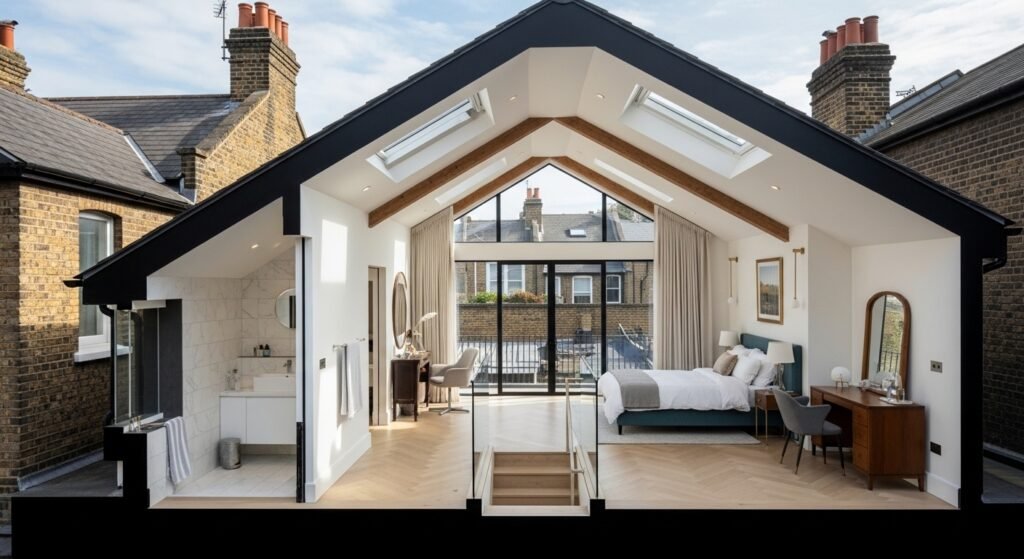
Camden’s Victorian terraces in Kentish Town, Tufnell Park, and Gospel Oak are well suited to rear dormer conversions, which add a box-shaped extension to the rear roof slope to maximise headroom and usable floor area. The borough’s larger Georgian townhouses in Primrose Hill and Belsize Park often suit mansard conversions, which alter the entire roof slope and add what feels like an additional storey.
Cost Breakdown in Camden
| Conversion Type | Typical Cost (inc. VAT) |
|---|---|
| Velux / rooflight | £22,000 – £38,000 |
| Rear dormer | £58,000 – £90,000 |
| Hip-to-gable | £65,000 – £100,000 |
| Mansard | £90,000 – £130,000+ |
Planning in Camden
Most rear dormer conversions on Camden houses outside conservation areas qualify as permitted development, subject to the 40 cubic metre volume limit for terraced houses. Some flat roofs are finished by flat roof experts. However, Camden has extensive conservation area coverage, particularly in Hampstead, Primrose Hill, Belsize Park, and parts of Kentish Town. Any external roof alteration within these areas requires a householder planning application costing £548, with an 8-week decision target.
If you live in a flat, permitted development rights do not apply. All loft conversions in flats require full planning permission regardless of conservation area status.
2. Rear Kitchen Extension
Value added: 10 to 20% | Typical cost: £60,000 to £120,000 (all-in)
A rear extension creating an open-plan kitchen-dining space connected to the garden is the single most transformative ground-floor improvement available to Camden Victorian terraces. Most families complete the layout with a new kitchen renovation. The Georgian and Victorian properties that dominate Camden’s residential streets were designed with small, separate kitchens. Opening these up to the garden via a rear extension, with bifold or sliding doors, produces the kind of flowing ground-floor layout that Camden’s family buyer market pays a premium for.
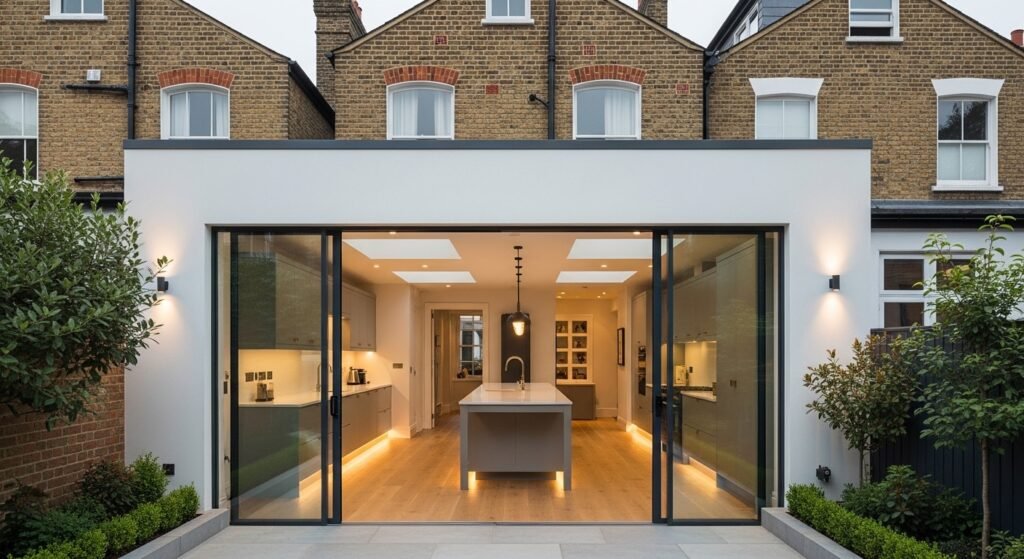
Camden is particularly well-suited to rear extensions because its Victorian terraces in Kentish Town and Tufnell Park have rear gardens with enough depth to absorb a 3 to 5 metre extension without the property feeling closed in. The Georgian streets near Regent’s Park and Primrose Hill involve more heritage scrutiny and typically limit extension ambition.
Typical Extension Costs in Camden
| Extension Type | Structural Build Cost (ex. VAT) |
|---|---|
| Single-storey rear (15–20m²) | £55,000 – £80,000 |
| Single-storey rear (20–30m²) | £80,000 – £110,000 |
| Side return | £42,000 – £68,000 |
| Wraparound (rear + side) | £95,000 – £155,000 |
These figures exclude kitchen fit-out, which adds £18,000 to £45,000 depending on specification, and professional fees at 10 to 15% of build cost. After the build, many owners hire local kitchen fitters.
Planning Reality for Extensions in Camden
Camden Council receives one of the highest volumes of planning applications of any London borough. Conservation area coverage across much of the borough’s residential stock means the majority of extensions require planning permission. Camden’s planning officers apply a consistent set of design principles: extensions must be visually subordinate to the host building, materials must respect the existing character of the street, and rear extensions must not overwhelm the garden or neighbouring properties’ access to light.
3. Side Return Extension
Value added: 8 to 15% | Typical cost: £45,000 to £80,000**
The narrow alleyway that runs beside most Victorian terraces in Camden is one of the most underused spaces in the borough. Structural openings often require expert wall construction. A side return extension fills this gap to widen the ground floor, transforming a narrow galley kitchen into a spacious kitchen-dining room. In streets like Inkerman Road in Kentish Town or Caversham Road in Gospel Oak, side return extensions have become almost the default improvement for families with young children who want more usable ground-floor space without moving.
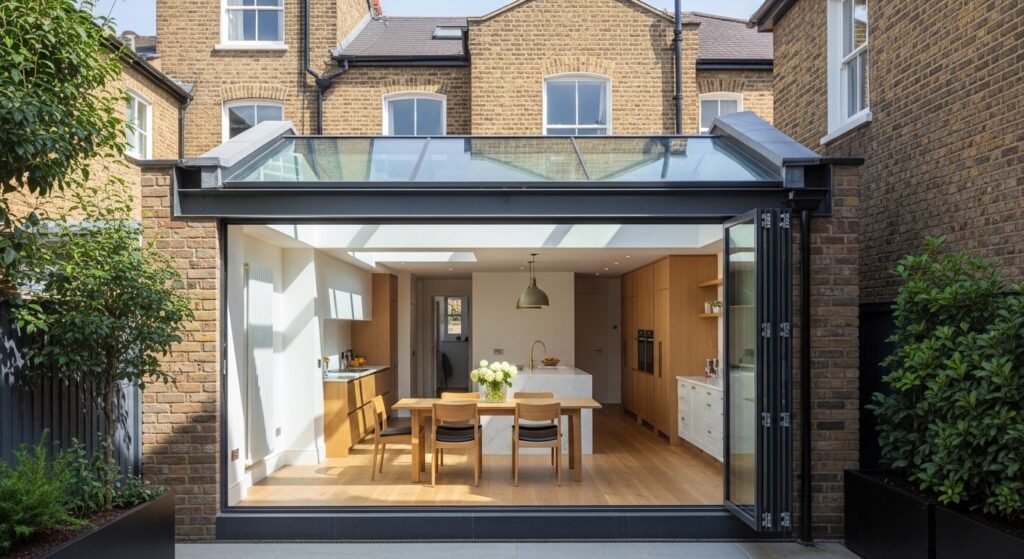
The typical side return adds 8 to 15 square metres of floor area, which sounds modest but changes the geometry of the ground floor completely. Removing the side wall and opening the kitchen across the full width of the property, often with a glass roof or rooflight above the new section, transforms a dark and cramped working kitchen into a bright, wide family room.
Side returns in Camden’s conservation areas require planning permission regardless of depth, because they are not permitted development on designated land. The design must match or complement the existing building’s materials and character. A glass box or contrasting contemporary finish is accepted in principle by Camden, provided it reads as a clearly secondary addition to the original Victorian structure.
4. Kitchen Renovation
Value added: 5 to 10% | Typical cost: £18,000 to £50,000**
A kitchen renovation without a structural extension still delivers meaningful value in Camden, particularly where the layout is functional but the fixtures and finishes are outdated. Modern homes often need updated electrical upgrades for appliances. A tired kitchen with worn units, dated tiles, and a cluttered layout suppresses buyer offers in Camden’s competitive market. A well-executed renovation at mid-range specification removes that suppression and typically returns 50% of its cost in added value.
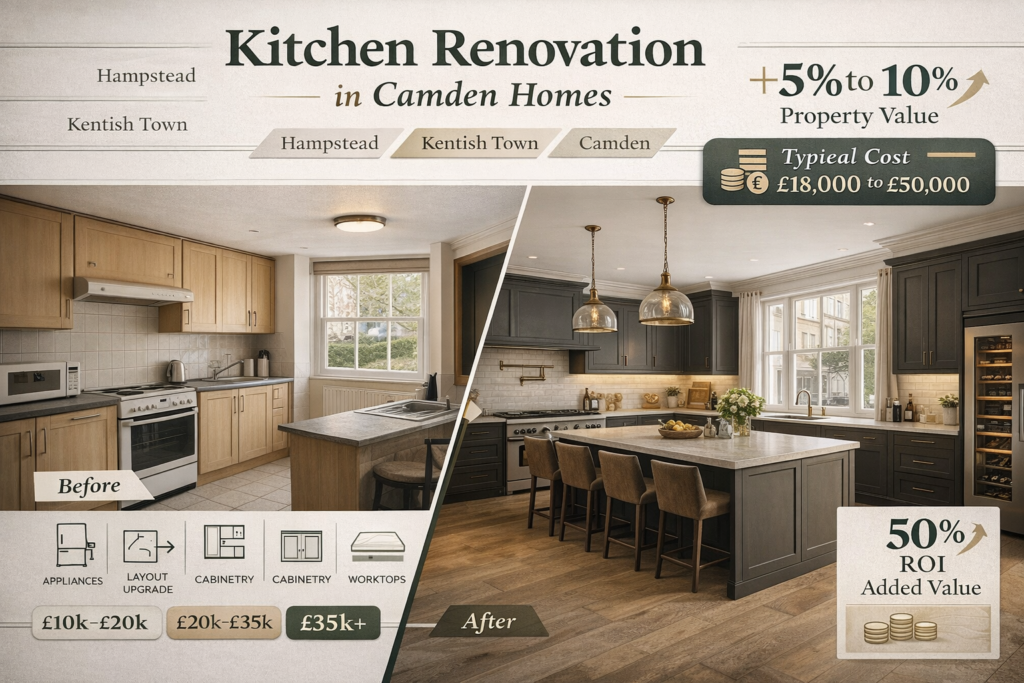
The most important principle in a Camden kitchen renovation is to match the specification to the property and the street. A £50,000 bespoke kitchen with hand-painted cabinetry and natural stone worktops makes sense in a Hampstead townhouse where buyers expect that level of finish. The same kitchen in a Kentish Town terraced house where comparables sell for £600,000 is over-specified and will not return its cost.
Mid-range Camden kitchen renovation benchmarks in 2026:
- Budget renovation (units replaced, no layout change): £10,000 to £20,000
- Mid-range full renovation with layout change: £20,000 to £35,000. Worktops and units are often installed during kitchen installation.
- High-end bespoke kitchen: £35,000 to £65,000+
The current trend in Camden’s period properties is away from white gloss and Scandi minimalism toward warmer tones, darker cabinetry, natural stone or engineered quartz worktops, and integrated appliances that do not interrupt the visual flow of the room. This aesthetic reads well to buyers of Georgian and Victorian properties who want character alongside functionality.
5. Bathroom Addition or Renovation
Value added: 3 to 8% per room | Typical cost: £10,000 to £25,000**
In Camden’s older housing stock, the number and quality of bathrooms is a consistent differentiator between properties at the same price point. A three-bedroom Victorian terrace with one small bathroom loses ground to comparable properties that have added an ensuite to the main bedroom. Adding a second bathroom or upgrading an existing one removes a common buyer objection. Many households use specialist bathroom fitters.
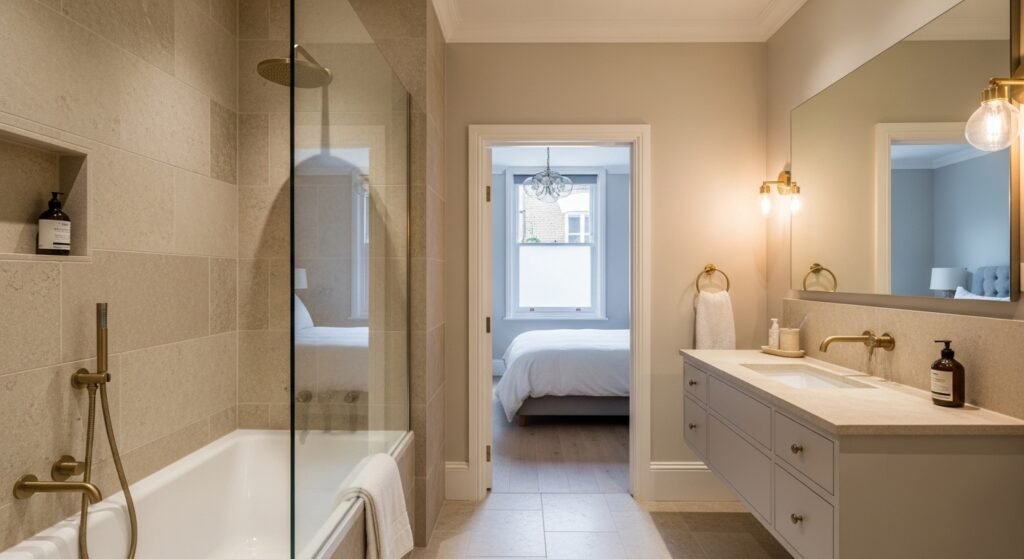
A mid-range full bathroom renovation in Camden costs £10,000 to £18,000. A quality bathroom renovation improves resale appeal. An ensuite addition to a bedroom that did not previously have one costs £12,000 to £22,000, depending on where the plumbing runs need to go. A high-end renovation with a freestanding bath, natural stone tiles, and bespoke vanity unit costs £18,000 to £30,000.
The functional priority in a Camden bathroom renovation is waterproofing. Camden’s Victorian terraces have solid brick walls that hold moisture differently from modern cavity-wall construction. Tanking (waterproofing the walls) before tiling is not optional in these properties. Professional waterproof tanking helps prevent damp issues. Bathrooms that skip this step fail within a few years and create exactly the damp problems that depress value.
Hard water from Thames Water is a permanent feature of Camden properties. Limescale accumulates rapidly on glass shower screens, taps, and brassware. Specifying limescale-resistant coatings or an inline water softener during renovation extends the life of fixtures and keeps the bathroom looking new without constant cleaning.
6. Basement Conversion
Value added: 20 to 30%+ | Typical cost: £80,000 to £200,000+**
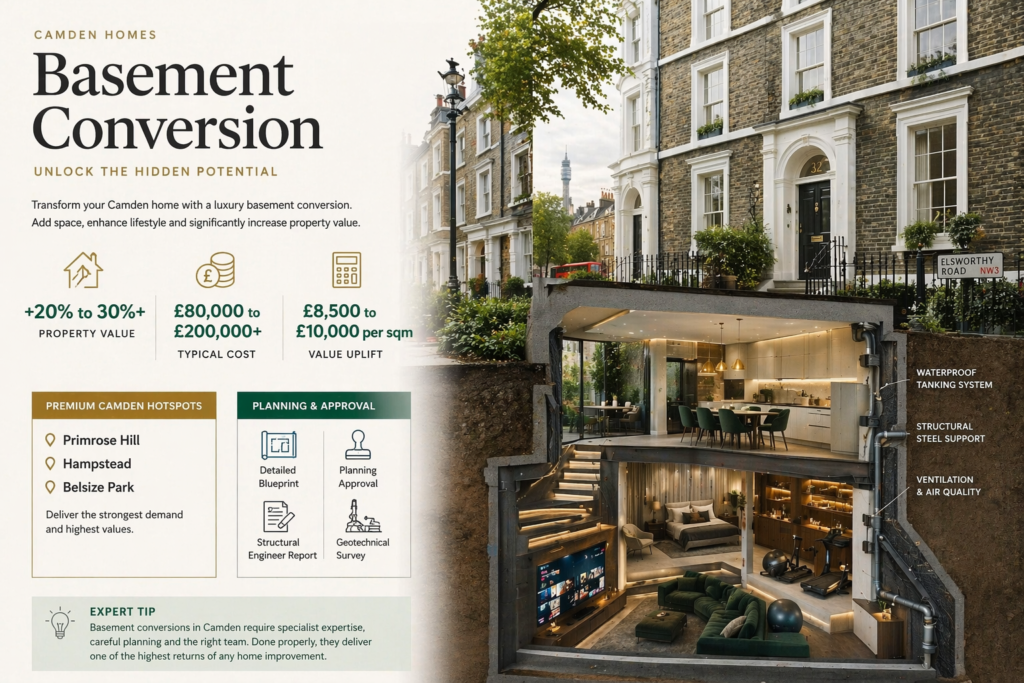
For Camden homeowners in streets where above-ground extension options are exhausted or heavily restricted by planning, a basement conversion adds space in the one direction planning policy cannot easily constrain. Camden’s Georgian townhouses and larger Victorian properties frequently have cellars or semi-basements that can be converted to full habitable rooms with proper waterproofing, lighting, and ventilation. Basement spaces often need compliant plastering services after structural works.
The financial case for basements in Camden is strong. Research indicates properties in prime Camden postcodes can achieve value uplifts of £8,500 to £10,000 per square metre of basement floor area, and in the most sought-after streets of Belsize Park, Primrose Hill, and Hampstead, this can rise to £19,000 per square metre or more. A well-executed 30 square metre basement conversion in Primrose Hill can add £500,000 or more to a property’s market value, making the £150,000 to £200,000 construction cost look modest.
Camden Council has detailed basement policy requirements. Projects are typically limited to a single basement storey, with excavation under the house footprint having higher approval rates than extensions under the garden. Camden requires a structural method statement and an impact assessment as part of any basement planning application. Planning approval rates for well-designed basement projects in Camden run around 72%, which means projects need careful design and professional guidance from the outset.
Basement conversions are not suitable for every property. Properties close to the River Fleet’s buried route, or in areas with high groundwater levels near the Lee Valley, can face engineering challenges that significantly inflate cost. A geotechnical assessment before committing to a basement project is a worthwhile £500 to £1,500 investment.
7. Period Feature Restoration
Value added: 3 to 8% | Typical cost: £2,000 to £15,000**
Camden’s property market consistently rewards properties that have retained or restored original period features. Buyers seeking Georgian and Victorian homes in Belsize Park, Primrose Hill, Kentish Town, and Hampstead are specifically looking for cornicing, ceiling roses, original fireplaces, sash windows, and period joinery. These features are not decorative extras: they are fundamental to what makes a Camden period property desirable and saleable.
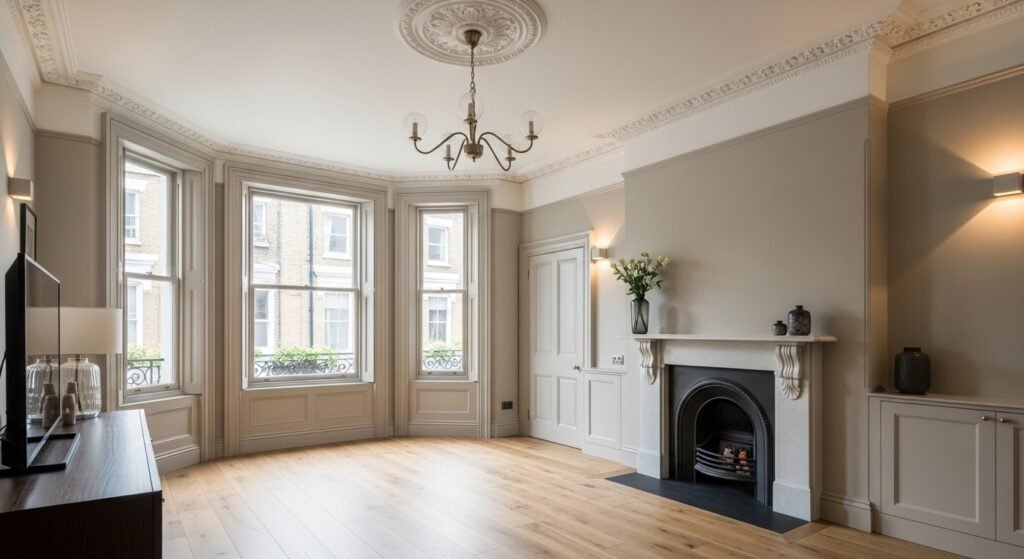
The most impactful restorations for value in Camden are:
Original fireplaces. Removing fireplaces was common in the 1970s and 1980s. Reinstating them, or restoring those that remain, adds warmth and character that buyers in Camden reliably respond to. A professional fireplace restoration costs £1,000 to £3,000. Sourcing and installing a period-appropriate cast iron surround with a working hearth costs £2,000 to £6,000.
Cornicing and ceiling roses. Specialist plasterers can restore damaged cornicing using traditional lime-based techniques for £50 to £150 per linear metre. Reproduction cornicing from suppliers like Stevensons of Norwich starts at £8 per linear metre for simpler profiles. Intact original cornicing significantly improves the perceived quality of a room without any structural work.
Sash windows. Original timber sash windows in Camden properties are worth restoring rather than replacing. Many period homes need careful window repairs instead of replacement. Draught-proofing and secondary glazing of an existing sash costs £300 to £600 per window and performs close to a new double-glazed unit thermally, without the expense or planning complexity of replacement in a conservation area.
Original timber floorboards. Baltic pine floorboards under carpet in Victorian terraces are a hidden asset. Refinished boards can outperform new flooring installation in period homes. Professional sanding and finishing costs £15 to £25 per square metre. The result is more authentic and more valuable than any replacement flooring.
8. Energy Efficiency Upgrades
Value added: 3 to 10%+ | Typical cost: £3,000 to £20,000**
Energy efficiency has moved from a secondary consideration to a front-line valuation factor. Buyers are increasingly aware that properties with poor EPC ratings carry higher running costs and may face future regulatory requirements. A property that moves from an EPC rating of E or D to C or B sells faster and at a higher price. Research from Oxford Economics suggests homes with better energy ratings achieve a 3.4% price premium over comparable homes with lower ratings.
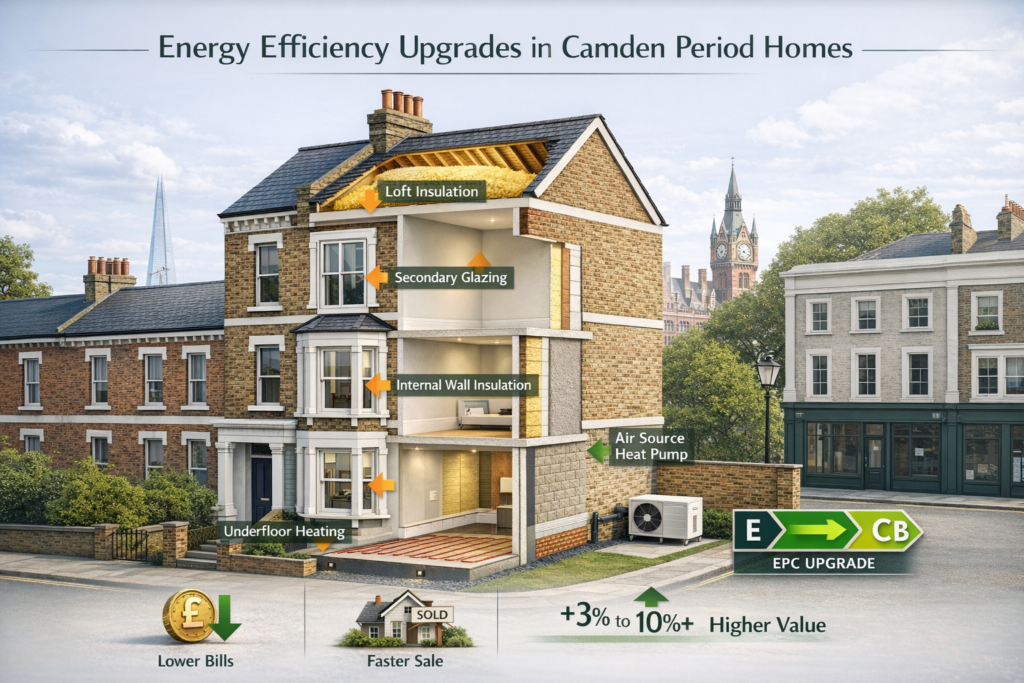
The most cost-effective energy upgrades for Camden’s period housing stock are:
Loft insulation. Insulating the loft floor to current standards costs £300 to £600 for a standard Victorian terrace. Some owners also improve thermal comfort with underfloor heating. This alone can reduce heat loss by up to 25% in an uninsulated property and improve the EPC rating meaningfully.
Secondary glazing on sash windows. In Camden’s conservation areas, replacing original sash windows is often restricted or requires planning permission. Secondary glazing installed internally costs £300 to £600 per window and significantly reduces heat loss and noise ingress from busy Camden streets, without requiring planning approval.
Heat pump installation. Air source heat pumps are increasingly suitable for period properties in Camden, particularly those with well-insulated lofts and updated radiators. Heating upgrades should be reviewed by qualified heating engineers. The government’s Boiler Upgrade Scheme currently provides a £7,500 grant toward heat pump installation. A qualified installer can assess whether your Camden property’s heat loss characteristics are compatible with a heat pump before you commit.
Wall insulation. Camden’s Victorian solid-wall terraces are harder to insulate than cavity-wall properties. Internal wall insulation costs £40 to £60 per square metre installed and reduces heat loss significantly, but it reduces the floor area of each room by several centimetres per wall. External wall insulation is more effective but often restricted in conservation areas because it changes the appearance of the building. Discuss options with a specialist before committing.
Camden Council offers the Warm Homes Local Grant scheme for eligible homeowners, which can fund free energy upgrades, including insulation measures, solar panels, or heat pumps for qualifying low-income properties. Check the council’s website to see whether your postcode qualifies.
9. Open-Plan Ground Floor Reconfiguration
Value added: 5 to 10% | Typical cost: £8,000 to £20,000**
Many of Camden’s Victorian terraces still have the original compartmentalised ground floor layout: a narrow hallway, a front reception room, and a separate kitchen at the back. This arrangement made sense for Victorian domestic life. It is poorly suited to how families use their homes in 2026, and it is a consistent suppressor of buyer interest and sale price.
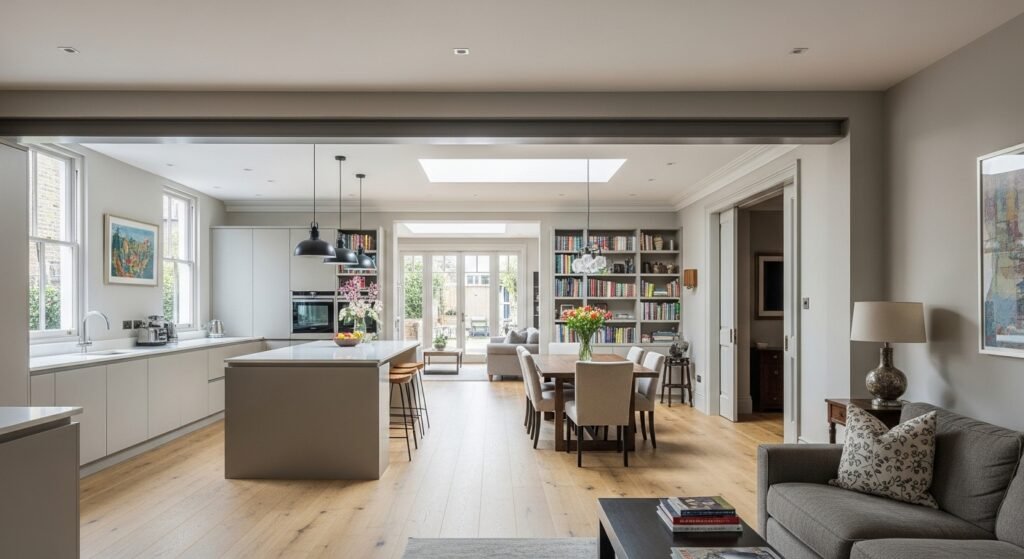
Removing the wall between the rear reception room and the kitchen, or opening the front and rear rooms into a single through-room, transforms the ground-floor experience without extending the property’s footprint at all. In Camden, this kind of internal reconfiguration creates the open-plan family kitchen-dining-living space that buyers expect, at a fraction of the cost of an extension.
The key structural cost is the RSJ (Rolled Steel Joist) beam required when removing a load-bearing wall. Many reconfigurations also include partial house rewiring. In a typical Camden Victorian terrace, removing the rear ground-floor wall between the back room and kitchen requires a single RSJ installation costing £2,500 to £5,500, including structural engineer sign-off. Add plastering, flooring, and decoration, and a complete ground-floor reconfiguration comes in at £8,000 to £20,000.
Some Camden homeowners worry about acoustic privacy with open-plan layouts, particularly for families with children or home workers. The current trend toward “broken plan” living addresses this, using bookshelves as partial dividers, level changes between kitchen and living areas, or pocket doors that can close off sections when needed, maintaining connection and light while enabling separation when required.
10. Kerb Appeal and Exterior Improvements
Value added: 3 to 7% | Typical cost: £2,000 to £10,000**
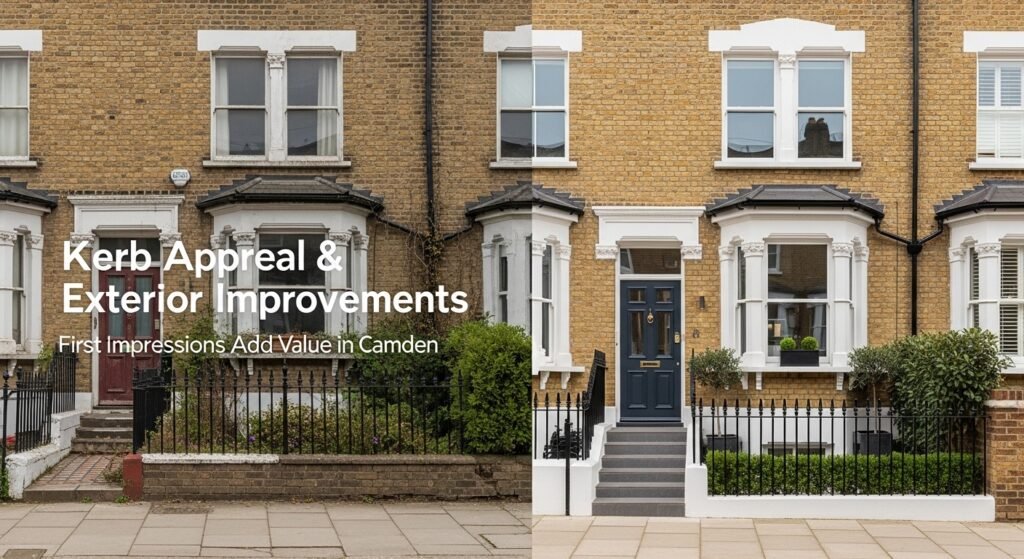
First impressions drive buyer decisions in Camden’s competitive property market. A property that looks well-maintained from the street generates more viewings, higher offers, and faster sales than a comparable property with a tired exterior. The good news is that exterior improvements typically cost far less than internal renovations and deliver a strong return relative to their cost.
Front garden and boundary. Many Camden Victorian terraces converted their front gardens to paving in previous decades. Reinstating a proper front garden with a low hedge or period-appropriate railing, and fresh planting, restores street character and creates an immediate positive impression. This costs £1,500 to £4,000, depending on the size and specification.
Front door and ironmongery. A freshly painted or replaced front door in a period-appropriate colour with new ironmongery is one of the highest-return low-cost improvements in Camden. A door painted in Farrow & Ball’s Railings, Hague Blue, or a similar heritage shade, with polished brass or cast iron furniture, signals that the property has been cared for. Cost: £500 to £2,000.
External decoration. Repainting external woodwork, replacing damaged or mismatched window frames, and repointing brickwork where it has deteriorated are all exterior improvements that prevent ongoing damage while improving appearance. In Camden’s conservation areas, painting unpainted brickwork may require planning permission. Check before proceeding. Damaged roofs should be fixed through trusted roof replacement works where needed.
Garden and outdoor space. Rear garden improvements, including landscaping, a quality patio or decking area, and external lighting, add usable living space in a borough where outdoor space is scarce and highly valued. A well-designed garden that flows from the kitchen extension through bifold doors to a properly landscaped space is a consistent feature of the highest-achieving Camden sale prices.
Camden-Specific Factors That Affect Every Project
Several characteristics of Camden’s planning environment and housing stock affect the return on all of these projects.
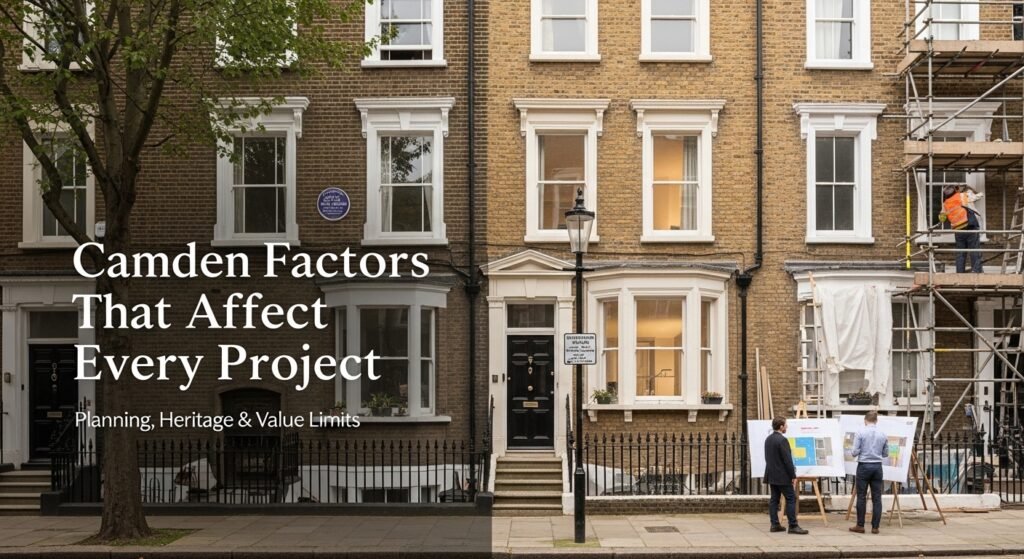
Conservation area density. Camden has extensive conservation area coverage, including Hampstead, Belsize Park, Primrose Hill, Chalk Farm, and parts of Kentish Town. In these areas, external alterations typically require planning permission, materials must match the existing building character, and heritage statements may be required as part of the application. Budget an additional £2,000 to £5,000 in professional fees for any project in a conservation area, and allow 3 to 5 months additional time for planning.
Listed buildings. Camden contains hundreds of listed buildings across its Georgian and Victorian streets. Any works to a listed building, internal or external, require Listed Building Consent in addition to planning permission. This applies to works as minor as replacing a fireplace or removing internal plasterwork. Confirm your property’s listing status before planning any work at historicengland.org.uk.
The ceiling price constraint. In some Camden streets, particularly those at the top of their local price bracket, the value that any improvement can add is capped by the ceiling price of comparable properties. A £200,000 renovation on a Kentish Town terrace surrounded by properties selling for £800,000 will not produce a £200,000 uplift. Research comparable sold prices in your specific street and postcode before committing to a major project.
The period property premium. Camden’s market consistently rewards properties that have preserved or restored their original Georgian and Victorian character. A house with intact cornicing, working fireplaces, original sash windows, and period floorboards commands a premium over an equivalent property that has been stripped of its features and modernised. When planning any improvement, always ask whether it preserves or enhances the period character of the property.
Labour costs and wait times. Camden is a premium borough for construction work. Skilled contractors familiar with Camden’s conservation areas, its planning officers, and its period housing stock are in high demand. Reputable builders and architects working in Camden are typically booked 3 to 6 months ahead. Factor this into your project timeline and start the contractor search well before you want work to begin.
How to Prioritise: Which Project for Which Property?
Not every Camden property benefits equally from every project. Here is a practical guide to prioritising based on your situation.
If you are buying a fixer-upper in Camden, address the structure and services first. Rewiring, replumbing, roof repairs, and damp treatment before any cosmetic work. Then consider an open-plan reconfiguration and kitchen renovation before tackling extensions or loft conversions.
If you are preparing to sell in 12 to 24 months, Focus on the improvements with the fastest payback: kitchen renovation, bathroom upgrade, period feature restoration, and kerb appeal. These deliver visible improvements to buyer perception without the 6 to 12 month project timelines of major structural work.
If you plan to stay for five or more years, Larger projects justify the investment. A loft conversion, rear extension, or basement conversion adds both living value for your family and lasting resale value. Consider tackling the loft and extension simultaneously to reduce total disruption and professional fees.
If your Camden property is in a conservation area, every external change needs a planning application. Prioritise internal improvements, energy upgrades, and period feature restoration first. These add value without planning complexity. When you are ready for external projects, appoint an architect experienced specifically in Camden’s conservation areas before approaching builders.
FAQ
Q: Which home improvement adds the most value in Camden?
A loft conversion typically delivers the highest return on investment in Camden, adding 15 to 25% to a property’s value at a cost that is significantly lower per square metre than a ground-floor extension. Basement conversions can add 25% or more in prime Camden postcodes like Primrose Hill and Belsize Park, but at a higher total cost and with more complex planning requirements. For homeowners on a tighter budget, a kitchen renovation or open-plan ground-floor reconfiguration can deliver 5 to 10% value uplift for £8,000 to £35,000.
Q: Do home improvements need planning permission in Camden?
Many internal improvements, including kitchen and bathroom renovations, rewiring, replumbing, and open-plan reconfigurations, do not need planning permission. External changes are more complex. Camden has extensive conservation area coverage and many listed buildings, where external works require planning permission even for minor alterations like replacing windows. Extensions, loft conversions with external dormers, and basement conversions all require planning applications in most of Camden’s residential areas. Check the Cden Council’s planning pages and your property’s conservation area and listing status before starting any external work.
Q: What is the average property value in Camden, and how much can improvements add?
Camden is one of London’s most valuable residential boroughs, with average property prices varying significantly by neighbourhood. Hampstead and Belsize Park consistently rank among London’s highest, with detached houses regularly exceeding £3 million. Kentish Town and Gospel Oak are more accessible, with Victorian terraces typically selling between £800,000 and £1.5 million. Even at the lower end of Camden’s market, a well-executed loft conversion or extension can add £80,000 to £200,000 of value, making these projects financially compelling for most homeowners.
Q: Is it worth renovating a listed building in Camden?
Listed buildings in Camden require Listed Building Consent for any works affecting their special interest, which adds complexity and cost. However, the premium that listed buildings command in Camden’s market is substantial. A sensitively restored listed Georgian townhouse in Primrose Hill or Belsize Park consistently outperforms non-listed comparables at sale. The key is to work with architects and contractors experienced in listed building work, who understand what Camden’s conservation officers will and will not accept. Well-executed restorations of listed properties in Camden typically deliver strong returns.
Q: How long do home improvement projects take in Camden?
Internal renovations, including kitchens and bathrooms, take 2 to 6 weeks. Open-plan ground-floor reconfigurations take 4 to 8 weeks. Loft conversions take 8 to 16 weeks of construction, plus 3 to 5 months for design, planning permission in conservation areas, and professional fees. Rear extensions take 12 to 20 weeks of construction. Basement conversions take 9 to 15 months from inception to completion, including planning (3 to 4 months) and three construction phases. Budget the planning and design phase into your timeline before you count the build duration.
Conclusion
Camden’s property market rewards home improvements that add genuine usable space, enhance period character, and respect the architectural heritage of the borough. Loft conversions and rear extensions deliver the largest absolute value uplifts. Kitchen and bathroom renovations are the most accessible entry points for adding value without major structural disruption. Period feature restoration and energy upgrades are the most Camden-specific improvements, directly aligned with what buyers in this particular market pay premiums for.
The correct project for your property depends on what it currently lacks relative to the comparable homes that buyers will see alongside it. A Camden Victorian terrace that has all its original features, but a dark ground floor needs an extension more than a loft conversion. One with an already-open ground floor but only two bedrooms needs a loft conversion more than anything else.
Start with the project that addresses your property’s most obvious weakness relative to the local market, use an architect experienced in Camden’s planning environment, and set aside a 10 to 15% contingency on top of your quoted costs. Done well, the right home improvement in Camden does not just add value. It makes the property what buyers in this borough are actively looking for. For tailored project advice, you can contact our team.

Tilly Bani is a renovation and roofing specialist with over 15 years of experience in construction and property refurbishment across North London. He specialises in roofing, structural repairs, and full home renovations, helping homeowners improve property value and safety.