
Quick Answer
A traditional shower with a low-profile tray is usually the lower-risk and lower-cost choice for a first or second-floor Victorian terrace bathroom in North London, costing £3,000 to £6,000 fitted. Many homeowners choose professional shower installation for a faster and simpler upgrade. A wet room is possible, but it needs structural prep, tanking, and accurate drainage. A wet room is achievable on timber floors but demands significant structural preparation, comprehensive waterproofing, and precise drainage work, adding £2,000 to £4,000 to the project cost and significantly raising the consequences of any installation error. For ground floors with accessible drainage and solid or near-solid substrates, a wet room becomes more practical. The right choice depends on floor construction, drainage position, ventilation capacity, and how long you plan to stay.
Introduction
The wet room has become one of the most requested bathroom features in North London Victorian terraces over the past decade. On Instagram and in estate agent listings, the appeal is immediate: seamless tiling from floor to ceiling, no shower tray lip, no enclosure frame, just an expansive and clean space that makes a compact Islington or Hackney bathroom feel far larger than it is. Many period homeowners combine these upgrades with full bathroom installation projects.
The gap between how a wet room looks and what it takes to build one in a 130-year-old suspended timber-floored terrace is the source of most of the problems bathroom contractors in North London deal with. Older homes often need hidden repairs before installation, especially plumbing heating upgrades and floor strengthening. Water follows gravity. In a building where the floor flexes by a few millimetres under load, where joist centres may be compromised by 100 years of use and repeated plumbing interventions, and where the drain must sit precisely in relation to the soil pipe below, the margin for error is smaller than it appears.
This guide gives you a direct comparison of wet rooms and traditional shower installations, specific to the construction realities of North London’s Victorian housing stock. It covers what each option costs, what the installation actually involves, and the factors that should determine which one you choose.
What a Traditional Shower Actually Means in 2026
The term “traditional shower” covers more than the old over-bath shower on a flexible hose. In 2026, the range of enclosed and walk-in shower options available for a Victorian terrace bathroom is broad.
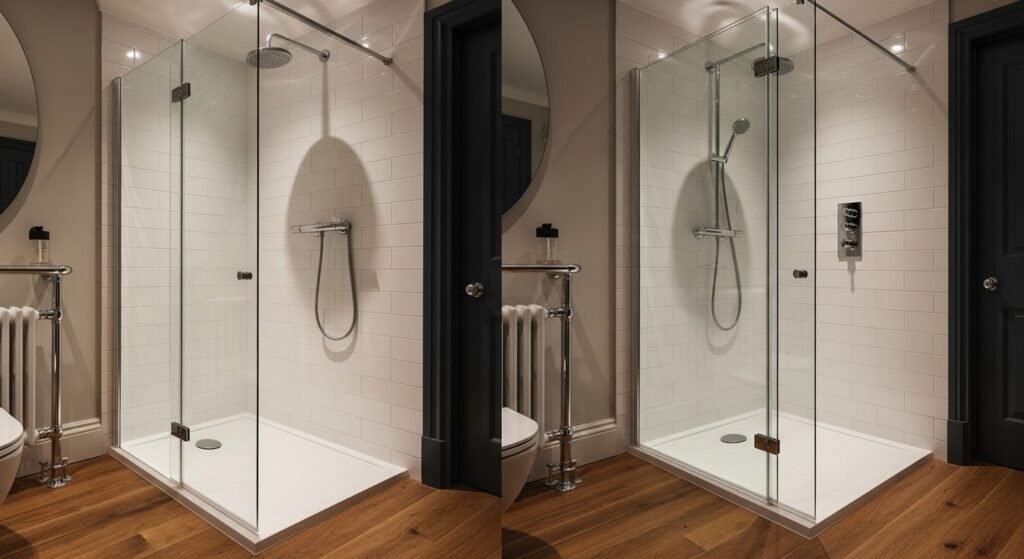
A standard shower tray with enclosure uses a stone resin, acrylic, or ceramic tray as the base. The tray is set level on the floor, water drains through the tray waste into the existing drainage, and glass panels contain water within the shower zone. Many owners choose quality Islington shower installation services for this setup. This is the simplest installation and the lowest risk on timber floors because the water containment is handled by the tray itself rather than by the floor tanking. A 900 x 900mm stone resin tray with a quality frameless glass screen costs £500 to £1,200 for the units, plus two to three hours of fitting time.
A low-profile walk-in tray with a single glass panel uses a tray of 30 to 40mm height, virtually flush with the surrounding floor, with a minimal lip and a large fixed glass screen. These often sit alongside modern bathroom remodelling upgrades. This looks closer to a wet room aesthetic while retaining the water containment and lower installation complexity of a tray-based system. It is currently the most popular shower configuration in Victorian terrace bathroom renovations across North London. A 1,200 x 800mm low-profile stone resin tray with frameless panel costs £800 to £1,800 for the units.
Both options can be installed on a Victorian timber floor without the structural reinforcement, floor depth modification, and comprehensive tanking that a true wet room requires.
What a Wet Room Requires in a Victorian Terrace
A wet room is not a shower without a tray. It is a fully waterproofed room where the entire floor surface is the shower floor, sloped to a central or linear drain, with no containment boundary between the shower zone and the rest of the bathroom floor.
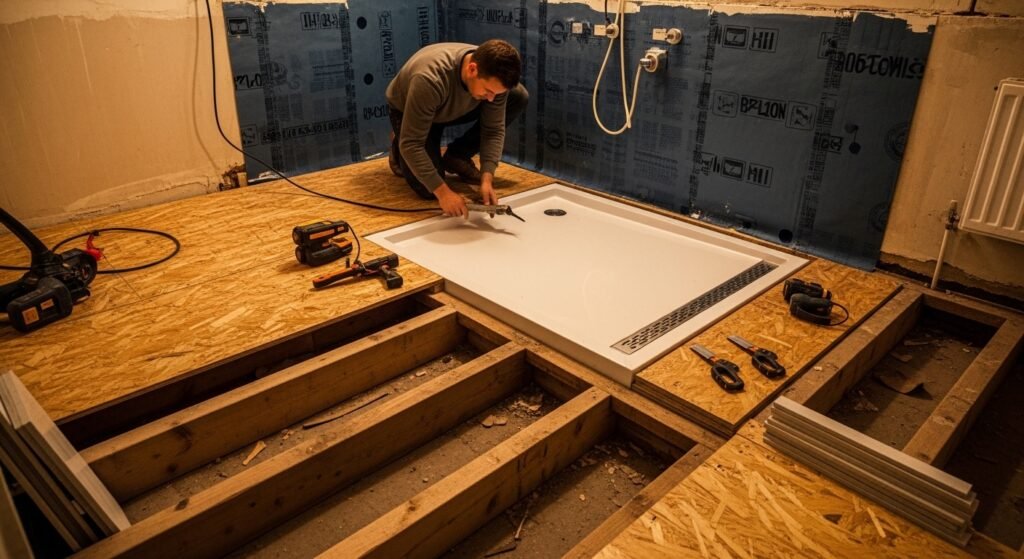
Victorian timber floors usually need reinforcement, subfloor replacement, and proper waterproofing tanking before tiling starts. This definition has specific structural and construction consequences in a Victorian terrace.
The Timber Floor Problem
Victorian terraces in Islington, Hackney, Haringey, and across North London almost universally have suspended timber floors on the first and second floors. These floors consist of floorboards laid on joists, which span between the front and rear walls and rest on mid-span sleeper walls. The construction is robust for its intended purpose but has two characteristics that create difficulty for wet room installation.
First, suspended timber floors have some inherent flex. Even a well-maintained Victorian floor deflects slightly under load. In a normal room, this deflection is invisible and irrelevant. In a wet room, where the waterproofing membrane and the tile adhesive must remain absolutely stable and crack-free across the entire floor area, any sustained movement causes grout joint failure and eventually membrane failure. Water then tracks through the failed joints into the timber substrate beneath, where it causes wet rot that may not be visible until significant structural damage has already occurred.
Second, creating the required drainage fall of 1 to 2% across the floor towards the drain point requires either lowering the floor level locally, using a pre-formed wet room former that sits within the joist depth, or building up the surrounding floor to create the gradient. Each approach involves significant preparation work that goes beyond any traditional shower installation.
Structural Preparation for a Timber Floor Wet Room
The correct approach for a timber floor wet room involves these steps, in sequence:
Joist assessment and reinforcement. Every joist in the bathroom must be assessed for structural condition. Any joist showing signs of rot, compression, or previous mechanical damage must be repaired or sistered (a new joist bolted alongside the damaged one). The joists must be noggled (short timber pieces fitted horizontally between joists) to add rigidity and prevent lateral twisting. The goal is a floor with zero perceptible flex when loaded.
Marine plywood subfloor. The original floorboards are removed and replaced with a minimum of 18mm marine-grade exterior plywood, fixed to the joists and noggins. Plywood provides a moisture-resistant, rigid, and uniform surface. Standard chipboard or OSB is not appropriate for a wet room substrate.
Pre-formed floor former. A pre-formed XPS (extruded polystyrene) wet room former is set into the floor construction within the shower zone, sitting within the joist depth so that its surface is flush with the surrounding floor level. The former has a pre-cast drainage gradient of 1 to 2% sloping to the drain point. This is the most reliable way to achieve a correct and consistent drainage fall on a timber floor.
Full tanking. The entire floor and lower wall sections are covered with a waterproofing membrane, sealed at all wall-to-floor junctions with fabric tape and flexible sealant. The membrane must extend up the walls to a minimum of 150mm above the floor level, and to at least 1,800mm height in the shower zone.
This preparation sequence adds two to four additional days of labour to the project, plus materials, before any tiling begins. In London, that translates to approximately £1,500 to £3,000 in additional cost over a standard shower tray installation. Some projects also require stud wall construction to improve layout and pipe boxing.
The Drainage Position Constraint
Drainage matters more than design. If the soil pipe is too far away, costs rise quickly. Before work begins, many contractors inspect for leaks and waste issues with leak detection or drainage repairs. The drain in a wet room must be positioned precisely in relation to the soil pipe below. The waste from the wet room drain must fall to the soil and vent pipe at a minimum gradient of 1:40 without any falls that reverse direction. In a Victorian terrace, the soil pipe position is fixed by the existing plumbing, and the bathroom may be on the opposite side of the property from where the drain could be conveniently positioned.
If the soil pipe is not directly beneath or very close to where the drain needs to sit for the wet room floor plan, extending the waste run increases the risk of inadequate fall and future blockage. A plumber must assess this before any wet room design is finalised.
Cost Comparison: North London 2026
These costs reflect London labour rates, which run 20 to 30% above the national average. Many households bundle bathroom work into larger full refurbishment projects for better value.
Traditional Shower Tray with Enclosure
| Component | Cost |
|---|---|
| Stone resin tray (900 x 900mm) + frameless panel | £600 to £1,200 |
| Plumber: first fix + second fix | £600 to £900 |
| Tiler: shower walls (tiles included) | £800 to £1,500 |
| Waterproofing behind shower | £200 to £400 |
| Total (shower zone only, not full bathroom) | £2,200 to £4,000 |
Low-Profile Walk-In Tray with Glass Screen
| Component | Cost |
|---|---|
| Low-profile tray (1,200 x 800mm) + frameless screen | £900 to £1,800 |
| Plumber: first fix + second fix | £700 to £1,000 |
| Tiler: walls and floor surround (tiles included) | £1,000 to £1,800 |
| Waterproofing | £250 to £500 |
| Total | £2,850 to £5,100 |
Wet Room on First-Floor Victorian Timber Floor
| Component | Cost |
|---|---|
| Structural assessment and joist reinforcement | £400 to £800 |
| Marine plywood subfloor | £300 to £600 |
| Pre-formed floor former + linear drain | £400 to £800 |
| Full room tanking (floor and walls) | £600 to £1,200 |
| Plumber: first fix, drain connection, second fix | £900 to £1,400 |
| Tiler: full room floor-to-ceiling (tiles included) | £2,000 to £4,000 |
| Glass screen (optional) | £400 to £1,200 |
| Total | £5,000 to £10,000 |
Note that the wet room total is for the wet room installation element only. A full bathroom renovation, including the wet room, WC, basin, and all decoration, typically runs £12,000 to £20,000 for a mid-range Islington Victorian terrace bathroom.
Performance Comparison in a Victorian Property
Thermal Comfort
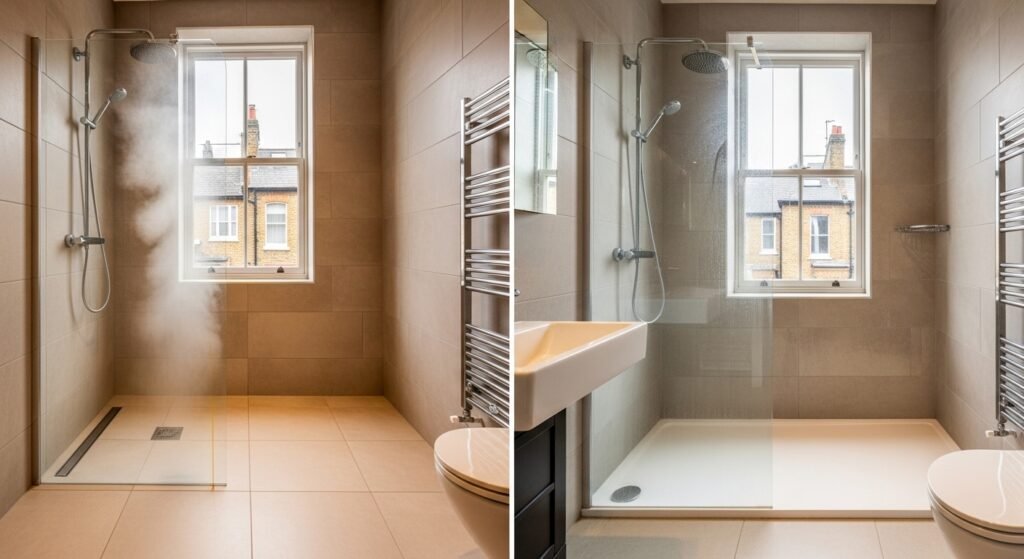
Victorian terrace bathrooms are often on the colder side. The solid brick external walls lose heat faster than modern cavity wall construction, and the room is typically the furthest point from the boiler. A wet room, where the entire floor and wall surface is wet after showering, takes longer to dry and feel warm than a bathroom where only the tray and shower enclosure are wet. Wet rooms can feel colder because more floor area gets wet. Electric underfloor heating makes a major difference.
Underfloor heating significantly improves this. A wet room without underfloor heating can feel cold and damp between uses, particularly in winter. Wet room installations in Victorian terraces should budget for electric underfloor heating beneath the tile, which adds £500 to £1,000 to the project cost but transforms the post-shower experience.
Traditional shower trays, where the wet area is contained, warm up and dry faster without UFH.
Ventilation Requirements
Building Regulations Part F requires mechanical ventilation extracting at a minimum of 15 litres per second for a bathroom with a shower. In a wet room, where the entire room is the shower zone, ventilation is more critical because the volume of humid air produced is higher and the drying time without extraction is longer.
Victorian terraces in North London frequently have bathrooms that are either in the middle of the upper floor (no external wall access) or in a rear outrigger. In both cases, the extractor fan must be ducted through the ceiling into the loft and out through a roof vent. Confirm this duct route is achievable before committing to a wet room.
An underspecified extractor fan in a wet room creates persistent condensation on cold surfaces, which in a Victorian terrace with uninsulated external walls means mould growth at wall corners and above windows. This is a building fabric problem, not a cosmetic one. Good extraction is essential. Many older homes need new lighting installation and extractor wiring during renovations.
Cleaning and Maintenance
Wet rooms have fewer corners, no shower tray waste to unblock at tray level, and no enclosure frames where limescale and mould accumulate. The wall-to-wall tiled surface is easier to squeegee after use. Many owners choose easy-clean bathroom tiling finishes. If the tanking membrane fails, water enters the substrate beneath the tiles.
The limitation is hard water. London’s water supply is very hard, and limescale on porcelain and natural stone in a wet room is more visible and more widespread than in a contained shower enclosure. A wet room with natural stone on the floor requires regular sealing to prevent mineral absorption. Grout in a wet room covers more area and requires more regular attention.
Waterproofing Failure: The Risk Difference
This is the most important comparison between the two options.
A shower tray contains water by design. If the sealant at the tray-to-wall junction fails, the consequence is typically a small water ingress that becomes visible as a damp patch on the ceiling of the room below, usually within days or weeks of the failure. The repair involves re-sealing the junction with fresh silicone: a straightforward, cheap, and quick fix.
A wet room failure is fundamentally different. Wet rooms have fewer corners but more tiled surface area to maintain. On a timber floor, this water is immediately in contact with the floor former, the marine plywood, and eventually the joists. Wet rot in joist timber can develop over months before any visible sign appears in the room below. By the time the downstairs ceiling shows a damp patch from a wet room waterproofing failure, the joists may have been wet for six months and the repair cost is measured in thousands rather than hundreds. This is the biggest difference. A failed tray seal is usually cheap to repair. A failed wet room membrane can damage hidden timber floors and joists.
Where ceilings or walls are affected, repairs may involve full replastering or wall skimming.
This risk asymmetry does not make wet rooms inadvisable in Victorian terraces. It makes them inadvisable without a specialist with documented experience of timber floor wet room installations, and without the full structural preparation described above. A wet room installed correctly by a specialist on a properly prepared substrate is no more likely to fail than any other bathroom installation. A wet room cut-price by a generalist contractor who skips the joist reinforcement and uses standard plasterboard instead of marine ply will fail, and the failure will be expensive.
Which Floors Work Best for Each Option
Ground Floor with Solid Concrete Base
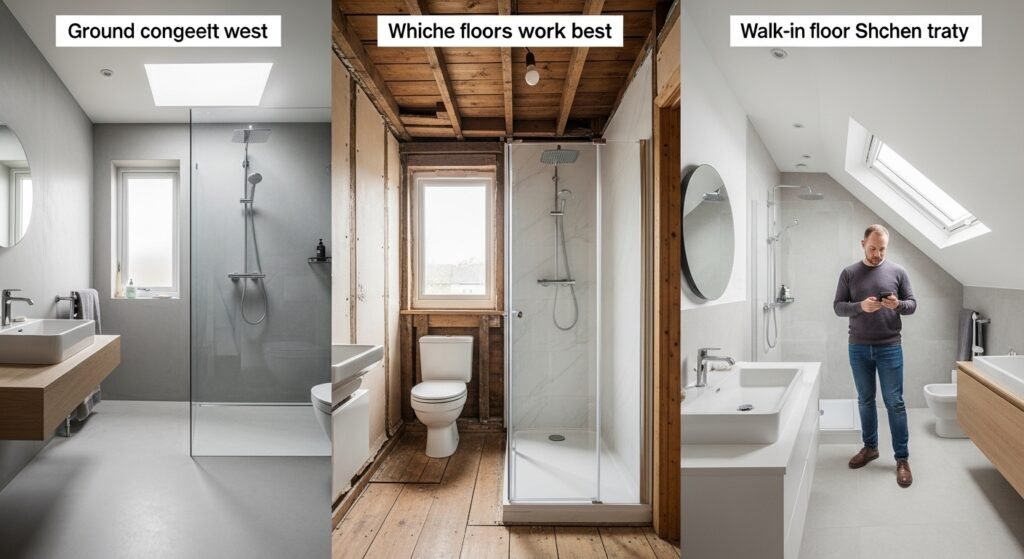
A ground-floor Victorian terrace bathroom, whether original or a converted reception room, may have a solid concrete or flagstone floor. This substrate makes wet room installation significantly simpler than a timber floor. There is no flex risk, no need for pre-formed formers within joist depth, and the drainage fall can be screeded directly. If you are converting a ground-floor space into a shower room or wet room in an Islington or Hackney Victorian property, a wet room is a much more straightforward proposition than the same project on the first floor.
First Floor on Timber Joists
The most common bathroom position in a North London Victorian terrace. Both options work. The traditional shower tray is simpler, cheaper, and lower risk. The wet room is achievable with the right preparation but costs significantly more and requires a specialist. The decision here depends on budget, how long you intend to stay, accessibility needs, and the specific joist condition.
Second Floor Loft Conversion
Loft conversion bathrooms typically have a concrete screed or chipboard over engineered joists. The screed floor is a better wet room substrate than original Victorian joists, but the drainage route to the soil pipe is often the constraining factor. A soil pipe run from the top floor to the ground adds cost and noise transmission risk. Many loft conversion bathrooms in North London opt for a low-profile walk-in tray rather than a wet room for exactly this reason. Many loft bathrooms choose walk-in trays and combine them with heating wiring upgrades.
Accessibility: The Strongest Case for a Wet Room
If anyone in the household has or anticipates mobility limitations, the case for a wet room shifts substantially. A wet room eliminates the tray lip entirely, allows wheelchair access, accommodates a shower seat without spatial penalty, and enables a carer to assist without navigating a shower enclosure threshold. A well-designed wet room with a fold-down bench, grab rails, and a handheld shower head is a genuinely superior facility for older adults or people with mobility limitations.
If accessibility is a current or likely future priority, the additional cost of a correctly installed wet room is justified, and the decision should be made at the point of the bathroom renovation rather than later, when retrofitting a wet room into an existing bathroom is more disruptive and expensive.
Property Value Impact
A well-executed wet room adds perceived value to a North London Victorian terrace, particularly in higher-value postcodes like N1, N5, N16, and N6, where buyers expect a certain standard of bathroom finish. Estate agents in these areas report that a poorly done wet room, with visible grout staining, inadequate slope to the drain, or water ponding, is one of the most off-putting features in a property viewing. A high-quality wet room can add appeal in premium North London postcodes. However, a badly built one can reduce buyer confidence. Many owners improve resale value further with nearby bathroom renovation upgrades or Hackney bathroom renovation projects.
A low-profile walk-in tray installation with frameless glass achieves 80 to 90% of the wet room aesthetic impact at significantly lower cost and with substantially lower installation risk. For a Victorian terrace where the bathroom will be sold within five to ten years and the primary goal is to achieve a contemporary bathroom without a period-property compromise, a quality walk-in tray installation is the more defensible investment.
FAQ
Q: Can you install a wet room on a first-floor Victorian timber floor?
Yes, but it requires specific structural preparation. The joists must be assessed and reinforced where needed, noggled for rigidity, and covered with a minimum of 18mm marine plywood. A pre-formed floor former provides the drainage gradient within the joist depth. A comprehensive tanking system covers all floor and lower wall surfaces. Done correctly by a specialist, a timber floor wet room is durable and waterproof. Done without this preparation, it is likely to cause hidden timber damage through membrane failure.
Q: Is a wet room more expensive than a walk-in shower in North London?
Yes, significantly. A low-profile walk-in tray installation with frameless glass in a North London Victorian terrace costs £2,850 to £5,100 for the shower zone. A wet room on the same floor costs £5,000 to £10,000 for the wet room installation. The additional cost reflects the structural preparation, comprehensive tanking, and full-room tiling that a wet room requires. For most Victorian terrace bathrooms, the walk-in tray option delivers a near-identical visual result at a lower cost and with less structural risk.
Q: Does a wet room add value to a Victorian terrace in Islington or Hackney?
A properly installed wet room with quality materials adds perceived quality and contemporary appeal to a North London Victorian terrace bathroom. The key qualifier is “properly installed.” A wet room with visible pooling, grout staining, or a poorly positioned drain is one of the most visible renovation failures in a property viewing. The value impact depends almost entirely on the quality of execution, not on the presence of a wet room per se.
Q: What is the most common wet room failure in Victorian properties?
Floor flex is cracking the waterproofing membrane. Victorian suspended timber floors deflect slightly under load. On a timber floor wet room where the structural preparation was inadequate (joists not noggled, subfloor not rigidly plywooded, no pre-formed former), this flex causes micro-cracks in the tanking membrane and grout joints over time. Water enters the crack, travels into the timber structure beneath, and causes wet rot. The failure is often not visible for months. The prevention is correct structural preparation before any tanking or tiling begins.
Q: Do I need planning permission for a wet room in a North London conservation area?
No. Converting a bathroom to a wet room is an internal alteration that does not require planning permission, regardless of conservation area status or Article 4 Directions. Building Regulations approval may be required if the project involves moving drainage runs, creating a new drainage connection, or significant electrical alterations. Confirm with your plumber and electrician whether self-certification through their competent persons scheme covers the work, or whether a formal Building Regulations application is needed.
Conclusion
For most North London Victorian terraces on first-floor suspended timber floors, a quality low-profile walk-in tray with a frameless glass screen is the better decision. It delivers the contemporary, open aesthetic that most homeowners want, at lower cost, with lower installation risk, and without the structural preparation demands of a true wet room.
A wet room makes compelling sense on ground floors with solid substrates, in homes where the budget extends to proper structural preparation and specialist installation, and where accessibility is a current or anticipated priority.
The decision should be driven by floor construction, drainage route, ventilation capacity, budget, and length of stay, not by the aesthetic gap between the two options, which, in a well-specified walk-in installation, is smaller than most homeowners expect before they see both side by side.

Tilly Bani is a renovation and roofing specialist with over 15 years of experience in construction and property refurbishment across North London. He specialises in roofing, structural repairs, and full home renovations, helping homeowners improve property value and safety.