
| Quick Answer Most cracks in Victorian houses are not structural and do not require urgent action. Hairline cracks under 1mm, fine vertical cracks at wall-to-ceiling junctions, and map cracking in old plaster are all normal in 120-year-old buildings. Cracks that warrant immediate professional assessment are those wider than 5mm, diagonal cracks wider at the top than the bottom, stepped cracks following mortar joints, horizontal cracks in external walls, and any crack that has visibly grown over a period of weeks. The BRE crack classification scale, used by RICS surveyors, categorises severity from negligible to very severe based on width and pattern. |
Introduction
Cracks in walls are one of the most common concerns for owners of Victorian houses, and also one of the most frequently misunderstood. The moment someone notices a crack running across a ceiling or diagonal across a wall, the word subsidence comes to mind, and the anxiety begins. Where damage is cosmetic, repairs are often part of wider Victorian house renovation plans.
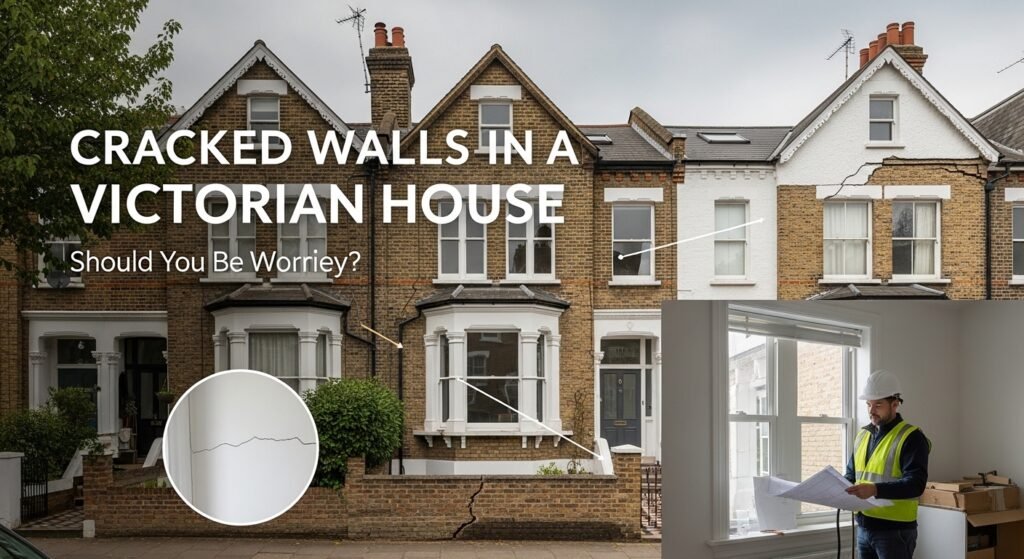
The reality is that Victorian houses crack routinely and for entirely benign reasons. A building that is 120 to 160 years old has been through thousands of thermal cycles, hundreds of wet and dry seasons, generations of occupants, and decades of repair and modification. Some cracking is the physical record of that history. Most of it is neither dangerous nor progressive.
The skill is in knowing which cracks represent normal building movement and which ones warrant a structural engineer’s attention. This guide explains the crack types found in Victorian houses, the diagnostic framework surveyors use, the causes that matter, and when to act.
Why Victorian Houses Crack More Than Modern Properties
Understanding why Victorian houses crack helps calibrate how much concern any given crack deserves.
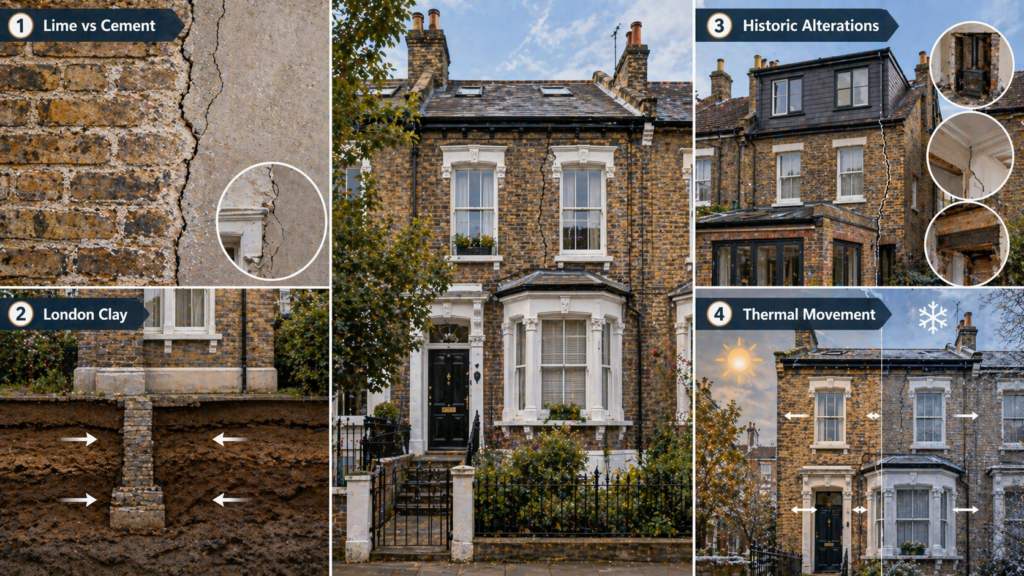
Lime mortar and plaster. Victorian terraces were built with lime mortar in the brickwork and lime plaster on the walls. Lime is softer and more flexible than modern cement. It accommodates small building movements without cracking. But where modern cement mortars or gypsum plasters have been applied during later refurbishments, the interface between the flexible Victorian structure and the rigid modern materials creates stress. Many owners later correct these finishes with full replastering using suitable materials. Cracks appear at these junctions, not because the building is moving significantly but because the two materials respond differently to the same movement.
Shallow foundations on London clay. Victorian terraces across North London were built on strip foundations at depths of 450mm to 600mm, adequate for 19th-century conditions. London clay is a reactive subsoil that expands when wet and contracts when dry. Seasonal moisture variation causes the clay to move, and the shallow Victorian foundations move with it. Historic movement patterns are common in older homes needing damp proofing Islington support, and structural maintenance. The building rises fractionally in winter and settles fractionally in summer. Over 130 years, this cyclical movement has produced a pattern of historic cracks in virtually every Victorian terrace in Islington, Hackney, Camden, and Haringey.
Settlement cracks from historic modifications. Victorian terraces have been modified repeatedly. Past works often include extensions or internal stud wall construction changes. Loft conversions, rear extensions, chimney breast removals, and structural alterations all impose new loads on old structures. Settlement cracks at the junction between old and new elements, or at points where loads have changed, are the structural record of those modifications. They are not evidence of current instability. They are evidence of past movement that has long since stabilised.
Thermal expansion. Brick expands in heat and contracts in cold. A Victorian terrace facade cycles through this expansion daily and annually. Cracks at the corners of window openings, where sash window repair work has been delayed for years, at the junction between the bay window and the main front elevation, and at the meeting of the outrigger and the main rear wall are all common consequences of differential thermal movement in different elements of the same structure.
The BRE Crack Classification Scale
Surveyors and structural engineers in the UK use the Building Research Establishment (BRE) crack classification scale to assess severity. Understanding this scale gives you a framework before you call anyone.
| Category | Width | Description | Action |
|---|---|---|---|
| 0 (Negligible) | Less than 0.1mm | Hairline cracks only | None required |
| 1 (Fine) | Up to 1mm | Fine cracks in plaster or mortar | Redecoration |
| 2 (Slight) | 1 to 5mm | Cracks easily filled | Minor repair |
| 3 (Moderate) | 5 to 15mm | Noticeable cracks, some opening | Professional investigation |
| 4 (Severe) | 15 to 25mm | Extensive cracking, distortion | Structural engineer urgently |
| 5 (Very Severe) | Over 25mm | Structural instability risk | Structural engineer immediately |
The width alone does not determine the category. Direction, location, pattern, and whether the crack is progressive all matter. A 4mm diagonal crack in an external wall at the corner of a window opening in a North London Victorian terrace is more concerning than a 6mm crack in old plaster at a ceiling junction in an internal room. Surveyors interpret width in context, not in isolation.
Types of Cracks and What They Mean
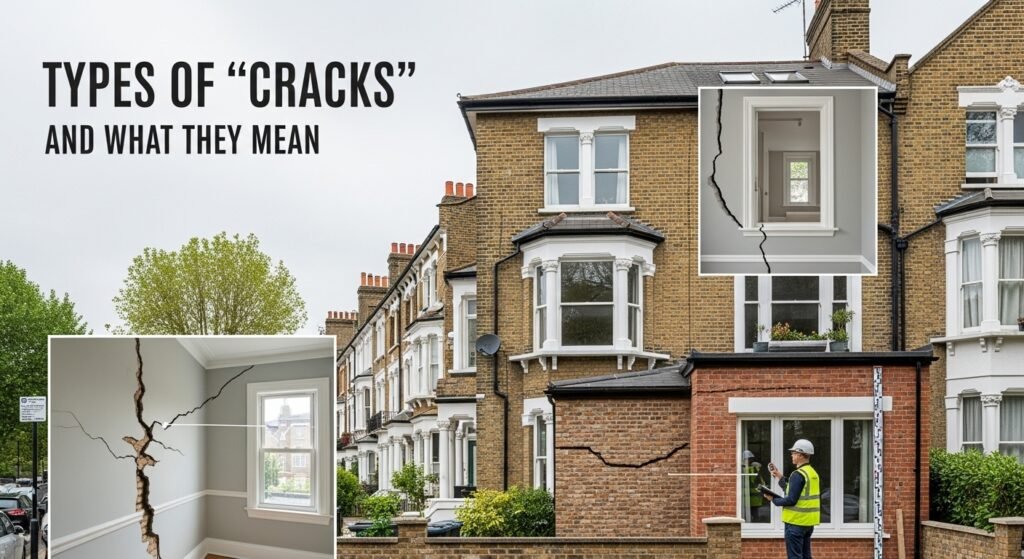
Hairline Cracks in Plaster (Categories 0 to 1)
These are the most common cracks in Victorian houses. They appear on plastered internal walls and ceilings as thin lines, often forming a map or crazing pattern across the plaster surface. They are caused by the natural drying and shrinkage of plaster over decades, by minor thermal movement, and by the loss of adhesion between plaster coats.
Map cracking in old lime plaster is almost universal in Victorian properties and has no structural significance. Where hairline cracks follow the line of lath and plaster keys (the thin gaps between the original timber laths), the crack is simply the plaster key breaking down with age.
These cracks fill and redecorate. Many owners combine this with home improvement costs planning before starting repairs. They require no further investigation. Simple cosmetic repairs usually involve painting and decorating.
Vertical Cracks at Wall-to-Ceiling Junctions (Category 1 to 2)
A fine vertical crack running along the line where an internal wall meets the ceiling is extremely common in Victorian terraces and almost never structural. It occurs because the wall and ceiling are different elements of the building that move at slightly different rates in response to temperature and moisture changes. The crack opens in dry summer conditions and closes in wet winter conditions.
Unless the crack is wider than 5mm, is opening progressively, or shows evidence of displacement (one side is higher than the other), this is a cosmetic issue.
Diagonal Cracks at Window and Door Corners (Category 2 to 4)
Diagonal cracks running from the corner of a window or door opening at 45 degrees into the surrounding wall are among the most frequently seen cracks in Victorian houses. External movement may also affect frames, and homeowners often inspect nearby broken sash window issues at the same time. The opening creates a weak point in the masonry, and the diagonal crack is the masonry’s response to the stress concentration at the corner.
These cracks range from entirely benign to genuinely concerning, and the difference depends on three factors.
First, width. A hairline diagonal crack at a window corner has been there for decades and is stable. A crack wider than 5mm at the same location warrants investigation.
Second, the direction of taper. A crack that is wider at the top and narrows toward the bottom suggests the wall is rotating or settling at the base of the opening. This is more concerning than a crack of even width.
Third, whether it is in the plaster or through the masonry. A diagonal crack through the plaster only is significantly less concerning than a diagonal crack that can be seen from outside, continuing through the brickwork.
Stepped Cracks in Brickwork (Category 3 to 5)
Stepped cracks follow the mortar joints in brickwork, moving diagonally across the wall in a staircase pattern. They occur because movement is taking the path of least resistance through the softer mortar rather than through the harder brick.
Stepped cracks are always external or visible through external masonry. They indicate differential movement between two sections of the building, often where an extension joins the main house, where a bay window has foundations at a different depth to the main front wall, or where subsidence is affecting one part of the building more than another.
Stepped cracks in brickwork are more concerning than equivalent cracks in plaster because they pass through the structural material itself. Any stepped crack wider than 3mm in external brickwork warrants a structural engineer’s assessment. Repairs often include careful London builders’ brickwork and masonry work.
Horizontal Cracks in External Walls (Category 4 to 5)
Horizontal cracks running along the mortar joints of an external wall are the least common type in Victorian terraces, but the most potentially serious. They indicate lateral pressure on the wall, either from the earth behind a retaining structure, from wall tie failure in a cavity wall (less common in Victorian solid-brick construction), or from structural overloading. In some cases roof spread or water ingress may also be contributing, making roof repair Islington checks worthwhile.
Horizontal cracks that run along a single mortar course, particularly in a basement wall or a wall retaining garden or street level above, require urgent structural assessment. They are rare in Victorian terraces, but when they occur, they represent a genuine structural risk.
Cracks at the Junction Between Extension and Original House (Category 2 to 4)
Where a Victorian terrace has had a rear extension added, either the original Victorian outrigger or a later 20th-century addition, cracks often appear at the junction between the old and new structure. This is extremely common and, in most cases, represents normal differential settlement between two elements built at different times with different foundation depths.
The key question is whether the crack is still moving. A crack at an old extension junction that opened when the extension was built and has remained stable for decades is a record of past settlement. A crack at the same location that is widening or deepening now indicates ongoing movement that requires investigation.
How to Monitor a Crack Before Calling an Engineer
Not every crack requires an immediate structural engineer call-out. For cracks that fall in the borderline range (Category 2 to 3), monitoring the crack over six to eight weeks tells you whether movement is ongoing or historical.
The tell-tale method. Draw a pencil line across the crack at right angles, marking a point on each side of the crack. Date it. Return in four weeks. If the marks have moved relative to each other, the crack is still active. If the marks have not moved, the crack is stable historic movement.
Photographic monitoring. Photograph the crack with a ruler beside it for scale. Date the photograph. Repeat every four weeks. A sequence of photographs that shows no change in width over two to three months is evidence of stability.
Crack monitors. Professional crack monitors are small plastic gauge strips that span the crack and show movement in two dimensions. They cost around £10 to £20 each and are available from builders’ merchants. Where a crack is in a location that is difficult to photograph consistently, a crack monitor provides a more reliable record.
If monitoring shows the crack is stable over six to eight weeks during a period of dry weather (when clay soil movement is at its greatest), it is almost certainly historical. If the crack is still active during monitoring, a structural engineer assessment is the next step.
When the Cause Is Subsidence
Subsidence is the word that frightens most Victorian house owners when they see cracks, but it is worth knowing that most North London Victorian terraces experience what is technically described as seasonal movement rather than progressive subsidence. The distinction matters.
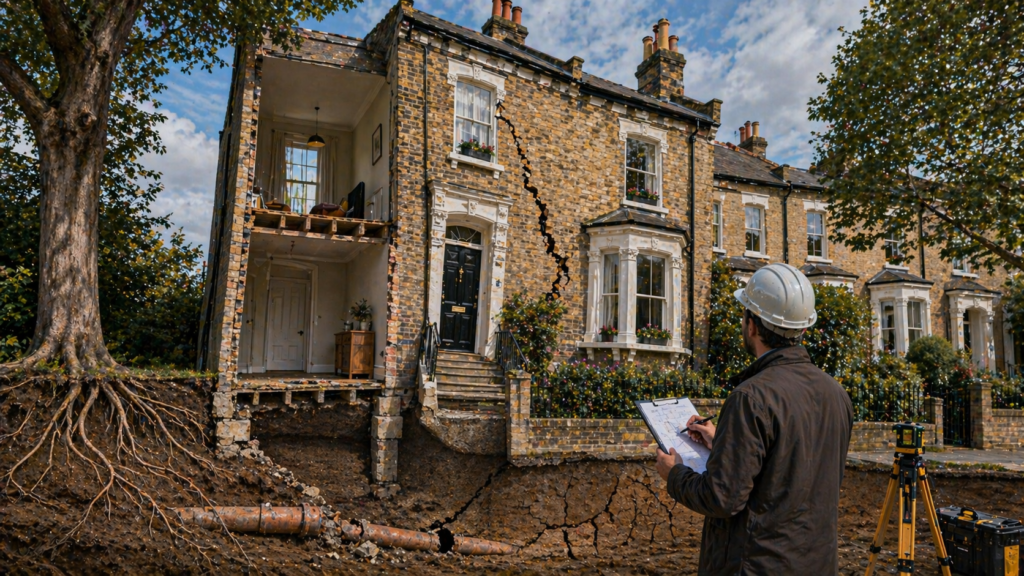
Seasonal movement is the cyclical rise and fall of the building in response to the London clay expansion and contraction with moisture. The building rises fractionally in winter (when the clay is wet and expanded) and settles fractionally in summer (when the clay is dry and contracted). This produces cracks that open and close with the seasons and have been doing so for decades. This is not progressive subsidence.
Progressive subsidence occurs when one part of the building moves more than another, and the movement does not reverse. The most common causes in North London are tree roots extracting moisture from the clay beneath the foundations (causing localised drying and permanent clay shrinkage) and damaged underground drainage that washes away the sub-base beneath the foundations. This usually requires investigation and possible drainage repairs.
Subsidence cracking is distinguished from seasonal cracking by these characteristics:
- The crack is diagonal and wider at the top than the bottom, indicating the wall is rotating as the foundation drops
- The crack continues to widen when monitored, even after a wet period
- Doors and windows in the affected part of the house stick or jam
- There is a floor slope visible in the affected rooms
- The crack is visible in the external brickwork, not just the internal plaster
If these characteristics are present, call a structural engineer, not a builder, and not a subsidence repair company. An independent structural engineer’s assessment costs £500 to £1,500 and provides an objective analysis that determines whether any intervention is needed.
Repair Costs for Wall Cracks in Victorian Houses
Once a structural assessment has confirmed that cracks are cosmetic or require repair (rather than structural remediation), the repair costs are straightforward.
| Repair Type | Typical Cost |
|---|---|
| Hairline crack filling and redecorating (per room) | £150 to £400 |
| Plaster hack-off and replastering (per m²). Many owners also upgrade finishes with fresh wall skimming after repairs. | £45 to £80 |
| External repointing of stepped brickwork cracks (per m²) | £30 to £50 |
| Structural engineer inspection and report | £500 to £1,500 |
| Underpinning (traditional mass concrete, per property) | £15,000 to £25,000 |
| Resin injection underpinning (per property) | £10,000 to £20,000 |
For the vast majority of cracks found in Victorian houses, the repair cost is the cost of a plasterer and a decorator, not a structural engineer and an underpinning contractor. The important step is correctly identifying which category your cracks fall into before committing to any repair.
Effect on Mortgages and Property Sales
Cracks in Victorian houses appear in building surveys and RICS Level 2 and Level 3 survey reports. Their presence does not automatically prevent a mortgage or a sale, but how they are described in the survey report and whether a structural investigation has been completed determines the impact.
A survey report that notes fine cracks consistent with normal settlement in a Victorian property of this age and recommends no further action creates no mortgage problem.
A survey report that recommends further investigation by a structural engineer creates a condition that must be resolved before exchange. The buyer’s solicitor will require either a clean structural engineer’s report, evidence that repairs are complete, or indemnity insurance.
If cracking is identified during your ownership and you obtain a clean structural engineer’s report confirming stability, keep that report. It is valuable when selling to buyers comparing other Islington builders’ renovation options nearby. It is valuable evidence when you come to sell, and it prevents the crack from becoming a negotiating point it does not merit.
FAQ
Q: Are cracks in a Victorian house normal?
Yes, to a significant degree. Victorian houses that are 120 to 160 years old have undergone continuous minor movement from thermal cycling, seasonal clay movement, and the cumulative effect of past modifications. Most cracks visible in Victorian houses are the record of that movement, are stable, and have been present for decades. The BRE defines hairline cracks under 0.1mm as negligible and fine cracks up to 1mm as requiring only redecorating. Most cracks in Victorian houses fall into these two categories.
Q: What type of crack in a Victorian house is most concerning?
Diagonal cracks are wider at the top than the bottom, stepped cracks in external brickwork that are widening when monitored, and any horizontal crack in an external wall. These crack patterns indicate progressive movement rather than historic stable settlement. A structural engineer should assess any crack wider than 5mm in external masonry, any crack that is visibly growing when monitored over four to six weeks, and any crack accompanied by sticking doors, sloping floors, or other signs of building distortion.
Q: Can I just fill the cracks in my Victorian house and redecorate?
For hairline and fine cracks up to 1mm in internal plaster, yes. Use a flexible filler that accommodates minor movement, apply decorator’s caulk at moving joints, and redecorate. Do not use rigid filler on cracks at junctions that are subject to seasonal movement, because rigid filler will crack again within a year as the building cycles. For cracks in external brickwork, use lime mortar for repointing, not cement, to maintain the flexibility and breathability of the original construction. Experienced contractors offering building services can advise on suitable materials.
Q: How much does a structural engineer cost for a Victorian house crack assessment in London?
A structural engineer’s inspection and written report for a London Victorian terrace costs £500 to £1,500, depending on the complexity of the assessment and whether the engineer needs to return for monitoring visits. For a straightforward assessment of cracks at a specific location, expect to pay £500 to £800. For a more extensive assessment involving multiple locations, monitoring over several visits, and a detailed written report, expect £1,000 to £1,500. This cost is substantially less than the cost of unnecessary remediation work on a property that turns out to be structurally stable.
Q: Does having cracks in a Victorian house affect the property value?
Cracks that are confirmed as cosmetic or historic settlement by a structural engineer’s report do not materially affect property value in London’s Victorian terrace market. These properties are understood by experienced buyers and their surveyors as inherently having historic cracking. Cracks that have not been investigated and cannot be explained by a survey report create negotiating uncertainty. The most effective way to protect property value is to obtain a structural engineer’s assessment when cracks raise questions, retain the report, and present it at the time of sale.
Q: What is the difference between settlement and subsidence in a Victorian house?
Settlement is the normal compression and adjustment of the ground beneath a building under the weight imposed on it, typically occurring in the first years after construction or after a modification. In Victorian houses, settlement is largely complete and historic. Subsidence is the ongoing downward movement of the ground beneath part or all of the foundations, caused by soil shrinkage, drainage failure, or tree root activity. The critical difference is progression: settlement cracks are stable, subsidence cracks continue to grow. Monitoring a crack over six to eight weeks is the first practical step to distinguishing between the two.
Conclusion
Cracked walls in a Victorian house are a reason to look carefully, not a reason to panic. The majority of cracks in these properties are the physical record of 120 years of thermal cycles, seasonal clay movement, and accumulated modifications. Most fall into the BRE’s negligible or fine categories and require nothing more than filler and paint.
The cracks that warrant professional assessment are those that are wide, diagonal, stepped through external brickwork, horizontal, or visibly growing when monitored. For these, a structural engineer is the correct first call, not a builder, and not a subsidence repair company. After assessment, remedial work is best handled by contractors experienced in building project management and older property repairs. An independent assessment from a qualified professional costs far less than unnecessary remedial work and provides the documentation that protects the property’s saleability.
Monitor first. Measure. Photograph. Then decide.

Tilly Bani is a renovation and roofing specialist with over 15 years of experience in construction and property refurbishment across North London. He specialises in roofing, structural repairs, and full home renovations, helping homeowners improve property value and safety.