
Quick Answer
A party wall agreement, technically called a Party Wall Award, is a legal document required under the Party Wall etc. Act 1996 before certain building work on or near a shared wall, boundary, or structure. You must serve written notice on affected neighbours between one and two months before starting notifiable work. If they consent within 14 days, no surveyor is needed. If they dissent or do not respond, a surveyor prepares an Award before work can begin. In Islington and Hackney, expect to budget £700 to £3,600 per affected neighbour, depending on whether one agreed surveyor or two separate surveyors are involved.
What Is a Party Wall Agreement and When Do You Need One
A party wall agreement confirms how building work affecting a shared wall, boundary, or nearby structure will be carried out, and it protects both the person doing the work and the neighbour whose property sits alongside it. The legal framework behind it, the Party Wall, etc. The Act 1996 applies across England and Wales and has not changed materially since it came into force, though surveyor fees and local practice shift year on year.
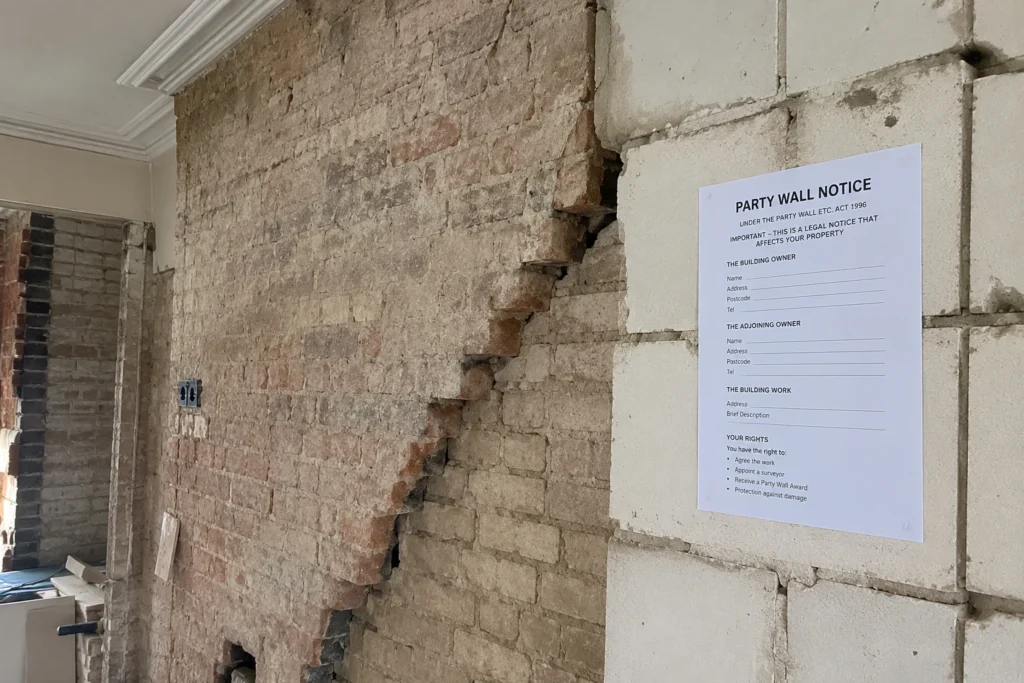
The person carrying out the work is called the building owner under the Act, regardless of whether they actually own the freehold outright, and the neighbour affected is the adjoining owner. This terminology matters because it appears throughout any notice, award, or correspondence during the process. Party walls also come up in a non-structural context; our guide to soundproofing party walls covers when acoustic work on the same wall needs the same notice.
The Three Types of Notifiable Work
The Act covers three distinct categories of work, each with slightly different notice requirements.
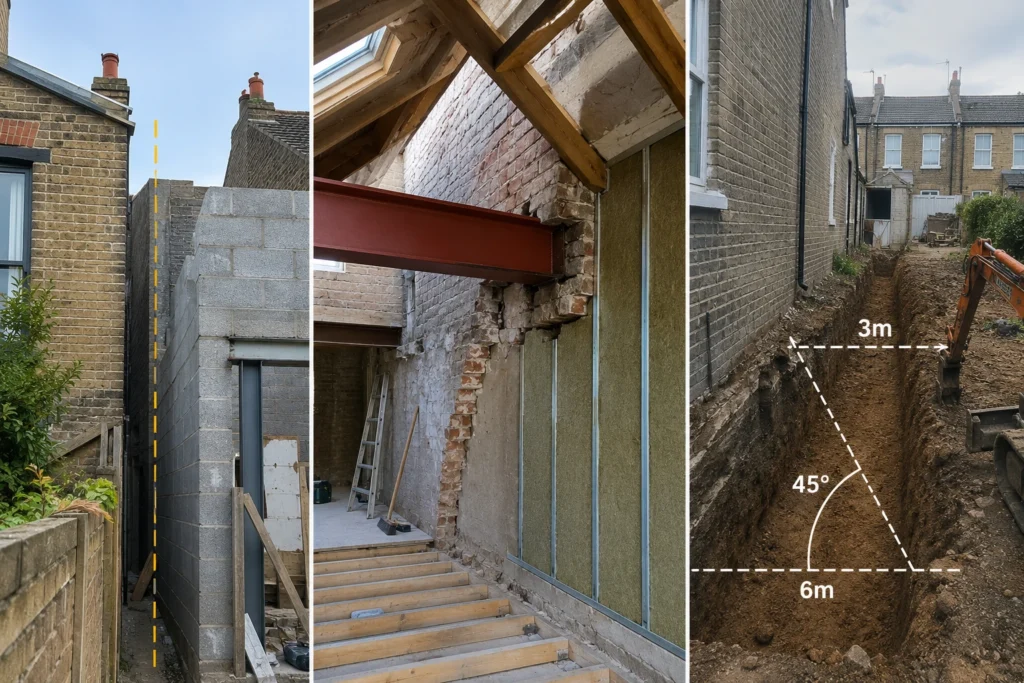
Line of junction work covers building a new wall astride or up to the boundary line between two properties, common where a side return extension is being built right up against the next door.
Party structure work covers any work directly on an existing shared wall or structure, including cutting into it to insert a beam, raising its height, underpinning it, or demolishing and rebuilding it. This is the category that catches most loft conversions and extensions in a terraced house, since inserting steel beams to support a new floor almost always requires cutting into the party wall. Where work affects a shared wall, homeowners also take the opportunity to improve acoustic performance through professional soundproofing services, helping to reduce noise transfer between adjoining properties.
Excavation notices apply where you are digging within 3 metres of a neighbouring building or structure, and your excavation will go deeper than their foundations, or within 6 metres if the excavation falls within a line drawn at 45 degrees down from the bottom of their foundations. Basement conversions and even a standard rear extension foundation in a tightly packed terrace frequently trigger this notice type.
Party Wall Rules for Victorian Terraces
Victorian and Edwardian terraces raise specific party wall issues that a semi-detached or detached property simply does not have to deal with, and these are worth understanding before your architect finalises drawings.
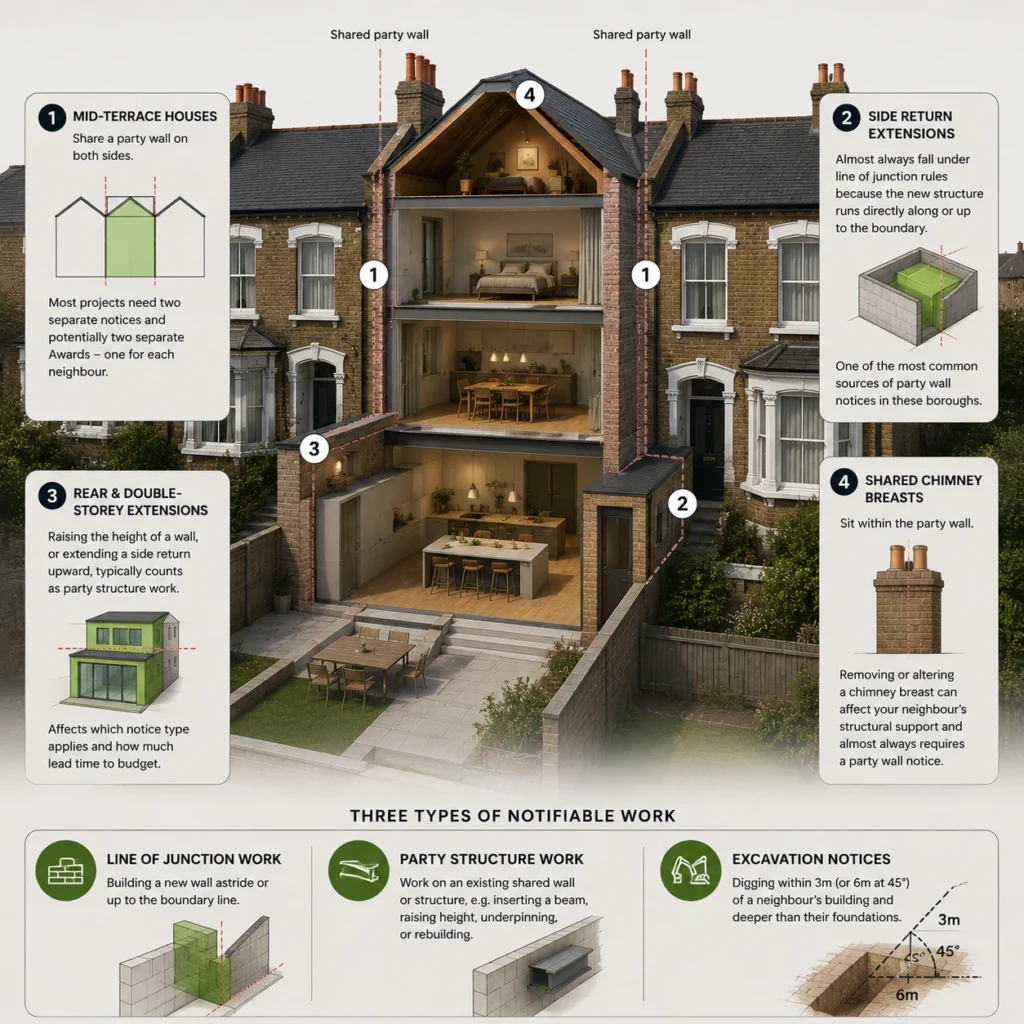
Mid-terrace houses share a party wall with the property on both sides, which means most extension or loft projects need two separate notices and potentially two separate Awards, one for each neighbour. A corner terrace or end-of-row house may face a similar situation if it shares a wall with a property behind or beside it.
Side return extensions, extremely common across Islington and Hackney’s Victorian terraces, almost always fall under line of junction rules because the new structure runs directly along or up to the boundary shared with the next door. This is one of the most frequent sources of party wall notices in the borough, and party wall fees are worth budgeting for alongside general extension costs rather than as an afterthought once drawings are done.
Rear and double-storey extensions raise a separate consideration: where a new wall is built at a height above the existing party wall, or where an existing single-storey side return is extended upward, this typically counts as party structure work rather than line of junction work, since it involves altering the wall itself rather than simply building alongside it. Deciding between a single or double storey design early affects which notice type applies and how much lead time to budget.
Shared chimney breasts, another feature specific to this era of housing, sit within the party wall itself. Removing or altering a chimney breast, even on your own side, can affect the structural support the neighbour’s chimney breast relies on, and this almost always requires a party wall notice, even though the work appears to be entirely internal to your property. Structural movement of this kind is one of the more common causes of cracked walls in a Victorian terrace when it is not properly managed.
The Process Step by Step
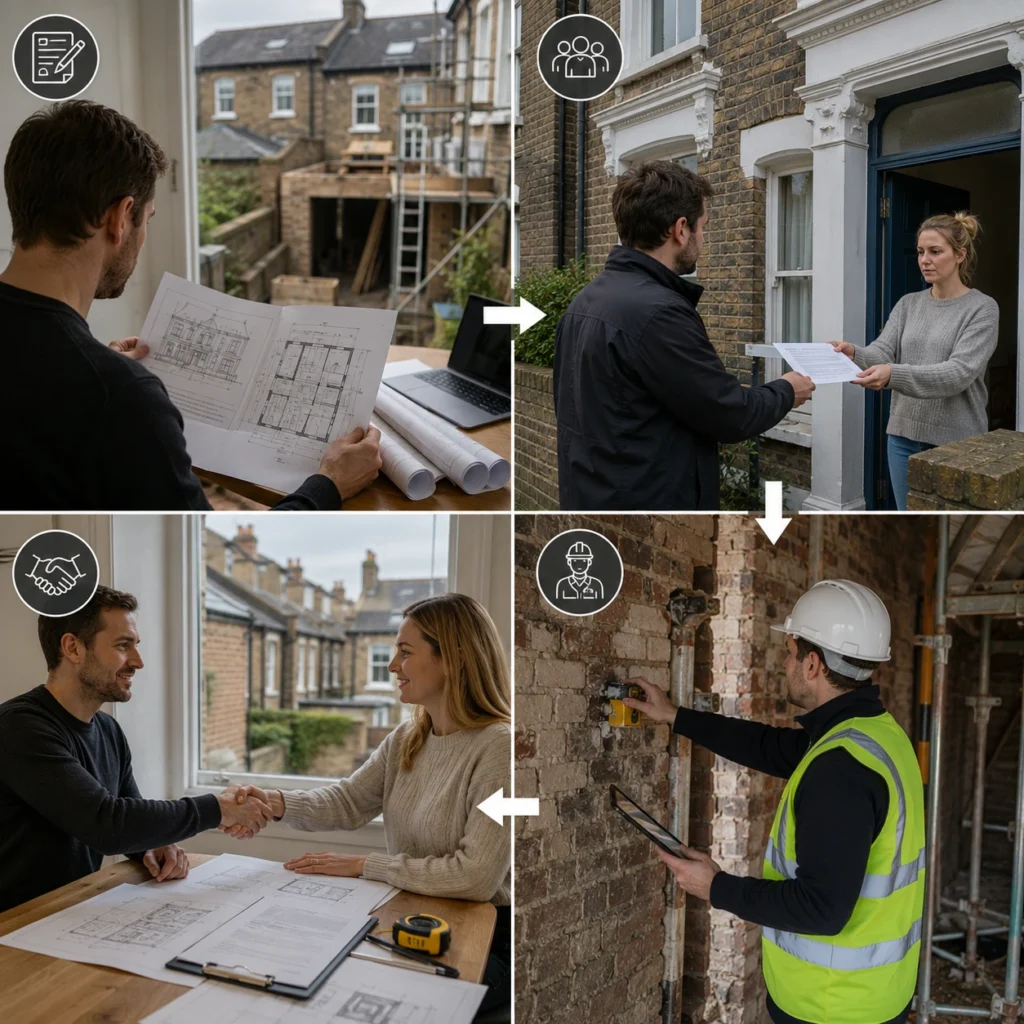
Serving the Notice
Notice must be served in writing, with the correct legal names of all owners, a clear description of the proposed work, and enough technical detail, drawings or a structural description, for the neighbour to understand what is planned. A vague description such as “building an extension” is not sufficient. Party structure and excavation notices require a minimum of two months before work starts, while line of junction notices require one month. Serve notice as soon as drawings are finalised, since the process routinely takes longer than the minimum legal window once a surveyor is involved. This is particularly important where renovation plans include alterations to external elements such as window frames and sill repairs, which may form part of a wider refurbishment project affecting a party wall or boundary.
The 14-Day Response Window
Once served, the adjoining owner has 14 days to respond. They can consent in writing, in which case no surveyor is required, though a Schedule of Condition recording the pre-work state of their property is still strongly advisable. They can dissent, or they can simply not reply, which the Act treats as automatic dissent. Dissent is not a veto. It triggers the formal surveyor process, but the building owner retains the legal right to carry out the notified work once an Award is in place.
Appointing a Surveyor
Where a neighbour dissents, both sides need surveyor representation, but there are two routes. An Agreed Surveyor acts impartially for both the building owner and the adjoining owner, which is the cheaper and generally faster option, and is worth proposing to the neighbour directly before appointing anyone. Alternatively, each side appoints its own surveyor, and the building owner pays for both under the Act, which roughly doubles the cost compared to a single agreed surveyor.
The Party Wall Award
The surveyor, or surveyors, then prepare the Award, a binding legal document setting out what work is permitted, the method of construction, permitted working hours, access arrangements, and the Schedule of Condition for the neighbouring property. Once the Award is served, there is a 14-day period during which either party can appeal to the county court, though this is rare in practice for straightforward domestic projects.
Party Wall Surveyor Costs
Costs in Islington and Hackney sit toward the higher end of the national range, reflecting London surveyor rates and the density of terraced housing where multiple adjoining owners are often involved on a single project.
| Item | Typical Cost (2026) |
|---|---|
| Notice preparation | £20 to £150 per notice |
| Schedule of Condition | £300 to £600 per neighbouring property |
| Agreed Surveyor (single, both parties) | £700 to £1,500 per neighbour |
| Two separate surveyors, per neighbour | £1,500 to £3,600 total |
| Third surveyor for dispute resolution | £200 to £300 per hour, usually shared |
| Mid-terrace project, two neighbours, agreed on the surveyors | £1,500 to £3,000 |
| Mid-terrace project, two neighbours, separate surveyors | £3,000 to £7,200 |
Under Section 10(13) of the Act, the building owner pays all reasonable party wall surveyor fees, including the adjoining owner’s surveyor if they choose to appoint one separately. Proposing an Agreed Surveyor early, with clear drawings and credentials shared upfront, is the single most effective way to keep costs down, since it removes the need to fund two professionals working on the same wall. For side return and rear projects specifically, see our kitchen extension costs guide for how party wall fees typically sit alongside the build budget.
What Happens If a Neighbour Refuses or Doesn’t Reply
A dissenting or unresponsive neighbour cannot permanently block a legitimate project. Non-response after 14 days is treated as dissent under the Act, which simply moves the project into the formal surveyor and Award process rather than stopping it. Once an Award is served and the 14-day appeal window passes without challenge, the building owner has a clear legal right to proceed with the notified work exactly as described in the Award.
Where a neighbour raises genuine concerns, structural risk to a shared chimney breast or an inadequate excavation method, for example, these are exactly the issues an Award is designed to resolve, and a competent surveyor will often adjust the method statement to address them rather than blocking the work outright.
What Happens If You Skip the Process
Skipping notice entirely does not remove the legal requirement; it simply removes your protections. A neighbour who discovers notifiable work being carried out without notice can apply to the county court for an injunction, which halts the entire project, not just the element touching the party wall, until an Award is agreed. This can add months to a build programme and typically means paying the legal costs of the dispute on top of the party wall fees you would have paid anyway.
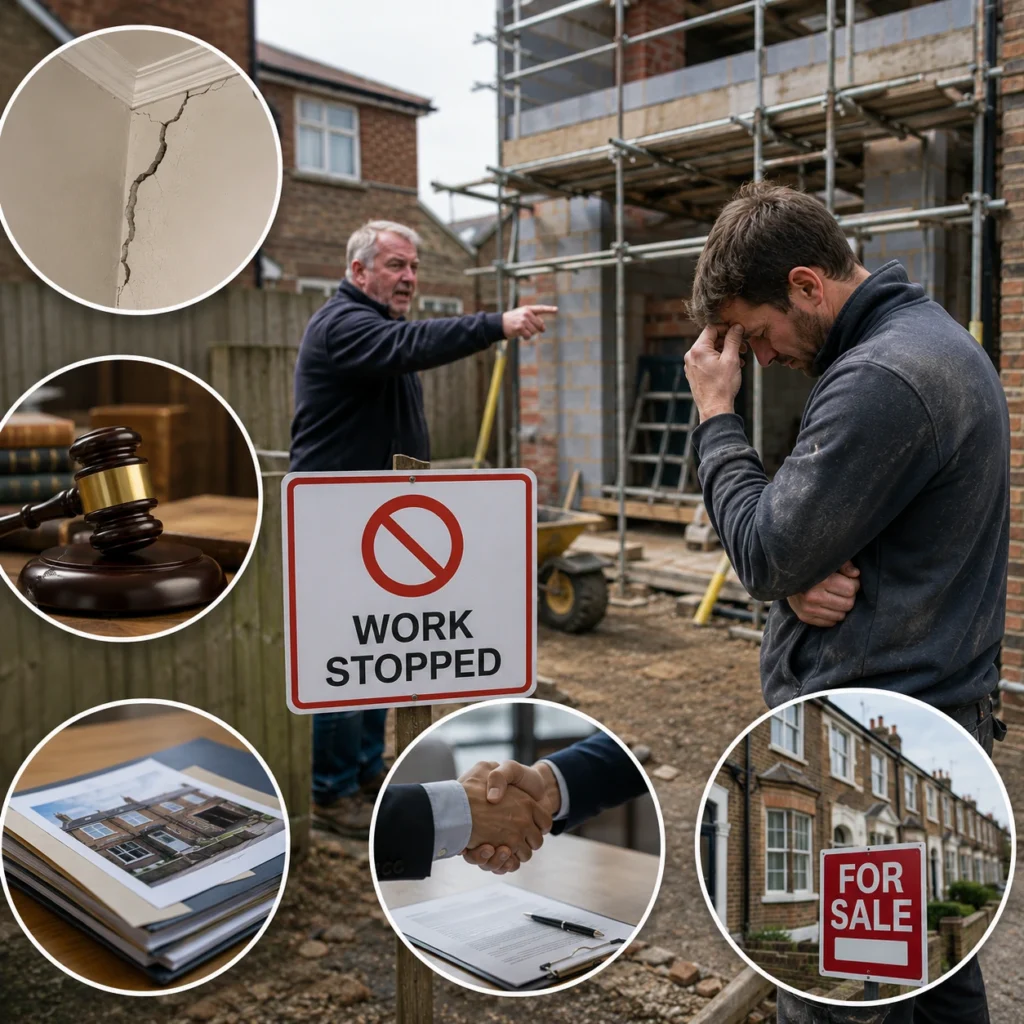
Skipping the process also means skipping the Schedule of Condition. Without a dated, photographed record of the neighbour’s property before work started, any crack or settlement they notice afterward becomes something you have to disprove caused the damage, rather than something they have to prove, which is a materially worse legal position to be in.
An unresolved party wall issue can also surface years later at the point of sale, since a conveyancing solicitor acting for a buyer will typically ask whether party wall matters were correctly handled for any structural work visible on the property. This is one of several reasons early planning matters so much, covered in more depth in our guide to managing a build project.
Party Wall Agreements and Leasehold Flats
Many Victorian terraces across Islington and Hackney have been converted into two or more flats, and this adds a layer the Act does not directly cover: leasehold consent alongside the statutory party wall process.
If you are a leaseholder planning work that affects a party wall, you still need to follow the Party Wall etc. Act 1996 in exactly the same way as a freeholder, since the Act applies to whoever is actually carrying out the work, not just to freehold owners. Separately, most leases also require freeholder consent for structural alterations, which is a contractual requirement sitting alongside, not instead of, the statutory party wall process. Missing either the statutory notice or the lease consent can cause delays or disputes, even where the other has been handled correctly. This is particularly important in older properties where renovation work may uncover issues such as the different types of damp in Victorian terraces, requiring both structural and legal considerations before remedial work begins.
Timeline: How Long Does the Whole Process Take
A straightforward project where the neighbour consents within 14 days can move from notice to legal clearance to build in as little as one month, limited mainly by the one or two-month statutory notice period itself. Where a neighbour dissents and an Agreed Surveyor is appointed, expect six to ten weeks from notice to a served Award. Two separate surveyors, particularly where there is genuine disagreement over method or scope, can extend this to three to four months. Basement and large excavation projects, which often involve multiple adjoining owners and more complex structural engineering, regularly take four months or longer from first notice to a finalised Award.
Serve notice as early as possible once drawings are settled. Starting the party wall process late is consistently the single biggest cause of build programmes slipping in terraced house projects across North London. Delays can also affect budgeting, since prolonged project timelines may influence the overall house extension cost through additional professional fees, revised construction schedules, and changing material prices.
If You’re the Adjoining Owner: What to Do When You Receive a Notice
Everything above is written from the building owner’s side, but a large share of people searching for party wall guidance in Islington and Hackney have just received a notice from next door rather than sent one themselves.
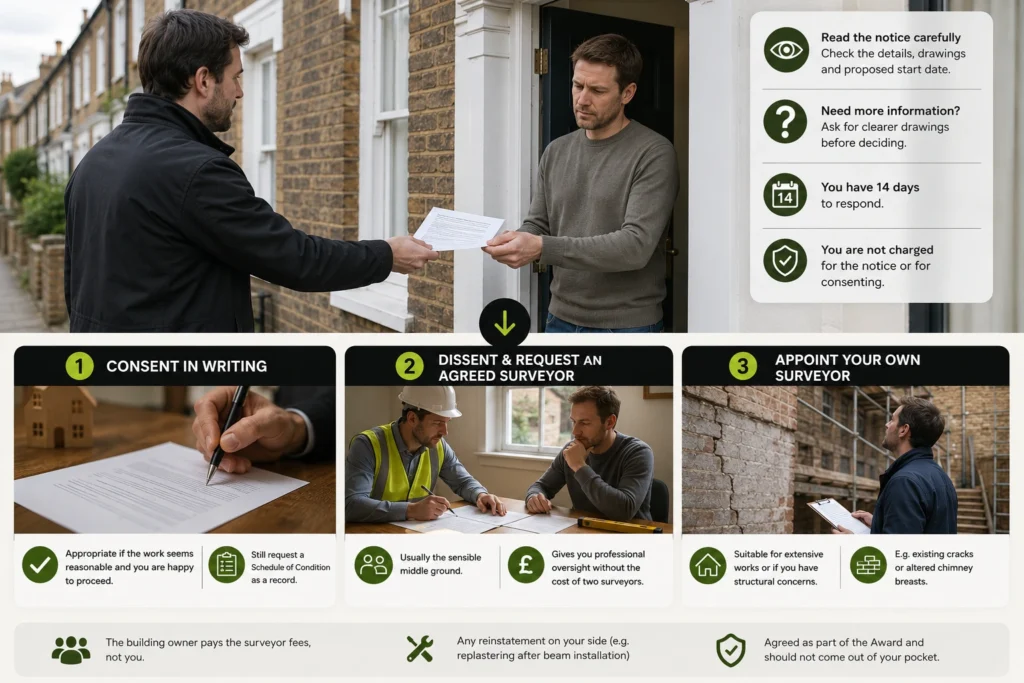
Read the notice carefully first. It should name the correct owner, describe the proposed work in enough technical detail to understand what is actually planned, and state the intended start date. If the description is vague, a valid response is to ask for clearer drawings before deciding whether to consent.
You have three options within the 14-day window. Consenting in writing is appropriate where the work seems reasonable, and you are comfortable proceeding without a formal Award, though you should still ask for a Schedule of Conditions to be prepared as a record of your property’s current state. Dissenting and requesting an Agreed Surveyor is usually the sensible middle ground, giving you professional oversight without the cost of two separate surveyors. Appointing your own separate surveyor makes sense where the works are extensive, such as a basement excavation, or where you have specific structural concerns about your side of the wall, such as an existing crack or a chimney breast that has already been altered.
You cannot be charged for consenting or for the initial notice itself, and if you choose an Agreed Surveyor or your own surveyor, the building owner pays those reasonable fees, not you. Where reinstatement is needed on your side once work finishes, for example, replastering after a beam is cut through, this is agreed as part of the Award and should not come out of your own pocket, and general plastering and decorating work of this kind is typically specified directly in the Award’s method statement.
Compensation If Something Goes Wrong
The Party Wall etc. Act 1996 does more than authorise work; it also sets out how damage is handled if the building owner’s project causes harm to the adjoining property.
Under Section 7(2) of the Act, the building owner must compensate the adjoining owner for any loss or damage caused by the notified work. This is precisely why the Schedule of Condition matters so much: without a dated record of the wall and surrounding areas before work started, establishing that a crack or damp patch was caused by the works, rather than pre-existing, becomes far harder to prove.
Where damage does occur, the surveyor or surveyors involved in the original Award are usually the first point of contact to assess the cause and agree a remedy, rather than starting a fresh dispute from scratch. Minor damage, a hairline crack in plaster or a chip to external render, is typically made good directly by the building owner’s contractor as part of the project. More significant structural damage, movement affecting a chimney breast or a section of wall needing full replastering, may need its own scope agreed between the surveyors before repair work such as our full replastering service, is instructed.
Common Mistakes That Delay the Process
A handful of avoidable errors account for most of the party wall delays seen on terraced house projects in North London.
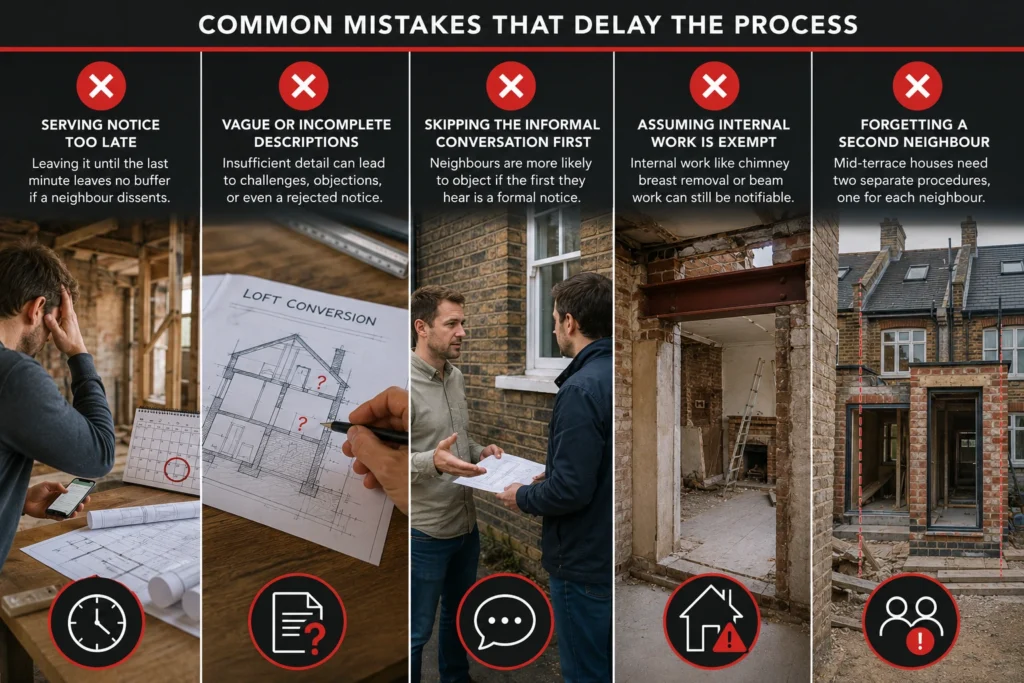
- Serving notice too late. Waiting until the week before you want to start work leaves no buffer if a neighbour dissents, since the statutory notice period alone can use up most of a tight programme.
- Vague or incomplete descriptions. A notice that simply says “loft conversion” without structural detail, beam sizes, or excavation depth is frequently challenged or rejected outright, forcing the process to restart.
- Skipping the informal conversation first. Neighbours who hear about work through a formal legal notice, with no prior heads-up, are statistically more likely to dissent and appoint their own surveyor than neighbours who were shown plans informally beforehand.
- Assuming internal work is exempt. Chimney breast removal, internal beam work, and even some plastering close to a party wall can still be notifiable, and assuming otherwise is a common and costly misjudgement.
- Forgetting a second neighbour. Mid-terrace houses need two separate procedures, one per adjoining owner, and treating it as a single process is a frequent oversight that resurfaces late in the programme.
Frequently Asked Questions
Q: Do I need a party wall agreement for a loft conversion?
Almost always, yes. Most loft conversions involve cutting into the party wall to insert steel beams supporting the new floor and roof structure, which falls under party structure work and requires notice at least two months before work starts.
Q: Can my neighbour stop my extension with a party wall agreement?
No, a neighbour cannot permanently block a legitimate project through the party wall process. Dissent triggers the formal Award process rather than stopping the work, and once an Award is served and the appeal window passes, the building owner has a clear legal right to proceed as described.
Q: How much does a party wall agreement cost in Islington?
Budget £700 to £1,500 per neighbour if an Agreed Surveyor handles the process, or £1,500 to £3,600 per neighbour if each side appoints a separate surveyor. A mid-terrace house with neighbours on both sides should budget for two separate procedures, roughly doubling the total cost.
Q: Who pays for the party wall surveyor?
The building owner, meaning whoever is carrying out the notifiable work, pays all reasonable surveyor fees under Section 10(13) of the Act. This includes both your own surveyor’s fees and the adjoining owner’s surveyor if they choose to appoint one separately rather than agreeing to a single shared surveyor.
Q: What is a Schedule of Condition and do I need one?
A Schedule of Condition is a detailed, dated record, usually including photographs, of the neighbouring property’s condition before work starts. It is strongly recommended even where a neighbour consents without requiring a formal Award, since it protects both sides if a dispute over damage arises later.
Q: Can I serve a party wall notice myself without a surveyor?
Yes. Serving the initial notice does not require a surveyor and can be done using a standard template, provided it includes accurate ownership details and a sufficiently detailed technical description of the work. A surveyor only becomes necessary if the neighbour dissents or does not respond within 14 days.
Q: Does a party wall agreement affect planning permission?
No, they are entirely separate legal frameworks. Having planning permission or permitted development rights for a project does not remove the requirement for a party wall notice, and having a party wall Award in place does not substitute for planning permission. Most extension and loft projects need both handled in parallel, not sequentially.
Q: I’ve just received a party wall notice from my neighbour, what should I do?
Read the technical description carefully and ask for clearer drawings if anything is vague. You then have 14 days to consent in writing, request an Agreed Surveyor if you would like professional oversight, or appoint your own surveyor for more extensive works. Whichever route you take, ask for a Schedule of Condition to record your property’s current state before work begins.
Q: Who pays if the building work damages my property?
The building owner is responsible for compensating you for any loss or damage caused by the notified work under Section 7(2) of the Act. This is one of the main reasons a Schedule of Condition is prepared before work starts, since it provides the evidence needed to establish that damage was caused by the works rather than pre-existing.
Q: Does a Party Wall Award expire if work doesn’t start straight away?
The Act does not set a fixed expiry date on an Award, but a significant delay between the Award being agreed and work starting can be a problem in practice, particularly if the property’s condition has changed or ownership has transferred in the meantime. Where a substantial gap is expected, it is worth flagging this to your surveyor so the Schedule of Condition can be updated closer to the actual start date.
Conclusion
Party wall matters are one of the most predictable sources of delay in a Victorian terrace project, and almost always avoidable with early notice and clear drawings. If you are planning a side return extension, a loft conversion involving steel beams, or any excavation close to a neighbouring foundation in Islington or Hackney, build the party wall process into your programme from the design stage rather than treating it as paperwork to handle once building starts.
Planning permission and party wall matters run on separate tracks, our permitted development guide covers what you can build without full planning approval before party wall notices even come into play. EBT Build coordinates party wall timing alongside full refurbishment projects across Islington and Hackney, so notices go out early enough that they never become the reason a build programme slips.

Tilly Bani is a renovation and roofing specialist with over 15 years of experience in construction and property refurbishment across North London. He specialises in roofing, structural repairs, and full home renovations, helping homeowners improve property value and safety.