
Quick Answer
An Article 4 Direction is a legal tool that lets a council remove specific permitted development rights in a defined area, most commonly a conservation area. Where one applies to your property, work that would normally be allowed without planning permission, such as a rear extension, a loft dormer, or new windows, instead requires a full planning application. Islington has Article 4 Directions covering 40 of its 42 conservation areas, Hackney has confirmed directions in specific conservation areas, including Brownswood and De Beauvoir, and Camden applies extensive directions across Bloomsbury, King’s Cross, and Hampstead. Always check your exact address before assuming permitted development covers your project.
What Is an Article 4 Direction
An Article 4 Direction is issued under the Town and Country Planning General Permitted Development Order 2015 and allows a local planning authority to withdraw specific permitted development rights in Islington from properties within a defined boundary. Permitted development rights are the national default that lets homeowners carry out certain extensions, loft conversions, and alterations without a full planning application, provided the work stays within set size and design limits. An Article 4 Direction switches that default off for the classes of work it names.
Article 4 vs Conservation Area: Not the Same Thing
These two terms get used interchangeably, and that mix-up causes more planning mistakes than almost anything else in period property renovation.
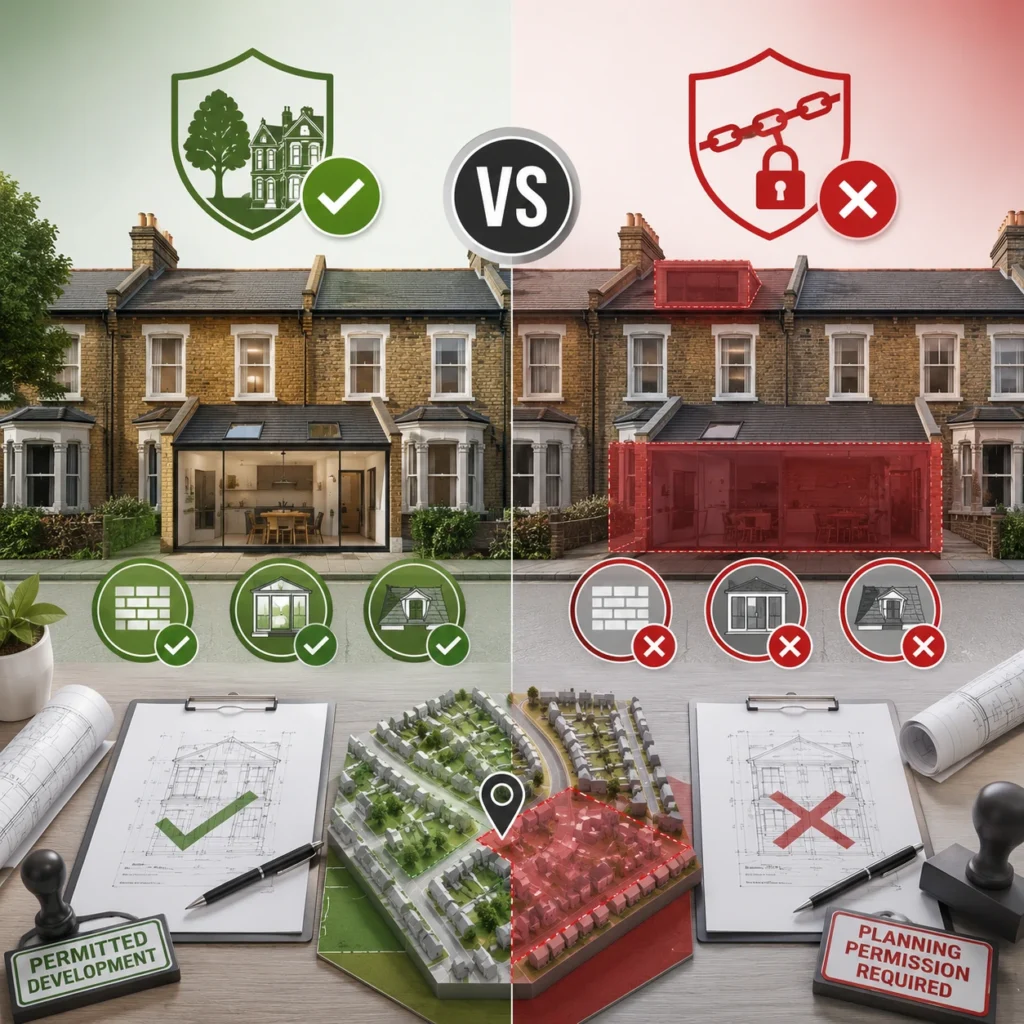
A conservation area is a designation protecting the character of a neighbourhood, and it already brings some automatic restrictions, mainly around demolition and tree work. Being in a conservation area on its own does not remove your permitted development rights for a standard rear extension.
An Article 4 Direction is a separate, additional step a council can apply on top of a conservation area, specifically removing named permitted development rights. A property can sit inside a conservation area with no Article 4 Direction attached, keeping full permitted development rights, or it can sit inside both, losing them entirely. Checking one without the other gives an incomplete answer. Before starting any extension or structural alteration, it is also worth understanding the differences between a structural engineer vs builder, as each plays a distinct role in ensuring the project complies with planning and building requirements.
Which Permitted Development Classes Get Removed
Article 4 Directions are not all-or-nothing. Each direction specifies exactly which classes of permitted development it withdraws, and a council may remove some classes in one street and different classes in the next.
| Class | Covers | Common Effect When Removed |
|---|---|---|
| Class A | Rear, side, and wraparound extensions | Full planning permission needed for any extension, regardless of size |
| Class B | Loft extensions and roof enlargements | Dormers and roof extensions need full planning permission |
| Class C | Roof covering material changes | Cannot swap slate for concrete tile without permission |
| Class D | Porches | A new porch, however small, needs an application |
| Class E | Outbuildings, sheds, garages | Garden structures above certain sizes need permission |
| Class G | Aerials and satellite dishes | Rarely removed, occasionally restricted on street-facing roofs |
| Class M | Change of use, including HMO conversion | Converting a house into flats or an HMO needs permission |
A terraced street might have Classes A and B withdrawn to control extensions and roof alterations, while leaving Class G untouched, since satellite dishes rarely affect the wider streetscape. This is why the specific direction schedule for your street matters more than the general reputation of the borough.
Article 4 Directions Across Islington, Camden, and Hackney
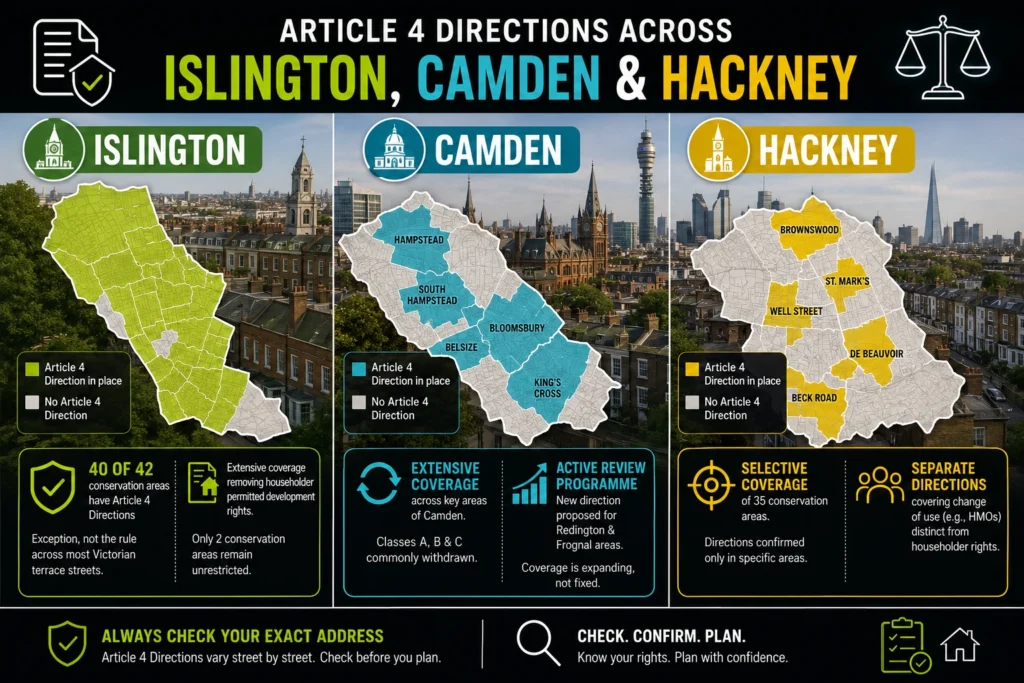
Islington
Islington applies some of the most extensive Article 4 coverage in London. Of the borough’s 42 conservation areas, 40 currently carry an Article 4 Direction removing householder permitted development rights, meaning the exception has effectively become the rule across most of the borough’s Victorian terrace streets. Our full guide to permitted development in Islington covers the complete list of affected conservation areas and what survives in the two that remain unrestricted.
Camden
Camden applies extensive Article 4 coverage across Bloomsbury, King’s Cross, Hampstead, South Hampstead, and Belsize, with Classes A, B, and C commonly withdrawn in these zones. The council has an active review programme, including a new direction proposed for the Redington and Frognal areas, which means coverage in Camden is still expanding rather than fixed.
Hackney
Hackney’s position is more selective than Islington’s. The borough has 35 conservation areas, but Article 4 Directions removing householder Part 1 rights have been confirmed only for specific conservation areas, including Brownswood, Beck Road, Well Street, De Beauvoir, and St Mark’s, rather than applying borough-wide. Hackney also maintains separate Article 4 Directions covering change of use, which are unrelated to a straightforward home extension and worth distinguishing from the householder directions when you check your address.
What This Means for Your Extension
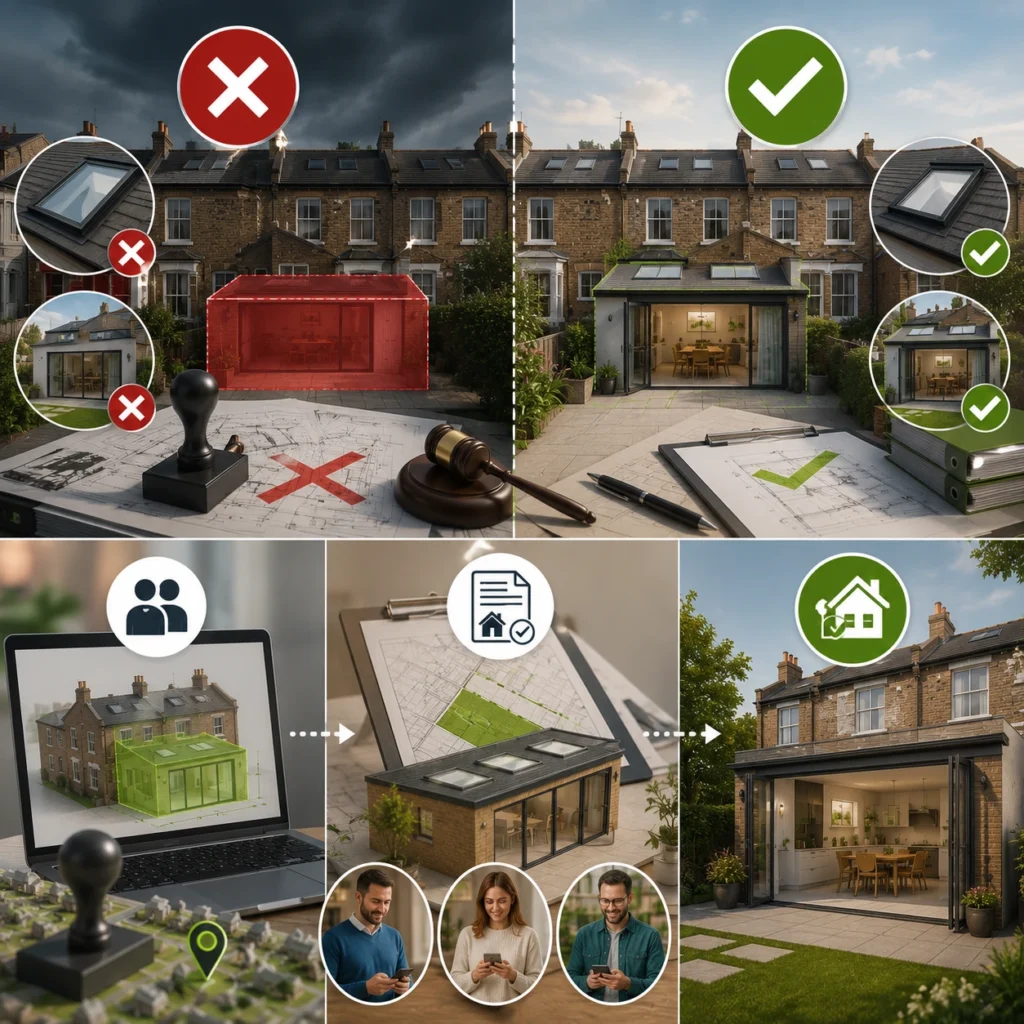
If Article 4 removes Class A rights on your street, the size and design limits that normally define permitted development become irrelevant, since the entire class requires a full application regardless of how modest the extension is. A single-storey rear extension well within normal permitted development dimensions still needs planning permission if Class A has been withdrawn. The same principle can apply to other alterations, so homeowners considering skylight installation in Islington should always check whether local planning restrictions or an Article 4 Direction affect their property before starting work.
Prior Approval vs Full Planning Permission
Where permitted development rights remain in place, certain larger single-storey rear extensions can use the neighbour consultation scheme instead of full planning permission. This route notifies adjoining neighbours and, provided no objection leads the council to refuse, allows a larger extension without a full application. As of April 2026, this route costs £249, compared with £548 for a full householder planning application covering a single dwelling house. This route is only available where Class A rights have not been removed by an Article 4 Direction, so it disappears entirely on an affected street.
The Larger Home Extension Neighbour Consultation Scheme
This scheme allows single-storey rear extensions beyond the standard permitted development depth, typically up to 8 metres on a detached house or 6 metres on a terraced or semi-detached house, without a full planning application, provided neighbours do not raise a valid objection within the consultation period. It sits entirely within permitted development and is unavailable wherever Article 4 has removed Class A.
Cost and Timeline When Article 4 Applies
Budget more time and a higher fee once a project moves from permitted development to a full planning application.
| Item | 2026 Cost | Typical Timeline |
|---|---|---|
| Householder planning application (single dwelling house) | £548 | 8 weeks statutory determination |
| Larger extension neighbour consultation scheme | £249 | 6 weeks, PD only |
| Pre-application planning advice | £100 to £600, borough dependent | 2 to 6 weeks |
| Lawful Development Certificate | £129 | 6 to 8 weeks |
| Conservation area consent (where demolition is involved) | No fee in most boroughs | 8 weeks |
Pre-application advice is worth the cost on anything beyond a straightforward extension, since a planning officer flagging a major concern before detailed drawings are commissioned can save far more in redesign fees than the advice itself costs.
How to Check If Your Property Is in an Article 4 Area
Do not rely on an estate agent’s description or a general sense of the neighbourhood’s character. Confirm your exact address through three steps.
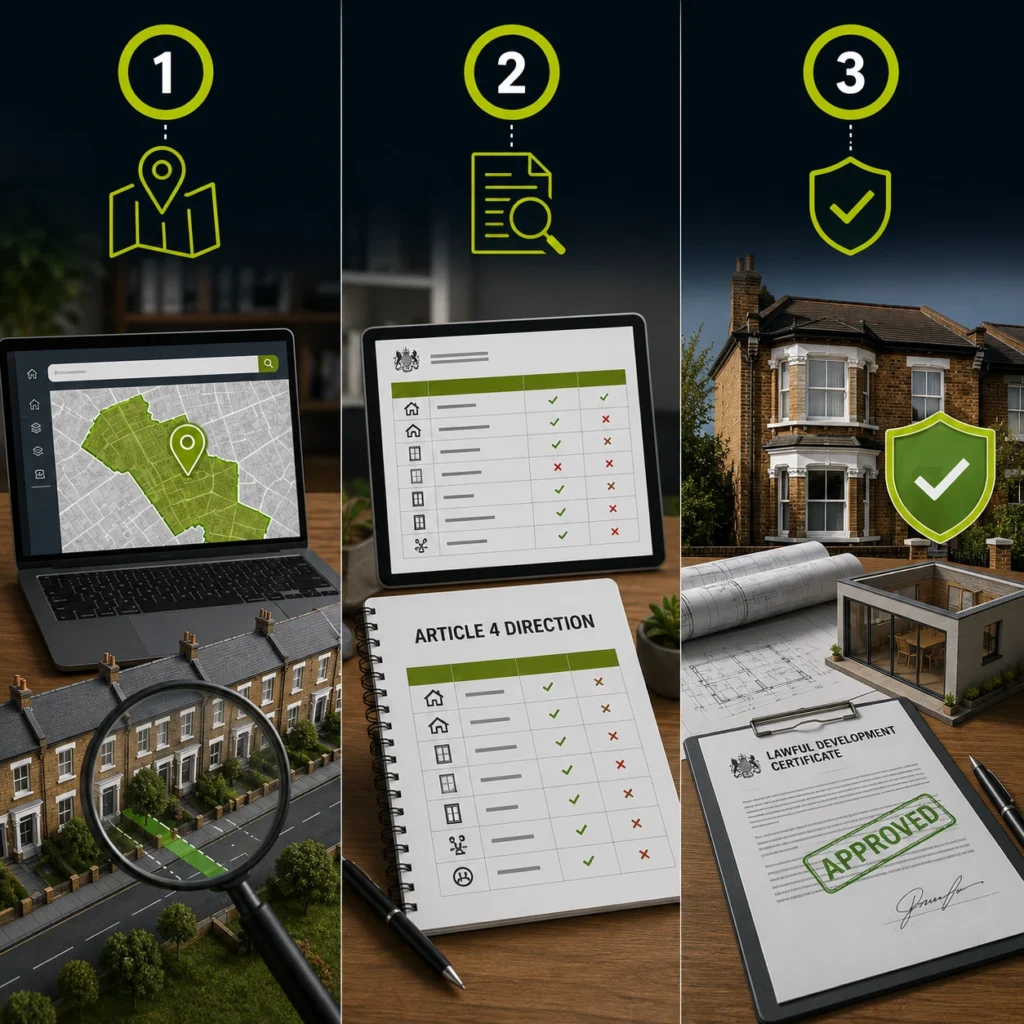
Check the borough’s planning portal and search the conservation area map for your specific street, since conservation area boundaries frequently stop partway down a road rather than covering an entire postcode.
Read the actual Article 4 Direction schedule for that conservation area, not just its title, since a direction may remove only certain classes rather than all permitted development rights, and the schedule is the only document that lists which classes apply. This matters as much for window and door work as it does for extensions; our Islington sash window team regularly checks this before quoting on a replacement or repair project.
Use pre-application advice or a Lawful Development Certificate where the outcome affects a purchase decision or a significant budget commitment, since a written confirmation carries far more weight than an assumption based on a neighbouring project or what a builder tells you informally. This is particularly important before undertaking wider renovation works that may include floor levelling services, structural alterations, or other improvements that could be affected by planning restrictions and building regulations.
What Happens If You Build Without Checking
Carrying out Class A or Class B work in an Article 4 area without planning permission is a breach of planning control, and the council can issue an enforcement notice requiring the work to be altered or removed, in some cases, including full demolition. Enforcement action can be pursued up to four years after unauthorised building work in most cases, and indefinitely if the council can show the breach was deliberately concealed. Beyond the direct cost of remedial work, an unresolved enforcement issue is a common reason a sale falls through at the conveyancing stage, since a buyer’s solicitor will flag any structural work lacking the correct permission history. Getting planning right at the outset is one of the fundamentals covered in our guide to managing a build project.
Getting a Lawful Development Certificate
A Lawful Development Certificate is a formal confirmation from the council that proposed or completed work is lawful under permitted development, and it is worth applying for even though it is not a legal requirement to carry out the work itself.
The certificate costs £129 in 2026 and typically takes 6 to 8 weeks to process. Its value comes at two later points: mortgage lenders and conveyancing solicitors treat a Lawful Development Certificate as firm evidence when a property is remortgaged or sold, and it protects the owner against a future Article 4 Direction being applied retrospectively to the same conservation area, since the certificate locks in the lawful status of the work at the time it was carried out. Similar documentation is often important when selling a property, particularly where recent renovations have involved regulated work that requires records such as gas safety certificates and other compliance paperwork.
Buying a Property in an Article 4 Area
Article 4 status matters just as much before you buy as after, and it is one of the most commonly missed checks during a property purchase in North London.
An estate agent’s listing has no obligation to mention Article 4 status, and “potential to extend” in a listing description means very little until the conservation area map and direction schedule confirm it. A property in Barnsbury or Canonbury advertised with extension potential may have Class A rights fully withdrawn, turning what looked like a straightforward permitted development project into a planning application with no guaranteed outcome.
Standard conveyancing searches do not automatically flag Article 4 status either, since it sits within planning records rather than the standard local authority search most solicitors order as default. If extending the property is part of the reason you are buying it, request a specific planning search or commission pre-application advice before exchange, not after completion. This is particularly relevant where a purchase is partly justified by a planned kitchen extension, since the budget and design brief both depend on which planning route is actually available.
Common Article 4 Myths, Corrected
A few misconceptions come up repeatedly among homeowners in Islington, Camden, and Hackney, and each one has led to a real planning mistake at some point.
- “My neighbour did the same extension without permission, so I can too.” Article 4 status is assessed against your specific address and the current direction schedule, not against what a neighbour built, possibly years before the direction was introduced, or possibly without permission themselves. An unauthorised precedent next door is not a defence.
- “Conservation area means Article 4 automatically applies.” They are separate designations. Many conservation areas across London carry no Article 4 Direction at all, and permitted development rights remain fully intact in those areas.
- “Article 4 means I can never extend my house.” It removes the automatic right to build without an application, not the ability to build. Most well-designed extensions in Article 4 areas are approved through the standard planning process.
- “Internal work is never affected by Article 4.” Most internal work genuinely is unaffected, since Article 4 controls external changes. The exception is change of use under Class M, which can apply even where the external appearance does not change, such as converting a single house into multiple flats.
- “A Lawful Development Certificate is only needed if the council asks for one.” Nobody will ask for one proactively. Its value is protective; confirmed lawful status becomes essential evidence years later at remortgage or sale, and applying after the fact, once ownership has changed or memories of the original project have faded, is far harder than applying at the time.
Special Planning Considerations Beyond Article 4
Article 4 is the most common reason permitted development disappears in these boroughs, but it is not the only planning layer that can affect a project.

Listed Buildings
A property does not need to be in a conservation area to be listed, and listed status brings its own separate consent requirement, Listed Building Consent, which applies to both external and many internal alterations, regardless of what Article 4 does or does not cover in the surrounding area. Listed Building Consent has no application fee but carries its own approval process, run in parallel with, not instead of, any planning permission the extension itself needs.
Tree Preservation Orders
Mature trees in a garden, particularly in established Victorian terrace gardens across Islington and Camden, are sometimes protected by a Tree Preservation Order, which restricts felling, pruning or root disturbance regardless of Article 4 status. An extension or excavation planned close to a protected tree’s root zone needs its own separate consent, and this is frequently missed during early design because it sits outside the standard conservation area check.
Flat Conversions and Article 4
Where a Victorian terrace has already been split into flats, permitted development rights work differently again. Flats generally have far fewer permitted development rights than houses, even without Article 4 in play, since most alterations to a flat require planning permission by default under national rules, not just under a local direction. Checking Article 4 status on a flat conversion project without also confirming the baseline flat rules gives an incomplete picture of what is actually achievable.
Frequently Asked Questions
Q: Does Article 4 apply to the whole of Islington?
No. Article 4 Directions cover 40 of Islington’s 42 conservation areas, meaning the vast majority of the borough’s Victorian terrace streets are affected, but two conservation areas remain without a direction, and areas entirely outside any conservation area boundary are unaffected by Article 4 regardless.
Q: Can I still extend my house if Article 4 applies?
Yes. Article 4 does not ban extensions; it simply moves the project from permitted development into the standard planning application process. Most well-designed extensions that respect the character of the conservation area are approved, though the process takes longer and costs more than permitted development.
Q: How do I find the Article 4 Direction schedule for my street?
Search your borough’s planning portal for the specific conservation area name, then look for the Article 4 Direction document linked to that area, which lists the exact permitted development classes withdrawn. If the schedule is unclear, the council’s planning department can confirm by phone or email, or pre-application advice can provide written confirmation.
Q: Is a Lawful Development Certificate the same as planning permission?
No. A Lawful Development Certificate confirms that specific work already qualifies as permitted development and does not need planning permission. It is a certificate of legal status, not a permission being granted, and it is only relevant where Article 4 has not removed the rights covering the work in question.
Q: What is the difference between Article 4 and a listed building?
Article 4 Directions apply to a defined geographic area, usually a conservation area, and remove specific permitted development rights for everyone within that boundary. Listed building status is attached to an individual property based on its architectural or historic significance, and it brings its own separate consent requirements, Listed Building Consent, on top of anything Article 4 controls in the wider area.
Q: Do window replacements need permission under Article 4?
Frequently, yes. Class A permitted development normally allows some window replacement, but many Article 4 Directions in Islington and Hackney specifically target windows and doors on street-visible elevations. Secondary glazing is generally exempt regardless of Article 4 status, since it does not alter the external appearance. Our guide to double glazing in conservation areas covers the window-specific rules in more depth.
Q: Does Article 4 affect a loft conversion the same way as an extension?
It can, but under a different class. Rear and side extensions fall under Class A, while roof alterations including a dormer loft conversion, fall under Class B. A direction can remove one class without the other, so a street might allow permitted development extensions while still requiring full permission for any roof-level change, or the reverse.
Q: Should I check Article 4 status before buying a house I plan to extend?
Yes, and before exchange rather than after completion. Article 4 status is not flagged by a standard conveyancing search, so if extension potential is part of why you are buying, commission a specific planning check or pre-application advice while you can still walk away or renegotiate based on the answer.
Q: Does an Article 4 Direction reduce a property’s value?
Not typically on its own, since most conservation area properties in Islington, Camden, and Hackney already carry Article 4 restrictions, and buyers factor this in as normal for the area. What does affect value is unauthorised work carried out without the correct permission, which can require costly remedial action or block a sale entirely at the conveyancing stage.
Conclusion
Article 4 Directions are the single most common reason a straightforward extension in Islington, Camden or Hackney ends up needing full planning permission rather than a quick permitted development build. Check your exact address and read the actual direction schedule before finalising a design, since assuming permitted development covers a project in these boroughs is the most expensive planning mistake a homeowner can make.
For a detailed breakdown of costs across different extension types once planning permission is confirmed as necessary, see our extension cost guide and our comparison of single versus double-storey designs. Once planning is granted, party wall matters typically follow next for any project touching a shared wall, covered in our party wall agreement guide. EBT Build manages planning strategy alongside full refurbishment projects across North London’s conservation areas, checking Article 4 status before any design work begins.

Tilly Bani is a renovation and roofing specialist with over 15 years of experience in construction and property refurbishment across North London. He specialises in roofing, structural repairs, and full home renovations, helping homeowners improve property value and safety.